
A Leading Explanation Can Still Have Unfinished Physics
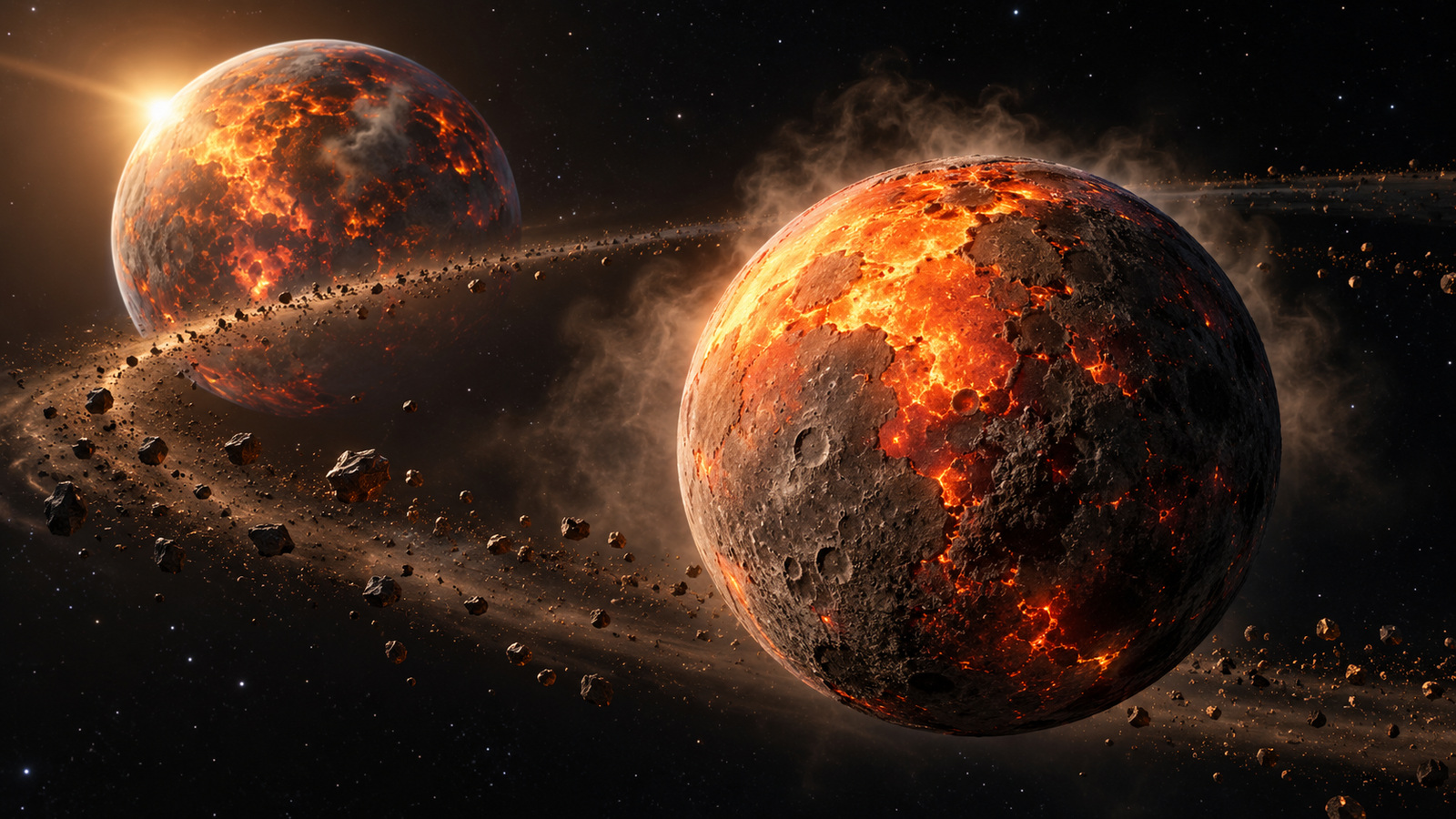
The Moon’s origin is mysterious because the evidence is demanding, not because scientists lack a plausible starting point. A major collision involving the young Earth remains the leading framework. It can help explain why the Moon is rich in rocky material, has a relatively small metallic core, and belongs to an unusual Earth-Moon system. Yet a satisfactory account must reproduce much more than a dramatic splash of debris. It must also explain chemical similarities, surviving volatile substances, orbital motion, and the path from impact material to a stable satellite. Different collision models solve different parts of that problem, sometimes creating new tensions elsewhere. The unresolved task is to connect all those clues within a physically consistent history, including the cooling and orbital evolution that followed the initial encounter.
The Target Is a Complete Earth-Moon System
A lunar-origin model must finish with two appropriate bodies and a plausible relationship between them. Producing a lump with the Moon’s mass is insufficient if it contains too much iron, escapes Earth’s gravity, or leaves an incompatible rotation state. Conversely, matching the chemical composition does not help if the material cannot assemble in a viable orbit. Those constraints are connected through the collision’s energy and material flow. This is what makes the investigation difficult: mass, chemistry, heat, and dynamics cannot be tuned independently without checking what the changes do to the rest of the system.
Chemical Similarity Creates a Powerful Constraint
Lunar samples and Earth’s rocky material share closely similar ratios in several isotope systems. Isotopes are variants of an element distinguished by neutron number, and their relative abundances can record differences among early source reservoirs. Other Solar System materials can show different signatures, so a separate impactor might be expected to carry distinguishable ingredients. In many classic simulations, substantial lunar material comes from that impactor. Explaining the observed similarity is consequently more difficult than merely finding a collision that places enough rock around Earth.
One route is to begin with similar ingredients in the two colliding bodies. Another is to promote exchange or mixing during the impact and its aftermath. A third issue concerns how well available samples represent the entire Moon rather than selected crustal and volcanic reservoirs. These approaches are not interchangeable because they make different predictions about composition and interior structure. A study of planetary feeding zones investigated whether impactors and their targets could naturally begin with similar compositions, illustrating how the chemical problem extends into the earlier stages of planetary growth.
The similarity is most informative when several isotope systems are considered together. An element drawn into a metallic core records a different processing history from one that stays mainly in rocky material. Evaporation can change another element’s surviving abundance or isotope balance. Matching Earth’s oxygen signature alone therefore does not guarantee that a model has supplied the right complete mixture. These differences let researchers ask whether similarity was inherited from the starting bodies, produced during the collision, or altered during later lunar evolution.
Rotation and Orbit Keep the Energy Budget Honest
The Earth-Moon system carries angular momentum in Earth’s rotation and the Moon’s orbit. A 2012 comparable-mass impact study illustrates the chemistry-versus-motion tradeoff: colliding bodies of similar size produced an Earth and debris disk with similar compositions, but the resulting system had about two to two-and-a-half times today’s angular momentum. Internal tides can transfer spin into the lunar orbit, yet they cannot by themselves remove that excess from the combined system. The proposed history consequently needs an external exchange, such as a suitable early resonance involving the Sun. That extra dynamical step must be demonstrated under plausible conditions, rather than added as an arbitrary correction to a chemically successful collision.
Tidal interactions subsequently move angular momentum between Earth’s spin and the lunar orbit, contributing to Earth’s slower rotation and the Moon’s outward migration. The present system is therefore not a frozen copy of the immediate post-impact arrangement. Reconstructing its early state requires modeling long-term evolution and relevant solar perturbations. The Moon’s orbital inclination also needs an explanation. A collision calculation must connect to that later dynamics, because a good early snapshot may still evolve toward the wrong final orbit.
Orbiting Debris Must Become a Lasting Satellite
The familiar picture places impact debris into a disk around Earth, after which it gathers into the Moon. This is an appealing sequence, but the disk is a hot and evolving physical environment rather than a quiet pile of construction material. It may contain vapor and molten droplets, with collisions, spreading, cooling, and exchange with Earth occurring together. Some material falls back, while some moves outward. Its evolution determines both how much material remains available and how its chemical record changes before becoming a satellite.
Earth’s tides create a region where assembling a large bound body is difficult. The Roche limit captures the competition between a growing body’s self-gravity and disruptive tidal forces, with details depending on material density and structure. Farther out, material can more readily gather into moonlets. The actual disk pathway must connect transport across those environments to eventual accretion. A mass of debris initially in orbit is therefore an important result, but it is not yet a completed lunar-origin explanation.
Heat loss introduces further coupling. Condensation changes what phases are present, while radiation and the release of energy during accretion influence cooling. Volatile-bearing material may be redistributed or lost under some conditions and retained under others. A useful model needs to track enough of that behavior to justify its final composition. Otherwise, the collision and the satellite chemistry remain two separate stories. The hard work lies in connecting them through the evolving conditions of the material that actually builds the Moon.
Rapid Assembly Is Another Possible Pathway
High-resolution calculations have explored whether a substantial satellite can be launched directly into a suitable orbit rather than slowly assembled from a conventional disk. NASA’s account of 2022 research describes examples in which a Moon forms on a timescale of hours. Such outcomes alter the early conditions that later cooling models must inherit. They remain conditional simulation results, with composition, survival, and subsequent evolution still requiring scrutiny. A headline about formation speed consequently refers to one modeled assembly route, rather than proving that the real Moon’s entire geological development occurred in an afternoon.
Material Strength Has Become a Fresh Modeling Issue
Many high-energy impact calculations treated the colliding bodies primarily as flowing material, assuming ordinary rock strength was relatively unimportant at such large scales. A September 2026 Southwest Research Institute study examined temperature-dependent geological strength and found that the pre-impact thermal state could affect whether an intact Moon emerges or a protolunar disk forms. The result provides a link between the bodies’ earlier cooling histories and the nature of the immediate lunar outcome.
This is a useful example of why the mystery persists while models become more detailed. An assumption reasonable for an initial calculation may need revision as computational tools improve. Adding physical realism can expand possible outcomes while also adding constraints. The new work does not remove the need to explain compositional similarity, and the researchers identify that issue as continuing. It instead asks investigators to evaluate thermal state and strength as parts of the origin problem, rather than assuming those inputs cannot significantly change the answer.
A Synestia Changes the Post-Impact Environment
Some sufficiently energetic and rapidly rotating impacts can create an expanded structure in which the ordinary separation between planet, atmosphere, and surrounding disk becomes inappropriate. Researchers call this configuration a synestia. A published lunar-origin model examined how a satellite could grow within such a hot silicate-rich environment as it cools. The proposal differs from a compact Earth surrounded by a clearly separate debris ring. Its attraction is that the formation environment may connect chemical equilibration with satellite growth in a new way.
The concept should not be described as the observed shape of early Earth. It is a physically modeled category with conditions involving thermal state and angular momentum. Investigators test how material condenses, how moonlets exchange with vapor, and how the structure retreats as cooling proceeds. Those processes matter because they determine what the Moon inherits. A colorful doughnut-like illustration can help visualize the broad geometry, but the evidence concerns thermodynamic and dynamical behavior rather than the illustration’s resemblance to a familiar object.
Synestia models face the same final accountability as other proposals. They must yield the right composition, masses, orbital relationship, and subsequent history. Their ability to address one chemical problem cannot exempt them from angular-momentum or thermal tests. Comparing them with conventional disk and direct-satellite pathways helps identify observations capable of discriminating among the scenarios. The existence of several serious impact variants shows how much scientific content sits inside the broad phrase giant-impact theory, which can otherwise sound like a single settled animation.
Several Impacts Could Distribute the Construction Work
A different proposal uses a sequence of smaller impacts that produce moonlets, followed by their eventual combination into a larger Moon. Research on a multiple-impact origin explored this route partly as a way to address compositional constraints. The idea still needs a viable history of moonlet survival, migration, and merger. Averaging material from several events is not enough unless the resulting system also matches the dynamical evidence. The proposal therefore offers another testable construction pathway, rather than a license to assume every sequence of collisions inevitably makes a Moon.
Moonlet interactions add risks as well as opportunities. Encounters can merge bodies, remove material, or alter their orbits, while later impacts onto Earth can affect satellites already present. A full sequence needs to follow these consequences over time. Researchers must also consider whether the resulting chemical mixture remains consistent across the available lunar evidence. This is a broader history than one collision, so evaluating it requires more than comparing the first and last frames. The intervening steps can determine whether the promised final Moon survives at all.
Age Measurements Date Processes, Not Always the Collision
Radioactive decay allows scientists to date mineral formation or resetting under appropriate conditions. A lunar crystal’s measured age may record crystallization after melting, later cooling, or disturbance by another event. It does not automatically give the exact moment the Moon first became a separate body. Origin studies must connect each clock to a geological process. Disagreement among ages can therefore identify a complex history rather than demonstrate that all the measurements are useless. The distinction is especially important when an old mineral is compared with a younger volcanic rock or impact-altered sample.
The Next Tests Need Diversity Rather Than One Magic Clue
Samples from different lunar regions can reveal reservoirs poorly represented in existing collections, especially when their geological context is understood. Interior measurements can constrain core size, deep structure, and the distribution of material relevant to formation. Improved collision calculations can test sensitivity to resolution, material properties, and initial conditions. None of these efforts alone has to supply a final answer. Their power grows when they force the same scenario to satisfy independent constraints that cannot be adjusted arbitrarily.
Future tests can target those tradeoffs directly. A chemical match accompanied by excessive angular momentum calls for a calculation of the proposed solar exchange and the orbit it leaves behind. A successful orbit accompanied by the wrong proportion of impactor-derived rock calls for better ingredient constraints. A thermal history inconsistent with retained volatiles calls for a different cooling or assembly route. Each test asks a particular physical question, so an improved scenario gains credibility by resolving an actual mismatch rather than accumulating broad statements of agreement.
The Moon’s formation remains unresolved in its details because the surviving world asks several difficult questions at once. Giant impacts supply a strong framework, while disk assembly, direct formation, hot expanded structures, and multiple events explore different ways to satisfy it. Chemistry and dynamics keep those possibilities accountable. Understanding the mystery at this level makes new results easier to interpret: each improvement contributes to reconstructing one ancient history, whose successful explanation must make the neighboring Moon and the Earth beneath us fit together.


