

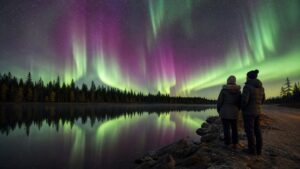
Best Time to See the Northern Lights in 2026 (Month-by-Month Guide)
No calendar can guarantee an aurora. Solar eruptions and high-speed solar-wind streams control geomagnetic activity, while season, latitude, cloud cover, moonlight, and local darkness control whether a person can see it. The useful way to plan 2026 is therefore to choose months with enough darkness and weather opportunity, then use space-weather alerts for the final decision.
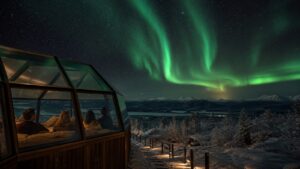
Where to See the Northern Lights: Top Destinations Worldwide
The best aurora destination is not automatically the farthest north. A successful location combines frequent placement under the auroral oval with clear weather, dark horizons, safe nighttime access, suitable accommodation, and enough schedule flexibility to wait through inactive periods. Different regions solve that equation in very different ways.
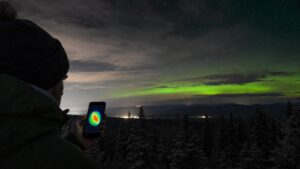
Northern Lights Forecast Tonight: How to Predict Aurora Activity
An aurora forecast is a chain of evidence rather than one number. Solar observations reveal eruptions or high-speed streams, models estimate arrival, spacecraft near Earth measure the solar wind, geomagnetic indices summarize disturbance, and auroral maps estimate the oval. The forecast becomes useful only after local darkness, cloud, latitude, and viewing direction are added.