


What Is Cosmology? Exploring the Science of the Universe
Cosmology is the science of the universe itself—its birth, structure, and future. From the Big Bang to dark matter and the accelerating expansion of space, cosmology reveals how galaxies formed, how stars forged the elements of life, and how the cosmos continues to evolve. It’s the story of everything—and our place within it.

The Origin of the Universe: How Did It All Begin?
Discover the awe-inspiring story of how everything began. From an unimaginably hot, dense state to the birth of stars, galaxies, and life itself, this journey through cosmic origins reveals the universe as a place of transformation, mystery, and endless wonder.

What Came Before the Big Bang?
What preceded the hot Big Bang remains unknown. Compare the evidence for early cosmic history with inflation, bounce and quantum initial-condition proposals.
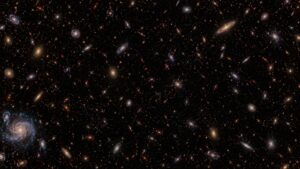
Could the Universe Be Infinite?
Infinity is compatible with some cosmological models, but a nearly flat observable universe does not establish its total extent. Geometry and topology answer different questions.
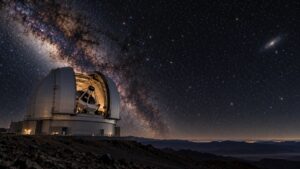
How Big Is the Universe Really?
The observable universe spans roughly 93 billion light-years in present-day distance, despite a cosmic age near 13.8 billion years. The explanation depends on what distance means.
The Fate of the Universe: Expansion or Collapse?
Continued expansion is the baseline forecast, but the universe’s distant future depends on how dark energy behaves. Heat death, a Big Crunch, and a Big Rip are conditional scenarios.
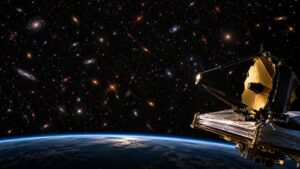
What Is the Observable Universe?
The observable universe is the domain whose information can reach us, not a complete cosmic inventory. Its limits depend on signal travel, expansion, and cosmic history.
Is There a Center of the Universe?
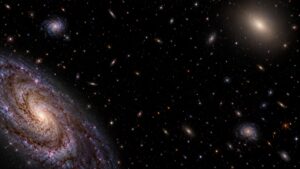
The standard expanding-universe model has no preferred spatial center. Observer-centered maps, galaxy centers, and the early hot universe describe different things.
Why the Universe Has No Edge (and What That Means)
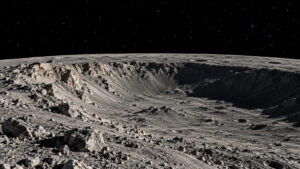
A cosmic horizon limits what we can observe, but it is not a wall where space ends. Explore why standard cosmology needs no outer border.

What Was the Big Bang? A Beginner’s Guide
The Big Bang describes an early hot, dense universe that expanded and cooled. Learn the observations behind the model and the questions it leaves open.

The First Three Minutes After the Big Bang
In the early minutes, cooling opened a brief window for nuclear reactions. Follow how protons, neutrons, and deuterium produced the primordial light-element mixture.
What Is Dark Matter? The Hidden Mass of the Universe
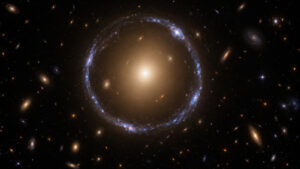
Galaxy motions, gravitational lensing, cluster collisions, and early-universe patterns point toward matter beyond the luminous inventory. Its identity remains unknown.