
Different Origin Stories Make Different Kinds of Claims
The Moon invites stories because it is familiar, beautiful, and visibly different from Earth. Some stories express cultural meaning; some are scientific hypotheses that once competed for acceptance; others are modern misconceptions repeated as established facts. Those categories deserve different treatment. A traditional narrative does not become a failed physics paper, and a discarded scientific model does not become foolish simply because later evidence challenged it. The useful comparison is between physical explanations and the measurements they must satisfy. Lunar rocks, the Moon’s composition, and the motion of the Earth-Moon system constrain what could actually have happened. They favor an origin involving a major collision, while leaving important details unresolved. Understanding why older proposals struggled helps us judge dramatic claims without mistaking an attractive picture for a demonstrated history.
A Scientific Hypothesis Has to Risk Being Wrong
A physical origin model must explain more than the existence of a nearby round object. It needs a mechanism that could operate in the early solar system, produce enough material, and leave that material in an appropriate orbit. It should also predict properties we can compare with measurements. A proposal that accounts for one appealing similarity but ignores several troublesome differences has not completed the job. The strength of an explanation comes from surviving those combined demands, rather than from sounding simple or offering a memorable name.
This distinguishes a scientific hypothesis from a story whose purpose is symbolic, religious, or artistic. Cultural traditions are diverse, and their meanings belong to particular communities and historical settings. Treating them all as interchangeable attempts at modern astronomy erases those differences. Here, the word myths chiefly refers to popular misconceptions and misleading retellings of older physical models. The scientific comparison concerns evidence about lunar formation, without inventing a universal cultural account or claiming that every story about the Moon is trying to answer the same question.
Capture Requires More Than Earth’s Gravitational Pull
The capture hypothesis imagines a Moon that formed elsewhere and later became Earth’s companion. At first the picture feels natural because Earth attracts other objects gravitationally. But attraction alone is insufficient to trap a passing body in a permanent orbit. An approaching object accelerates as it falls inward, then can regain outward motion as it departs. Something must change its energy and often its angular momentum if it is to remain bound. Saying that Earth’s gravity simply grabbed the Moon skips the most demanding part of the mechanism.
There are genuine ways for astronomical capture to occur. Encounters involving additional bodies can redistribute energy, and gas can provide drag in some environments. Those processes should not be dismissed as impossible throughout astronomy. The difficulty is constructing a suitable version for the Earth-Moon system while also matching its other properties. The Moon’s large size relative to Earth makes the problem different from trapping a small irregular satellite around a giant planet. A mechanism demonstrated in one setting does not automatically explain another setting with different masses and surroundings.
The chemical relationship adds another test. A body assembled far from Earth might be expected to preserve a noticeably different material history, depending on where it formed. Lunar measurements instead show important similarities to terrestrial material alongside substantial compositional differences. A capture model must account for both. NASA’s historical assessment of lunar-origin dynamics illustrates how researchers evaluated several physical mechanisms against the system’s constraints. The weakness of simple capture is a failure of the complete explanation, rather than a rule that gravity never produces captured moons.
Fission Makes a Familiar Parent-Child Picture
Fission proposes that a rapidly rotating young Earth shed material that became the Moon. The idea offers an appealing reason for a chemical relationship: the satellite would begin as part of its parent planet. However, imagining separation is easier than demonstrating it dynamically. A model must establish a plausible initial spin, show how material escapes into a sustainable orbit, and reproduce the final system after subsequent evolution. A cartoon of a bulge breaking away does not supply those calculations. It also says little about the heating and rearrangement the material would experience.
Modern descriptions sometimes associate fission with the notion that a present ocean basin marks the missing piece. That is misleading geological reasoning. Earth’s current ocean floor is shaped by ongoing plate tectonics and does not preserve a simple empty mold from the Moon’s birth billions of years earlier. More generally, a present surface shape cannot be projected backward unchanged through Earth’s long geological history. NASA’s discussion of early lunar hypotheses places fission among older proposals, rather than presenting it as the accepted explanation today.
Growing Together Does Not Guarantee Matching Outcomes
Co-formation, also called co-accretion, imagines Earth and Moon assembling from neighboring material. This could naturally provide related chemical ingredients. Yet starting near each other does not by itself explain why the finished bodies differ in bulk composition or how their particular orbital arrangement developed. A complete model must follow the growth, collisions, heating, and separation of materials. The Moon’s relatively small metallic core is especially relevant to that comparison. Shared birthplace is a beginning for an explanation, not its conclusion, just as two cakes made in one kitchen can differ because their ingredients and preparation were different.
Rocks Turn an Origin Debate into a Testable Problem
Returned lunar samples transformed the discussion by putting actual Moon material into laboratories. Researchers could study mineral structure, chemical abundance, and isotopic composition instead of inferring everything from a distant surface. These measurements supply several kinds of evidence rather than a single decisive magic rock. Some record crystallization and heating; others help compare the source material of Earth and Moon. The samples also carry a history of later impacts and alteration. Interpreting them requires separating information about formation from information added during subsequent geological events.
A useful distinction concerns elements and isotopes. Elements describe chemical ingredients such as oxygen or iron, while isotopes are variants of an element with different numbers of neutrons. Isotopic comparisons can reveal relationships that ordinary visual resemblance cannot. They do not function as a simple label reading born on Earth, however. Mixing, reservoirs, and later processes matter when researchers connect a laboratory measurement with a proposed early event. The NASA overview of lunar formation describes why samples and orbital observations continue to constrain the debate, even within collision-based explanations.
A Giant Impact Is a Framework, Not a Finished Film
The leading family of explanations involves a substantial impact during Earth’s early history, followed by the production of material capable of forming the Moon. This framework can connect the satellite’s silicate-rich composition with the violent environment of planetary assembly. It also provides ways to redistribute material and motion that simpler origin pictures lack. But giant impact does not specify one universally settled collision sequence. Different models explore different impactor properties, collision geometries, thermal states, and routes by which material becomes a satellite. Agreement on the broad mechanism leaves room for disagreement about those details.
An artist’s illustration often presents one version as a crisp scene with a particular approach direction and a neatly defined plume. Such artwork helps readers imagine enormous scales, but its apparent precision exceeds the certainty of the reconstruction. No observer watched the event, and the early Earth would not have looked like the modern blue planet. A scientific illustration should therefore be understood as an explanatory representation. The enduring evidence resides in measured properties and physically tested models, rather than in the realism of the rendered clouds, glowing rocks, or collision angle.
Computational work can reveal possibilities that a simple mental picture misses. For example, NASA’s account of high-resolution impact simulations describes a route toward rapid satellite formation in particular modeled conditions. That is a result about a possible mechanism, not direct footage of what occurred. Comparing multiple modeled outcomes with lunar measurements remains essential. A simulation becomes persuasive when it explains independent constraints without relying on implausible assumptions; increasing visual detail alone cannot establish a historical event.
The Moon Is Neither a Hollow Shell nor an Artificial Lamp
The hollow-Moon claim often grows from a real Apollo observation described with a misleading analogy. After the Apollo 12 lunar module’s ascent stage was deliberately crashed, seismometers recorded a long vibration signal; NASA’s experiment account reports more than 55 minutes. Calling that response bell-like describes persistence, not a measured empty cavity. Seismic waves can scatter through a fractured outer layer and lose little energy in dry rock, extending their recorded tail. The same account explains these scattering and attenuation effects using the material properties of the lunar interior. Those rock properties explain why an impact signal can last much longer than a familiar terrestrial tremor. The instruments measured ground motion, not an audible metallic bell, and the duration alone does not establish hollowness. Gravity, density, and wave propagation instead constrain a natural interior, while the Moon’s visible glow is reflected sunlight rather than an artificial lamp.
Later Lunar Changes Are Not Separate Birth Events
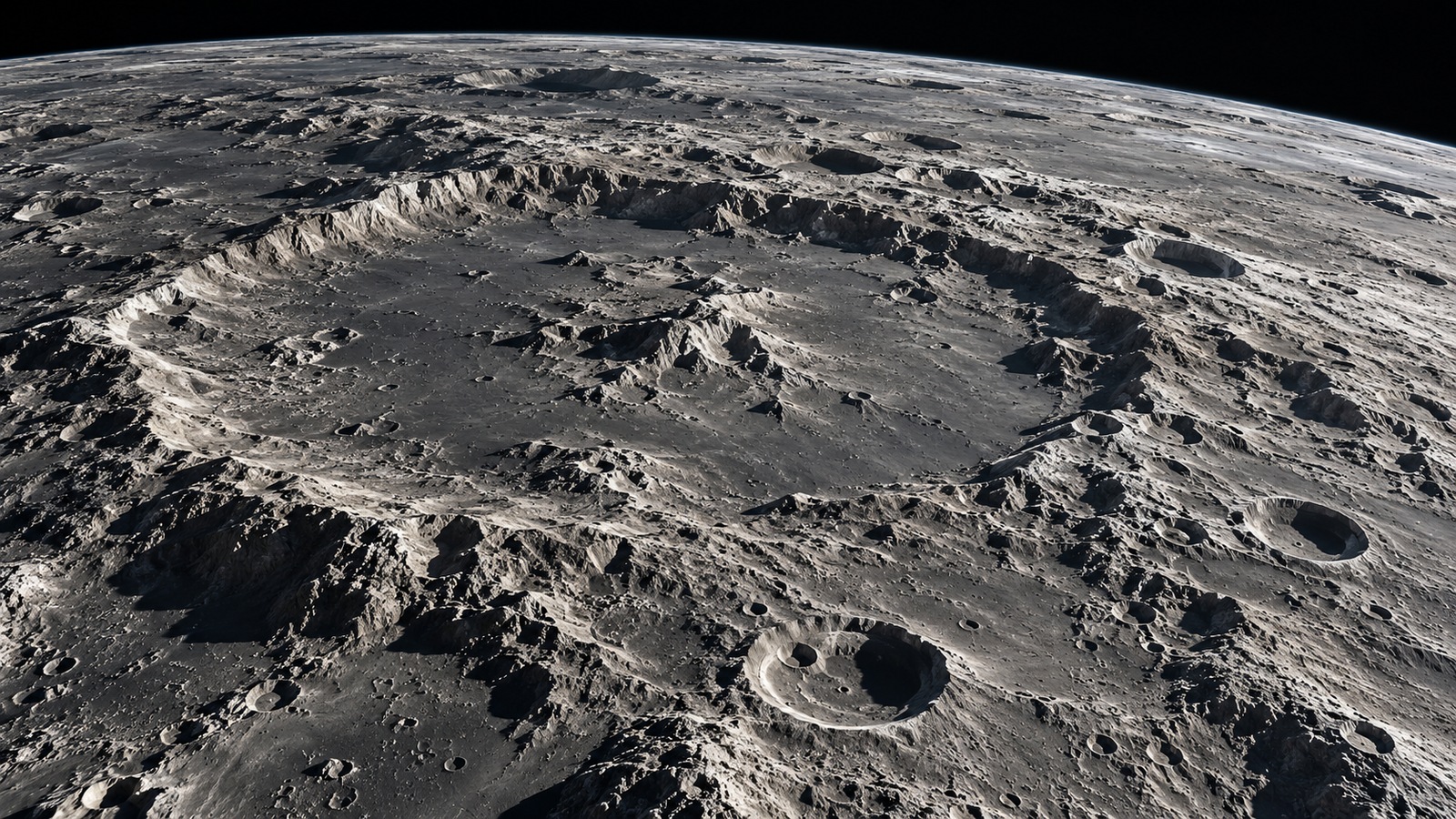
The dark plains visible from Earth formed through volcanism long after the Moon began assembling. Large impact basins, smaller craters, and deposits of broken surface material also record later events. These features tell valuable stories about lunar history, but they should not all be assigned to the initial formation episode. When a photograph shows a huge crater, it does not identify the collision that created the Moon. The crater sits on an already existing body. Confusing the Moon-forming event with the impacts that later scarred its surface collapses several stages of history into one.
The current orbit also reflects change. Tidal interactions have altered the Earth-Moon system over time, including the satellite’s distance and Earth’s rotation. Its present configuration is a constraint on formation models, but not a frozen photograph of the earliest arrangement. Researchers must connect an initial state with a plausible evolutionary path. This is why origin arguments can involve both ancient chemistry and current motion. Neither evidence stream replaces the other; together they reduce the set of histories that could lead to the system we observe.
Uncertainty Does Not Give Every Claim Equal Weight
Scientific uncertainty is specific. Researchers may disagree about how efficiently materials mixed after an impact while agreeing that a simple captured stranger fails important tests. They may debate the duration of satellite assembly without treating an artificial Moon as a comparably supported option. Knowing the boundaries of the disagreement prevents an all-or-nothing misunderstanding. An incomplete theory can still be much stronger than an alternative that explains less, lacks a mechanism, or contradicts observations. The proper comparison considers evidence, explanatory reach, and unresolved problems together.
Headlines sometimes announce that a new model has solved the mystery, only for another study to introduce a different scenario. This need not mean that lunar science repeatedly starts from zero. Researchers are often refining the same broad framework by testing an overlooked process or changing a parameter that older calculations could not explore. Pay attention to what the study actually claims: a viable possibility, a constraint, or a preferred solution under stated assumptions. Those are different achievements. A responsible account keeps the scope of the result attached to the result itself.
When evaluating a Moon-origin claim, ask what evidence would distinguish it from competitors. Does it account for composition and motion, or just one attractive visual resemblance? Does it explain how the process works, or merely name a force? Does it acknowledge the Moon’s later geological evolution? These questions make scientific reality more interesting than a fixed collection of debunkings. The Moon’s origin remains a problem that can be investigated, with older hypotheses showing how measurements sharpen explanation and with current uncertainties identifying where better evidence can still change the picture.


