Sunlight Arrives with an Invisible Traveling Companion
The Sun sends Earth more than the light that warms a pavement or brightens a room. Its outer atmosphere continually releases a stream of charged particles called the solar wind. That flow fills much of the space between planets and helps shape the environment around Earth, even though we cannot feel it as a breeze at ground level. The familiar word wind is useful because something travels outward, but the material is a thin plasma rather than ordinary air. Its speed, density, and magnetic properties change, sometimes abruptly. Following those changes reveals a connection between small structures near the Sun and disturbances millions of kilometers away. It also helps separate three things often confused in headlines: steady solar-wind flow, radiation from a flare, and a large eruption of solar material.
A Plasma Stream Escaping from the Corona
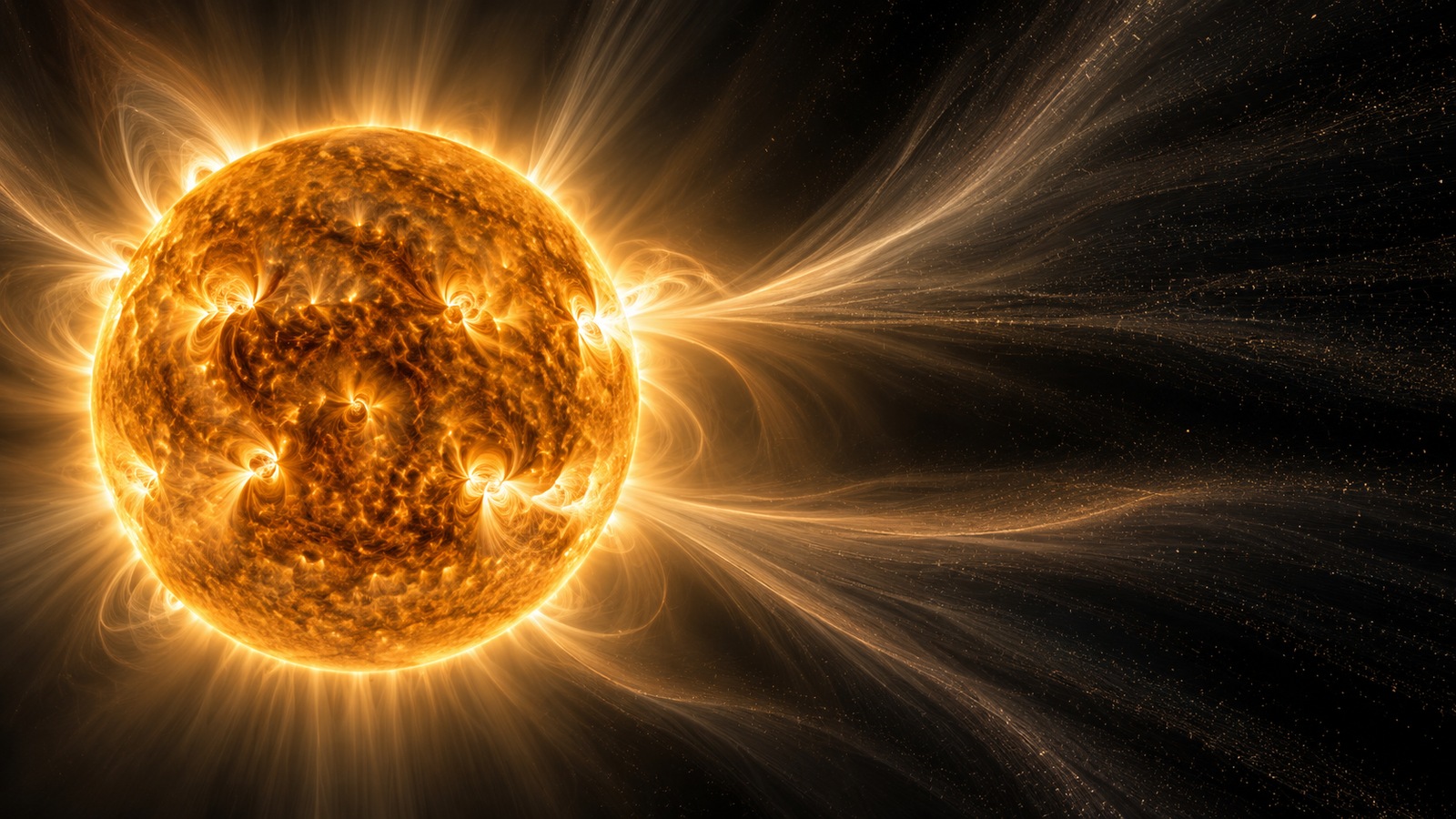
Solar wind consists mainly of electrons and protons, with helium nuclei and smaller contributions from heavier ions. A proton is the nucleus of a hydrogen atom; an electron carries a negative charge. In the Sun’s hot outer atmosphere, many particles are no longer bound together as neutral atoms. Their electrical charges make collective electromagnetic behavior central to the flow. Space between planets is therefore not simply an empty stage crossed by occasional rocks. It contains a tenuous moving material whose particles and fields can exchange energy.
Sunlight is electromagnetic radiation, which travels much faster than the bulk solar-wind flow. Light crosses the Sun-Earth distance in roughly eight minutes, while ordinary solar-wind material takes days, depending on its speed and path. This difference is fundamental when interpreting solar events. A change seen in a solar image is not automatically arriving at Earth as particles at that moment. Conversely, spacecraft can measure a passing particle stream long after its source region was observed. The same star supplies both radiation and material, but their journeys and effects must be followed separately.
The solar wind begins in the corona, the Sun’s hot and extended outer atmosphere. This region is much hotter than the visible photosphere, despite being farther from the central source of energy. That temperature contrast is part of the coronal-heating problem, not evidence that the Sun has a simple inverted oven-like structure. Magnetic processes transport and release energy in the atmosphere. They also influence how material escapes. Explaining the outflow therefore requires both a treatment of gravity and a treatment of the magnetic environment through which the particles move.
Gravity holds material toward the Sun, but a sufficiently energetic expanding atmosphere need not remain static. Eugene Parker developed a model of a continuous outflow, challenging a picture of interplanetary space with little solar material in it. Subsequent spacecraft measurements established that the flow was real. The modern problem extends beyond proving its existence. Researchers investigate how different regions feed it, where energy is deposited, and which processes accelerate particles. A successful explanation has to account for measured speeds, temperatures, composition, and magnetic fluctuations rather than merely establish that something escapes.
The corona is difficult to study because the bright solar disk overwhelms its faint light under ordinary conditions. Coronagraphs block that glare to reveal surrounding structures, while instruments at selected wavelengths examine hot plasma. Particle detectors supply a complementary view by sampling the wind where it passes. The NASA history of solar science places the prediction and confirmation within a long development of observing techniques. The transition from a theoretical outflow to a measured space environment changed how scientists understood the Sun’s reach.
Fast and Slow Streams Have Different Source Environments
Near Earth, solar wind commonly travels at hundreds of kilometers per second. Scientists often distinguish a faster component associated with coronal holes from a more variable slower component. Coronal holes are regions of comparatively low coronal emission, not physical holes bored through the Sun. Their magnetic configuration includes field lines extending outward into interplanetary space. This gives plasma pathways different from the closed magnetic loops that can confine material. Fast and slow are useful observational categories, but neither describes a single unchanging substance with one exact speed.
The origins of slower wind are especially varied. Source regions can include boundaries around closed structures and contributions associated with coronal-hole environments. Composition and magnetic behavior help identify those possibilities, because speed alone can conceal important similarities. A Parker Solar Probe study of slow wind from an equatorial coronal hole illustrates why a strict holes-equal-fast rule is too simple. Researchers use the labels as a starting point, then investigate the physical pathways that produced each measured stream. The distinction organizes the evidence without replacing the evidence.
Magnetic Fields Travel through the Flow
The solar wind carries the Sun’s magnetic influence outward. Because the Sun rotates while plasma flows away, the large-scale interplanetary magnetic field develops a curved pattern often described as the Parker spiral. This is a description of field geometry, not a rigid wire rotating through space. Local fluctuations, evolving source regions, and interactions complicate the pattern. A spacecraft passing through the wind may therefore encounter both an overall direction and rapid changes superimposed upon it. The magnetic field matters because Earth’s response depends on its orientation as well as the particles’ speed and density.
Small-Scale Motions Can Help Explain a Vast Flow
Solar-wind particles do not behave exactly like molecules in a familiar breeze. Collisions can be infrequent, allowing different particle populations to maintain different temperatures and motion patterns. Waves and turbulence transfer energy through the plasma, while magnetic reconnection can rearrange field connections and release stored energy. These processes can occur across very different scales. A large stream observed near Earth may retain clues to processes in much smaller source structures. The challenge is identifying which clues survive the journey and which were transformed by interactions along the way.
Parker Solar Probe has measured sharp bends called switchbacks in the magnetic field close to the Sun. Their appearance and relationship to the flow provide information about how the corona and wind connect. Researchers explore more than one route for producing or modifying them, so a switchback should not be treated as a settled answer to every acceleration problem. NASA’s account of the competing explanations shows how observations can make a familiar broad phenomenon more complicated and more revealing at the same time.
Earth Meets the Wind through Its Magnetic Surroundings
Earth’s magnetic field forms a magnetosphere that interacts with the incoming flow. The encounter compresses the sunward region and stretches the nightside into a long magnetotail. The boundary is not a hard shell through which nothing can pass. Its shape and behavior change as solar-wind conditions change, and energy can enter through processes involving the fields and particles. Most people experience none of this directly as a surface breeze. The interaction occurs in space and the upper atmosphere, far above the dense air of everyday weather.
A southward-directed component of the incoming magnetic field can favor magnetic reconnection with Earth’s field. Under suitable conditions this increases the transfer of energy into the magnetosphere. That energy can later drive currents and particle motion, with effects that include enhanced auroral activity. The solar-wind speed alone therefore does not determine the outcome. Two flows with comparable speeds can produce different responses if their magnetic orientations, densities, and duration differ. A report that calls every fast stream a major storm leaves out these controlling factors.
The aurora is a visible result of particles depositing energy in the upper atmosphere, causing atmospheric species to emit light. It is not sunlight reflecting off a wind cloud or the solar wind burning like a flame. The chain from the Sun to auroral emission includes magnetic transport and acceleration around Earth. That chain explains why the most vivid display need not simply follow the moment of the fastest measured flow. Studying the surrounding magnetic system connects an otherwise invisible stream with changes people can sometimes see in the night sky.
Continuous Does Not Mean Uniform
The Sun rotates, source regions evolve, and streams of different speeds meet. Faster flow catching slower material can create compressed interaction regions. Such structures may recur as long-lived source regions rotate back into favorable positions, but recurrence does not imply perfect repetition. Each passage can have different magnetic and plasma conditions. The word constant in a basic description refers to the continuing supply of material. It should not suggest fixed speed, steady density, identical composition, or an unvarying effect on Earth. Variability is part of the phenomenon rather than an exception to it.
Flares and Mass Ejections Add Distinct Events
A solar flare is a sudden release of electromagnetic radiation from a solar eruption. Its photons can rapidly change Earth’s sunlit upper atmosphere, including conditions important for some radio communication. A coronal mass ejection, or CME, is a large expulsion of plasma and magnetic field. It may travel through the surrounding solar wind and, if its trajectory intersects Earth, disturb the magnetosphere on arrival. These events can accompany one another, but their association does not make them identical. Their timing, contents, and effects require separate analysis.
The ordinary wind provides the background through which a CME travels. It can affect how that eruption moves and evolves, just as a road’s conditions influence a vehicle without making the road and vehicle the same object. Energetic particles from solar events form another category, distinct from the bulk stream’s typical particles. Keeping these distinctions clear makes space-weather reports more intelligible. A flare observed today, a particle enhancement, and a later magnetic disturbance may belong to one eruption sequence, yet each represents a different physical part of the Sun-Earth connection.
Spacecraft Turn Invisible Flow into Measured Conditions
Particle instruments count incoming particles and measure their energy, direction, and species. Magnetometers measure the surrounding magnetic field. Together they provide quantities that can be compared across locations and times, including speed, density, temperature, and field orientation. Near-Earth monitors are useful for tracking approaching conditions, while missions closer to the Sun investigate origins before transport changes the material. A measurement at one spacecraft is local. Scientists must account for the spacecraft’s position and the flow’s geometry before assuming that another planet or observer encounters the same conditions.
Remote images add context by showing coronal structures, eruptions, and changing source regions. Combining imaging with in-situ sampling is powerful because the two methods answer different parts of the problem. An image shows where bright plasma structures appear; a particle detector tells researchers what actually passed through its location. NASA’s report on Parker Solar Probe entering the solar atmosphere explains how close measurements provide access to a region previously investigated mainly from afar. Near-source evidence sharpens the connection between the corona and escaping material.
Farther outward, the solar wind helps establish the heliosphere, the region shaped by the Sun’s interaction with surrounding interstellar material. It eventually slows and encounters boundaries whose structure depends on pressures and fields on both sides. That large-scale reach should not be confused with the much shorter distances relevant to an individual terrestrial storm. From its origin in hot coronal plasma to its role far beyond the planets, the wind connects many scales. Understanding it begins with the simple recognition that our star continually sends matter, as well as light, into its surroundings.