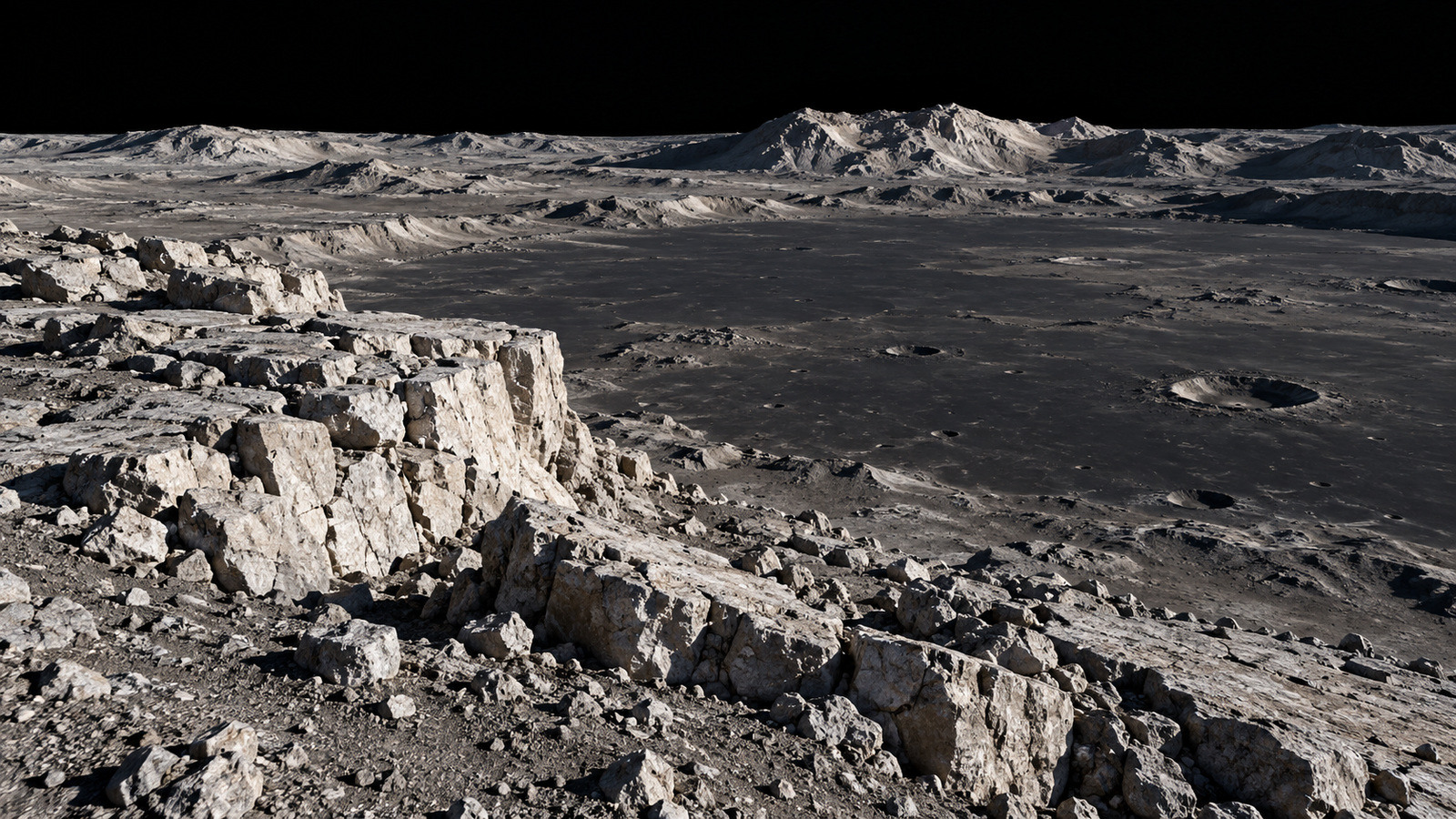
A Quiet Moon with a Fiery Past
The Moon, scientifically known as Luna (Earth I), is often seen as a silent, gray world where nothing stirs but dust and shadows. Yet beneath its calm exterior lies a dramatic history of fire and fury. Billions of years ago, the Moon was volcanically active, its surface reshaped by vast flows of molten lava and explosive eruptions. Today’s cratered plains and dark patches are echoes of this fiery past.
Studying lunar volcanism is more than curiosity—it tells us about the Moon’s evolution, its cooling interior, and the way planetary bodies transform over time. Unlike Earth, which remains geologically active, the Moon’s volcanic history has ended. But the evidence remains etched in its crust, visible through telescopes and confirmed by samples brought back to Earth. These ancient volcanoes reveal that Luna was once a dynamic world, its surface glowing with rivers of molten rock under a young and violent Sun.
Discovering Volcanism on the Moon
The idea that the Moon was once volcanic began with observations of its surface. Through telescopes, early astronomers saw dark plains that contrasted with the bright highlands. These smooth, dark areas, known as maria, were once thought to be seas. Modern science has shown that they are ancient basaltic lava plains, formed by immense volcanic activity billions of years ago.
Apollo missions provided the first direct evidence. Astronauts collected basalt samples rich in iron and magnesium, minerals that form when lava cools. These rocks confirmed that the maria were volcanic in origin. Remote sensing later revealed volcanic domes, rilles, and pyroclastic deposits—further proof of widespread eruptions. While Earth’s volcanoes are often dramatic and ongoing, the Moon’s eruptions belong to deep history. They tell a story of a hot, molten interior that gradually cooled into the quiet body we see today.
The Lunar Magma Ocean
Shortly after its formation, the Moon is believed to have been covered by a global magma ocean. This molten layer, hundreds of kilometers deep, slowly cooled and solidified. Denser minerals sank toward the interior to form the mantle, while lighter minerals floated to create the anorthosite crust of the highlands.
This process set the stage for later volcanism. Heat trapped in the mantle produced pockets of molten rock that erupted onto the surface through fractures and impact basins. The cooling of the magma ocean also left behind distinctive chemical signatures that can still be found in lunar rocks. The magma ocean theory not only explains the Moon’s layered structure but also why volcanism occurred in pulses, linked to the release of internal heat and the formation of impact basins that weakened the crust.
Basaltic Plains and the Lunar Maria
The most visible evidence of the Moon’s volcanic history is the maria. Covering about 17 percent of the lunar surface, these dark plains are vast fields of basalt created by lava flows. Some flows stretched hundreds of kilometers, filling enormous basins left behind by massive impacts.
Apollo samples revealed that lunar basalts are chemically diverse. Some are rich in titanium, giving them a distinctive signature, while others are low in titanium and resemble basalts on Earth. These differences point to variations in mantle composition and the conditions of eruption. The maria date from about 3.1 to 3.9 billion years ago, marking a time when the Moon was far more active than it is now. To the naked eye, they form the familiar dark patches we see as the “man in the Moon” or other cultural patterns, silent reminders of ancient volcanic seas.
Volcanic Domes and Shield Volcanoes
Beyond the vast maria, the Moon also hosts smaller volcanic structures. Volcanic domes, resembling low, rounded hills, are scattered across the surface. These domes formed from viscous lava that oozed slowly rather than flowing freely. Some are only a few kilometers across but rise hundreds of meters above the surrounding plains.
Larger features, such as shield volcanoes, also exist on the Moon. Mons Rümker, in Oceanus Procellarum, is a prominent example, rising over a kilometer high. It consists of overlapping volcanic domes formed by repeated eruptions. These structures closely resemble shield volcanoes on Earth, such as those in Hawaii, though they are smaller due to the Moon’s weaker gravity and cooler mantle. Such features show that lunar volcanism was not limited to massive floods of lava but also included localized eruptions that built mountains over time.
Sinuous Rilles and Lava Tubes
One of the most intriguing volcanic features on the Moon is the sinuous rille. These winding channels, resembling dry riverbeds, are actually remnants of ancient lava flows. Lava carved channels across the lunar surface, and when the flows ceased, the channels remained as geological scars. Some sinuous rilles extend for hundreds of kilometers, demonstrating the immense scale of lunar eruptions.
Lava tubes are another legacy of volcanic activity. When the surface of a lava flow cooled and hardened while molten rock continued to flow beneath, hollow tubes were left behind. These structures have been detected from orbit and confirmed in places where their roofs have collapsed, revealing skylights. Lava tubes may one day serve as shelters for astronauts, offering protection from radiation and temperature extremes. Their existence proves that the Moon’s volcanic past continues to shape the possibilities of its future.
Explosive Volcanism and Pyroclastic Deposits
While much of the Moon’s volcanism involved slow basaltic flows, evidence also points to explosive eruptions. These eruptions produced pyroclastic deposits—blankets of volcanic glass and ash that spread across the surface. Dark mantling deposits observed from orbit are remnants of these violent events.
Apollo missions brought back tiny beads of volcanic glass in colors ranging from orange to green. These beads formed when molten rock was sprayed into space during explosive eruptions and cooled rapidly. Some of these deposits contain water in trace amounts, suggesting that lunar volcanism released volatile elements. The discovery of explosive volcanism challenges earlier views of the Moon as completely dry and highlights its chemical complexity. These eruptions show that even small worlds can produce powerful volcanic events with lasting geological signatures.
The Timeline of Lunar Volcanism
Lunar volcanism was most intense between 3 and 4 billion years ago, during the period known as the Late Heavy Bombardment. Massive impacts created basins that became the sites of volcanic flooding. The maria formed as lava filled these lowlands, reshaping the lunar surface.
Volcanism gradually waned, but evidence suggests it did not end abruptly. Some basalt flows are as young as one billion years old, and recent studies suggest small eruptions may have occurred as recently as 100 million years ago. If true, this means the Moon remained volcanically active far longer than once believed. The long timeline of lunar volcanism illustrates how even small worlds can sustain geological activity for billions of years before cooling into silence.
Why Lunar Volcanoes Stopped
Today, the Moon is volcanically dead. Its small size meant it lost internal heat more quickly than larger planets like Earth. Without sufficient heat to melt mantle material, volcanism ceased. The absence of plate tectonics also limited the recycling of materials that could have fueled new eruptions.
Despite its inactivity, the Moon still experiences minor “moonquakes,” some triggered by tidal forces from Earth. These quakes remind us that the Moon is not entirely inert, but its days of fiery eruptions are long gone. The quiet, cratered surface we see now is the frozen legacy of a once-dynamic world. Understanding why volcanism ended on the Moon helps scientists compare it with Earth and other planets, shedding light on how size and internal energy govern planetary lifespans.
Clues from Seismology and Gravity
Seismometers placed on the Moon during Apollo missions recorded moonquakes and revealed details about its interior. These data suggest the Moon has a small, partially molten core and a mantle that once supported widespread volcanism. Gravity measurements from later missions, such as GRAIL, mapped mass concentrations beneath the surface, many of which align with ancient volcanic features.
These findings confirm that the Moon’s interior was once hot and dynamic enough to support widespread eruptions. The fact that volcanism persisted for billions of years before fading shows that even small bodies can sustain activity for long periods. By piecing together seismic and gravitational clues, scientists reconstruct the story of the Moon’s interior and how it fueled the fiery episodes that shaped its surface.
What Lunar Volcanism Teaches Us About Earth
Studying the Moon’s volcanic history also teaches us about Earth. Because the Moon lacks an atmosphere and plate tectonics, its surface preserves volcanic features for billions of years. On Earth, erosion and geological recycling erase much of this record. The Moon therefore offers a clearer view of early volcanic processes that may have also occurred on Earth.
By analyzing lunar basalts, scientists gain insight into mantle chemistry and the role of impacts in triggering eruptions. The Moon’s volcanic history also provides a contrast to Earth’s, showing how size and environment influence geological activity. Comparing the two bodies highlights why Earth remains active while the Moon became dormant. In this way, Luna serves as both a partner and a counterpoint, revealing fundamental truths about planetary evolution.
Implications for Exploration and Settlement
The Moon’s volcanic features are not just scientific curiosities—they may hold practical value for future exploration. Lava tubes could provide natural shelters for astronauts, protecting them from radiation and temperature extremes. Volcanic glass deposits may contain resources such as water or useful materials for construction.
Understanding the distribution and composition of volcanic deposits helps mission planners identify potential landing sites and resource-rich areas. For example, pyroclastic deposits may contain volatiles that could be extracted for fuel or life support. Exploring the Moon’s volcanic past is therefore essential for building its future as a base for human activity. The same fiery processes that once reshaped the surface may one day support humanity’s presence on another world.
Comparisons with Volcanism on Other Worlds
The Moon’s volcanic history is part of a larger story of volcanism across the solar system. Mars hosts the largest volcano in the solar system, Olympus Mons, and shows evidence of eruptions that lasted into recent geological time. Io, a moon of Jupiter, is volcanically active today, with eruptions fueled by tidal heating. Venus is covered in volcanic plains, though whether it remains active is still debated.
Compared to these worlds, the Moon is modest in its volcanism, yet no less significant. Its eruptions reveal how a small, rocky body can sustain internal activity for billions of years before cooling. By comparing Luna’s volcanism with that of other planets and moons, scientists build a broader understanding of how size, composition, and environment shape volcanic activity across the solar system.
The Moon as a Record of Solar System History
The Moon’s volcanic history also preserves clues about the broader solar system. Many eruptions occurred shortly after the Late Heavy Bombardment, linking volcanic activity to impacts. These events may have provided heat and fractures that triggered lava flows. By dating volcanic deposits, scientists refine the timeline of solar system evolution.
The Moon’s basalt plains and volcanic domes therefore serve as markers of cosmic events. They show how impacts, internal heat, and external forces combined to shape planetary surfaces. In this sense, the Moon is not just a record of its own history but also of the dynamic events that influenced the entire inner solar system during its early years.
Why the Moon’s Volcanic Past Still Matters
Though the Moon has been quiet for billions of years, its volcanic past remains central to our understanding of planetary science. Volcanism shaped its surface, altered its chemistry, and preserved records of cosmic history. It influenced the Moon’s role as Earth’s companion, determining its geology and the resources it holds today.
For scientists, studying lunar volcanism offers insight into planetary cooling, mantle chemistry, and the connections between impacts and eruptions. For explorers, it highlights resources and structures that may support future missions. For humanity, it reminds us that even seemingly quiet worlds can hold dramatic histories of fire and transformation. The Moon’s ancient volcanoes are evidence that silence often conceals stories of extraordinary change.
Space Products Reviews
Blast off with Lyra Street’s ultimate guide to the Top 10 Best Space Products Reviews! From high-powered telescopes to stellar star maps and astronomy gear, we explore the most impressive cosmic tools available today. Dive into detailed reviews and an easy-to-navigate comparison chart to find the perfect gear for your stargazing adventures or space-inspired lifestyle.