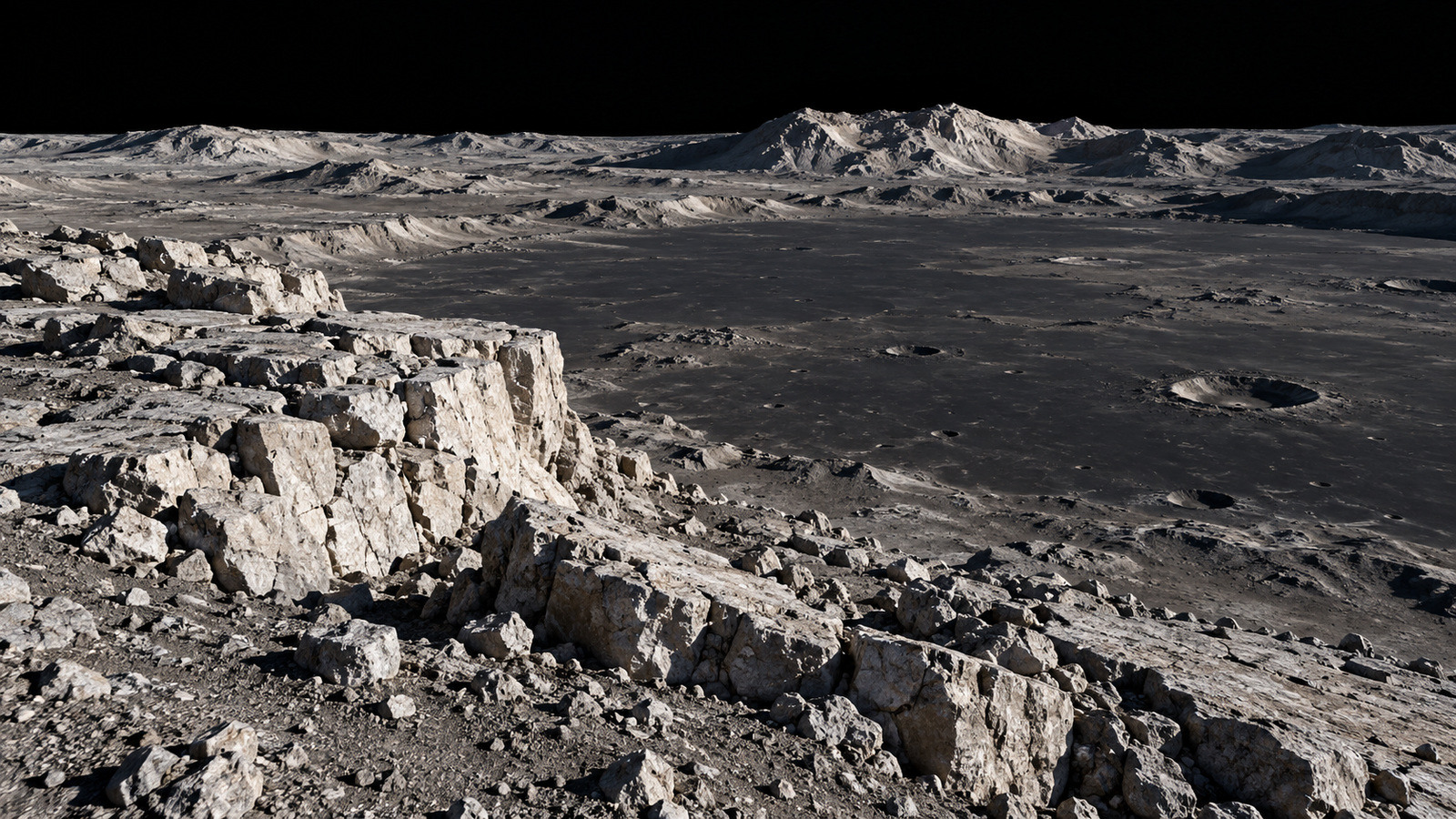
The Rediscovery of a Dry World’s Secret
For much of the 20th century, scientists assumed the Moon, scientifically known as Luna (Earth I), was bone dry. Apollo astronauts brought back lunar rocks and soil that seemed almost entirely devoid of water. Without an atmosphere or protection from the Sun’s radiation, it seemed impossible for water to survive on the Moon. Yet over the past few decades, new technology and missions have overturned this assumption, revealing that Luna hides water in surprising places.
The discovery of water on the Moon has revolutionized our understanding of its geology and history. Water has been detected as ice in shadowed craters, as molecules bound in minerals, and as hydroxyl on the surface grains. These discoveries reshape the story of how the Moon formed and open the door to new possibilities for exploration. Once thought to be a barren desert, the Moon is now recognized as a more complex and resource-rich world.
The First Hints of Lunar Water
The earliest Apollo missions seemed to confirm a dry Moon. The rocks and regolith samples analyzed in laboratories showed almost no evidence of water, reinforcing the belief that Luna was airless and parched. However, small hints emerged. A few samples contained trapped gases and traces of volatile elements, though they were initially dismissed as contamination from Earth.
It wasn’t until decades later that scientists re-examined Apollo samples with more advanced techniques. Using improved instruments, researchers discovered tiny amounts of water locked inside volcanic glass beads. These findings were startling, suggesting that the Moon’s mantle might contain water. The overlooked evidence from Apollo became the foundation for a new era of lunar science, proving that even old samples can yield new secrets when viewed through a modern lens.
Discoveries from Lunar Missions
In the 1990s and 2000s, spacecraft missions began to change the narrative. NASA’s Clementine mission hinted at the presence of ice in permanently shadowed craters at the poles. Later, the Lunar Prospector confirmed hydrogen deposits consistent with water ice. These findings were indirect but compelling, suggesting that cold traps near the poles might hold reserves of frozen water.
The turning point came with NASA’s LCROSS mission in 2009. By deliberately crashing a spacecraft into a shadowed crater and analyzing the plume, scientists detected water ice directly. Around the same time, India’s Chandrayaan-1 spacecraft carried instruments that confirmed hydroxyl and water molecules spread across the lunar surface. Together, these discoveries shattered the old view of a completely dry Moon and revealed a more dynamic and hydrated environment.
Where Lunar Water Resides
Water on the Moon is not found in oceans or rivers but in more subtle forms. The most dramatic reservoirs are in permanently shadowed craters near the poles. These craters, never touched by sunlight, remain colder than the surface of Pluto. In these icy traps, water molecules delivered by comets or formed through chemical reactions can persist for billions of years. Elsewhere, water exists in much smaller quantities. It is bound within minerals, locked in volcanic glass beads, or present as hydroxyl on the surfaces of dust grains. This water is constantly created and destroyed, forming a delicate balance with solar radiation. While most of the Moon appears arid, these hidden reservoirs prove that water is more widespread than once imagined, scattered in both polar ice and microscopic traces throughout the regolith.
Permanently Shadowed Craters and Polar Ice
The polar regions of the Moon host some of the most extreme environments in the solar system. Because of the Moon’s small axial tilt, sunlight never reaches the floors of certain craters at the poles. These areas remain in perpetual darkness, creating cold traps where temperatures plunge to –230 °C. Radar and spectrometer measurements have revealed reflective signatures consistent with water ice in these regions. LCROSS confirmed that at least some shadowed craters contain significant deposits of ice mixed with soil. Estimates suggest billions of tons of ice may exist at the lunar poles, though it is unevenly distributed and challenging to access. These frozen reservoirs represent both scientific treasures and potential resources for future missions, offering water for drinking, fuel production, and sustaining long-term human presence.
Volcanic Glass and Ancient Water
Apollo missions provided another line of evidence for lunar water hidden in volcanic glass beads. These beads formed during explosive eruptions billions of years ago, when molten magma spewed from the interior and cooled rapidly. Advanced analysis revealed that some of these beads contain water trapped within.
This discovery suggests that the Moon’s mantle contains small but measurable amounts of water, contradicting earlier assumptions that it was completely dry. The presence of water in volcanic material also indicates that the early Moon’s interior chemistry was more complex than believed. By studying these ancient volcanic deposits, scientists gain insight into how water was stored and transported in the Moon’s interior over geological time.
Solar Wind and Surface Water Formation
In addition to ice and volcanic deposits, the solar wind plays a role in creating water on the Moon’s surface. The solar wind carries hydrogen ions that strike the lunar regolith. When these ions interact with oxygen in the minerals, they form hydroxyl and water molecules. These molecules are transient, forming during the lunar day and possibly migrating across the surface before being lost to space or trapped in colder regions. This process explains why spacecraft detected widespread hydroxyl signatures on the Moon’s surface. It also highlights the Moon’s chemical activity, where even in the absence of an atmosphere, radiation and particles from the Sun can generate water. The solar wind turns the Moon into a natural laboratory, demonstrating how energy and chemistry interact on airless bodies.
The Role of Comets and Asteroids
Another major source of lunar water may be external delivery by comets and asteroids. In the early solar system, both Earth and the Moon were heavily bombarded by icy bodies. These impacts delivered volatiles, including water, which could have been trapped in shadowed craters or incorporated into the regolith.
Even today, small impacts continue to add traces of water to the surface. While much of this water is lost to space, some survives in cold traps or becomes bound in minerals. This external delivery complements the other processes—volcanic outgassing and solar wind chemistry—that contribute to the Moon’s water budget. By studying lunar water, scientists also learn about the broader history of volatile delivery to terrestrial planets.
Migration and Trapping of Water Molecules
Water molecules on the Moon do not stay put. With no atmosphere to hold them, they migrate across the surface, hopping between grains under the influence of temperature and sunlight. Some molecules escape into space, while others settle in colder regions where they are permanently trapped.
This migration explains how water created by solar wind interactions or delivered by impacts can eventually end up in polar craters. Over billions of years, the Moon’s surface has acted like a vast conveyor belt, slowly shuttling water toward the poles. The presence of ice in these craters is the result of countless tiny processes, all converging to concentrate water in places untouched by the Sun’s heat.
Evidence from Recent Missions
Modern lunar missions continue to add detail to the picture of water on the Moon. NASA’s Lunar Reconnaissance Orbiter has mapped hydrogen deposits across the surface, while instruments on India’s Chandrayaan-2 and NASA’s SOFIA observatory confirmed water molecules even in sunlit areas. These detections show that lunar water is more widespread and dynamic than previously thought.
China’s Chang’e missions have also contributed, with Chang’e-5 returning samples that contained measurable amounts of water in minerals. Each new mission refines our understanding of how water is distributed and stored. The evidence now suggests that water is not confined to shadowed craters but exists in varying forms across the lunar landscape, making Luna far more hydrated than earlier generations believed.
How Water Shaped Lunar History
The discovery of water on the Moon also reshapes theories about its history. If volcanic eruptions released water from the interior, it suggests that the mantle retained volatiles even after the Moon’s violent birth in a giant impact. If comets delivered significant amounts of water, it ties the Moon’s history to the broader bombardment of the early solar system. Understanding when and how water accumulated on the Moon provides insight into planetary formation. It shows how volatiles can survive even in harsh, airless environments and how they contribute to shaping planetary surfaces. For Earth, the Moon’s water offers a parallel story of how volatiles influenced the evolution of terrestrial planets.
Scientific Value of Lunar Water
From a scientific perspective, water on the Moon is a treasure trove. It preserves records of solar wind interactions, impact delivery, and volcanic outgassing. By studying water in lunar samples, scientists can reconstruct the history of the Sun, the solar system, and even Earth’s own volatile evolution.
Water molecules trapped in ice or minerals provide isotopic fingerprints that reveal their origins. Distinguishing between water formed by solar wind, volcanic activity, or cometary impacts helps scientists unravel the sources of volatiles on other planets. The Moon thus serves as a natural laboratory for understanding how water moves, accumulates, and transforms in space environments.
Practical Importance for Exploration
Beyond science, lunar water has profound practical importance. Water is essential for sustaining human presence, and transporting it from Earth is expensive. Ice at the poles could be mined and purified for drinking water. Electrolysis could split it into hydrogen and oxygen, producing both breathable air and rocket fuel. The possibility of using lunar water to create a “gas station” in space excites mission planners. Access to in-situ resources would make long-term bases more feasible and reduce costs for missions to Mars and beyond. The same processes that deposited and preserved water now offer humanity a chance to expand exploration in ways once considered impossible.
Challenges of Extracting Lunar Water
Despite its promise, extracting lunar water poses challenges. Ice is not uniformly distributed; it is often mixed with regolith or buried beneath layers of dust. The extreme cold of shadowed craters makes access difficult for machinery. In sunlit regions, water exists in tiny quantities that must be extracted from minerals or glass beads, requiring energy-intensive processes. Future missions must develop technology capable of handling these difficulties. Drilling into icy soil, heating regolith to release water, and operating in permanent darkness are formidable engineering problems. Yet the rewards are great, and solving these challenges will unlock resources that could sustain humanity’s future beyond Earth.
The Moon as a Model for Other Worlds
Studying water on the Moon also informs our understanding of other worlds. Mercury, asteroids, and even some moons of Jupiter and Saturn share similarities in how they retain volatiles in shadowed craters or surface minerals. By unraveling the Moon’s water story, scientists build models that can be applied across the solar system. The Moon’s proximity makes it an ideal test case for exploring volatile behavior. Lessons learned here will guide the search for water on Mars, where similar processes may occur, and on icy moons where volatiles dominate. Luna’s water is not just about our nearest neighbor but about the universal role of water in shaping worlds.
Why Lunar Water Matters to Humanity
The discovery of water on the Moon changes how humanity views its companion. Once thought lifeless and barren, Luna is now recognized as a resource-rich partner in exploration. Its water connects science, technology, and future settlement in ways that were unimaginable during the Apollo era. For scientists, it provides clues about planetary history. For engineers, it offers resources that can support bases and missions. For humanity as a whole, it represents the possibility of living beyond Earth, sustained by the very processes that once seemed to deny the Moon water entirely. The story of lunar water is one of discovery, persistence, and hope.
Space Products Reviews
Blast off with Lyra Street’s ultimate guide to the Top 10 Best Space Products Reviews! From high-powered telescopes to stellar star maps and astronomy gear, we explore the most impressive cosmic tools available today. Dive into detailed reviews and an easy-to-navigate comparison chart to find the perfect gear for your stargazing adventures or space-inspired lifestyle.