A World Beyond Our Sight
Earth’s Moon, scientifically called Luna, has been our closest celestial companion for billions of years. For all of human history, however, we only saw one familiar face gazing down on us. The Moon rotates at the same rate that it orbits Earth, a phenomenon called synchronous rotation, so the same hemisphere always faces our planet. The far side, often misnamed the “dark side,” remained invisible until the mid-20th century. Today, thanks to spacecraft, satellites, and robotic explorers, we are beginning to uncover the hidden secrets of the Moon’s far side—and what we’ve found reveals a side of Luna that is dramatically different from the one we know so well.
The far side is not permanently dark. It receives just as much sunlight as the near side, but it is permanently turned away from Earth’s view. Because of this, the far side remained a mystery until the Space Age, when the Soviet spacecraft Luna 3 transmitted the first grainy images back to Earth in 1959. Since then, we have learned that the far side holds unique geological features, a distinct history, and potential resources that may one day shape humanity’s future in space.
The Discovery of the Hidden Hemisphere
For centuries, poets, scientists, and philosophers speculated about what might lie beyond the Moon’s visible face. With no way to see over the lunar horizon, the far side was shrouded in mystery. That changed when Luna 3 captured photographs that stunned the world. Instead of the familiar dark basalt plains, or maria, that dominate the near side, the far side appeared rugged, heavily cratered, and largely lacking in smooth plains.
This revelation transformed our understanding of Luna. It showed that the Moon was not symmetrical and that each hemisphere had a very different history. Later missions, including NASA’s Lunar Orbiter program and Apollo missions, provided higher-resolution images and maps. More recently, spacecraft like NASA’s Lunar Reconnaissance Orbiter and China’s Chang’e missions have revealed the far side in unprecedented detail, peeling back layers of mystery that had persisted for millennia.
A Surface of Ancient Craters
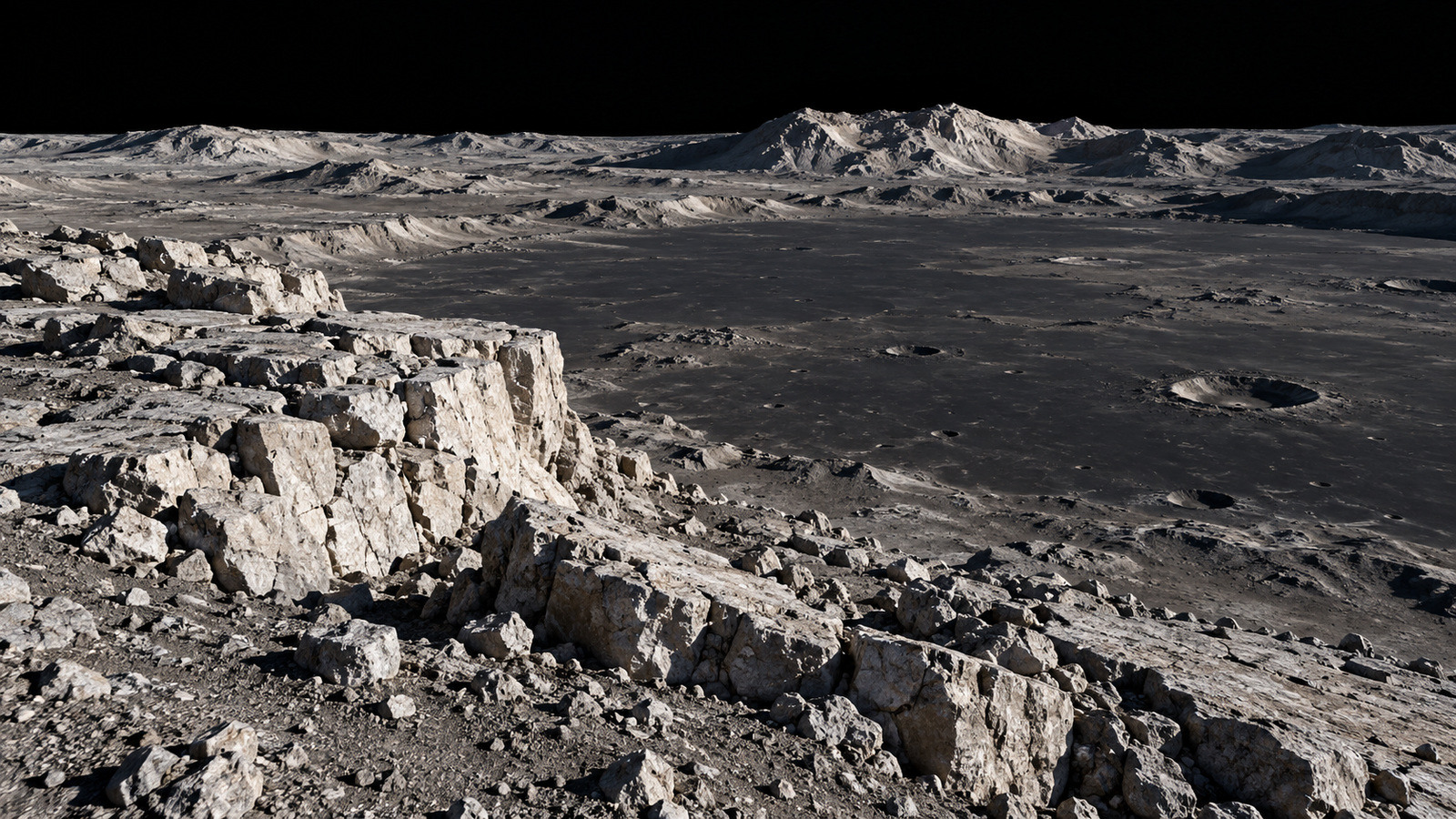
One of the most striking features of the Moon’s far side is its heavily cratered terrain. While the near side shows vast plains of dark basalt formed by ancient volcanic eruptions, the far side is dominated by highlands, scarred with craters from billions of years of impacts. These highlands are older than the maria, preserving a record of the Moon’s earliest history. Because the far side lacks the large basalt plains that filled in many of the near side’s craters, its surface offers scientists a window into the violent early days of the solar system. The abundance of craters suggests that the far side has remained geologically quiet for most of its history, preserving ancient features that were erased or modified on the near side. In this way, the far side is like a natural archive, holding evidence of impacts that occurred during the Moon’s—and Earth’s—infancy.
Why the Two Sides Are So Different
The question of why the Moon’s near and far sides are so different is one of the most enduring puzzles in lunar science. The near side is covered with maria, large dark plains formed by volcanic eruptions billions of years ago. The far side, by contrast, has very few maria and is dominated by rugged highlands.
Scientists believe this asymmetry may be linked to differences in the thickness of the Moon’s crust. Data from missions such as NASA’s GRAIL (Gravity Recovery and Interior Laboratory) suggest that the far side has a thicker crust than the near side, which may have prevented magma from reaching the surface to form maria. Another theory is that the young Earth’s heat influenced the near side, thinning its crust and allowing volcanic activity. Whatever the cause, the differences highlight the Moon’s complex formation and the interplay of internal and external forces that shaped it.
The South Pole–Aitken Basin: A Window Into the Moon’s Interior
One of the most fascinating features of the far side is the South Pole–Aitken Basin, a colossal impact crater stretching 2,500 kilometers in diameter and up to 8 kilometers deep. It is one of the largest known impact structures in the solar system. This basin is so vast that it exposes material from deep within the Moon, offering scientists a rare opportunity to study its interior.
The South Pole–Aitken Basin has become a prime target for future exploration because it may hold clues about the Moon’s composition and history. Scientists hope to analyze rocks ejected from the impact to better understand the Moon’s mantle and perhaps even gain insights into how Earth and the Moon formed. The basin’s depth and scale make it one of the most scientifically valuable sites in the entire solar system, a natural window into planetary processes that shaped both Luna and Earth.
Radio Silence: The Far Side as a Haven for Science
One of the most surprising secrets of the Moon’s far side is not geological but practical. Because the far side is shielded from Earth’s radio signals, it is an ideal location for building radio telescopes. On Earth, radio astronomy is limited by interference from our planet’s constant transmissions, but the far side offers pristine radio silence.
Astronomers dream of placing a large radio observatory there to study the universe at low frequencies that are blocked by Earth’s atmosphere. Such a telescope could provide unprecedented views of the early universe, star formation, and cosmic phenomena. In this way, the Moon’s far side could become humanity’s quiet listening post for unlocking the deepest cosmic mysteries.
Chang’e 4: The First Landing on the Far Side
In January 2019, China’s Chang’e 4 mission made history by becoming the first spacecraft to land on the Moon’s far side. It touched down in the Von Kármán crater, within the South Pole–Aitken Basin. Because the far side never faces Earth directly, the mission required a relay satellite, Queqiao, to transmit signals back to mission control. Chang’e 4 carried a lander and rover, Yutu-2, which continues to explore the terrain. The mission has studied the surface composition, captured panoramic images, and even conducted biological experiments with seeds and organisms. By exploring the far side directly, Chang’e 4 has opened a new era of lunar science, demonstrating the possibilities and challenges of working on this hidden hemisphere.
Resources Hidden on the Far Side
The far side of the Moon may hold resources valuable for future exploration. Scientists believe that regions near the poles, including areas on the far side, contain deposits of water ice hidden in permanently shadowed craters. This ice could one day be harvested for drinking water, breathable oxygen, and rocket fuel, making the Moon a staging ground for deeper space exploration. In addition to water, the Moon may also contain helium-3, a rare isotope that could potentially be used in future fusion reactors. While mining helium-3 remains speculative, the possibility underscores the Moon’s role as both a scientific target and a potential economic resource. The far side, with its untouched landscapes, could become an important site for these future endeavors.
A Unique Perspective on Earth and Space
From the far side of the Moon, Earth is never visible. For billions of years, this hemisphere has faced only the blackness of space and the distant stars. This perspective is unique, and it has profound implications for science and exploration. Instruments placed on the far side could observe the universe without interference from Earth’s light and noise, making it an unparalleled platform for astronomy. The absence of Earth in the far side’s sky also makes it a place of poetic mystery. To stand there and look up would mean seeing the cosmos in its full brilliance, without the comforting glow of Earth. This perspective reinforces the far side’s role as a frontier not just of science but of imagination.
The Future of Far Side Exploration
As humanity plans its return to the Moon, the far side is becoming a focus of interest. NASA’s Artemis program, China’s lunar ambitions, and international collaborations are all considering missions that could explore the far side more deeply. Building bases or telescopes there would mark a new chapter in lunar exploration, turning Luna into a platform for science and a gateway to the solar system.
Future missions may target the South Pole–Aitken Basin, search for water ice in permanently shadowed craters, or place advanced observatories on the far side’s radio-quiet plains. These endeavors will not only deepen our understanding of the Moon but also provide stepping stones for missions to Mars and beyond. The far side, once hidden, may become a central hub of humanity’s expansion into space.
Cultural and Symbolic Meanings
The far side of the Moon has always carried a sense of mystery. Long before spacecraft revealed its surface, it was a blank canvas for human imagination. Myths, music, and stories often spoke of the “dark side” as a place of secrets or otherworldly beauty. When the far side was finally photographed, it reshaped that narrative but did not diminish the fascination. Even today, the far side represents the unknown. It is a reminder that even our nearest neighbor still holds surprises waiting to be uncovered. As science peels back the mysteries, the far side continues to inspire creativity, blending the boundaries between fact and imagination.
A Hemisphere Unlike Any Other
When all its features are considered, the far side of the Moon stands as one of the most extraordinary places in the solar system. Its rugged, cratered surface preserves a record of ancient history. Its crust and composition reveal secrets about planetary formation. Its radio silence offers a unique platform for science. Its hidden perspective on Earth makes it a place of profound wonder. The far side is not merely the unseen half of a familiar world. It is a distinct realm with its own story, a hemisphere unlike any other moon’s. As humanity prepares to return to the Moon and expand into space, the far side will no longer be hidden—it will become a place of discovery, exploration, and inspiration for generations to come.
Space Products Reviews
Blast off with Lyra Street’s ultimate guide to the Top 10 Best Space Products Reviews! From high-powered telescopes to stellar star maps and astronomy gear, we explore the most impressive cosmic tools available today. Dive into detailed reviews and an easy-to-navigate comparison chart to find the perfect gear for your stargazing adventures or space-inspired lifestyle.