
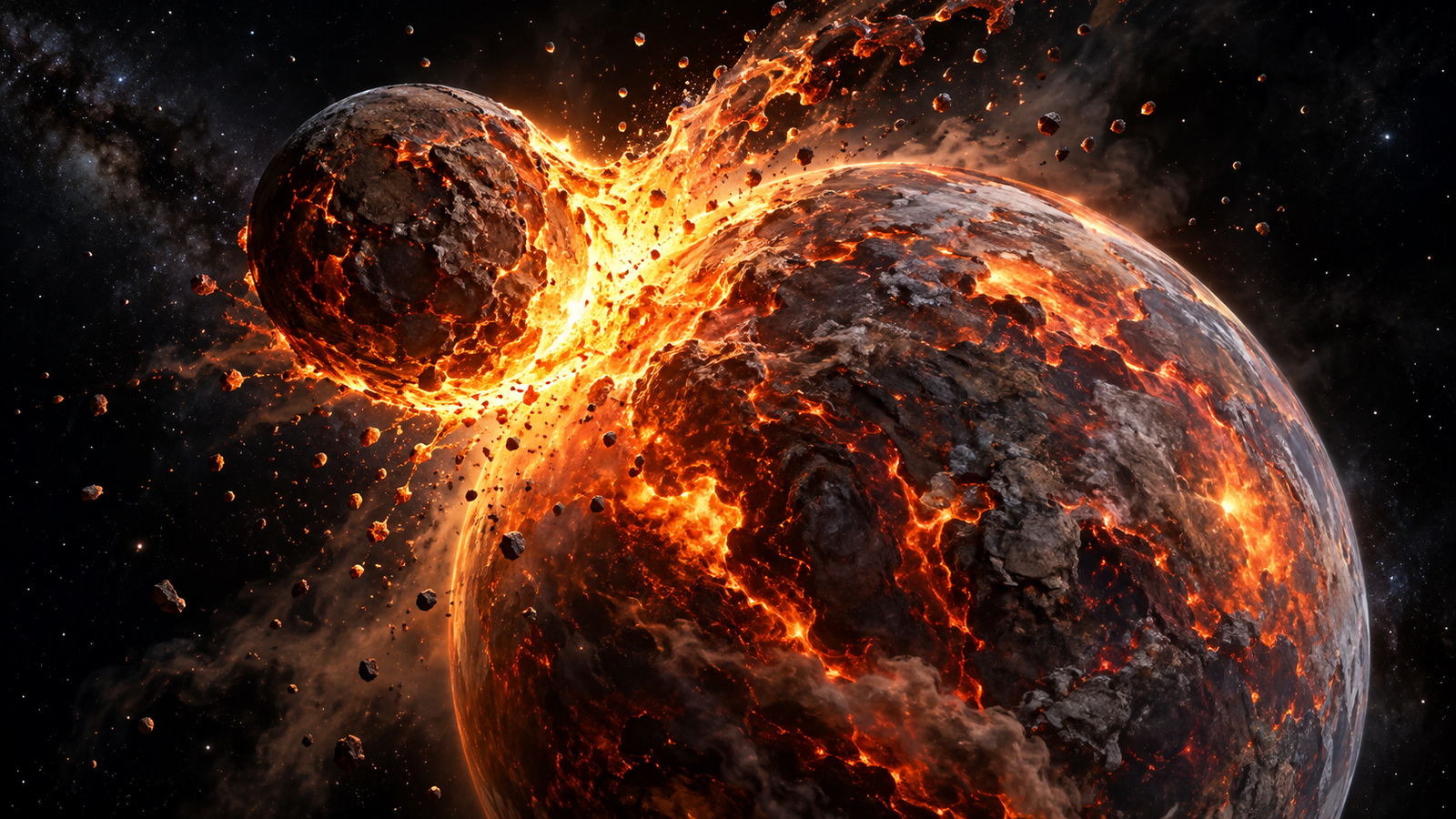
A Named Impactor, Rather Than a Planet We Have Seen
Theia sounds like a missing member of the Solar System whose orbit might still be recovered from an old map. In planetary science, the name instead refers to the hypothesized body involved in the collision that helped form the Moon. No telescope observed it, and no intact remnant has been identified as a surviving planet. Its role is inferred from the Earth-Moon system, lunar rocks, and calculations of early planetary growth. The giant-impact explanation is the leading framework for lunar origins, but that does not fix every detail of the impactor’s size, composition, or path. Asking whether Theia was real therefore opens a careful distinction: evidence can strongly favor a major collision while leaving the exact identity and history of the participating body uncertain. The scientific investigation concerns those surviving clues, not a complete recovered portrait.
Early Earth Grew in a Crowded Neighborhood
The terrestrial planets assembled from smaller bodies within the young Solar System. Dust and rocks contributed to progressively larger objects, and the final stages involved gravitational interactions among planetary embryos. Their orbits could become unstable as they perturbed one another. Collisions on planetary scales were therefore a natural part of growth rather than an extraordinary exception requiring a visitor from another star. A body capable of striking young Earth fits the broad environment predicted by models of planetary accretion.
These embryos were not modern planets simply placed into today’s otherwise finished arrangement. Their masses, orbits, thermal states, and neighbors evolved as material was acquired and bodies were removed or merged. Calling Theia a lost planet is understandable shorthand, but protoplanet or planetary embryo better communicates that unfinished context. The present-day Solar System is the outcome of that evolution. A plausible impactor need not leave an empty orbital slot or a recognizable belt of fragments that allows its entire original orbit to be reconstructed.
The distinction also changes how we imagine the impactor’s disappearance. Modern planet names encourage the image of a permanent set of neatly separated worlds, yet accretion calculations begin with many possible participants. Some merge, some are scattered, and others leave the region entirely. Theia would represent one participant whose encounter had an especially consequential outcome for Earth. Its importance comes from that outcome rather than a requirement that it resemble one of today’s eight planets in every respect. Recovering its history involves working backward through a changing population, where a body’s original ingredients, final mass, and last orbit may describe different stages of the same growth process.
The Moon Requires an Explanation That Joins Several Clues
The Moon is large relative to Earth, has a comparatively small metallic core, and shares important chemical relationships with Earth’s rocky material. Its orbit and Earth’s rotation also constrain the dynamics of any proposed origin. An impact can, under suitable conditions, merge much of the colliding bodies while placing silicate-rich material around the resulting Earth. That makes the framework attractive because it links several features within one physical event. It does not mean that any large collision would produce our Moon. The conditions and subsequent evolution still need to reproduce the observed combination.
Theia’s Familiar Size Is a Model Description
Popular accounts often describe Theia as Mars-sized. That description comes from a widely studied class of impact simulations in which an embryo of approximately that scale strikes a larger proto-Earth. It is not a dimension measured from a surviving disk or shadow. Models investigate different impactor masses because changing the mass ratio changes the distribution of material, energy, and angular momentum. The familiar comparison is useful for conveying scale, but it should not become a claim that scientists have independently weighed an extinct planet with precision.
Impact speed and angle matter alongside size. A near head-on collision and a glancing encounter distribute material differently, while initial rotation adds another important variable. Some interactions merge bodies directly; others involve an initial encounter followed by a later collision. Researchers examine those options because a physically plausible story must put material into a suitable orbit, not merely blast it away. Debris that escapes the system or falls promptly back onto Earth cannot by itself supply a lasting Moon.
The objects’ initial internal states matter too. An embryo with a metallic core and silicate mantle responds differently from a uniform sphere, and cold strong rock does not behave exactly like very hot or partly molten material. Numerical models represent those conditions with assumptions about material properties. Improving the representation can change which outcomes are possible. This is another reason to retain flexibility in Theia’s inferred biography: the reconstruction depends on understanding the collision physics as well as matching the surviving geological evidence.
Isotopes Help Investigators Compare the Ingredients
Isotopes are versions of the same element with different numbers of neutrons. Ratios between isotopes can preserve clues about source material and later processing, allowing researchers to compare lunar rocks, terrestrial rocks, and meteorites. Some isotope systems show Earth and the Moon to be strikingly similar. That resemblance creates a demanding constraint for a model in which the Moon contains much material from a separate body. The model must explain why the presumed impactor’s contribution did not produce a readily distinguishable overall signature.
The similarity can be approached in several ways. The colliding bodies may have started with similar ingredients, impact processes may have mixed material, or the part of the Moon sampled at the surface may not perfectly represent its complete interior. Each possibility requires tests rather than serving as an automatic solution. Different elements respond differently to melting, metal separation, and later addition of material. A convincing reconstruction therefore needs more than a matching ratio for one element. It must account for relationships among multiple chemical systems.
Origin Studies Narrow Possibilities Without Recovering an Orbit
Comparisons with meteorites help establish whether proposed ingredients resemble material associated with the inner or outer Solar System. A 2025 study summarized by the Max Planck Institute for Solar System Research used highly precise iron-isotope measurements alongside other chemical constraints to argue for an inner-Solar-System origin for Theia. Its inference concerns source material and likely formation environment. It does not amount to a direct observation of the embryo’s original location or a complete determination of the route it followed toward Earth.
This distinction is important when a headline says researchers have discovered where Theia came from. The scientific result may favor one family of ingredient mixtures over another under a stated model. Converting that preference into a precise starting orbit would require additional dynamical assumptions. Early bodies also moved and acquired material from more than one place. A compositional origin is consequently not identical to the object’s position at every moment of its life. The evidence narrows the reconstruction while leaving room for multiple histories.
Other isotope studies have emphasized differences among lunar rock types and the possible effects of later processing. Research on lunar oxygen isotopes, for example, investigated variations linked to sample lithology and their implications for source material. Different results should be compared at the level of samples, methods, and physical assumptions rather than treated as competing announcements that alternately reveal and erase Theia. The research challenge is to integrate those constraints into an account of the complete Earth-Moon system.
A Major Merger Would Remove the Independent Body
If a Moon-forming collision involved a major merger, the impactor’s material would be redistributed among Earth, orbiting debris, and material lost elsewhere. Its metallic core could contribute to Earth’s growing core, while silicate material followed different paths. Theia would cease to exist as a distinct planet even though its atoms persisted. That is why the absence of an intact body today is not an objection to the scenario. The relevant evidence concerns retained material and system properties, not finding a planet still traveling along its former orbit.
Earth’s Deep Mantle Offers a Proposed Remnant Test
Seismic studies reveal large regions near the base of Earth’s mantle where waves behave differently from their surroundings. A 2023 modeling study proposed that some material delivered by the Moon-forming impactor could survive and gather into structures resembling these large low-velocity provinces. The idea links a lunar-origin event with a separate terrestrial geophysical observation. It is scientifically interesting because it generates conditions to investigate, including differences in composition, density, and the survival of material over Earth’s history.
The measured anomalies are in the mantle near the core, rather than an intact planet inside the core itself. Their existence is observed through seismic behavior; their interpretation as Theia remnants is a hypothesis tested with simulations and other constraints. Alternative explanations for deep-mantle structures remain relevant. A model that produces similar-looking piles shows that a pathway is possible, but resemblance alone does not establish unique ancestry. Careful accounts separate the well-supported geophysical structures from the still debated origin assigned to them.
Different Impacts Leave Different Ingredients
The classic Mars-sized-impactor picture offers a clear starting point. A glancing encounter can send rocky material into orbit while much of the metal sinks into the growing Earth. That separation helps explain a satellite rich in silicates with a relatively small core. However, many such calculations place a large share of the impactor’s mantle in the orbiting debris. The resulting Moon would then inherit substantial Theia material, making the measured chemical resemblance between Earth and the Moon an important test of the impactor’s ingredients. A successful collision has to explain which material escaped into orbit as well as how much escaped.
Other models change the starting bodies instead of simply demanding extra mixing after the impact. In SwRI’s 2012 comparable-mass collision study, the target and impactor each contained roughly four to five Mars masses. Their similar sizes helped the surviving planet and its disk acquire similar mixtures. That addresses one chemical difficulty through the collision’s symmetry, but it also leaves a more rapidly rotating system that requires a credible later reduction in angular momentum. Such a result makes the model tradeoff concrete: improving the match between ingredients can create a new demand on the orbital history.
Theia’s inferred properties therefore depend partly on which route can satisfy the whole Earth-Moon record. Increasing the impactor’s mass changes not only a label in a diagram but also the gravity, collision energy, and balance of material retained by Earth or placed in orbit. Altering the angle changes how efficiently the encounter transfers spin and launches debris. Changing the starting temperature affects how the rocky bodies deform and how much material becomes vapor. Researchers can compare those predicted outcomes with isotope patterns, the Moon’s metallic core, and the system’s eventual motion. The useful question is which initial conditions explain these related measurements together, rather than which animation looks most like a familiar splash.
The Missing Planet Has an Inferred Identity
A substantial impactor is strongly motivated within the leading Moon-forming framework, while Theia remains a reconstructed participant. Isotope measurements constrain ingredients; seismic structures test proposed remnants; orbital calculations restrict viable encounters. These clues do not yet supply an exact mass, impact angle, or recovered original orbit. Theia need not survive intact for its role to be investigated, because a merger would redistribute its material among Earth and the forming Moon. Its scientific identity lies in that linked physical history, and a convincing reconstruction must account for both worlds rather than recover a presently hidden planet.


