The Familiar Surface Covers a Layered World
The Moon’s bright highlands and dark plains are visible from Earth, but they are only the outer expression of a much deeper structure. Beneath the loose dust and broken rock lies a crust, a thick rocky mantle, and a comparatively small metallic core. Those layers preserve a record of early melting, mineral separation, impacts, and long-term cooling. Scientists cannot simply drill through the Moon to inspect them. Instead, they combine returned rocks, earthquake-like vibrations, orbital gravity measurements, and the Moon’s response to external forces. Each method answers a different part of the puzzle, and the strongest interior models satisfy several constraints at once. Understanding the layers therefore means learning both what the Moon contains and how researchers infer hidden geology from evidence gathered at the surface, in orbit, and back on Earth.
Dust and Shattered Rock Sit Above the Main Crust
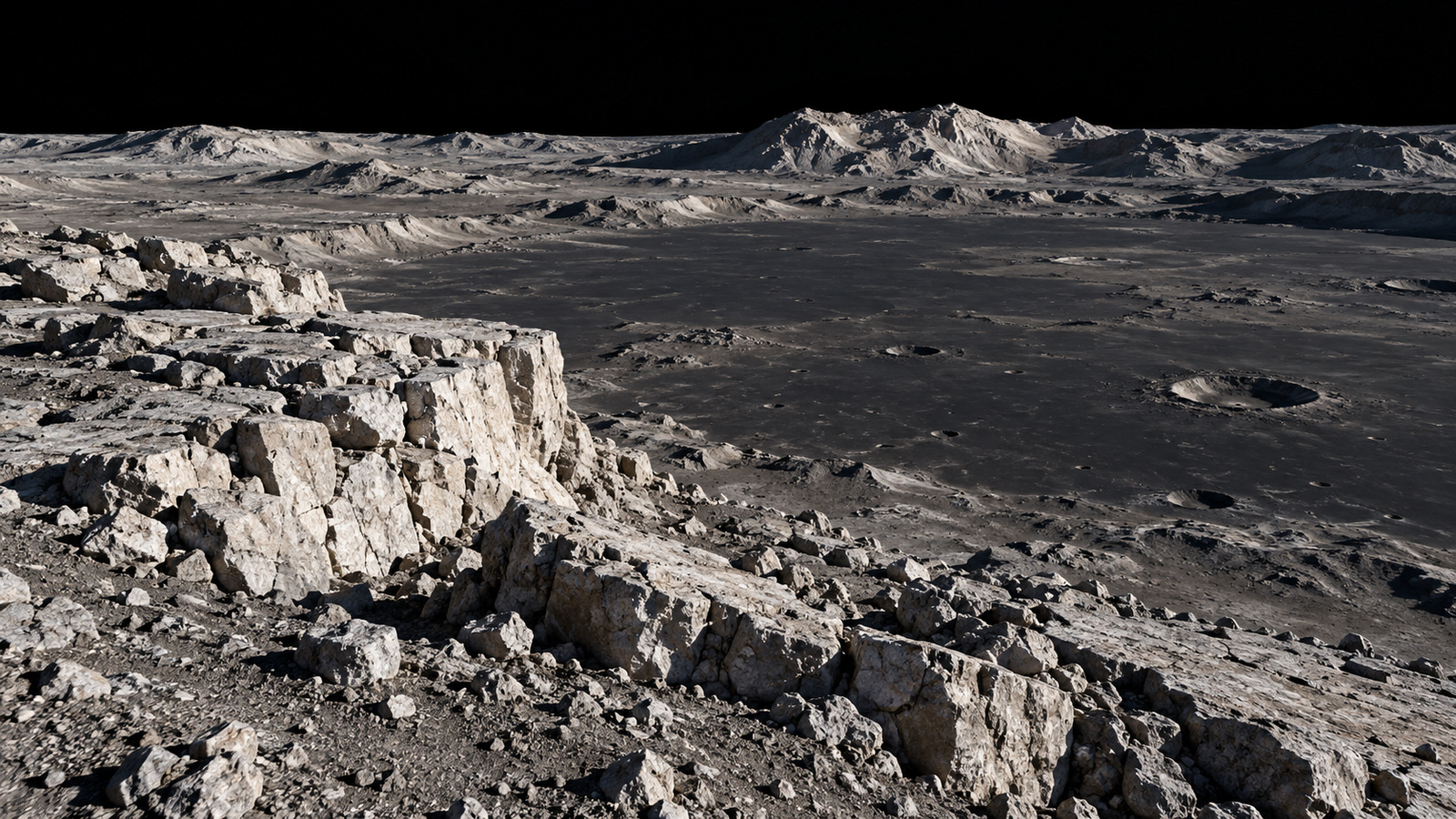
The loose material that blankets much of the Moon is called regolith. It includes mineral grains, rock fragments, glass, and particles altered by long exposure to space. Impacts constantly break and mix material, while tiny collisions can melt small amounts and bind fragments into glassy aggregates. This is not soil produced by vegetation, rain, and living organisms. Its origin reflects an airless surface exposed directly to incoming objects and energetic particles, making the lunar ground chemically and mechanically different from an ordinary terrestrial landscape.
Regolith thickness varies with location and geological history. Older terrain has generally experienced a longer period of bombardment, though local impacts can excavate, redistribute, or bury material. Beneath the loose blanket lies a heavily fractured region sometimes called megaregolith. That damaged rock belongs to the upper crust rather than constituting a separate planet-wide compositional layer equivalent to the mantle. Keeping these terms separate helps distinguish the material an astronaut walks on from the much thicker rocky shell studied through gravity and seismology.
A handful of surface material may contain several histories at once. It can mix locally derived grains with distant impact ejecta, volcanic fragments, and extraterrestrial material. Researchers therefore examine textures and chemical relationships before assigning a sample to a particular source. A rock found at a landing site need not have formed immediately beneath that site. This mixing complicates interior interpretation, but it also brings otherwise inaccessible material upward. The surface is a shuffled archive, and its scientific value depends on reconstructing how each piece entered it.
The Crust Is a Thin and Uneven Rocky Shell
The lunar crust represents the outermost main compositional layer, but it is not a shell of uniform thickness. The far side is generally thicker than the Earth-facing side, and large impact basins can locally thin the crust considerably. A GRAIL-based research study obtained a global average between about 34 and 43 kilometers under its model assumptions. That range should not be mistaken for the thickness beneath every crater. Density, porosity, topography, and seismic constraints all enter the estimate, so a simplified cutaway showing equal layers is educational shorthand rather than a literal map.
Bright Highlands and Dark Maria Record Different Processes
The bright highlands contain abundant anorthositic material rich in plagioclase feldspar. In the classic lunar magma-ocean account, comparatively buoyant plagioclase crystals gathered near the top of a cooling molten region and helped build an early crust. The mineral pattern provides evidence for differentiation: the Moon’s material was sorted instead of remaining a uniform mixture. Details of crystallization and later modification remain research topics, but the contrast between crustal and deeper mineral assemblages offers a physical explanation for the basic layered structure.
The dark maria are plains of basaltic volcanic rock, often filling older impact basins. Their lava came from partial melting within the Moon and subsequently reached the surface, where it cooled. A mare basalt is therefore a product of interior melting, transport, and crystallization rather than an untouched chunk of the entire mantle. Its chemistry provides clues to the source region and the conditions of melting. Reading that chemistry requires accounting for the steps between deep rock and an erupted lava flow.
The Mantle Holds Most of the Rocky Interior
Between the crust and metallic core, the mantle occupies the dominant part of the Moon’s interior. It is largely solid silicate rock, with olivine and pyroxene among the important minerals inferred from geophysical and petrological evidence. Calling it solid does not require it to be perfectly immobile over geological time. Rock can deform slowly under sustained stress at elevated temperature. Nor does a mostly solid mantle rule out localized or deep regions containing some melt; physical state can vary with depth and thermal conditions.
The distinction between mantle rock and erupted basalt matters. Partial melting extracts a liquid whose composition can differ from the source it leaves behind. As that melt rises and cools, additional processes alter the final rock. Scientists use laboratory experiments and mineral chemistry to work backward from samples, but the reconstruction is not a direct visual inspection of a mantle layer. Different source compositions and melting histories can sometimes produce overlapping results. Seismic and gravity information help limit which interpretations remain physically reasonable.
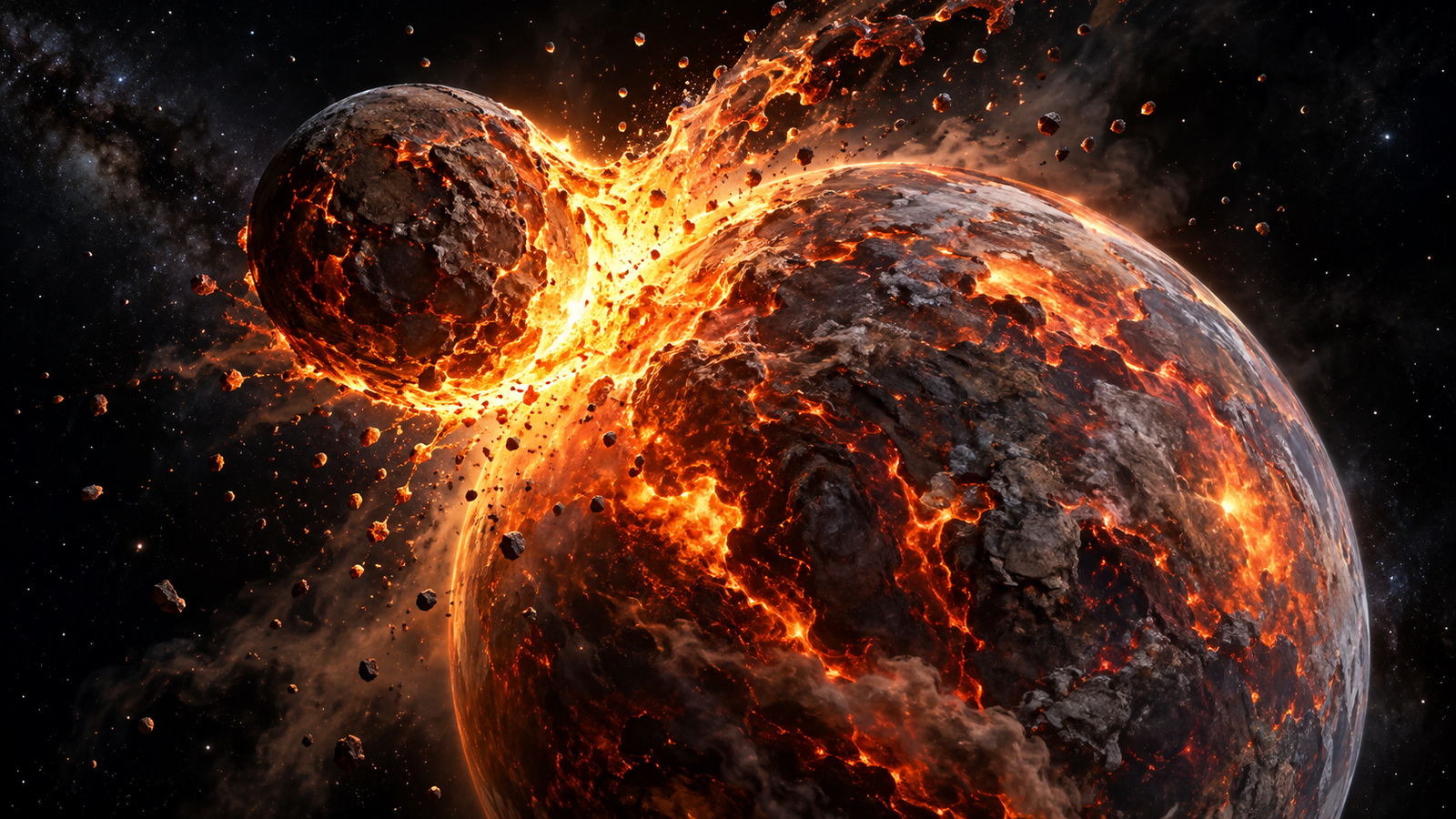
The mantle may also retain structure created during early crystallization. Layers that formed late in a magma ocean could have been denser than material below, making the arrangement gravitationally unstable. An overturn would redistribute those layers and change where heat-producing elements or iron-rich material were concentrated. This idea concerns long-term interior evolution, not a present-day ocean of freely circulating lava beneath the dust. Understanding such redistribution is important because present structure may preserve an altered record rather than the Moon’s initial order of mineral formation.
The Core Is Small, Metallic, and Internally Divided
The lunar metallic core occupies a much smaller fraction of the radius than Earth’s core does. Modern models support a solid iron-rich inner portion surrounded by a fluid outer portion, with lighter elements influencing composition and melting behavior. A 2023 study summarized by CNRS combined geophysical constraints to support a solid inner core approximately 500 kilometers in diameter. This refers to the inner part alone, so it must not be quoted as the diameter of the complete metallic core.
The core’s state helps connect present structure with the Moon’s magnetic history. Ancient rocks can retain magnetization acquired when a magnetic field existed, suggesting processes that differ from the weak, patchy magnetism measured around the Moon today. A conductive fluid core can participate in a dynamo if the necessary motion and energy sources are present. However, establishing that a fluid layer exists does not automatically establish a strong active dynamo now. Thermal evolution and the causes of fluid motion also need to be investigated.
Moonquakes Send Probes Through the Interior
Apollo astronauts deployed seismometers that recorded vibrations from moonquakes and impacts, including deliberate spacecraft impacts with useful timing information. Waves travel at different speeds through different materials and may reflect or refract at boundaries. Analysts use arrivals and patterns to infer the structures the waves encountered. The method resembles terrestrial seismology, but the limited lunar network and the Moon’s strongly scattering upper layers create distinct difficulties. Measurements obtained decades ago continue to support new results as processing methods improve and other constraints become available.
Gravity Maps Reveal Density Differences Without Drilling
NASA’s GRAIL mission flew two spacecraft in tandem and measured tiny changes in their separation. The differences reflected variations in the Moon’s gravitational field as the pair passed over surface features and subsurface mass distributions. Combining those measurements with topography helps researchers separate the pull of a visible mountain or basin from a hidden density contrast. The result is not a photographic image beneath the ground. It is a physical field that constrains how matter can be arranged inside the Moon.
Some prominent positive gravity anomalies are called mass concentrations, or mascons, and are associated with major basins. Their interpretation involves the impact’s effects, the mantle and crust’s response, and later volcanic filling in relevant cases. Simply picturing a lump of metal beneath every anomaly misses that complexity. GRAIL data make it possible to investigate basin architecture and crustal damage across both hemispheres. The mission’s twin-spacecraft gravity method is especially valuable where no seismometer or returned sample supplies a local measurement.
Gravity inversion is not unique: more than one subsurface arrangement can sometimes produce similar measurements. Researchers add independent information about rock density, seismic boundaries, and surface composition to constrain the possibilities. This is why a new map can change estimated crustal thickness without making earlier measurements meaningless. The observations remain valuable while the joint physical interpretation improves. Scientific confidence grows when distinct methods agree, and honest uncertainty identifies which quantities depend most strongly on assumptions rather than direct measurement.
Rotation and Laser Ranging Add Global Constraints
Laser ranging measures the travel time of light sent to reflectors on the Moon and returned to Earth. Over many observations, researchers track distance changes and aspects of lunar motion with great precision. The Moon’s rotation and response to gravitational tides carry information about its interior because fluid and solid layers behave differently. These measurements complement seismic and gravity results rather than replace them. A structure that fits local wave arrivals but fails the global rotational constraints would need reconsideration.
The moment of inertia gives another broad clue by describing how mass is distributed relative to a body’s rotation. Concentrating more material toward the center changes that quantity compared with a uniform sphere. Researchers combine it with the total mass and other measurements to investigate differentiation and core size. This cannot reveal every mineral layer separately, but it prevents some incompatible interior arrangements. Global constraints are valuable precisely because they examine the whole Moon from a perspective different from that of individual rocks or individual moonquake paths.
A Cooling Interior Still Leaves Active Signals
The Moon is much less geologically vigorous than Earth, yet quiet appearance should not be confused with complete inactivity. Moonquakes, tidal deformation, thermal effects, and evidence of contraction reveal continuing responses to forces and cooling. A layered model helps explain where those processes operate and what their signatures mean. Shallow stress events and deep tidally influenced events are different phenomena, so grouping them under one familiar earthquake analogy can conceal useful information about the lunar environment.
Future measurements are most valuable when they expand the kinds and locations of evidence. A wider seismic network, carefully selected samples, and improved global geophysical observations can reduce uncertainties that a small near-side network cannot resolve by itself. Samples from unusual basins may expose deeper or otherwise rare material, though their origin still requires careful assessment. Better coverage would help distinguish regional variations from truly global layers. It would also test whether proposed deep structures match the Moon’s behavior across different independent instruments.
The useful picture is therefore a differentiated world with a thin, battered crust, a thick predominantly solid silicate mantle, and a small metallic core containing distinct physical regions. Dust is the surface blanket, while maria and highlands reveal parts of the geological history that shaped the outer shell. Exact boundaries and compositions remain subjects for refinement. Holding the basic architecture together with the methods that support it gives the Moon’s layers more meaning than a colored cutaway: they become an evidence-based account of how a rocky world formed, cooled, and continues to respond today.