A Brief Window Built the First Light Nuclei
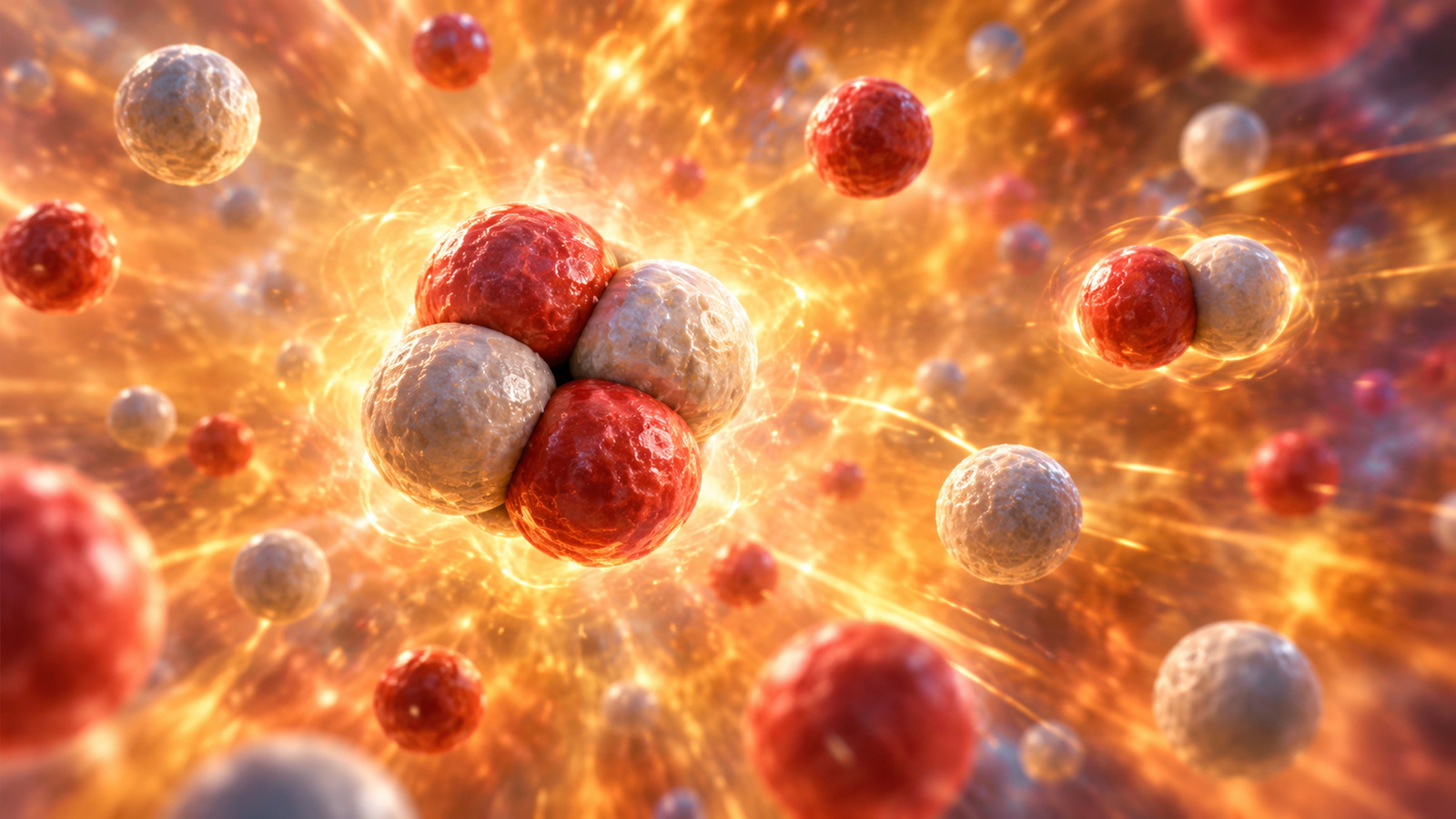
Three minutes sounds like a short interval, but the young universe changed rapidly enough for those minutes to leave a measurable chemical legacy. Protons and neutrons entered nuclear reactions as expansion lowered the temperature and diluted their surroundings. A proton and neutron could join into deuterium, opening reaction routes toward helium, while most protons remained available to become ordinary hydrogen. These events concerned atomic nuclei, not complete neutral atoms, stars, or planets. The familiar title is also approximate: primordial nucleosynthesis unfolded over several minutes and continued beyond a single three-minute alarm. Its importance comes from a temporary set of conditions in which reactions could occur faster than the universe’s changing environment shut them down. Understanding that window connects nuclear physics measured in laboratories with an early cosmic history reconstructed from surviving light-element abundances.
The Clock Refers to an Expanding Thermal History
The standard thermal timeline gives the title a numerical scale. Around an age of one second, the temperature was of order one megaelectronvolt, equivalent to roughly ten billion kelvin, and weak reactions were falling behind expansion. By a few minutes, temperatures approached a tenth of a megaelectronvolt, around a billion kelvin, allowing enough deuterium to survive for rapid light-nucleus assembly. These are approximate landmarks in the Particle Data Group’s physical account, not sharp switches occurring everywhere at a predetermined instant. Radiation dominated the expansion, so cooling and dilution changed the opportunities for reactions throughout this brief period.
The first-three-minutes phrase emphasizes the interval in which the main nuclear mixture was being established. More detailed histories follow the slowing reaction network into the following minutes; a review organized around the first twenty minutes describes the full early synthesis period. This longer window does not contradict the importance of the first few minutes. Reactions involving different nuclei freeze out at different rates as temperature and density fall. A useful timeline therefore distinguishes the preparation near one second, the opening of efficient assembly after a few minutes, and the later decline in processing rather than treating 180 seconds as a universal alarm.
Protons and Neutrons Were the Available Building Blocks
By the time primordial nucleosynthesis becomes the focus, protons and neutrons already exist as bound states of quarks. Protons carry positive electric charge, while neutrons have no net electric charge. They can join through the strong nuclear interaction under suitable conditions, but that possibility alone does not guarantee a lasting nucleus. Energetic photons and collisions can break fragile combinations apart. The early environment therefore determines not only whether assembly happens, but whether its products survive long enough to participate in subsequent reactions.
Electrons, positrons, neutrinos, and radiation also contribute to the surroundings. Their interactions affect the balance between neutrons and protons before widespread nuclear assembly. An account limited to collisions between two kinds of nucleon would miss this preparation stage. The ratio of available building blocks matters because most eventual helium-4 uses two protons and two neutrons. A universe with a different surviving neutron proportion would produce a different helium abundance even if the later reaction network were otherwise similar.
A simple route shows what nuclear assembly means. One proton captures a neutron to make deuterium and releases a photon. Deuterium can then capture another proton, producing helium-3 and another photon; helium-3 can react with deuterium to form helium-4 while releasing a proton. This is one pathway through a larger network, not a claim that every helium nucleus followed the same sequence. Counting the protons and neutrons on both sides keeps the ingredients clear. Most ordinary hydrogen nuclei instead remain single protons outside heavier nuclei. Electrons join nuclei into lasting neutral atoms much later, so the first-minutes process should not be pictured as complete atoms colliding in a chemical reaction.
Weak Interactions Set the Initial Balance
At sufficiently high temperatures, weak interactions continually transform neutrons and protons into one another through reactions involving leptons. Their relative abundance depends on the thermal conditions and the difference between neutron and proton mass. As expansion proceeds, the reaction rates eventually become too slow to maintain the earlier equilibrium efficiently. Researchers describe this as freeze-out, although interactions do not all vanish instantaneously. The term identifies a change in the competition between the reaction rate and the expansion rate.
Free Neutrons Face a Separate Survival Problem
An unbound neutron is unstable and can decay into a proton, electron, and antineutrino. The time spent waiting for efficient nuclear assembly therefore reduces the available free-neutron population. Once neutrons are bound within stable nuclei such as helium-4, their survival is governed by the nucleus’s physical stability rather than the free-neutron decay process. This creates a race between decay and incorporation. The helium yield remembers how many neutrons were available when the reactions could finally proceed effectively.
Laboratory measurements of the neutron lifetime enter the calculation, alongside reaction rates and cosmological conditions. Better nuclear data can therefore refine predictions about an epoch that no instrument observes directly. The connection does not eliminate every uncertainty; laboratory methods and astrophysical abundance measurements each have their own systematic issues. It does demonstrate why the early-minutes account is quantitatively testable. A change in an input must produce corresponding changes in the predicted mixture, which can then be compared with independent cosmic measurements.
Deuterium Must Survive Before the Chain Can Advance
A proton and neutron can bind into deuterium, the heavy isotope of hydrogen. Its nucleus supplies a crucial first step toward larger light nuclei. Initially, however, energetic photons break newly formed deuterium apart efficiently. Even if the average photon energy is falling, the energetic part of the distribution matters because photons greatly outnumber ordinary-matter particles. Enough destructive photons remain to hinder accumulation. This delay is known as the deuterium bottleneck and is central to understanding when substantial helium assembly begins.
Eventually the environment cools enough for deuterium to survive in useful quantities. Once that gateway opens, additional reactions can process deuterium into other light nuclei and ultimately substantial helium-4. The transition is not simply the first moment two nucleons touch. It is the point when formation and survival together allow the network to advance efficiently. The Particle Data Group’s nucleosynthesis review provides the detailed physical framework for these calculations. The bottleneck illustrates how a fragile intermediate can control a much larger chemical outcome.
Expansion keeps changing the conditions even after the gateway opens. Reactions need particles to encounter one another, so decreasing density eventually restricts further processing. The final abundance of deuterium reflects the fraction left unprocessed as the network slows. This makes it a sensitive diagnostic of ordinary-matter density. The amount remaining is not evidence that the universe failed to finish a predetermined task. It is the physical result of reaction opportunities running out in a rapidly evolving environment.
Helium-4 Collects Much of the Surviving Neutron Supply
Helium-4 contains two protons and two neutrons and is strongly bound compared with the small intermediates feeding its production. Under standard primordial conditions, it becomes the dominant assembled nucleus beyond ordinary hydrogen. A useful broad result is that roughly one quarter of primordial ordinary-matter mass resides in helium-4, with most of the remainder in hydrogen. Mass fraction should not be confused with atom or nucleus count. Because a helium nucleus is much heavier than a single proton, the numerical proportion of helium nuclei is smaller than its share of total mass.
The result depends on the neutron supply and the conditions governing assembly, so it is not an arbitrary recipe assigned after the fact. Light-nucleus abundances respond to the expansion rate, baryon density, and relevant nuclear inputs. Researchers calculate their expected relationships and compare them with observations. A model that successfully reproduces the general helium abundance has passed one important test, but the full test also includes other nuclei and uncertainty estimates. A single approximate percentage cannot represent all the information in primordial chemistry.
The Reaction Network Also Leaves Minor Products
Deuterium, helium-3, and small mass-seven contributions are part of the primordial reaction network. Tritium and beryllium-7 can participate as intermediates or precursors, with later decay affecting how the surviving products are described. These details matter when researchers calculate lithium abundances rather than simply draw a list of final elements. An isotope’s production pathway can include stages in which another nucleus carried the same nucleon count. The chemical inventory must therefore be followed through both reactions and subsequent nuclear transformations.
The Universe Did Not Build the Whole Periodic Table
Short duration, falling density, and gaps in the stability of small nuclei restrict efficient production of heavier elements. In particular, the absence of stable nuclei at mass numbers five and eight makes a simple one-step-at-a-time construction route ineffective. Stars later overcome parts of that problem through sustained conditions and processes such as the triple-alpha reaction. The early universe does not supply the same long-lived dense furnace. Nuclear possibility and sufficient reaction opportunity are separate requirements, and both must be satisfied to create a substantial abundance.
Carbon, oxygen, and many other ingredients of planets and living systems thus belong mainly to later enrichment history. Stellar evolution, explosive events, and compact-object interactions contribute different products. This does not reduce the importance of the primordial interval. Hydrogen and helium form the main raw material from which subsequent luminous generations develop. The first minutes established a starting composition that later processes modified selectively, rather than a completed collection of all the atoms found in a present-day kitchen or human body.
The distinction also keeps stellar fusion and primordial fusion from being treated as identical settings. Both involve nuclear reactions, but their densities, timescales, temperature histories, and available ingredients differ. A star can maintain conditions for immense periods through the relationship between pressure, gravity, and energy production. The early universe continuously expands and changes globally. Applying the intuition of a steady stellar core without accounting for that difference would predict the wrong opportunities for assembling and retaining nuclei.
Abundance Measurements Test a Past We Cannot Watch
Astronomers seek environments whose composition has undergone relatively little later stellar processing. Deuterium absorption in suitably selected distant gas can constrain its abundance, while helium estimates require careful interpretation of ionized regions and their chemical history. Lithium measurements in old metal-poor stars supply another test, though stellar processes complicate the reconstruction of an original amount. The aim is not to assume every observed abundance is primordial. It is to understand and correct the intervening history well enough to compare measurements with early-universe predictions.
The ordinary-matter density inferred from microwave-background patterns offers an especially valuable independent comparison. The CMB concerns conditions far later than nuclear assembly, yet a consistent model should connect both epochs using the same physical inventory. NASA’s WMAP cosmology overview explains the role of nucleosynthesis alongside radiation measurements. Agreement is meaningful because the methods depend on different observations and different physical processes. Disagreement can reveal observational errors, incomplete processing models, or physics needing further investigation.
Laboratory Rates Keep the Prediction Quantitative
Nuclear experiments measure reaction probabilities across relevant energies rather than assign the network a guessed efficiency. Those measurements enter calculations with uncertainties that can alter the predicted isotope yields. Improving a particularly influential rate can sharpen the comparison without changing the broad hot-universe framework. Researchers therefore need both better abundance observations and better laboratory inputs, because either side can limit the strength of a cosmological test.
The Lithium Problem Keeps the Tests Honest
Primordial lithium inferred from observations has long been lower than the amount expected from standard calculations using independently constrained ordinary-matter density. This is called the cosmological lithium problem. Researchers investigate stellar depletion, measurement effects, nuclear inputs, and possible additional physics. The discrepancy should be stated clearly without claiming that one proposed solution is established. It shows that agreement is not uniform across every isotope and that a successful framework can still contain a specific unresolved quantitative tension.
The title’s three minutes therefore represent a scientifically productive window rather than a perfectly settled story at every decimal place. Much of the light-element evidence supports the hot early-universe account, while individual measurements and reactions remain open to refinement. The nuclear record preserves information that later observations can interrogate. That makes this period unusually accessible to physical inference even though photons from the same minutes did not travel freely to our telescopes as an ordinary photographic view.
The lasting lesson is a competition among cooling, collision rates, nuclear stability, and neutron survival. Those processes produced predominantly hydrogen and helium, smaller light-isotope amounts, and a chemical starting point for later stars. Complete neutral atoms came much later, and the broader periodic table required additional cosmic history. Keeping the processes and timescales distinct allows a short title to carry a precise meaning: the early minutes established a measurable nuclear legacy, not an instant assembly of the familiar universe in miniature.