A Hot, Dense Past Became the Universe We See Today
The Big Bang model follows a universe that expanded and cooled over approximately 13.8 billion years. In its early seconds, matter existed in an intensely hot particle environment; in the first minutes, reactions assembled light nuclei. About 380,000 years later, electrons could remain bound to nuclei and ancient radiation began traveling much more freely. Stars and galaxies developed later as gravity gathered matter into structures. These stages describe changing conditions throughout space, rather than debris flying from one central explosion into an empty room. Astronomers reconstruct the sequence through expansion measurements, relic microwave radiation and primordial light-element abundances. The well-tested hot-universe history does not yet supply a complete account of the earliest possible instant, but it gives a beginner a clear timeline to connect with the evidence visible today.
Expansion Lets Us Reconstruct a Denser Past
On sufficiently large scales, galaxies outside bound local structures exhibit a relationship between distance and cosmological redshift. Their light reaches us stretched to longer wavelengths, with the interpretation depending on the expanding-spacetime description. Nearby motion complicates individual cases, so not every galaxy simply recedes according to one rule. The broad pattern is nonetheless essential evidence for cosmic evolution. If the scale of separations was smaller earlier, the average distribution of matter was more concentrated. This reasoning is about the universe’s large-scale history, not about every star or atom physically swelling.
Following expansion backward also changes the radiation environment. Radiation wavelengths were shorter in the past, corresponding to a hotter thermal background under the model. Matter and radiation interacted in conditions very different from today’s largely transparent intergalactic space. The early universe was not merely today’s galaxies crowded into a smaller volume. Many familiar structures had not formed, and the relevant ingredients behaved as particles, nuclei, and plasma. Reconstructing the past therefore requires physical laws describing changing states, rather than simply reversing a movie of modern galaxies.
The Model Is Supported by Several Independent Clues
Expansion is one major clue, but a persuasive cosmological account needs more than one observation. A hot early universe predicts a residual bath of radiation that cools as space expands. It also provides conditions in which nuclear reactions produce characteristic light-element abundances. These are different physical processes, allowing one history to face independent tests. Agreement matters because a model built only to fit redshifts would have less explanatory power than one also matching radiation and nuclear chemistry.
The cosmic microwave background, usually abbreviated CMB, is the relic radiation measured across the sky. Its spectrum is remarkably close to that of a thermal blackbody, now at about 2.7 kelvin. Tiny deviations in temperature across directions carry additional information about earlier density patterns and the evolution of the coupled matter-radiation system. The Planck mission’s overview describes how detailed measurements connect this radiation with cosmological parameters. The CMB is a measured signal, while the physical reconstruction comes from interpreting that signal through tested models.
Hydrogen, helium, and traces of other light nuclei supply another line of evidence. Their primordial proportions can be calculated from an early hot expanding environment, using nuclear reaction rates and the density of ordinary matter. Observations must then account for changes introduced by later stellar processing. Agreement between independent methods is especially informative because the chemical measurements are not simply another picture of the microwave sky. Together, the clues establish that a hot dense phase is far more than an evocative story about how things might have started.
Hot Does Not Mean a Fire Burning in Air
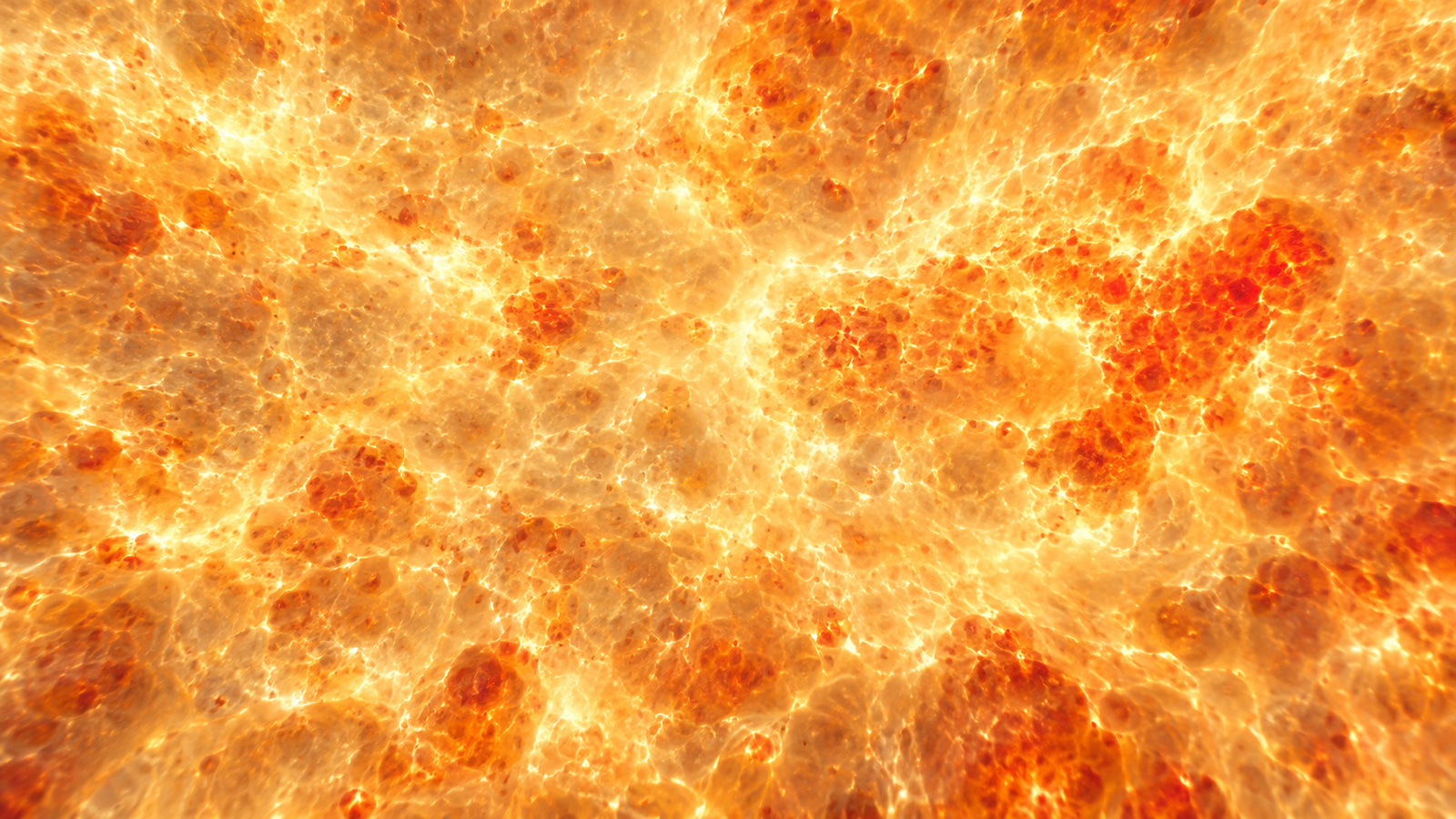
Temperature describes the distribution of particle motion and radiation energy under relevant physical conditions. The early universe’s heat did not require oxygen, fuel, or flames like a terrestrial fire. Dense matter and energetic radiation interacted, with the allowed particle populations changing as the environment cooled. Describing the state as a fireball can communicate intensity, but the comparison is limited. There was no surrounding atmosphere through which a burning sphere needed to travel, and a bright artist illustration should not be interpreted as an external camera view of the whole cosmos.
Nuclei Formed Long Before Familiar Neutral Atoms
During the early minutes, nuclear reactions assembled much of the primordial helium and small amounts of other light nuclei. A nucleus is the compact central part of an atom, containing protons and usually neutrons. It is not yet a neutral atom with bound electrons. At those early temperatures, ordinary matter remained highly ionized, and photons interacted frequently with charged particles. Distinguishing nuclear assembly from atomic assembly prevents a compressed timeline from making chemistry appear to happen all at once.
Hundreds of thousands of years later, cooling allowed electrons to remain bound to nuclei much more effectively. This stage is conventionally called recombination, even though the name can suggest a previous generation of ordinary atoms. As the free-electron population dropped, the radiation could travel more freely. The CMB we measure largely carries information from this transition, around 380,000 years into the standard history. It is consequently evidence about a later early-universe stage, not a direct photograph of the first instant.
Transparency Gave Ancient Light a Long Journey
Before neutralization, repeated scattering prevented photons from traveling freely across large distances. Afterward, the universe became substantially more transparent, allowing radiation to preserve information over a cosmological journey. Expansion stretched that light from its earlier wavelengths into the microwave range observed today. We receive photons from directions corresponding to distant regions at the time they last scattered. That does not mean a physical shell of light encloses the entire universe. The observed sky organizes the paths that happen to end at our instruments.
The slight variations in that sky matter as much as its broad uniformity. They encode the behavior of matter and radiation in the early universe and provide clues about the initial irregularities from which later structures developed. Extracting those clues requires separating foreground emissions, instrument effects, and model assumptions. A colored all-sky image often exaggerates extremely small differences so humans can see them. Its vivid colors represent a measured temperature pattern, rather than ordinary visible colors of the universe at that time.
Different observations constrain different parts of the history. A spectrum tests the thermal nature of the radiation, while angular patterns constrain physical conditions and geometry. Polarization contributes still more information about scattering and later evolution. No individual image contains a complete origin story. The strength comes from the way multiple measured properties can be described together within one quantitative framework. That is a useful model of scientific understanding: a coherent reconstruction constrained by complementary evidence, rather than one perfectly preserved snapshot.
Stars and Galaxies Needed Additional Time
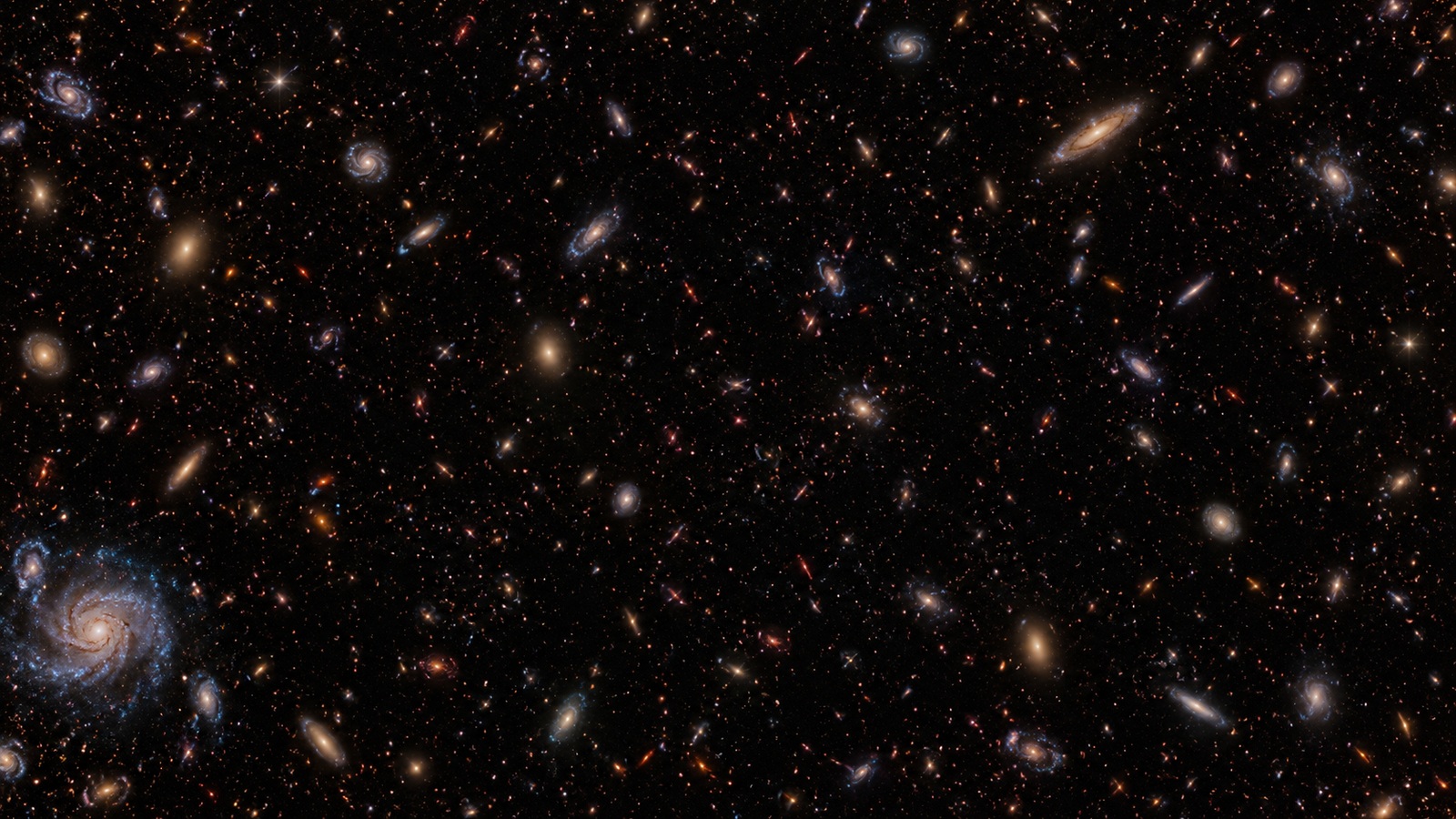
The early universe did not contain the mature stars and galaxies visible in modern deep-field images. Small density irregularities grew under gravity, while gas cooling and other physical processes helped material gather into the first luminous structures. Dark matter contributes to the gravitational framework in the standard model, but ordinary gas has its own thermal behavior. The formation of a star therefore involved more than expansion simply depositing ready-made objects at different positions. It required local collapse within the evolving large-scale environment.
The first generations of stars also changed the ingredients available for later worlds. Stellar reactions and explosive events produced and distributed many elements heavier than those made during primordial nucleosynthesis. Carbon, oxygen, and the material needed for rocky planets thus belong to an extended history of enrichment. The Big Bang did not directly manufacture complete Earth-like planets in the first minutes. It established early conditions and primordial material from which later processes built a much more varied cosmic environment.
The Common Expansion Picture Has Useful Limits
An analogy such as dots on an expanding surface can demonstrate increasing separation without identifying one privileged dot as the physical center. It can also mislead if its surrounding room is treated as a required feature of the real cosmos. Standard cosmology describes distances within space without needing an observable external container. Analogies should therefore be used for the relationships they illustrate, not as complete models of every feature. The same caution applies to a balloon’s rubber material, thickness, and inside volume, none of which must have a literal cosmic counterpart.
The Earliest Extrapolation Is Less Secure
Running classical equations backward can lead toward a singular state in which the description becomes inadequate. That mathematical limit does not constitute direct observation of a tiny object that existed inside empty space. It signals that the theory used for the extrapolation cannot simply be trusted without qualification at every earlier moment. A complete account of extreme conditions may require physics joining gravity with quantum behavior. Established hot-universe evidence should not be made to depend on claiming that this unsolved boundary has already been fully explained.
Inflation is a proposed very early period of accelerated expansion that offers explanations for several features of the observable universe. Particular inflationary models make predictions that can be compared with observations, but their detailed mechanism is not settled. Other proposals explore still earlier conditions or alternatives. Those discussions occupy a different level of certainty from the observed microwave background or light-element measurements. A beginner can recognize that difference without needing to decide every advanced theoretical dispute before understanding the central hot Big Bang account.
The words before the Big Bang also depend on what the speaker calls the Big Bang. If the phrase means the well-established hot dense phase, some theoretical accounts discuss an earlier stage. If it means a proposed ultimate beginning of time, asking before invokes a different conceptual problem. Neither usage should be silently substituted for the other. Being explicit about the definition keeps a discussion of tested cosmic evolution from becoming an unsupported declaration about whether time, space, or anything else existed beforehand.
The Age Is an Inference from a Consistent History
The familiar age of approximately 13.8 billion years is obtained within a cosmological model constrained by observations, rather than read from a clock left at the beginning. Measurements of expansion, radiation patterns, and other quantities help determine the model’s history. The Planck science summary places its age estimate within that analysis. Uncertainties and tensions among measurements remain scientifically important. They are opportunities to test the reconstruction, not reasons to treat all evidence for an early hot phase as equally unsettled.
Different kinds of distance are also involved when discussing ancient objects. The light-travel time is not automatically the same as their present-day separation, because expansion changes distances during the journey. This is why a finite cosmic age does not restrict the observable universe’s present radius to the age multiplied by light speed alone. The distinction need not dominate a first introduction, but it prevents familiar numbers from seeming contradictory. Cosmic history and distance definitions have to be interpreted together.
Follow the Main Landmarks Into the Present
Put the main landmarks in order. At roughly one second, the universe was still a hot mixture of particles and radiation. Over the early minutes, nuclear reactions established much of the primordial helium inventory; this did not yet make neutral atoms. Around 380,000 years, neutralization reduced scattering and released the radiation now observed as the microwave background. The NASA overview of cosmic history connects these stages to the later growth of stars and galaxies. Each landmark has a different physical cause, so the timeline is more informative than imagining one flash that immediately produced everything familiar.
The later chapters connect that early chemistry to ordinary surroundings. Hydrogen-rich gas gathered under gravity, stars fused additional elements, and stellar deaths returned enriched material to their environments. New generations could then form with ingredients for rocky planets and complex chemistry. The atoms in a rock therefore combine an early supply of light nuclei with a much later history of stellar processing. A telescope studies pieces of this sequence at different lookback times, while the microwave sky records an earlier stage than any ordinary galaxy image. The evidence forms a chronology because these records fit a shared evolving history.
The Big Bang is therefore best understood as a successful account of an early hot dense universe and its subsequent evolution, supported by expansion, relic radiation, and primordial chemistry. It is not a complete answer to every ultimate-origin question. That combination of success and limits is ordinary scientific practice. It allows beginners to understand the broad history confidently while leaving the unsolved earliest stages open to further measurement and theory, rather than treating uncertainty at the boundary as uncertainty about every stage that followed.