The Imagined Cosmic Wall Is the First Thing to Question
Picture traveling outward until the galaxies disappear and a final wall announces the end of everything. The image feels natural because rooms, countries, and planets have boundaries. Standard cosmological models do not require space to end that way. They describe a universe without a physical outer edge, even though our observations cover only a limited region. The title therefore expresses a feature of the usual models, rather than proof that astronomers have inspected every possible location. Understanding the distinction requires asking what a boundary would mean physically, why a viewing limit is different, and how space can be described without putting it inside a larger container. Once those questions are separated, the absence of an edge becomes less a strange exception and more a consequence of using the right kind of spatial description.
An Edge Would Be More Than a Dark Place
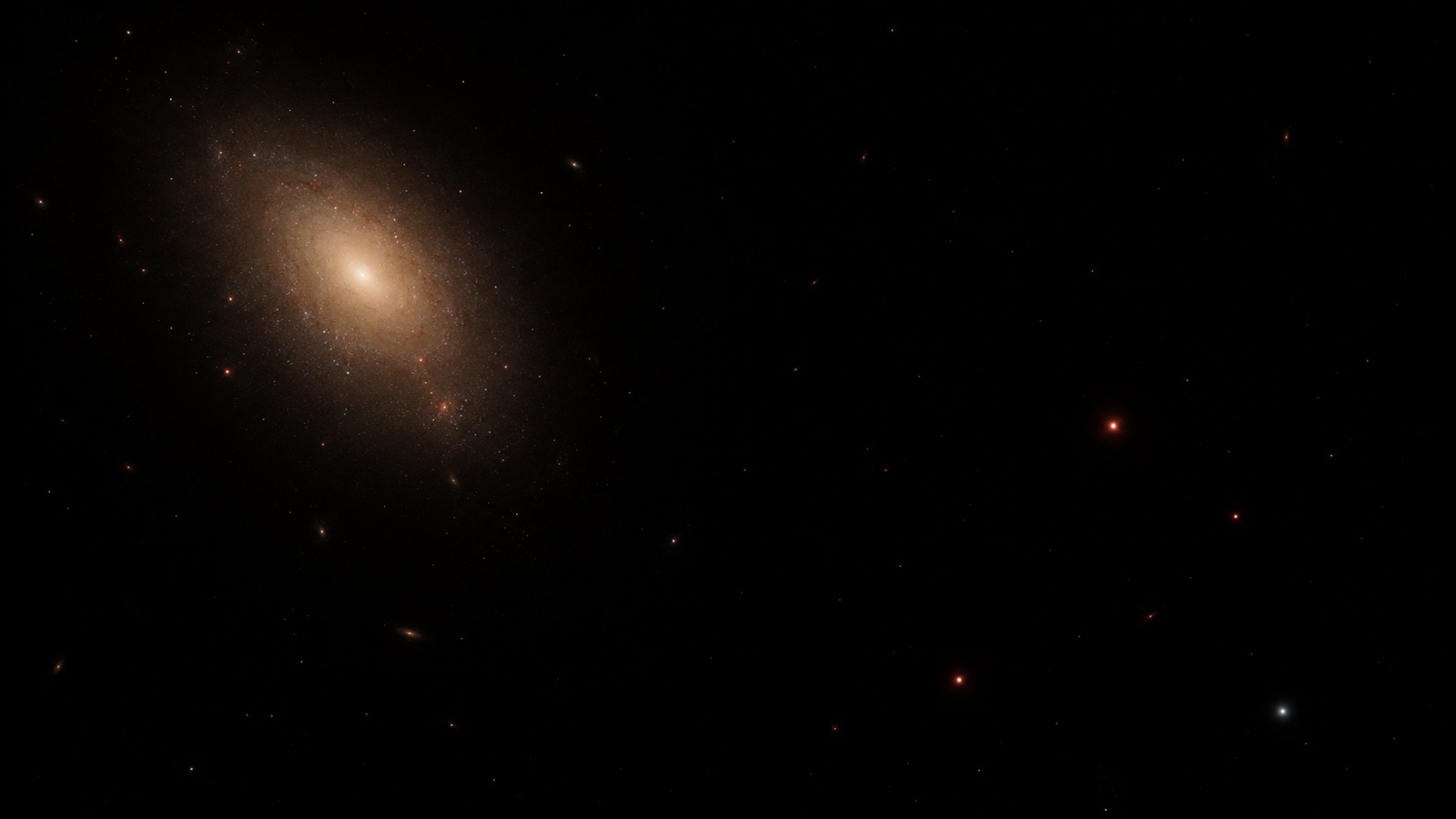
A real boundary of space would require a physical or geometrical distinction between locations that exist and whatever lies beyond them. A dark region is insufficient because darkness can mean that little light reaches us, not that there is no location there. The space between galaxies is also not an edge: it contains physical fields and material, although much of it is extremely tenuous. An empty-looking telescope image cannot establish that the region itself has stopped existing. Observation concerns received signals, while a boundary concerns the structure of space.
A wall would introduce its own questions. What is it made of, how does it interact with matter, and what sets its position? If it is ordinary material occupying space, it is a structure within the universe rather than necessarily the place where space ends. If it is a proposed geometrical boundary, a theory needs to specify how particles, light, and physical laws behave there. Calling a boundary the edge of everything does not supply those conditions. A useful hypothesis must state a testable difference from a universe that continues.
In an unbounded spatial model, every ordinary location has a surrounding neighborhood in which distances, motion and physical fields can be described. There is no final address where those local relationships stop solely because a traveler has moved outward. Expansion can change distances throughout that space without advancing a frontier into an external room. The absence of a wall is therefore part of the model’s geometry. Its success is tested through the expansion history and structure we can observe; a proposed alternative boundary would need to predict a difference in those observations.
A Map Can Stop While Its Landscape Continues
A map’s margin illustrates a simple distinction. The printed paper has an edge, but the landscape depicted need not end at that margin. Cosmological pictures likewise show a selected region, chosen time, or finite survey volume. Their dark background and circular outlines can encourage the impression of a sphere floating inside a surrounding emptiness. In many cases, the outline instead marks what the picture includes. Its border belongs to the representation, and readers need the caption to understand the physical quantity being displayed.
Light Gives Observers a Limited Reach
Signals take time to travel, and the universe has an evolutionary history of finite duration within the standard hot Big Bang framework. We therefore cannot receive arbitrary signals from every location. A cosmological horizon describes such a causal limitation under specified conditions. It is not normally a material surface against which a spacecraft would collide. The difference matters because a boundary of observable information is easily mistaken for a boundary of existence. The object beyond an observational horizon is not thereby assigned a place outside space.
The horizon’s interpretation depends on which horizon is meant. The region that has been able to send us information since the early universe differs from the region whose signals might ever arrive in the future. Expansion affects those questions, so neither can be reduced to a fixed-distance fence. NASA’s cosmology explanations emphasize that ordinary expansion need not occur into an external volume. That framework makes it possible to discuss signal limits without giving the universe a shoreline.
Moving the Observer Does Not Move a Cosmic Wall
A distant observer has a different set of received signals because the observer occupies another location. Some regions accessible to that observer may be inaccessible to us, and the reverse can also occur. This does not require different observers to disagree about a single physical border. Their accessible regions are centered on their observational circumstances, much as different people see different portions of a large landscape. The distinction is especially helpful when a diagram puts Earth at the center of a sphere: it may organize our received information without awarding Earth a unique cosmic position.
Finite Extent Does Not Automatically Require a Rim
The surface of a sphere has a finite area and no edge along the surface. A traveler confined to that two-dimensional surface can continue locally without encountering a place where the surface stops. This supplies an existence example for the statement finite yet unbounded. It does not demonstrate that our three-dimensional universe is the surface of a literal ball. Nor does it require a higher-dimensional surrounding space to be physically observable. The point is that a geometrical space can have finite measure without a boundary in its own dimensions.
Other mathematical examples identify opposite sides of a region so that crossing one side returns to a corresponding location. The edges drawn on a diagram then serve as coordinate instructions, not physical barriers. Such examples are useful for separating topology, the global way locations connect, from the appearance of the drawing. Their applicability to the actual universe needs observational tests. They cannot be promoted from an explanatory picture to an established description merely because they make a boundary-free arrangement easier to imagine.
Whether the whole universe is finite or infinite remains a separate issue from whether it has an edge. Familiar infinite models need no endpoint, while some finite models also lack one. The absence of an edge therefore does not by itself settle total volume or guarantee that a traveler would return to the departure point. The travel outcome depends on the global geometry, topology, expansion history, and practical causal limits. These questions become clearer when they are treated independently rather than bundled into one word, shape.
Coordinates Can Create Apparent Endpoints
Coordinates label locations, and a particular labeling system may fail or need replacement without the space ending. Longitude is inconvenient at Earth’s poles, yet the poles are real places rather than holes in the planet. Cosmological calculations have their own coordinate choices, which can produce apparent boundaries on a chart. Interpreting them requires examining the physical geometry and whether another description extends through the location. A limit in the mathematical labels can be a limitation of the labels themselves.
Likewise, a distance range shown in a simulation or survey is often a selected computational region. Researchers may use boundary conditions to make a calculation manageable or to represent a larger environment. Those choices belong to the calculation and need not imply that the universe has the same enclosing surface. A box containing simulated galaxies does not demonstrate a box-shaped cosmos. The physical conclusions come from the modeled behavior and its comparison with observations, while the displayed frame serves practical visualization.
Expansion Is a Change in Distances, Not an Advancing Front
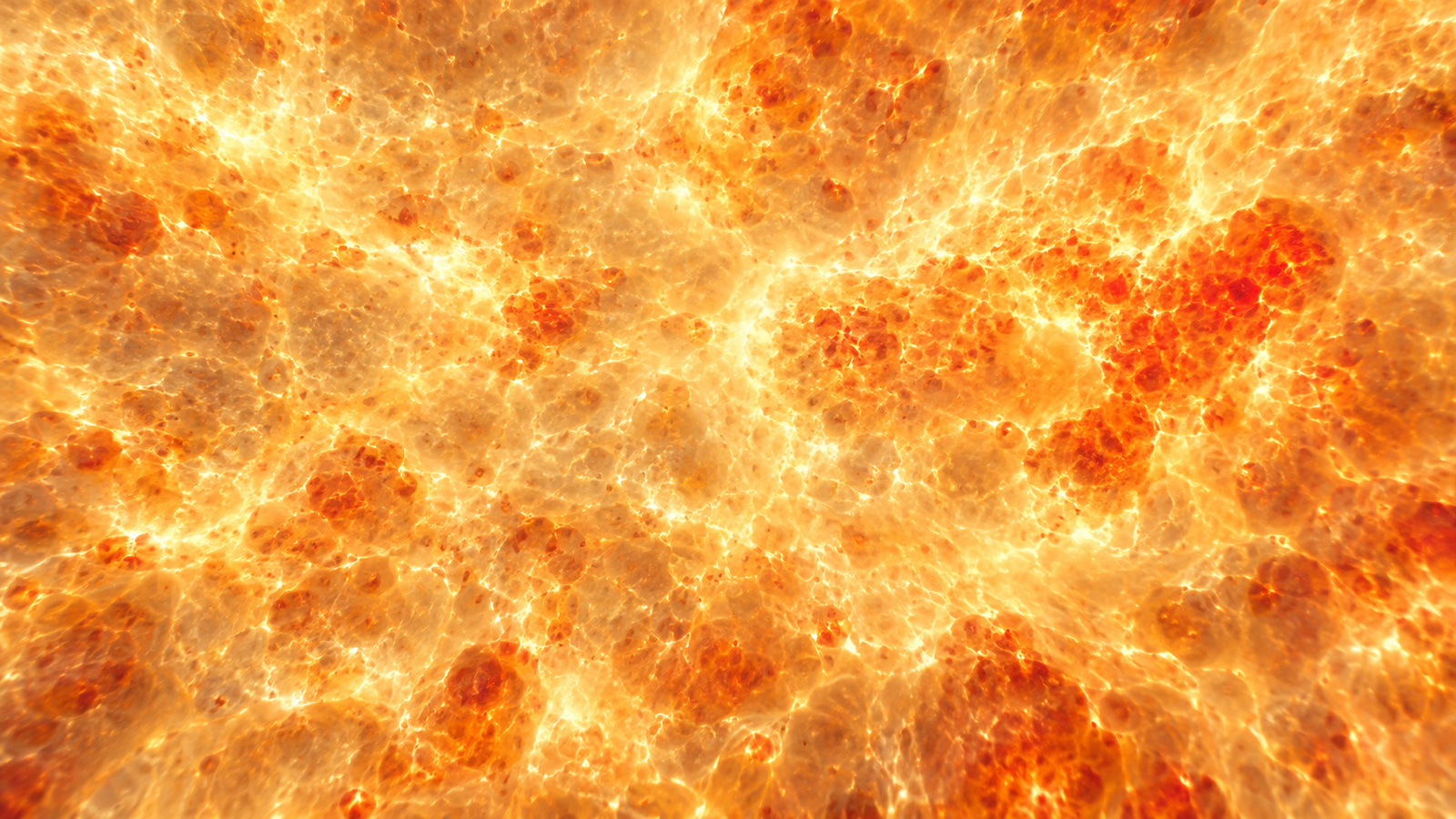
Within standard large-scale cosmology, expansion describes how separations between appropriately chosen unbound locations change with time. It does not require an outward-moving surface that sweeps previously external emptiness into the universe. This difference from a terrestrial explosion removes much of the imagined need for an edge. In an explosion, material travels through preexisting space from a localized event. Cosmological expansion concerns the evolving geometry used to measure separations across the distribution, and it can be described throughout the modeled space.
A finite model can change its overall spatial scale without being assigned an exterior container in the theory. An infinite model can also expand: distances between locations grow even though the space remains infinite at successive times. Those statements concern relationships among locations rather than an object expanding inside a laboratory chamber. Ordinary intuition is helpful for picturing a changing separation, but it becomes unreliable when it silently adds a larger room. The extra room is an assumption, not a requirement supplied by the equations.
This also means that expansion is not evidence for a frontier visible as a shell of outermost galaxies. A galaxy survey detects systems over a range of distances and lookback times, with selection limits that depend on brightness and wavelength. Its farthest measured galaxy defines an observational achievement. It does not identify the last galaxy in existence or the place beyond which space is absent. Better instruments may change the survey’s reach without changing the basic reason that a detection limit and a cosmic border answer different questions.
A Journey Would Test Local Conditions, Not a Picture’s Margin
Imagine an idealized probe traveling away from Earth while obeying physical limits on speed. In an unbounded model, its local environment does not suddenly become nonexistent when it crosses a line drawn around our observable region. It can still encounter space, fields, and perhaps matter, even if Earth cannot receive signals describing part of the journey. Communication and accessibility have to be calculated from the spacetime model. There is no justified universal prediction that the probe reaches a black wall, exits reality, or circles home merely by moving far enough.
Practical travel limits are much more restrictive than that thought experiment suggests. Expansion, finite speed, energy requirements, and the time available can prevent reaching many locations even when those locations exist. A place can be beyond a travel opportunity without being beyond a physical edge. This distinction lets us discuss unreachable regions without turning inability to visit them into a claim about their absence. It also explains why observational astronomy and hypothetical exploration cannot be treated as interchangeable methods for checking the universe’s entire structure.
Tests Constrain Models Within an Accessible Region
Cosmologists examine distances, the microwave background, and large-scale structure to test spatial descriptions. Researchers have also searched for signatures of particular global connections, including repeated patterns expected under some compact topologies. Planck’s geometry and topology analysis constrained specified models rather than proving every conceivable global possibility. This is a useful example of the scope of a null result. A search can rule out particular configurations at accessible scales while leaving a larger or differently connected universe unresolved.
The Claim Works Best with Its Limits Attached
A globe makes the finite, unbounded possibility tangible. Begin on the equator and travel east while remaining on the surface. Every step leads to another ordinary patch of surface, including the place where a flat map puts its right-hand edge. Continue around the globe and you eventually approach your starting point from the other side. The journey uses a finite surface without ever meeting its rim. This is a two-dimensional existence example, not a measurement of the universe’s three-dimensional global arrangement; the essential insight is that finiteness and an endpoint are different properties.
Now compare that continuous journey with a map that shows only one hemisphere. Crossing the map’s margin merely takes the traveler outside the displayed region. A grid seam can likewise move when the cartographer changes the projection, while the traveler’s local surroundings remain continuous. These two margins explain different confusions: a selected viewing domain and an inconvenient coordinate join can both look like boundaries on paper. Neither supplies a wall on the globe. The cosmic counterpart is to ask what a pictured line represents before giving it physical properties. A horizon concerns signals and a chart margin concerns representation, while global topology concerns how the space itself connects.
The resulting picture is not a journey toward a final shoreline. It is a universe whose standard geometry can continue without a material rim, combined with observers whose information is necessarily limited. Finite volume, infinite extent, signal horizons, and coordinate margins belong to different questions. Recognizing that separation makes the title precise enough to be useful: no edge describes how familiar cosmological models organize space, while the evidence and its limitations determine how far we can confidently extend that description.