The Famous Size Figure Measures a Particular Distance
The universe is about 13.8 billion years old, yet its observable region is commonly described as roughly 93 billion light-years across. Those numbers sound contradictory if a light-year is imagined as a timestamp or if space is treated as a fixed stage throughout the journey of light. They describe different quantities. Cosmic expansion changed the separations while ancient signals traveled, so the present distance associated with their sources is larger than a simple travel-time calculation suggests. The total universe introduces another uncertainty because it may extend far beyond the region whose information reaches us. A useful answer to the size question must first identify the region being measured, the time attached to the measurement, and the definition of distance used to express it.
A Light-Year Is a Length with a Time in Its Definition
A light-year is the distance light covers in vacuum during one year. The unit contains a time word because that is how its length is defined, not because it measures elapsed time. When a nearby star is several light-years away, its light takes approximately that many years to arrive in the usual local approximation. On the scale of the solar neighborhood, cosmic expansion is negligible for this practical comparison. Familiar usage works well there and can become misleading when transferred unchanged to the largest cosmological distances.
A billion light-years is therefore a huge length, while a billion years is a duration. Multiplying a light-travel duration by light’s speed produces one distance-like quantity, but it need not equal a cosmological source’s current separation. The distinction is not an arbitrary change of vocabulary. The geometry through which the light traveled changed during the journey. Astronomy needs more than one distance convention because observations combine locations and events separated in both space and time.
Units can also change without changing the physical claim. Astronomers commonly use parsecs and their larger multiples, while public explanations often prefer light-years. A parsec is approximately 3.26 light-years, and a gigaparsec is a billion parsecs. Converting units alone does not resolve an ambiguity about which distance was measured. Two reports can use the same unit and still discuss different cosmological quantities, or use different units while describing the same quantity.
Expansion Alters Separations During the Signal’s Journey
In a standard cosmological description, the scale factor tracks how distances between unbound comoving locations change with cosmic time. A photon travels locally at light speed while those locations become more widely separated as the universe expands. Its journey is therefore not a crossing of an unchanging ruler laid down when it departed. Calculating the travel history requires the expansion history along the path. This is why the cosmic age does not directly supply today’s radius simply by multiplication with light’s speed.
The source associated with very old light was much closer when that light was emitted than its corresponding comoving location is today. We observe the past emission event, not a photograph of the source’s current state. A present-day distance is an inference within a cosmological model that connects the event to the current spatial slice. The inference is physically meaningful without being a real-time observation of the faraway object. The same observation can consequently support a travel time, an emission-era separation, and a larger current separation.
Lookback Time Answers When the Light Was Emitted
Lookback time tells us how long ago the radiation now arriving was emitted. It is valuable for placing an observed galaxy in cosmic history, such as whether it appears during early galaxy assembly or a later period. It does not independently specify where that galaxy’s location sits on today’s spatial map. A headline using light-years can obscure this distinction when it really means light-travel time expressed as an equivalent length. Clear reporting states whether the number describes the age of the received signal or a spatial separation at a specified epoch.
Proper and Comoving Distances Organize an Evolving Map
Proper distance describes separation on a chosen spatial slice at a specified cosmic time. For a standard homogeneous cosmological model, this provides a way to ask how far apart comoving locations are today or were at an earlier epoch. Comoving coordinates factor out the uniform part of expansion, keeping idealized locations at fixed coordinates while the scale factor changes. Astronomers often normalize that factor to one today. With that convention, today’s proper distance and the corresponding comoving distance have the same numerical scale.
The coordinates do not assert that galaxies have no additional local motion. Galaxies can move relative to the idealized cosmic flow, and nearby gravitationally bound systems require their own dynamical treatment. The distinction separates the large-scale expansion from motions within or between local structures. A distance calculation can include a background model without treating every star or galaxy as perfectly fixed to it. The convenient map is an approximation with a well-defined purpose.
Talking about simultaneous faraway separation also requires a cosmological definition of cosmic time. We cannot place physical measuring stations across the whole universe and read their rulers instantly. Instead, the model supplies a spatial slicing consistent with the large-scale description. Observational data constrain the model’s parameters, and those parameters determine the inferred distances. This is a standard part of relativistic cosmology rather than a hidden claim that we have received instantaneous information from distant galaxies.
David Hogg’s research reference on cosmological distance measures sets out the different conventions used in calculations. Its value here is the distinction among quantities, rather than the historical parameter examples in the older paper. Modern distances use current parameter estimates and specified assumptions. A consistent calculation should name its convention before two apparently conflicting values are compared.
The Observable Diameter Is About 93 Billion Light-Years
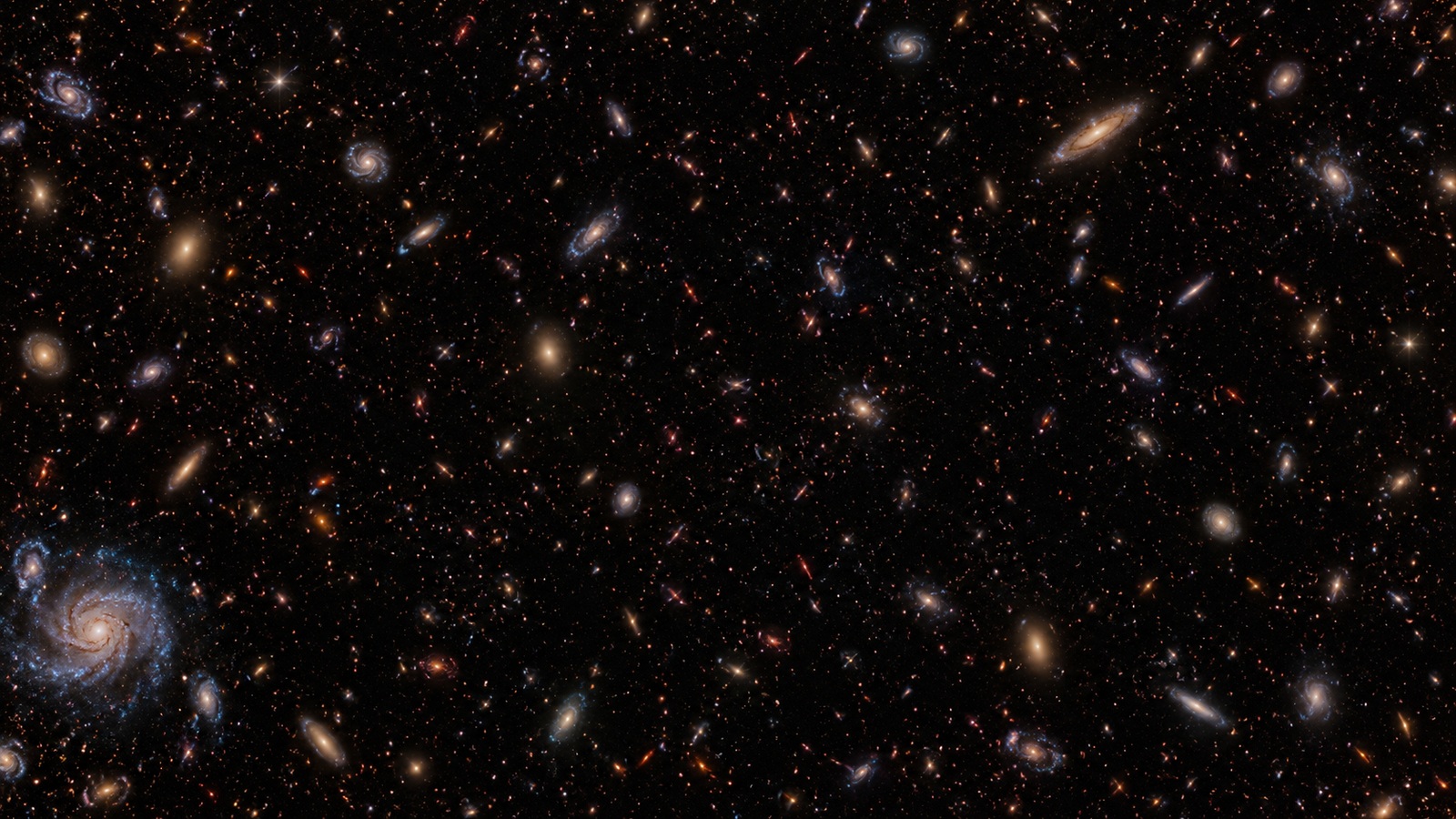
Within the standard cosmological model, the present distance to the particle-horizon region is approximately 46 billion light-years, giving a diameter around 92 to 93 billion light-years. The rounded number depends slightly on the adopted cosmological parameters and convention. It describes the scale of the accessible domain in a present-day spatial description, not a sphere of light that traveled that far through static space. The age near 13.8 billion years belongs to the time history. Expansion reconciles the two scales.
The research paper A Map of the Universe discusses horizon scales and how a map can distinguish cosmic distance from lookback history. Its historical parameter choices should not be treated as infinitely precise modern values. A rounded diameter is sufficient to communicate the scale without concealing its model dependence. More decimal places would imply confidence that the ordinary size question rarely warrants.
The limiting region is also not the location of the most distant individual galaxy currently measured. Galaxy observations depend on formation history, instrument sensitivity, and the transmission of radiation. The particle horizon describes a causal limit in the cosmological model, while a catalog record describes an observed source. Improving a telescope can increase the depth of a particular survey without changing the universe’s age or creating a new total-space measurement. Those achievements address different limits.
Brightness Gives a Useful Distance with Its Own Meaning
Luminosity distance is defined by how a source’s intrinsic output relates to the flux we receive. In an expanding universe, photons lose energy through redshift and arrive at a changed rate, so this distance incorporates more than simple geometric dilution. It is the appropriate quantity for certain brightness comparisons. It need not equal today’s proper separation to the source. Calling it a distance does not make it a redundant or erroneous version of a single universal ruler.
Apparent Size Uses Another Distance Convention
Angular-diameter distance relates an object’s physical transverse size at emission to its apparent angular size. Unlike the everyday expectation that a fixed-size object becomes steadily smaller as it is moved farther away, its cosmological behavior can be nonmonotonic with redshift. At sufficiently large redshift, the relationship changes because we observe an earlier epoch with a different expansion scale. This does not mean the galaxy grew larger solely because it is remote. It means that angle, physical size, and the time of observation are linked through cosmological geometry.
Comparisons require an actual physical-size estimate as well as the measured angle. Galaxies evolve, so they are not automatically interchangeable standard rulers. Dust, wavelength choice, and observational resolution can also affect which extent is measured. The concept is clean, while its application to a particular galaxy can involve substantial astrophysical work. A useful size claim keeps the distance convention separate from the assumptions about the object supplying the ruler.
The Distance Ladder Connects Local Evidence to Cosmic Scale
Nearby measurements establish calibrations that can be extended to more distant sources. Stellar parallax supplies geometrical distances for suitable stars, while variable stars with calibrated luminosity relationships help reach farther. Type Ia supernovae can then supply standardized brightness measurements over much larger ranges. Each link requires corrections and uncertainties rather than a blind repetition of one rule. The result is a chain of observations that connects local scales with the expanding universe.
NASA’s Hubble discussion of the distance scale and expansion tension explains the role of these comparisons. Independent early-universe methods can infer an expansion rate under a cosmological model, and their results need not agree perfectly with local approaches. That tension is an active problem whose interpretation requires careful treatment of both systematics and theory. It does not imply that every cosmic distance is meaningless. It identifies a specific place where the best measurements and models need to be reconciled.
Other techniques add complementary evidence, including galaxy-clustering scales, gravitational lenses, and suitable gravitational-wave sources. Different methods have different assumptions and observing challenges. NASA’s LAMBDA account of Hubble-constant measurements describes this diversity of approaches. Agreement across independent methods helps test the shared picture, while discrepancies guide additional investigation. Cosmic size estimates rest on a network of evidence rather than one photograph with a labeled outer rim.
Recession Beyond Light Speed Does Not Break Local Relativity
For sufficiently distant comoving locations, the change of proper separation associated with expansion can exceed light speed. That is not a spacecraft passing a nearby observer faster than a locally measured light beam. It concerns a distance defined across a large evolving spatial slice. Local special-relativistic limits remain applicable to motion and signals measured in an appropriate local frame. A cosmological recession value therefore should not be interpreted as an ordinary velocity through a fixed surrounding space.
This also makes the Hubble radius different from an absolute visibility wall. The distance where the instantaneous expansion-related recession equals light speed depends on the expansion rate at that epoch. A photon’s complete journey depends on how that rate evolves, so crossing or lying beyond that scale does not alone decide whether light can eventually reach us. Horizon calculations use the full expansion history. A single present-day speed comparison cannot replace them. For a nearby moving object, observers can often agree on a useful distance without invoking the entire cosmic expansion history. A cosmological horizon instead ties the distance claim to the selected model and epoch. Treating both cases as identical everyday ruler measurements hides the reason their numbers behave differently.
The Total Universe Still Has No Measured Diameter
The numerical answer has two parts: the universe has a measured age near 13.8 billion years, and its observable domain has an inferred present diameter near 93 billion light-years. The second number accounts for expansion during the journey of ancient light; it is not the distance a photon crossed through an unchanged space. The whole universe has no measured diameter. Refining the observable figure improves our map of the accessible domain without making a previously inaccessible global boundary visible.