Observable Means Available to Our Cosmic History
The observable universe is not simply everything that a powerful telescope can photograph. It is the region of cosmic history from which information can, in principle, reach our location by the present time. Finite signal speed, the universe’s age, and the expansion of space jointly determine that reach. Within it, instruments still miss faint objects, dust-hidden sources, and radiation outside their wavelength ranges. Beyond it, a better detector alone cannot retrieve a signal that has not arrived. This distinction makes the observable universe both a physical limit and a framework for interpreting observations. It describes what evidence is causally available to a particular observer, while leaving the extent of the entire universe and the future accessibility of other events as separate questions.
Every Received Signal Comes from an Earlier Event
Light from the Sun arrives about eight minutes after emission, and light from distant stars takes years. The same principle applies on cosmic scales, where a galaxy can be observed billions of years after the radiation left it. Its photograph depicts an emission event in its past. Looking farther generally reaches earlier periods of cosmic history, although the distance conversion becomes more involved in an expanding universe. We do not look through a window that displays every remote place at a shared current instant.
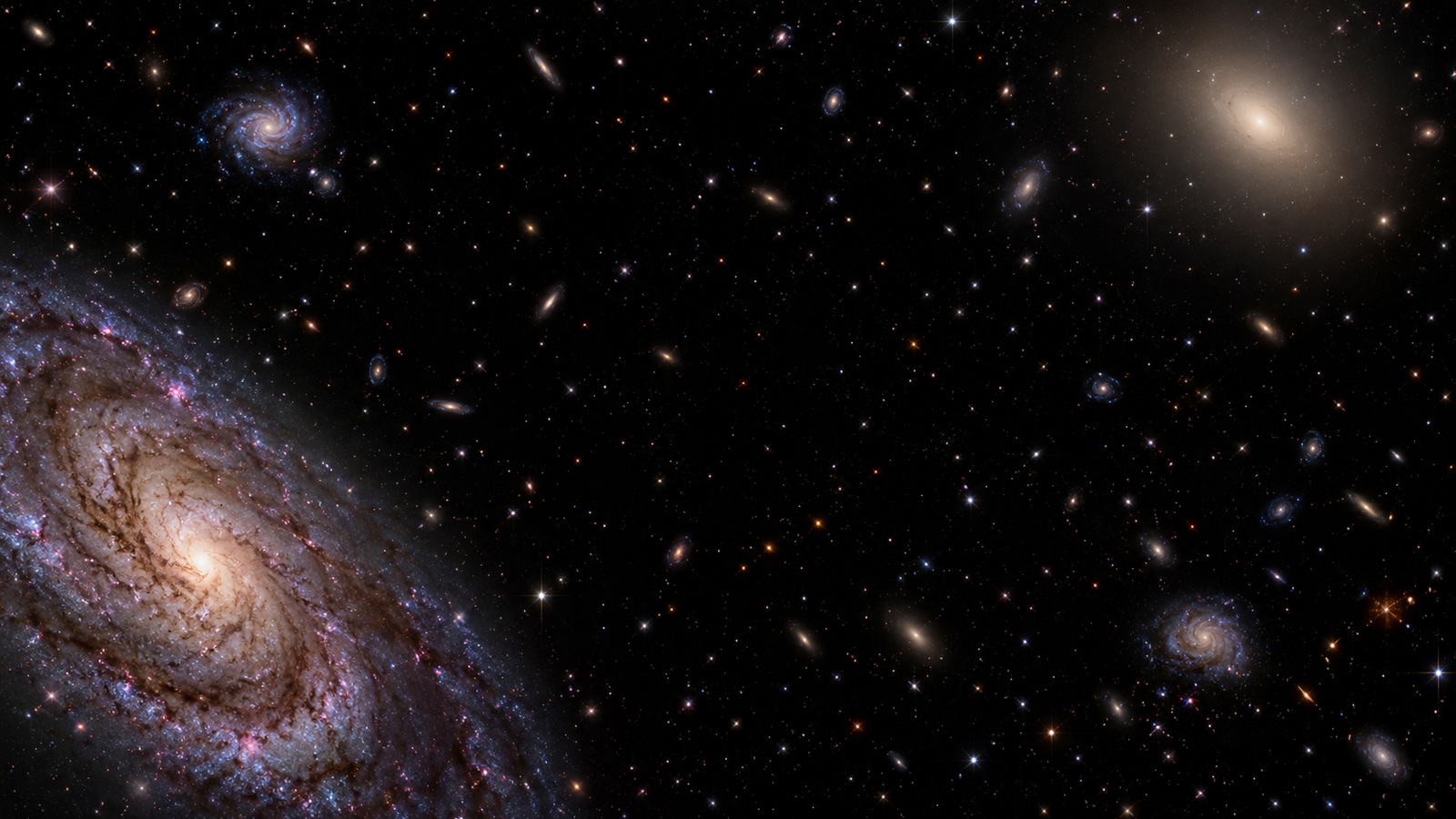
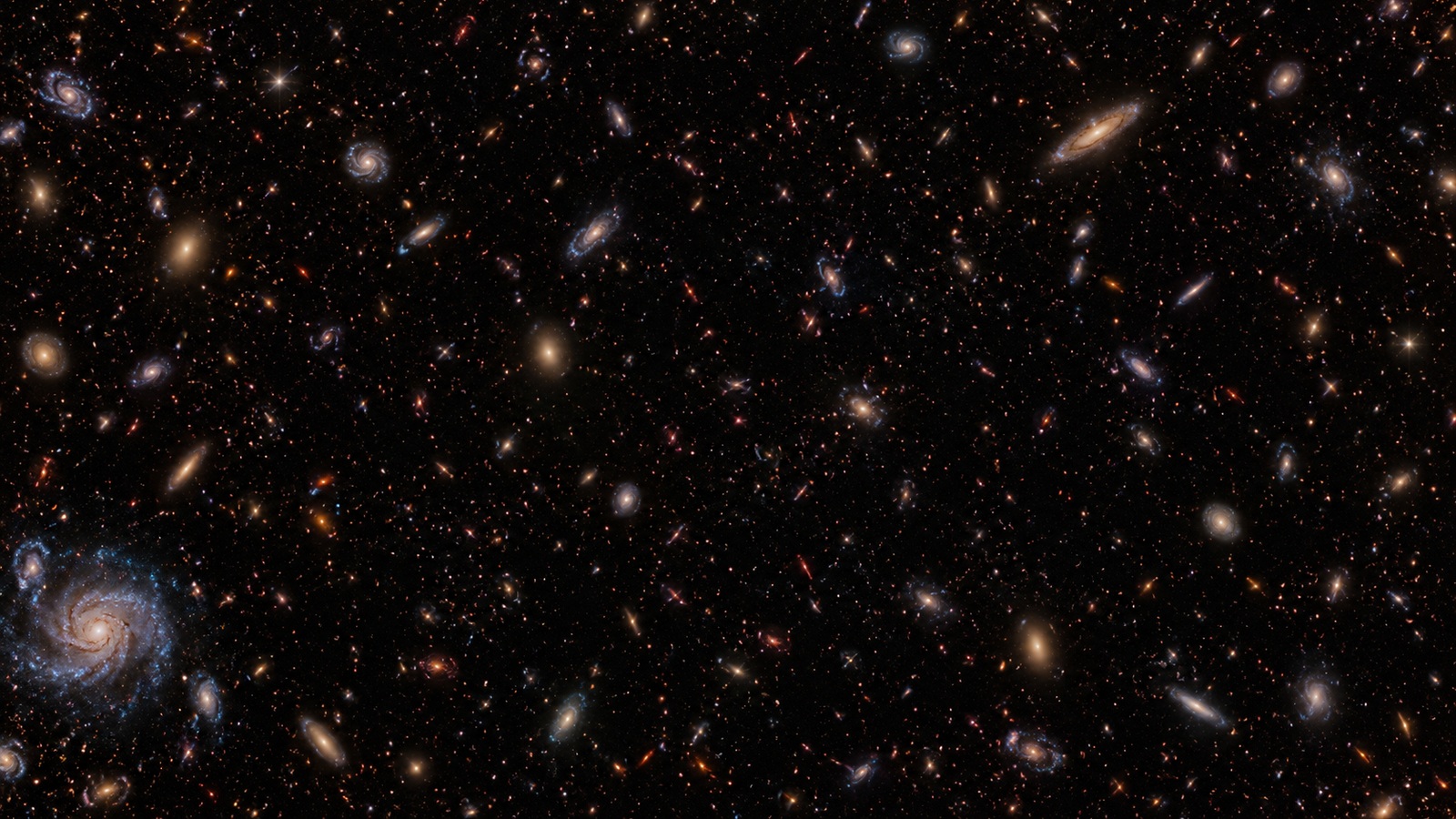
This means an all-sky image combines different epochs. A nearby galaxy and a very distant one can appear in the same frame while being observed at substantially different developmental stages. Astronomers use that mixture to reconstruct population evolution. They compare ensembles and account for selection effects rather than treating the photograph as a synchronized inventory. The information is real, but its temporal structure belongs in the interpretation.
The phrase past light cone organizes this relationship. It describes the set of events whose light can arrive at a chosen observing event, with the geometry of spacetime determining the paths. The cone in a diagram is a mathematical representation involving time as well as space. It is not a luminous cone physically surrounding Earth. Its purpose is to identify which events can supply evidence now.
Other messengers follow their own propagation and interaction histories. Gravitational waves can report violent events that are faint in ordinary light, while neutrinos offer another connection to high-energy processes. Their usefulness depends on production, travel, and detector sensitivity. They do not abolish the need for causal access. A new messenger can open a previously obscured part of the accessible history without becoming an instant view of arbitrarily distant space.
The Particle Horizon Marks a Causal Reach
In a standard expanding cosmological model, the particle horizon describes the limit of distances from which a signal could have reached us over the model’s past history. Its calculation integrates how the scale factor evolved rather than using a static-space shortcut. A rounded present-distance radius of roughly 46 billion light-years expresses that reach in a contemporary spatial description. It is not the length a photon covered against an unchanging ruler. It is also not a material shell enclosing the entire universe.
Consider two missing galaxies. One lies within the causal domain, but its arriving light is too faint for our detector; a longer exposure or more sensitive instrument might reveal it. The other is represented by a distant emission event whose light has not reached us by today. Improving the detector cannot make that second signal arrive sooner. The horizon calculation supplies the broad causal boundary, while absorption, lensing and sensitivity determine which sources we can actually detect within it. An all-sky catalog can therefore be incomplete without changing the physical meaning of the observable region.
An Observer’s Domain Is Centered on That Observer
Our observable region is centered on our location because received signals terminate here. An observer far away would define a corresponding domain around their own position. The two domains could overlap while including some different distant regions. This does not make either observer the privileged physical center of all space. The center belongs to the observation problem, like the center of a map drawn around a traveler.
The precise comparison requires specifying the observers’ cosmic times and motions. Observers at approximately the same cosmic epoch within a homogeneous model can have similarly sized domains, while observations made at different times have different accessible histories. Their local velocities can also change the appearance of radiation through familiar relativistic effects. A simple overlapping-spheres illustration leaves out those details. It is useful only when its assumptions are acknowledged.
No observer needs to stand at a cosmic edge in order to see a different horizon. Changing location changes which events have had time to send information there. A region inaccessible from Earth can be accessible to someone closer to it, without anyone crossing a wall. The causal geometry supplies the difference. This is why an observational boundary should not be mistaken for a universal physical border.
The Microwave Background Is an Early Screen with a Physical Cause
The cosmic microwave background is radiation from the era when the universe became sufficiently transparent for photons to travel long distances freely. Earlier, frequent scattering in the ionized plasma obscured a straightforward electromagnetic view. Around 380,000 years after the early hot beginning, neutral atoms became abundant enough that photons largely decoupled from matter. The radiation we receive is consequently a record of that transition. Its source surface is often called the surface of last scattering.
ESA’s explanation of microwave-background radiation describes this physical origin. The observed sky is not a picture of an outer cosmic wall or of the first mathematical instant of time. Different sightlines reach emission events on an approximately common early-era surface relative to us. The present distance associated with that surface is close to, but conceptually different from, the full particle-horizon scale. Its significance comes from transparency history rather than from a boundary where space stops.
Electromagnetic Opacity Is Different from Causality
Being inside the causal domain does not guarantee that every kind of signal passes through unimpeded. Dust can hide a young galaxy in visible light, dense plasma can scatter radiation, and an instrument can miss a wavelength altogether. Infrared or radio observations may reveal structures inaccessible to optical imaging for such reasons. Earlier messenger backgrounds might in principle probe eras before electromagnetic transparency, although detection is difficult and proposed signals require careful interpretation. These are access problems within physics and instrumentation, not a removal of finite signal-travel limits.
A Telescope’s Detection Limit Is Not the Cosmic Horizon
A survey records sources bright enough and suitably placed for its instruments and observing strategy. Its limiting magnitude, wavelength coverage, exposure time, and resolution all shape the catalog. A better telescope can find more distant or fainter galaxies within causally accessible space. That improvement does not push photons backward through time or change the universe’s age. It moves a practical observing limit closer to the physical reach allowed by history.
Different surveys consequently produce different most-distant-object claims. A photometric estimate can suggest a high-redshift candidate, while spectroscopy may provide a firmer assessment. Foreground contamination, unusual spectra, and lensing can complicate an identification. A record claim must state what was measured and how securely it was confirmed. Its relation to the observable universe is one of sampling, not of measuring the entire domain’s outer extent.
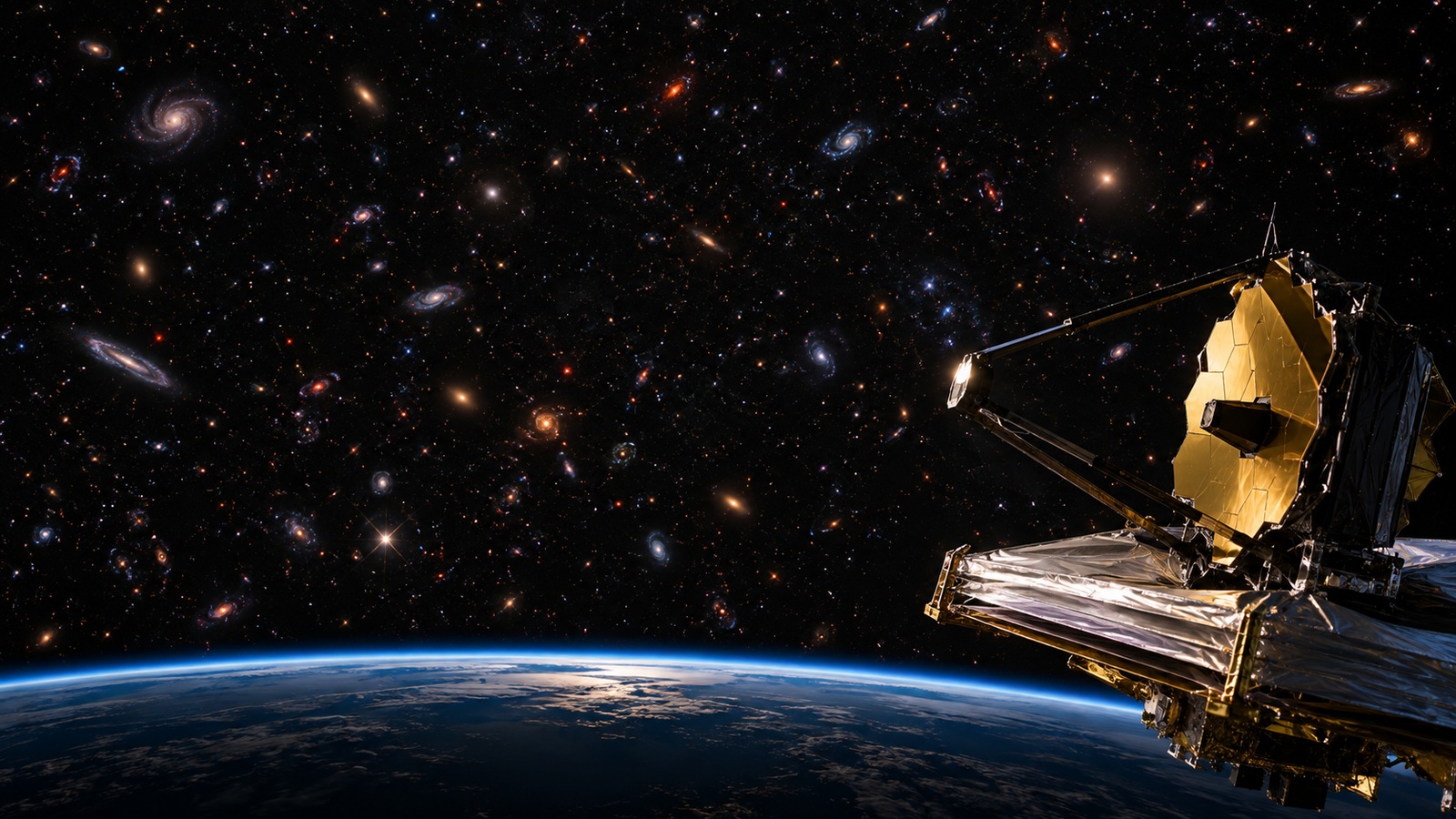
NASA’s Webb explanation of looking back in time connects deep observations to this historical perspective. Infrared sensitivity helps detect ancient radiation whose wavelengths have been stretched. It does not let the telescope watch those galaxies as they exist today. A deep-field discovery is valuable precisely because it supplies evidence from an earlier chapter of structure formation.
Some objects are brightened or distorted by gravitational lensing along the sightline. This can help reveal otherwise faint sources but introduces another interpretation step. The foreground mass changes how the background source appears rather than transporting us beyond the causal domain. Reconstructions can infer the source’s properties from the lensed observation. Their uncertainties belong with the result, especially when the apparent brightness is used to characterize a distant population.
The Domain Changes as Cosmic Time Advances
As observers live through later cosmic times, additional signals can arrive and the relevant particle-horizon reach evolves. In an expanding universe, it is important to specify whether that growth is described in proper or comoving distance. Accelerated expansion can limit the amount of additional comoving territory that ever becomes accessible, even as proper distances grow. The evolution must be calculated from the cosmological model. There is no universal fixed-radius bubble whose contents remain unchanged forever.
Proper distance describes separation on a chosen cosmic-time slice; comoving distance removes the shared expansion scaling. Suppose two modeled locations have a comoving separation of ten units. If the scale factor doubles, their proper separation doubles while that comoving label remains ten. A changing horizon can be described with either ruler, but its quoted growth will differ. Naming the ruler is especially useful when comparing a present-day size with a future reach: it prevents expansion of existing separations from being mistaken for access to an equally large amount of new cosmic territory.
The Future Event Horizon Asks a Different Question
The particle horizon asks what past information could have arrived by now. A future event horizon asks which events can ever send information that reaches the observer, given the entire future expansion history. Some cosmological models, including the usual long-term cosmological-constant picture, contain such a horizon. Not every possible expansion history has the same future boundary. The concept therefore introduces assumptions about future behavior as well as measured past history.
A galaxy can be visible through old light while its sufficiently late emission events remain permanently inaccessible. This is not a contradiction because visibility belongs to an event and a signal path, not simply to a galaxy labeled visible forever. Describing a location as observed today does not guarantee two-way communication with its current inhabitants in an imagined distant society. The difference matters for thought experiments about cosmic travel. It cannot be resolved by merely buying a larger detector.
The paper A Map of the Universe discusses horizon distinctions in a mapped cosmological setting. Its historical numerical choices should be kept separate from the continuing conceptual distinction. Particle, event, and Hubble scales describe different properties. Combining their names without defining the relevant question can turn a clear causal limit into a misleading claim about one universal cosmic edge.
The Hubble Radius Is Not an Absolute Visibility Cutoff
The Hubble radius is the instantaneous scale where expansion-related recession equals light speed in the chosen cosmological description. Its value changes as the Hubble parameter evolves. A signal’s ability to arrive depends on its whole trajectory through that changing history, not solely on whether its emitter once lay beyond this instantaneous scale. Some observed light was emitted from locations with superluminal expansion-related recession. This does not violate the local speed limit for light or make the Hubble radius identical to a particle horizon.
The Unobserved Whole Requires an Additional Inference
The whole universe may extend far beyond the accessible domain, with unknown total extent. Cosmologists extrapolate a model of large-scale structure and geometry beyond direct evidence when asking global questions. Such reasoning can be motivated by the consistency of observed physics and approximate uniformity. It is still different from receiving signals from those unobserved regions. A model can describe a larger universe without pretending that a telescope has inspected every part.
A deep astronomical image now has three useful coordinates in your mind: where the source lies in the cosmological description, when its detected light was emitted, and how the instrument selected that light. The familiar roughly 46-billion-light-year horizon radius concerns present separation in a standard model, while a galaxy image concerns an earlier event. Neither places a physical wall behind the last photographed object. Another observer can receive a different collection of events, and future observers can receive later signals from some of our current targets. The observable universe is this accessible archive, assembled through spacetime rather than displayed as one simultaneous photograph.