The Future Requires More Than Knowing Today’s Expansion
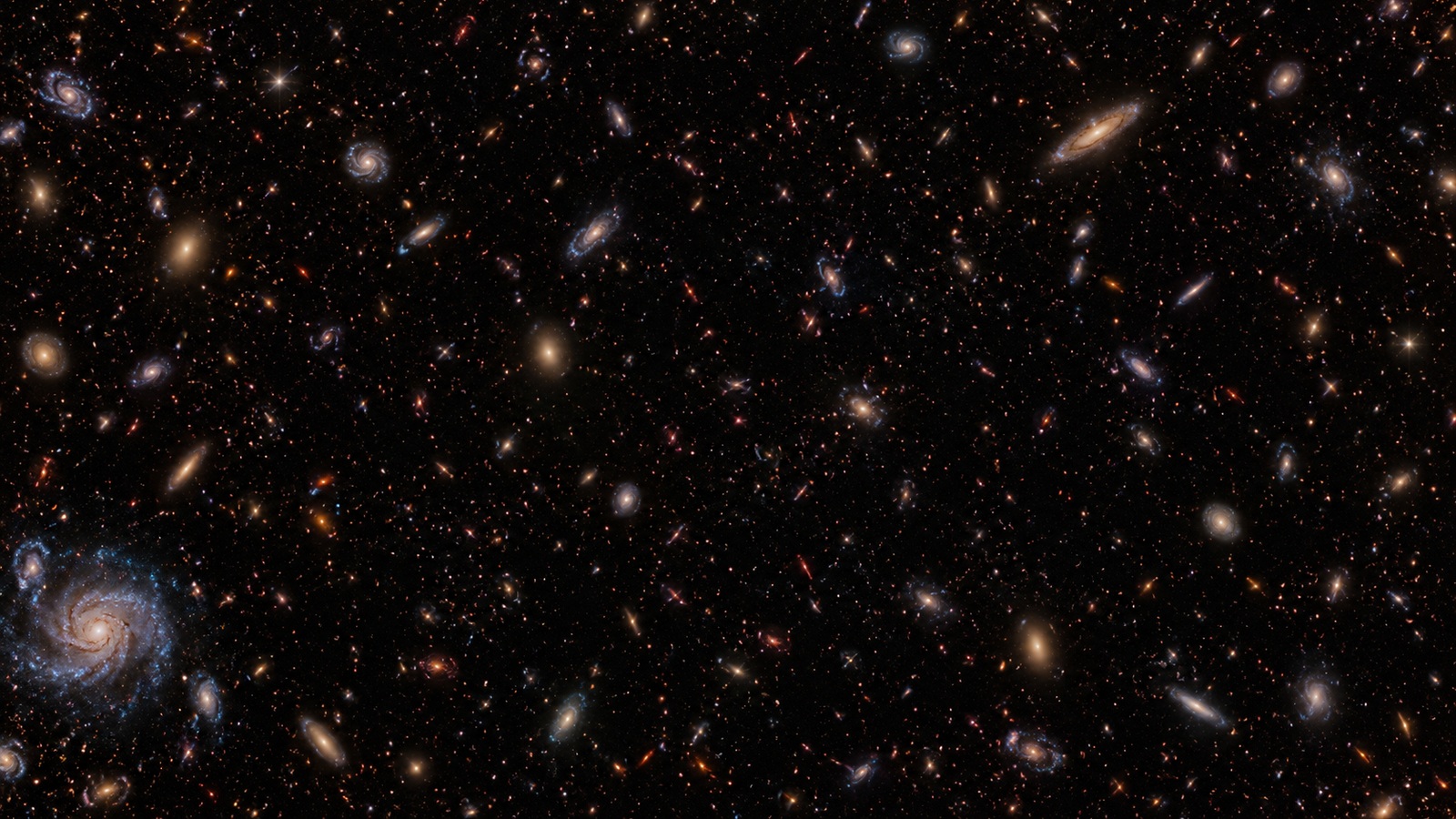
Galaxies reveal that the universe has expanded, and multiple observations support a period of accelerated expansion. Neither fact alone supplies a finished story about the distant future. A forecast depends on what fills the universe, how those components behave as space expands, and whether the rules inferred from accessible history continue to apply. In the standard model with a cosmological constant, continued expansion and increasing isolation are the leading long-term picture. Other assumptions can lead to different outcomes, including recollapse or extreme disruption. The scientific task is to distinguish those conditional possibilities from an observed ending. We can test the expansion history now, refine models of dark energy, and calculate consequences, while recognizing that the final fate remains an extrapolation whose certainty is limited by unresolved physics.
Expansion and Acceleration Describe Different Changes
Imagine two unbound galaxies whose modeled separation grows from 100 to 110 arbitrary distance units. The scale factor has increased by ten percent; the Hubble rate describes the fractional growth per unit time at a particular moment. A second pair initially 200 units apart would grow to 220 under the same homogeneous scaling. Acceleration asks a further question: how does the speed of that growth change over time? A growing separation and a growing fractional rate are not identical statements. This example describes the smooth cosmic background, leaving the internal orbits of a gravitationally bound galaxy to their own dynamics.
The Energy Inventory Determines the Background Dynamics
General relativity relates cosmic expansion to the density, pressure, and spatial curvature of the large-scale universe. Matter dilutes as a growing volume spreads its particles across larger separations. Radiation loses energy through redshift as well as dilution, so its influence changes differently. A cosmological constant has a constant energy density in the standard description rather than a fixed total energy in an expanding volume. These contrasting behaviors mean that the component dominating early evolution need not dominate the future.
Pressure matters gravitationally in this relativistic setting. A component with sufficiently negative pressure can support accelerated expansion under the cosmological equations. This does not require describing dark energy as a wind pushing every galaxy through surrounding space. The equations govern how the large-scale geometry evolves. A useful future scenario specifies the component’s physical behavior instead of relying solely on an everyday force analogy.
The quantities are inferred through observations rather than measured by collecting a sample of dark energy. Supernova distance comparisons, galaxy clustering, the cosmic microwave background, and other probes constrain the expansion and growth history. Their combination allows models to be tested over accessible epochs. No observation can directly measure an arbitrarily remote future epoch. A prediction therefore earns its credibility through tested premises and consistent evolution, not through direct inspection of the ending. Forecasts carry the assumptions required to extend those constraints beyond the period already sampled.
The Cosmological-Constant Model Predicts Continuing Expansion
In the usual flat model with cold dark matter and a positive cosmological constant, expansion continues and the constant-density component becomes increasingly dominant. Bound structures can retain their internal dynamics while unbound large-scale regions separate. The model does not predict that ordinary expansion immediately tears apart planets or atoms. Its future is characterized by widening isolation and continued local evolution. This is the appropriate baseline against which more dramatic alternatives should be compared.
Acceleration also creates a future event horizon in this kind of model. Some sufficiently distant events can never send signals that reach a given observer, even with unlimited future waiting. A galaxy whose ancient light is visible today may have a later history that remains inaccessible. The distinction concerns the timing of emitted information, not an instantaneous disappearance of every currently observed source. Visibility changes as radiation becomes increasingly redshifted and diluted.
Heat Death Concerns Usable Energy Rather Than One Explosion
The heat-death picture describes a long-term loss of accessible energy differences that can drive familiar processes. Stars consume fuel, new star formation becomes limited by available gas, and populations shift toward remnants. Cosmic expansion can make separate bound regions increasingly isolated. The outcome is not one universal moment when every star switches off together. Different objects and processes operate on very different timescales, and the language summarizes a trend toward an increasingly inactive state.
The sequence first separates short-lived stars from slow-burning ones. Massive stars exhaust their fuel quickly and leave neutron stars or black holes; Sun-like stars eventually leave cooling white dwarfs. The least massive red dwarfs can continue fusing for trillions of years, according to NASA’s stellar-evolution explanation. Meanwhile, repeated generations use up or lock away some of the gas available for new stars. These are overlapping processes, not a single scheduled shutdown. A galaxy can therefore become progressively richer in remnants while its longest-lived stars still shine.
Entropy supplies the organizing idea, but it should not be reduced to the claim that every temperature becomes exactly equal everywhere at a known time. Cosmological horizons and gravitational systems make the full thermodynamic story subtle. The broad loss of usable gradients is enough to explain why heat death is a different category from recollapse or a Big Rip. It describes the eventual character of a continuing-expansion scenario. It is not a directly observed condition toward which every individual object moves monotonically today.
Later, ordinary stellar light would grow scarce as even those slow-burning populations evolve. White dwarfs radiate stored heat rather than maintain ordinary hydrogen fusion, so they fade gradually instead of going dark in one event. Encounters can eject some objects from a bound neighborhood or feed others into black holes, changing the local inventory along the way. Continued expansion simultaneously separates that neighborhood from distant unbound systems. The resulting picture is a sparse community of remnants with fewer usable energy sources, not a uniform empty room. Predictions beyond this stage depend increasingly on untested particle lifetimes and very remote gravitational physics; no precise date for complete heat death follows from the stellar sequence.
Bound Neighborhoods Have Their Own Evolution
Galaxy groups, established clusters, and smaller gravitational systems are not simply expanded copies of the background universe. They can merge internally, redistribute gas, form or lose stars, and evolve through local encounters. Cosmic isolation changes what lies beyond them without specifying every event inside them. A far-future galaxy merger and a far-future expanding universe can therefore occur together. The local and global histories belong to different scales of the same physical description.
A Big Crunch Requires a Genuine Turnaround
A Big Crunch scenario has expansion stop and reverse into contraction. In simple older matter-only discussions, sufficiently high density and positive spatial curvature played a prominent role in such outcomes. Dark energy changes that relationship, so curvature alone no longer gives a universal fate verdict. A closed spatial model need not recollapse if a suitable positive cosmological constant keeps expansion going. The full energy behavior has to be included.
Some dynamical models can permit recollapse if their effective energy changes appropriately, for example through a field evolving into a negative-potential regime. A weakening positive dark-energy contribution does not automatically guarantee this outcome. The remaining components and the future field behavior determine whether a turnaround occurs. A claim that one hint of evolution proves an eventual crunch skips those requirements. The scenario must be calculated within a specific physically consistent model.
A Big Rip Requires an Even More Specific Behavior
In certain phantom-energy models, the effective equation-of-state parameter remains below minus one and the energy density grows as expansion proceeds. A sufficiently persistent version can drive a finite-time singular expansion, commonly called a Big Rip. The disruption can progress to increasingly tightly bound systems in the model. This is not what ordinary constant-density dark energy predicts. The dramatic label belongs to a special extrapolation rather than to the general fact that acceleration exists.
Whether such a model is physically viable raises theoretical questions as well as observational ones. Its assumed behavior might not persist, or a more complete theory might replace the apparent singularity. Present data constrain an accessible history and cannot directly certify indefinite phantom evolution. No defensible universal countdown follows from the phrase dark energy alone. A proposed date would inherit the exact parameters and future assumptions of the model that produced it.
Other possibilities include changes that avoid a singular ending or terminate acceleration without causing collapse. An evolving component may settle toward a constant value or dilute in a way that changes the balance gradually. The alternatives demonstrate why cosmic fate is not exhausted by two theatrical endings. Model space includes a variety of expansion histories. Researchers use data to restrict that space, rather than assigning equal credibility to every imaginable outcome.
Equation of State Connects a Component to Its Evolution
The parameter usually written w relates a component’s pressure to its energy density with the appropriate units. A cosmological constant corresponds to w equal to minus one. A measured preference for another value or for time variation would challenge that simple description, but the inference depends on the model and datasets. The parameterization used to describe the observed past may also behave badly if extended far into the future. A convenient fitting function is not automatically a complete physical theory.
This matters particularly for fate headlines. A fitted past trend can support investigation of dynamical dark energy while leaving its later evolution underdetermined. Two physical models can fit similar observations yet diverge strongly after the current epoch. Researchers need theory as well as data to construct a sensible extrapolation. The future is constrained by what has already happened, but it is not uniquely determined by every statistical curve that fits the available points.
The DESI collaboration’s March 2025 analysis strengthened hints of evolving dark energy in combinations of its galaxy measurements with other cosmological evidence. A July 2026 hydrogen-absorption analysis supplied standard-model-compatible constraints from a different, high-redshift probe. Together they make a useful test of how the expansion history changes across measured eras. They do not yet select one complete theory governing all future epochs. A revised model must fit these observations before its consequences for collapse or continuing expansion become a credible forecast.
The observational question is therefore concrete: does the constant-energy description continue to fit independent measurements, or does a consistent change emerge across them? The future question then asks what physical model could produce that measured behavior and how it would evolve later. Keeping those two steps distinct avoids a false countdown while preserving the discovery’s significance. Evidence that dark energy changes would reshape the baseline, even if several future histories still remained possible.
Physical Unknowns Limit the Most Remote Predictions
Even a well-constrained expansion model leaves questions about particle stability, quantum gravity, and the ultimate behavior of vacuum states. Some proposals explore vacuum decay or transitions with consequences different from the standard heat-death narrative. These are theoretical possibilities with substantial uncertainty, not observed threats or scheduled cosmic events. Including them responsibly means stating which physics is established and which is extrapolated. A list of conceivable endings is not a probability forecast.
The Leading Forecast Is Clearer Than the Ultimate Ending
The standard cosmological-constant framework favors ongoing expansion rather than a future global collapse. Its long-term picture includes increasingly isolated bound regions and declining opportunities for familiar stellar activity. That conclusion is conditional on the component behaving as the model assumes. Alternative dark-energy dynamics can change the outcome, while a Big Crunch and Big Rip each need more specific conditions than acceleration alone. Present observations favor a useful baseline without giving a completed inventory of all future physics.
The clearest explanation consequently separates three levels: measured history, the model that fits it, and the extrapolated fate. Surveys refine the first, competing theories address the second, and calculations explore the third. Astronomy can make real progress while the ending remains uncertain. The future of the universe is a scientific question because its scenarios have physical conditions and observable consequences in the accessible past, even when no observer can watch the final chapter in advance.