The Gravity Account Contains More Than the Light Account
Astronomers can estimate how much matter is present by examining the light it emits, but they can also investigate mass through its gravitational effects. Across galaxies, clusters, and the early universe, those approaches point to more gravitating matter than the ordinary visible inventory can explain. Dark matter is the name for the additional component used in the leading cosmological framework. It does not mean a cloud colored black, and it is not another name for dark energy. Its gravitational role is supported by several kinds of observation, while its underlying identity remains unresolved. The important first step is to separate those two questions: why researchers infer additional matter, and what that matter might be. Understanding the evidence makes the mystery more precise than the simple claim that most of the universe is invisible.
Dark Means Difficult to See, Not Painted Black
Ordinary matter interacts with electromagnetic radiation in ways that make stars, gas, and dust observable at different wavelengths. The inferred dark component does not supply those familiar signals at a level explaining the gravitational evidence. In standard models, it is not a light-blocking curtain hiding galaxies behind it. A dark-matter-rich region may contain visible stars and gas as well, because these components can occupy overlapping locations. Their coexistence does not make the visible objects the entire source of the measured gravitational field.
The name describes an observational distinction without specifying one exact substance. Dark matter might involve particles outside the established ordinary-matter inventory, with particular interactions that remain to be discovered. The description has to be supported by physical tests rather than by the evocative word dark. A candidate’s mass, abundance, and behavior must match astronomical constraints, and any proposed detectable interaction must survive experimental scrutiny. A useful explanation keeps the inferred gravitational component separate from a preferred microscopic theory about what constitutes it.
Galactic Rotation Reveals an Extended Mass Problem
A worked illustration shows why a flat rotation curve implies extended mass. Suppose an outer tracer circles at 200 kilometers per second at a radius of ten kiloparsecs, about 33,000 light-years. If nearly all the gravitating mass were already inside that radius, a tracer twice as far out would move at roughly 140 kilometers per second: for a centrally concentrated mass, circular speed falls with the square root of distance. Instead, suppose the measured speed remains near 200. In a simple spherical approximation, enclosed mass scales as speed squared times radius, so the required mass has approximately doubled. These are illustrative numbers, not a measurement of a named galaxy; real disk models include their nonspherical geometry, stars, and gas. ESO’s rotation-curve explanation describes the observed broader phenomenon: speeds remain high beyond the bright regions, supporting a halo spread over large distances.
The analysis needs more than a casual statement that outer stars move too fast. Stellar mass estimates depend on populations and luminosity, gas contributes additional material, and geometry affects the velocities observed along the line of sight. Noncircular motions and other complexities also matter in particular systems. NASA’s dark-matter overview places rotation evidence within the wider scientific case. Robust conclusions come from careful mass modeling and comparisons across systems, rather than assuming one ideal curve describes every galaxy perfectly.
A central supermassive black hole does not generally solve the extended problem. Its mass can dominate local motions near the nucleus, but the gravitational requirements across a much larger disk reflect the broader distribution. Concentrating the missing mass at one point would produce different orbital behavior from an extended halo. This distinction also prevents an incorrect picture of a galaxy held together solely by its central black hole. The dark-matter question concerns where the gravitating material must be distributed, not just whether some compact massive object exists somewhere.
Clusters Supply a Second Dynamical Scale
Galaxy clusters contain galaxies, hot intracluster plasma, and a large inferred total mass. Member motions and the state of the hot gas provide routes to estimating the shared gravitational environment. Researchers compare those requirements with ordinary matter measured through stellar light and gas emission. The resulting discrepancy appears on scales far beyond a single galactic disk. This matters because a successful explanation must address several environments, not only the detailed relationship between visible material and orbital speeds in one type of galaxy.
Lensing Measures the Bending Caused by Total Mass
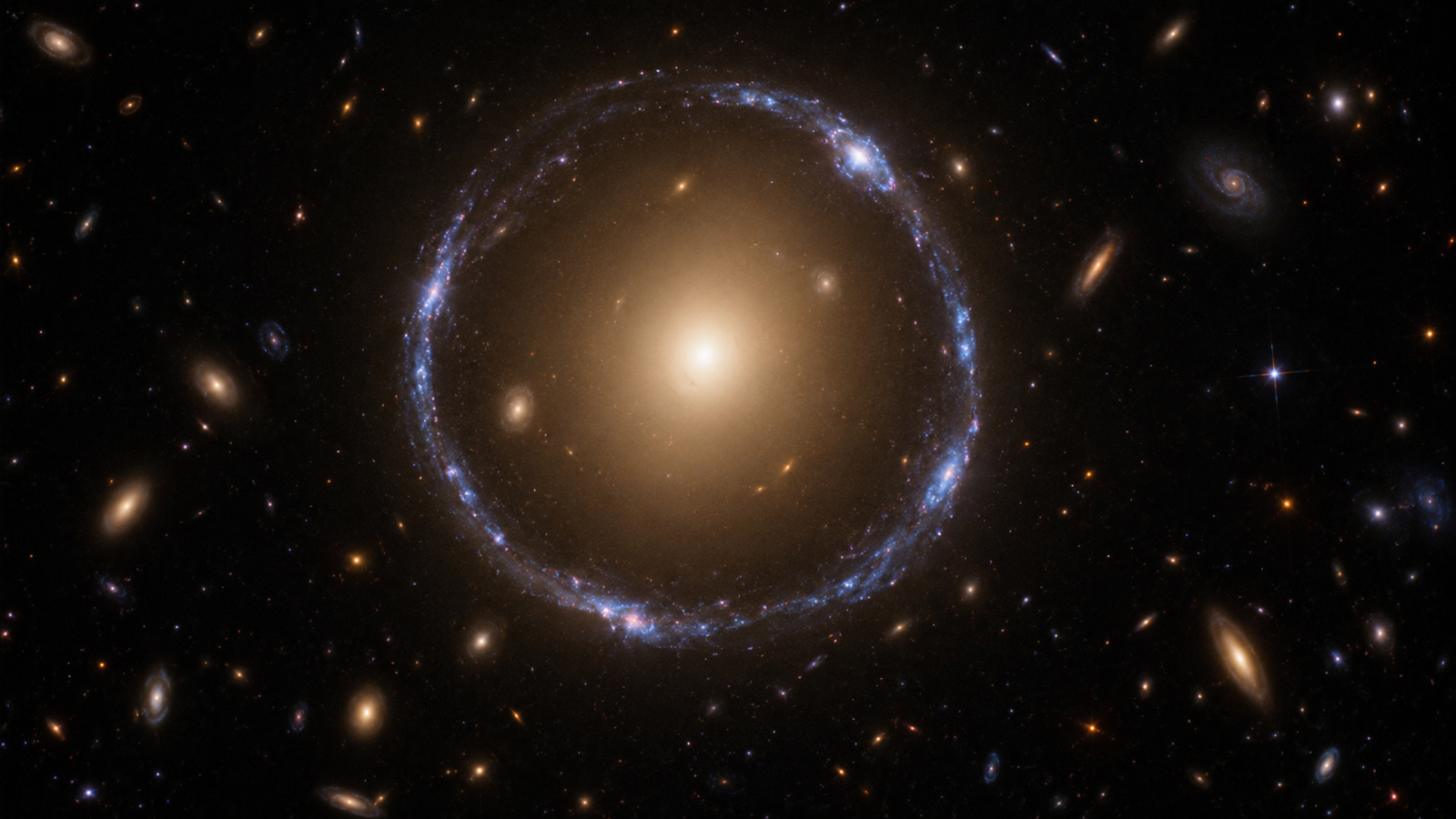
Gravity changes the paths of light traveling past a mass concentration. A foreground system can distort background galaxies, create arcs, or produce multiple images under favorable alignment. Strong lensing involves conspicuous effects in particular configurations, while weak lensing measures small statistical distortions across many sources. Researchers use these observations to constrain projected mass distributions. The method responds to the total gravitational field rather than requiring the foreground mass itself to shine.
That makes lensing an independent way to investigate a dark component, but it does not make every lensing feature a unique dark-matter detector. Ordinary matter also bends light, and models must include the visible mass as well as the additional component. Background-source geometry and other assumptions affect the reconstruction. The evidence becomes informative when the total mass needed by lensing exceeds or differs from the distribution accounted for by measured ordinary material. A beautiful ring alone shows gravitational lensing, not the identified microscopic composition of its lens.
Colored dark-matter maps usually display a reconstructed distribution. The colors are assigned to make the inferred mass legible alongside optical, infrared, or X-ray measurements. They are not the substance’s natural color or radiation photographed directly. Understanding this display convention protects a valuable measurement from being overstated. Lensing can constrain where mass is located with substantial power, while particle identity remains a different kind of question requiring additional observations or experiments.
Cluster Collisions Separate Gas from Much of the Mass
The Bullet Cluster provides a particularly informative comparison because colliding cluster components respond differently. Hot gas experiences strong interactions and slows during the encounter, while galaxies and much of the lensing-inferred mass pass through with less comparable drag. The dominant mass distribution is displaced from much of the ordinary hot gas. Chandra’s account of updated Webb and X-ray observations explains how complementary measurements sharpen that spatial comparison. The result favors a substantial component whose behavior differs from the collisional plasma.
The collision also constrains possible interactions among dark-matter particles, though the constraints depend on the detailed system and analysis. The absence of a particular measurable offset is not proof that every conceivable interaction is exactly zero. Nor does the system alone name a particle. Its value is that it combines gravity-based mass mapping with ordinary matter’s independently measured distribution and behavior. That relationship supplies evidence difficult to obtain by looking only at an undisturbed galaxy’s light and orbital motion.
The Early Universe Adds a Different Physical Test
The microwave background preserves patterns from an early period when ordinary matter and radiation interacted strongly. The pattern’s detailed scales and amplitudes depend on the matter inventory and the evolution of gravitational potentials. Standard analyses infer ordinary-matter and total-matter quantities that cannot be made identical merely by hiding today’s stars. This extends the evidence into cosmic history, before the present galaxy population existed. A candidate explanation must connect those early conditions with later growth and gravitational observations.
Primordial light-element abundances independently constrain the amount of ordinary baryonic matter. Baryons include protons and neutrons, making this a nuclear-physics limitation on how much ordinary material can be supplied. Adding faint stars, cold gas, or unnoticed planets cannot freely exceed that cosmic budget while preserving the rest of the evidence. Combining abundance constraints with early radiation patterns is therefore especially important. It shows why dark matter is generally understood as more than a census of dim ordinary objects omitted from a photograph.
Structure formation supplies another connected test. In the leading framework, a dark component helps gravitational irregularities grow, providing an environment in which ordinary gas later collects. Predictions can be compared with galaxy distributions, lensing, and the properties of smaller systems. The comparison is complicated by feedback and gas physics, so not every discrepancy has one interpretation. Even so, a successful alternative must explain the broad pattern across time. Dark matter’s scientific role rests on that connected body of evidence rather than one isolated anomaly.
Cold Describes Motion, Not a Refrigerator Temperature
Cold dark matter refers to a component moving relatively slowly compared with light at stages important for structure formation. It is not a claim that each particle carries an ordinary low-temperature thermometer reading. Faster particles can erase some small-scale irregularities more effectively, changing the structures expected later. Warm and hot classifications therefore relate to dynamical behavior and free streaming. The terminology is useful only when tied to the epoch and physical effect being discussed, rather than translated directly into everyday atmospheric temperatures.
Particle Candidates Need Their Own Evidence
Researchers investigate candidates such as weakly interacting massive particles and axions, among other possibilities. Each idea proposes particular masses, interactions, and production histories. Direct-detection experiments seek interactions with carefully monitored detector material, often underground to reduce backgrounds. Indirect searches examine possible radiation or particles associated with dark-matter processes, while accelerator work tests related particle physics. These approaches ask different questions from astronomical mass mapping, even though the same candidate theory should connect their results consistently.
The LUX-ZEPLIN detector makes a direct search concrete. A recoiling xenon nucleus can produce a prompt light flash and freed electrons; collecting those electrons generates a later light signal. Researchers compare the signals’ sizes, timing, and location with the behavior expected from candidate interactions and ordinary backgrounds. The apparatus records a physical energy deposit rather than a labeled dark-matter particle. Radioactivity and other particles can also leave signals, so identifying the source requires a consistent event pattern and background analysis. A null result limits the tested interaction strengths and masses without naming the substance responsible for the astronomical halo.
Compact objects are also considered in specified contexts, including primordial black holes under particular formation assumptions. Observations restrict how much of the inferred component can occupy many mass ranges, and ordinary stellar remnants face additional abundance constraints. Saying dark matter could be black holes is consequently not a general solution obtained merely by naming invisible objects. The distribution, origin, and allowed population have to fit multiple measurements. Candidate proposals remain useful when they make those requirements explicit and testable.
Modified Gravity Must Address the Whole Evidence Set
Some approaches investigate whether changing the gravitational description can explain observations without the usual dark-matter component or with a different inventory. Certain galactic relationships motivate that research. A full cosmological alternative must also account for lensing, clusters, early radiation, and structure growth using a consistent theory. Fitting one rotation pattern cannot by itself establish that every remaining problem is solved. The same standard applies to dark-matter models: success in one environment does not excuse failures elsewhere.
This is why the question is broader than choosing between invisible matter and a single altered equation for stars. Researchers compare complete physical frameworks and their predictions across independent observations. Models may face tensions at smaller scales where baryonic processes are difficult to calculate, and those tensions deserve investigation. The existence of open issues does not erase the combined evidence, but it does prevent a simplistic claim that every dark-matter model is already confirmed. The leading framework remains useful because of its broad explanatory performance, not because debate is prohibited.
Dark Matter and Dark Energy Have Different Jobs
Dark matter clusters gravitationally and helps explain mass distributions and the growth of structure. Dark energy is the label associated with the observed accelerated expansion within the usual cosmological account. Sharing the adjective dark does not make them one substance, opposite electric charges, or two halves of an established mechanism. Their evidence and modeled behavior differ. Keeping them separate is essential when reading percentages of the universe’s present mass-energy inventory, because a fraction of total matter and a fraction of total mass-energy use different denominators.
The distinction explains why dark matter can be described as most of the matter while occupying only roughly a quarter of the present total mass-energy inventory. The first comparison omits the dark-energy component; the second includes it. Radiation also contributes, although its present share is much smaller than in the early universe. These percentages are model-inferred quantities for a particular epoch. They do not mean that a fixed fraction of visible objects is dark matter or that separate colored substances fill distinct portions of space.
The hidden-mass question therefore has a strong gravitational answer and an unfinished microscopic answer. Multiple observations favor a substantial additional component whose behavior differs from ordinary luminous and collisional material. Its identity remains a target for theory and experiment. A responsible account can state both points firmly: the case extends beyond missing light in one galaxy, while maps, halos, and compelling astronomical evidence still do not provide the final name, mass, or interaction properties of the particles or objects carrying that gravitational role.