
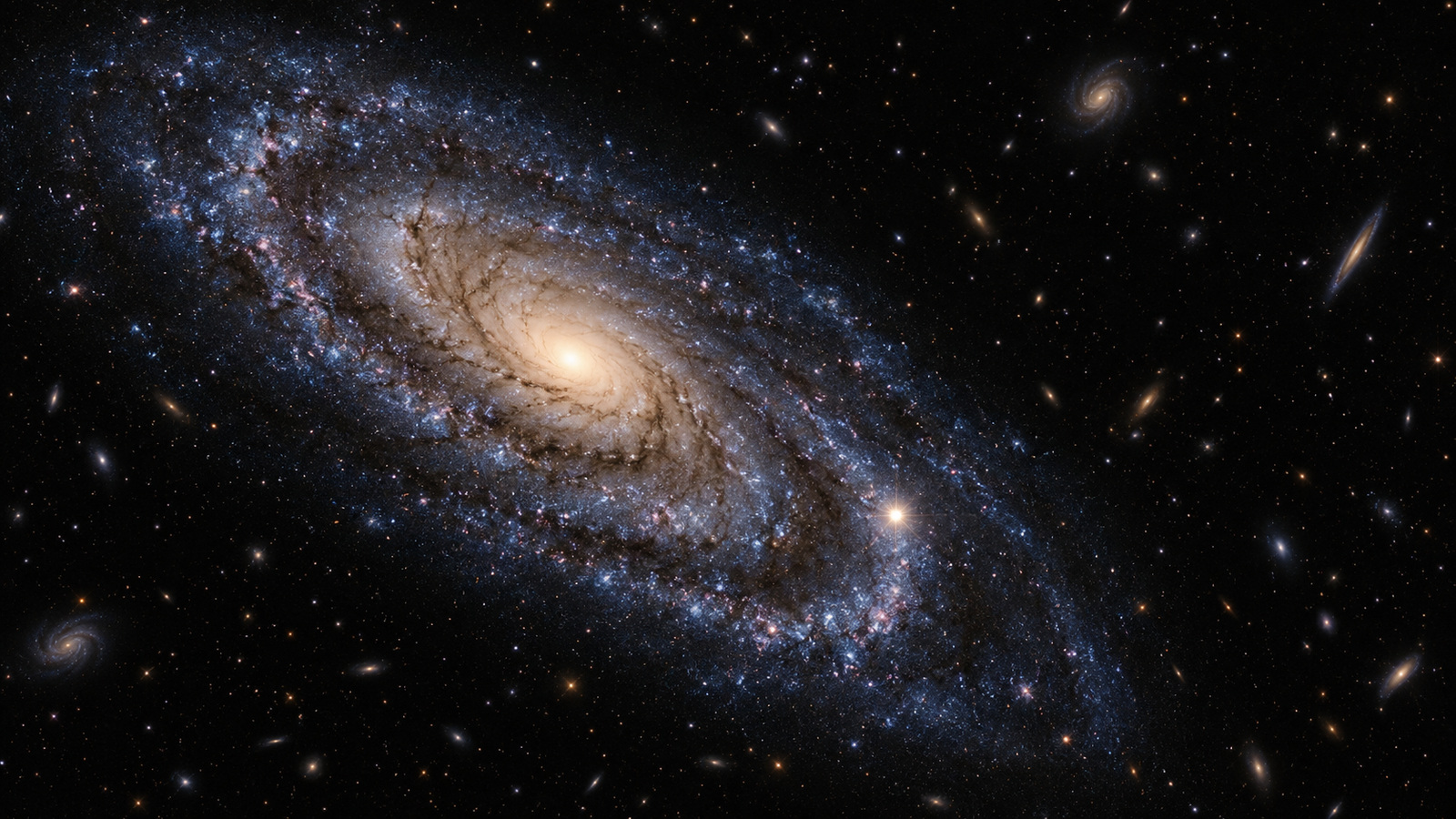
The Cosmic Push Is an Acceleration We Infer
The universe expands, but expansion alone does not explain why its large-scale evolution became accelerated. Dark energy is the name associated with that acceleration in the leading cosmological account. The phrase cosmic push makes the effect sound like a wind driving galaxies through a surrounding room, yet that is not the standard physical description. Researchers reconstruct how cosmic distances change with time and test what kind of energy inventory or gravitational theory reproduces the history. Supernova measurements, galaxy-survey rulers, and the microwave background contribute complementary constraints. The evidence for accelerated expansion is substantial, while the underlying mechanism remains uncertain. Understanding dark energy therefore begins by separating the measured behavior from its possible explanation, then examining why a cosmological constant works well and why scientists continue testing whether a richer description is needed.
Expansion and Accelerated Expansion Are Different Claims
Expansion describes an increasing large-scale distance scale between appropriately chosen unbound locations. Acceleration describes how the growth of that scale changes over time. A universe can expand while its expansion decelerates, just as an object can continue moving while slowing down. The analogy only illustrates the distinction between change and changing rate; galaxies are not collectively flying through a fixed external chamber. Cosmologists express the difference through the scale factor and its time evolution, which organize the geometry rather than assign a conventional engine to every galaxy.
The expansion rate quoted at one epoch is not identical to the acceleration of the scale factor. The Hubble parameter measures growth relative to the current scale, so its behavior can differ from an everyday statement that everything simply becomes faster by the same amount. A model with accelerated expansion does not require the Hubble parameter to increase at every moment. Keeping those quantities distinct prevents misleading interpretations of headlines about expansion speeding up. Observations constrain the whole history through distances and redshifts rather than one isolated number.
Local bound systems add another distinction. A planet’s orbit, a star’s structure, or a galaxy’s internal motions respond strongly to local gravity and other forces. They do not automatically expand at the same fractional rate as the large-scale cosmic separation. Dark-energy discussions concern a cosmological regime in which the smooth background description is useful. Converting the effect into a universal push on every object would erase the difference between a bound environment and the average evolving universe.
Supernova Distances Changed the Expected Story
Type Ia supernovae provide a way to estimate distances through their measured brightness after appropriate empirical standardization. Astronomers study how their light curves and colors relate to intrinsic luminosity, then compare inferred distances with redshifts. The key result in the late 1990s was that distant supernovae did not follow the distance relationship expected from a simple matter-dominated decelerating history. Their behavior favored an accelerated late expansion when interpreted within the cosmological framework. NASA’s Hubble dark-energy overview explains this observational connection.
A simple brightness example explains the inference. Suppose two supernovae have been standardized to the same intrinsic luminosity, and one delivers only one-quarter as much light as the other. In a simple inverse-square comparison, it lies twice as far away: doubling the distance spreads the light over four times the area. Cosmological observations use a luminosity distance that includes expansion and redshift effects, so this is an illustration of the brightness-distance step, not a full formula for cosmic geometry. Standardization and calibration let astronomers make that step with actual observations.
The crucial comparison then holds redshift in view. If a standardized supernova is fainter than predicted at its measured redshift, its inferred luminosity distance is larger than that particular expansion model predicts. Researchers compare the entire distance-redshift pattern with different histories rather than conclude that the star has simply changed its luminosity. The original Supernova Cosmology Project analysis used 42 high-redshift supernovae to investigate that relationship. The accelerated history emerged from fitting a sample and its uncertainties, not from one unusually dim photograph.
A standardizable candle is not a perfectly identical lightbulb. Dust, population differences, selection effects, calibration, and other issues require analysis. Those are reasons to improve measurements and seek independent checks, rather than reasons to ignore the technique entirely. A convincing cosmological result must survive appropriate treatments of such effects. The supernova discovery was consequential because it connected measurable light with a surprising expansion history, while later work expanded the evidence beyond one sample or one calibration procedure.
Galaxy Patterns Supply Cosmic Rulers
Early pressure disturbances in the coupled ordinary-matter and radiation environment left a characteristic scale in the later distribution of matter. Galaxy surveys measure the resulting statistical feature, known as baryon acoustic oscillations. It is not a literal line connecting two individual galaxies. Researchers infer the preferred separation across many objects and compare its apparent scale along and across the line of sight with cosmological models. That provides distance and expansion information through a physical method different from supernova brightness.
The Microwave Background Anchors an Earlier Epoch
The CMB supplies detailed information about conditions around the time radiation began traveling much more freely through the early universe. Its angular patterns constrain combinations of physical densities, distances, and other parameters. Dark energy’s familiar late-time influence should not be confused with a visible dark-energy pattern directly photographed in that sky. Researchers use a model connecting early physics with the intervening expansion history. The ancient signal then provides constraints that can be combined with later observations.
Different probes help reduce ambiguities that one data set cannot resolve alone. A supernova distance pattern, an acoustic ruler, and early radiation measurements depend on different observables and systematic effects. Their combination tests whether one history can account for all of them. Agreement strengthens the interpretation, while tensions can identify a calibration problem, an incomplete model, or a feature requiring further study. Combining data is therefore a physical cross-check, not a guarantee that every preferred parameter is independent of assumptions.
Growth of structure supplies another complementary perspective. Expansion affects how gravitational irregularities develop, while the gravity theory also determines how matter responds. Measurements of galaxy clustering, motions, and weak lensing can investigate that relationship. A candidate account must ideally explain both distances and growth consistently. This is especially useful when comparing an added dark-energy component with changes in the gravitational description, because different theories can resemble one another in a distance-only test yet diverge in their structure predictions.
A Cosmological Constant Is the Simplest Common Model
The cosmological constant appears as a constant term in Einstein’s gravitational equations and can be described as a uniform energy density associated with space. In the usual interpretation, its density does not dilute like ordinary matter as the universe expands. Its pressure has the negative value required by that description. The resulting model, combined with cold dark matter and ordinary components, is commonly called Lambda cold dark matter. Lambda is the conventional symbol for the constant, not the name of a measured particle.
This model is attractive because it supplies a compact account that fits a broad range of observations. Its success does not identify why the constant has its observed value. Connections with quantum vacuum energy create deep theoretical questions, including why straightforward expectations can differ so dramatically from the cosmological scale inferred. A useful distinction is between a mathematically simple successful parameter and a complete microscopic explanation. The former can work well while the latter remains one of fundamental physics’ major open problems.
Negative Pressure Is Not an Ordinary Suction Pump
In general relativity, pressure contributes to the gravitational dynamics alongside energy density. A sufficiently negative pressure can lead to accelerated expansion in a homogeneous cosmological model. That statement concerns the equations governing spacetime, not a fluid nozzle spraying galaxies outward. Mechanical analogies such as suction or pushing can communicate a tendency while hiding the mechanism actually being described. The safest explanation identifies the negative-pressure relationship and its cosmological consequence without assigning an unobserved material motor to the universe.
Other Explanations Predict More Complicated Behavior
Some theories describe dark energy through an evolving field whose density and pressure change over time. Others investigate altered gravitational behavior on cosmic scales. These ideas can produce different distance and growth histories, providing opportunities for tests. They are not all equivalent refinements of a confirmed substance. Each needs a consistent physical formulation and evidence that distinguishes it from the simpler cosmological-constant account. Adding flexibility can improve a fit, but the additional parameters also require justification.
Researchers often describe the pressure-to-density relationship with an equation-of-state parameter. Its value and possible time dependence summarize aspects of the model rather than fully specify every underlying theory. For a cosmological constant, the familiar value is minus one under the standard convention. A statistically preferred departure would be important, yet interpreting it requires checking the assumed parameterization and data combination. A fitted trend is not automatically direct observation of a field or proof that vacuum energy has stopped behaving constantly.
The distinction between expansion history and microscopic identity remains central across these alternatives. Distance measurements can constrain how an effective component behaves without revealing its particle content or fundamental origin. Growth measurements can test gravity’s response without uniquely identifying every proposed modification. The process resembles other astronomical inferences in its demand for complementary tests, but the phenomenon being investigated is specifically late-time cosmic acceleration. Its unresolved mechanism should not be confused with a lack of meaningful constraints on the models.
Recent Survey Results Need Their Qualifications
DESI’s 2025 results increased interest in evolving dark-energy models when combined with other observations, but the preference depended on the data combination. Its July 2026 hydrogen-absorption analysis reported agreement with the standard model for that probe. Together these results illustrate an active model comparison rather than a completed discovery of a changing field. The scientific task is to find one account that consistently matches distances and structure across independent measurements.
Dark Matter Is a Different Part of the Inventory
Dark matter explains much of the additional gravitating mass inferred in galaxies, clusters, and structure formation. It clusters and dilutes with expansion in a way unlike a constant dark-energy density. Dark energy’s role concerns the accelerated background evolution in the standard account. The two names share an adjective because their identities are not established through ordinary emitted light, but their evidence and behavior differ. One should not be described as the outward version of the other or assumed to be the same substance operating with reversed force.
Consider an idealized region whose linear scale doubles with cosmic expansion. Its volume becomes eight times larger, so a fixed amount of nonrelativistic matter has one-eighth its previous density. In the cosmological-constant model, dark-energy density remains constant instead. The two components can therefore change their relative importance without changing into one another. This simple scaling explains why a small early fractional contribution from Lambda can become important much later, while matter continues to form the local gravitating structures around galaxies.
Percentages Describe an Epoch and a Model
The frequently quoted cosmic inventory assigns roughly five percent to ordinary matter, about a quarter to dark matter, and approximately two thirds to dark energy in the standard present-day model. Those are fractions of total mass-energy density, not percentages of visible objects or portions of space filled with separate substances. They also change with cosmic time because components evolve differently. A universe dominated by radiation earlier need not resemble the current inventory. Quoted fractions require both an epoch and the model used to infer them.
The Real Mystery Is the Mechanism Behind a Measured History
The acceleration evidence comes from a reconstructed history of cosmic distances and expansion, reinforced by complementary measurements. Lambda supplies the simplest common description: a uniform energy density whose pressure enters the equations in a way that supports acceleration. It describes the observed large-scale behavior economically. That success still leaves a physical question about why the inferred density has its very small, nonzero value and whether it truly remains constant.
The cosmic push in the title is therefore a shorthand for accelerated expansion. It does not imply a wind striking every galaxy or an expanding force inside every bound system. Better distances, statistical rulers, and structure measurements test whether the simple constant account survives or needs a different description. The central mystery is the origin of the component that fits the measured history, not a missing picture of a substance scientists already know how to collect.


