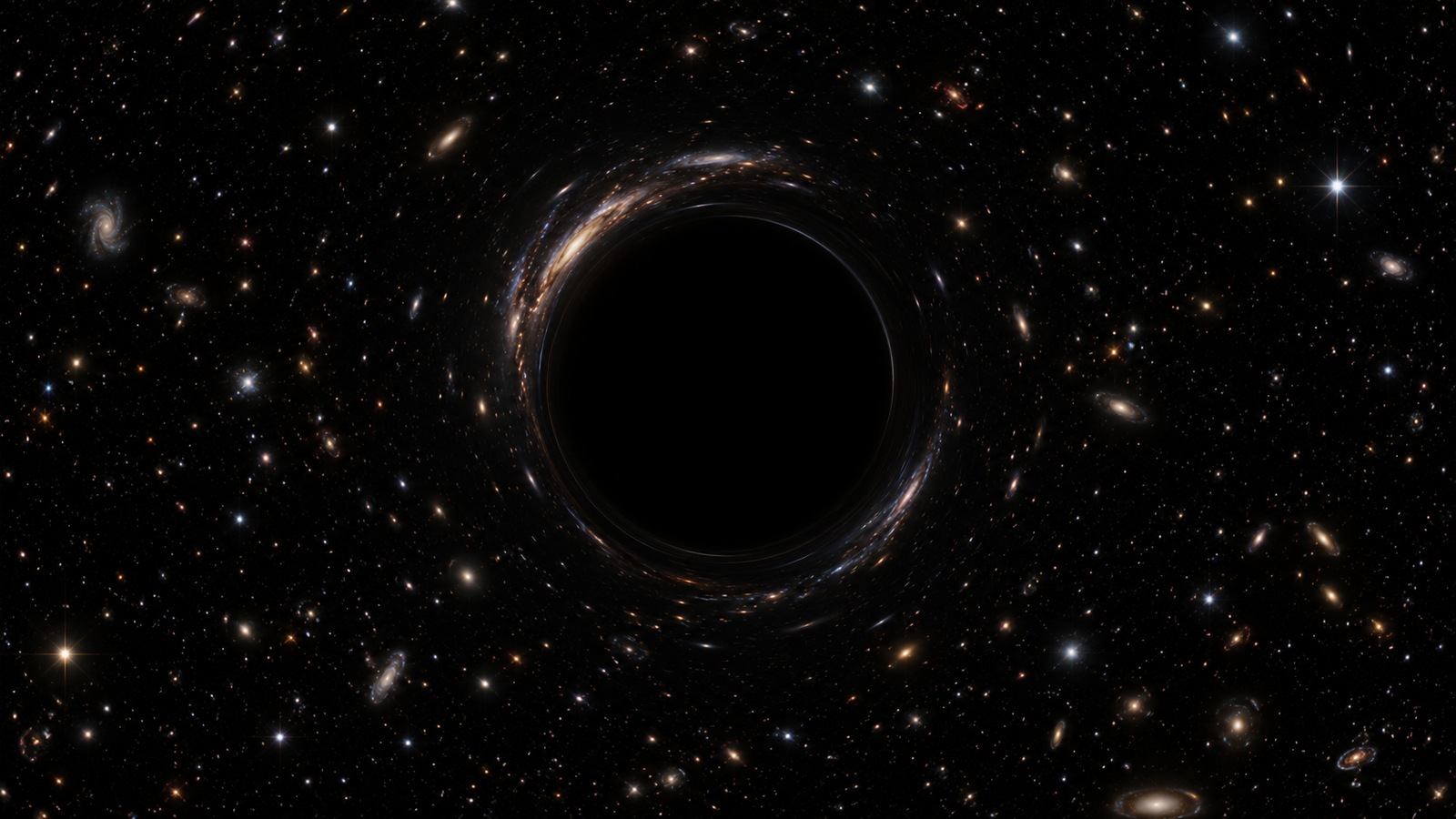
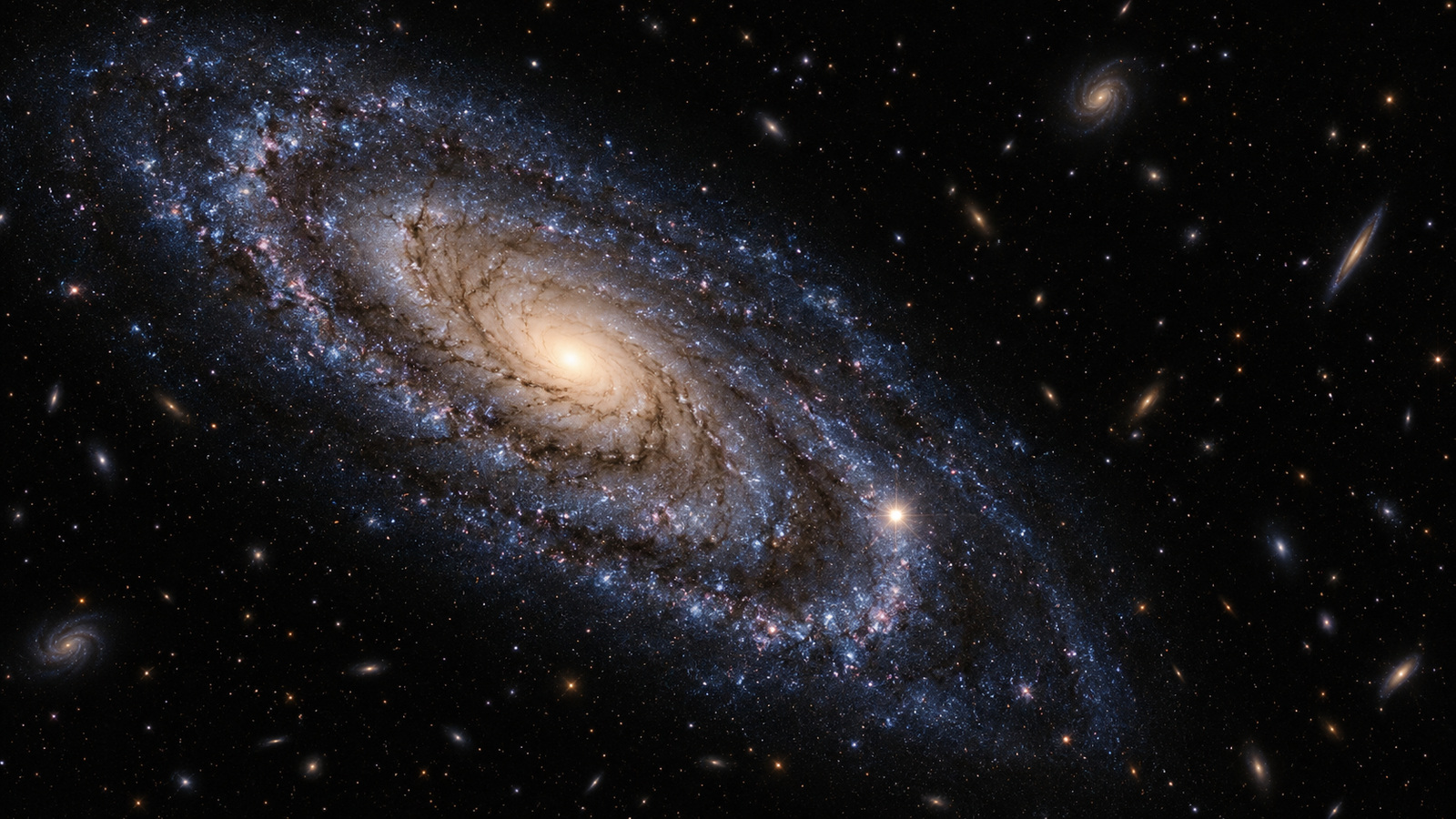
What if everything we see — every galaxy, star, and planet — exists inside something far stranger than we can imagine? According to some theoretical models, our entire universe could be the interior of a vast black hole, a concept known in cosmology as the Schwarzschild Cosmology or “Black Hole Universe Hypothesis.” This idea challenges our fundamental understanding of reality: space-time, expansion, and even the meaning of what lies “outside.” At first glance, the notion that our observable universe could be the inside of a cosmic black hole sounds like pure science fiction. Yet, it stems from serious general relativity mathematics and theoretical physics, including work by scientists such as Nikodem Popławski, Stephen Hawking, and Roger Penrose. The hypothesis proposes that when a black hole forms, the matter collapsing inward doesn’t vanish into an infinitely dense point — instead, it could give birth to a new expanding region of space-time, a baby universe. In other words, every black hole might contain a new universe, and our own might be one of them.
The Birth of a Black Universe
In traditional cosmology, the universe began with the Big Bang — a singular event approximately 13.8 billion years ago. But the Big Bang raises its own puzzles: What caused it? What existed before it? The Black Hole Cosmology provides a radical alternative.
When a massive star collapses under its own gravity, general relativity predicts it will form a singularity — an infinitely dense point hidden within an event horizon, where not even light can escape. But the equations describing this process — particularly the Einstein field equations — allow for another interpretation. Inside the event horizon, space and time can switch roles. This inversion can make the interior of the black hole resemble an expanding universe, one that grows as time moves forward from the singularity.
If true, the Big Bang might not have been an explosion from “nothing,” but rather the continuation of a collapse from another, larger universe. Our cosmos could be the result of a black hole forming in a parent universe, with our Big Bang as the moment of emergence on the other side of the event horizon.
The Mathematics Behind the Idea
To understand this theory, we need to revisit the Schwarzschild solution, a fundamental result of Einstein’s general relativity. It describes the gravitational field around a non-rotating, uncharged black hole.
The Schwarzschild metric has two key regions:
- The exterior, which corresponds to the space outside the event horizon where we can still observe gravity at work.
- The interior, where conventional space and time coordinates flip — and all paths lead inevitably toward the singularity.
The intriguing part is that, mathematically, these equations permit the interior of a black hole to behave like a Friedmann–Lemaître–Robertson–Walker (FLRW) universe — the same kind used to model cosmic expansion. Inside, instead of collapsing into a single point, the space-time fabric could stretch outward, expanding rapidly — just like our universe does.
Physicist Nikodem Popławski developed this concept further, suggesting that the “other side” of a black hole might be a white hole — the theoretical inverse of a black hole, which expels matter rather than consuming it. Our universe, he proposes, could be the interior of such a white hole, birthed by the collapse of matter in another universe.
Time, Expansion, and the Cosmic Connection
A crucial feature of our universe is that it is expanding — and doing so at an accelerating rate. Within the black hole model, this expansion could be explained by the geometry of space-time inside the event horizon. To an external observer in the parent universe, the collapse into a black hole appears to slow down as time dilation near the event horizon stretches moments infinitely. But inside the horizon, the opposite happens: time flows normally for internal observers, and space expands rapidly. From this interior perspective, that expansion could look like a cosmic inflation — the very one believed to have occurred in our universe shortly after the Big Bang. This temporal inversion solves one of cosmology’s long-standing mysteries: why the universe seems to have started from a singularity. In the black hole model, the “singularity” is simply the bridge between the collapsing star of one universe and the expanding space-time of another.
The Horizon We Cannot Cross
In a black hole, the event horizon is the ultimate boundary. Nothing, not even light, can escape it. If our universe is indeed inside a black hole, then the event horizon defines the limits of our observable universe — the cosmic horizon.
Interestingly, astronomers already recognize that our universe has an “edge” beyond which we cannot see — not because there’s a wall, but because light from farther away hasn’t had time to reach us since the beginning of cosmic expansion. The similarity between this cosmological horizon and a black hole’s event horizon is striking.
If the two horizons are, in fact, manifestations of the same physical principle, it would suggest a deep unity between cosmology and black hole physics — implying that every black hole is, in essence, a universe-in-the-making.
The Cosmic Family Tree
If our universe was born inside a black hole, it raises a profound question: could black holes in our universe also spawn new universes of their own? This idea leads to a kind of cosmic natural selection, sometimes called cosmological Darwinism. In this framework, universes that produce more black holes also produce more “offspring universes.” Over time, universes may evolve physical laws that favor black hole formation — much like organisms evolve traits that favor reproduction. The constants of nature — like the speed of light, the gravitational constant, or the strength of the electromagnetic force — might not be random. They could be fine-tuned because universes with these properties produce more black holes, and thus, more descendants. Our own existence might be the product of this grand cosmic lineage.
Clues in the Cosmic Background
While the Black Hole Universe hypothesis remains speculative, it does make testable predictions.
For instance, the cosmic microwave background (CMB) — the faint afterglow of the Big Bang — might contain subtle imprints of the parent universe. Small anomalies, like unexplained cold spots or deviations from expected temperature patterns, could hint at the influence of space-time curvature inherited from a black hole interior.
Additionally, the observed flatness of our universe could be a natural outcome of this model. The geometry inside a black hole’s event horizon can naturally lead to a large, homogeneous, and isotropic expansion — precisely what we observe.
Even dark energy, the mysterious force driving cosmic acceleration, might be linked to the gravitational effects of the surrounding event horizon. Some physicists speculate that the black hole’s boundary conditions could manifest as a repulsive energy inside — the same way that dark energy acts on cosmic scales.
Quantum Gravity and the Bounce Hypothesis
A major obstacle in unifying this theory with mainstream cosmology lies in the singularity itself. In classical general relativity, singularities are points where the equations break down, predicting infinite density and curvature. However, in quantum gravity — the still-emerging theory combining general relativity and quantum mechanics — singularities may be replaced by a phenomenon known as a bounce. Instead of collapsing to infinite density, matter compresses to a finite, incredibly dense state, then rebounds and expands. This “Big Bounce” scenario fits naturally with the black hole model: the collapsing star in one universe reaches quantum limits, rebounds, and inflates into a new universe on the other side of the horizon. Instead of an ultimate end, black holes become cosmic birthplaces.
The Multiverse Connection
The Black Hole Universe hypothesis also intersects with the idea of the multiverse — the possibility that countless universes exist, each with its own physical laws.
If every black hole births a new universe, and each of those universes forms its own black holes, then creation becomes a recursive, branching process — a cosmic tree of universes. Our own universe might be one “leaf” among trillions, emerging from the depths of another and giving rise to countless others within it.
In this framework, there is no single origin or endpoint — only an eternal cycle of creation, collapse, and rebirth. Time itself may not have a true beginning, only transitions from one universe to the next through the gravitational gateways of black holes.
Could We Detect the Parent Universe?
One of the most tantalizing questions is whether we could ever find evidence of the universe that birthed ours. Unfortunately, if the event horizon functions as an impenetrable boundary, we may never directly observe beyond it.
However, indirect signatures might exist. The anisotropies in the CMB or unusual distributions of matter could be remnants of conditions inherited from the parent universe. Some cosmologists propose that tiny irregularities or variations in the gravitational constant across vast distances might offer subtle clues to our cosmic origin.
Another speculative avenue involves gravitational waves. If universes are birthed through black holes, the process might produce unique gravitational signatures that, in principle, could be detectable by next-generation observatories.
Black Holes as Cosmic Laboratories
While we can’t escape or peer into a black hole directly, we can study their behavior and test theories that parallel our universe’s properties. Recent observations, such as those made by the Event Horizon Telescope, which captured the first image of a black hole’s shadow in 2019, allow scientists to test relativity in extreme conditions. The dynamics of matter near the event horizon — including accretion disks and relativistic jets — can reveal insights into how energy and information behave in strong gravitational fields. If these interactions align with the mathematical predictions of the Black Hole Universe model, it could strengthen the case that the same physics governs our cosmic expansion.
Philosophical Implications: The Ultimate Cosmic Mirror
Beyond physics, this hypothesis reshapes how we think about existence. If our universe is the interior of a black hole, then every night sky we gaze upon might literally be the inside of a cosmic shadow.
This perspective challenges traditional notions of “inside” and “outside.” There may be no absolute boundary — only a continuous interplay between regions of space-time. It also reframes our place in the cosmos: not as isolated observers in a vast emptiness, but as participants in an infinite, generative cycle of universes creating universes.
Moreover, the idea that black holes give birth to new universes imbues cosmic destruction with creative potential. The death of a star could be the birth of an entirely new realm — perhaps even with its own galaxies, civilizations, and physics.
Reconciling Observation and Theory
Skeptics of the Black Hole Universe hypothesis point out that, while mathematically elegant, it remains speculative without observational evidence. General relativity allows such models, but the physics inside a black hole remains beyond our reach.
Still, this theory provides elegant solutions to several cosmological puzzles:
- It explains the origin of the Big Bang without invoking “creation from nothing.”
- It accounts for the universe’s uniformity and flatness.
- It naturally incorporates cosmic inflation as a geometric consequence of black hole dynamics.
Future developments in quantum gravity, loop quantum cosmology, and holographic principles may one day test these ideas more rigorously. If we find that space-time behaves holographically — where all the information within a volume can be described by data on its surface — it could directly support the notion that our universe’s “surface” (the event horizon) defines everything within it.
Could Information Survive the Cosmic Birth?
One of the most intriguing puzzles tied to this theory is the black hole information paradox — the question of whether information falling into a black hole is truly lost. If our universe was born from a black hole, then perhaps information from the parent universe is encoded in our cosmic fabric, subtly influencing our physical constants or quantum fields. In this way, universes could “inherit” properties from their ancestors, forming a kind of cosmic heredity. Some models suggest that quantum entanglement might preserve these connections across universes, linking the fabric of space-time in ways that transcend the boundaries of any single cosmos.
A Universe of Paradoxes and Possibilities
The Black Hole Universe hypothesis invites us to reimagine cosmology as an infinite chain of transformation — a grand cosmic recursion where beginnings and endings are merely phases of an endless cycle.
It blurs the boundary between micro and macro, suggesting that what happens in the heart of a single star might mirror the creation of all existence. The very forces that compress matter to the brink of annihilation could also ignite the birth of new space-time.
In this sense, our universe may be not just a vast expanse, but a living continuation of something that came before — a child of collapse, growing in the womb of cosmic darkness.
The Continuing Search for Answers
Science thrives on bold questions, and few are bolder than asking whether we live inside a black hole. As our observational technologies advance — from gravitational wave detectors to high-resolution telescopes — the data may soon reveal whether this astonishing hypothesis holds weight. Even if the answer turns out to be no, exploring the question deepens our understanding of space, time, and the very fabric of existence. And if it turns out to be true, then the universe we know is far grander — and far stranger — than we ever imagined.
Living in the Shadow of Infinity
The theory that we might be living inside a “black universe” transforms the cosmic narrative from one of isolated beginnings to one of eternal continuity. Through the lens of Schwarzschild cosmology, the darkness of a black hole becomes not an end, but a beginning — a womb for new worlds.
Every black hole, then, could be a portal to creation. Every collapse, a spark of birth. And our own existence may be proof that even in the deepest gravity wells of the cosmos, the universe never truly stops creating.
In the end, whether or not we are living inside a black hole, the idea itself reminds us of something profound: the cosmos is not a static void, but a dynamic, ever-evolving story — and we, the observers, are part of its unfolding page by page, light by light, across the endless sea of space and time.