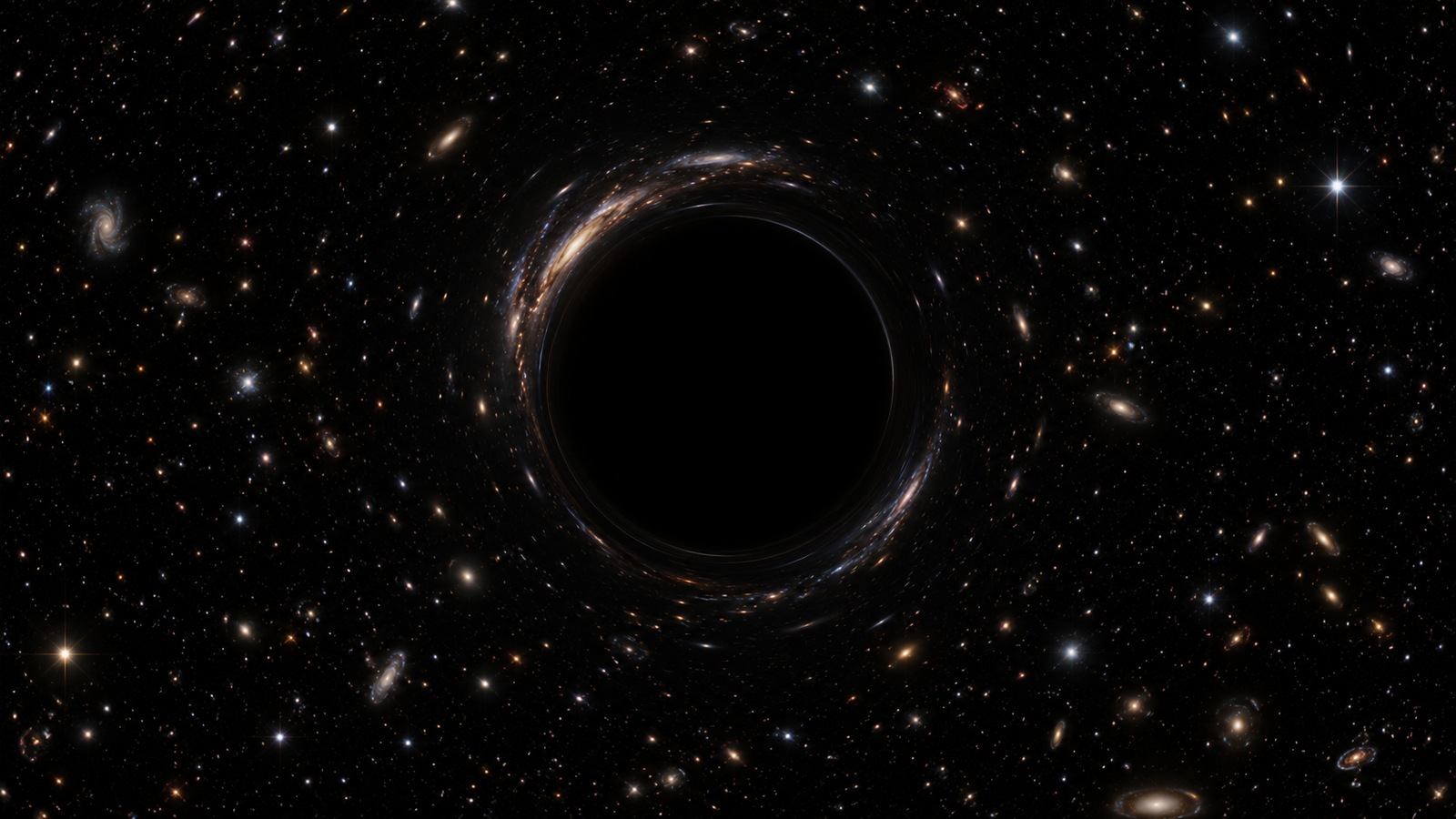
The term “Black Universe” evokes both wonder and unease—a poetic description for the unseen 95% of our cosmos that remains cloaked in mystery. In scientific terms, this hidden domain is often associated with dark matter (materia obscura) and dark energy (energia obscura), the invisible scaffolding and driving force that shape the universe’s destiny. Unlike the stars, gas, and galaxies we can observe, this “black” portion neither emits nor absorbs light, eluding even our most advanced telescopes. Yet, it governs everything—the movement of galaxies, the birth of stars, and perhaps the ultimate fate of existence itself. To understand the Black Universe is to peer into the most profound enigma of modern astrophysics. Scientists have charted cosmic microwaves, mapped gravitational distortions, and modeled invisible particles, but the full nature of this dark cosmos remains elusive. What exactly hides in the dark? Why does it matter? And what might happen if we ever manage to illuminate it?
The Observable Universe vs. the Unseen Realm
When we gaze at the night sky, the starlight that reaches us seems infinite. But in truth, all visible stars, planets, and galaxies account for less than 5% of the total mass-energy of the universe. The remaining 95%—comprising dark matter and dark energy—cannot be observed directly.
Astrophysicists describe the universe as a vast cosmic web. Ordinary matter—called baryonic matter—collects in thin filaments along the web’s strands, forming galaxies and clusters. Yet these luminous structures float like tiny islands on a much greater, unseen ocean. It is that invisible ocean—the Black Universe—that holds galaxies together and pushes them apart in a paradoxical dance between gravity and expansion.
This duality is what makes the cosmos such a mystery: one force binds, while another drives apart. Together, they define the universe we inhabit—an eternal balance between attraction and acceleration.
The Birth of the Black Universe Concept
The notion of an invisible universe is not new. In the early 20th century, Swiss astronomer Fritz Zwicky observed that galaxies in the Coma Cluster moved too quickly to be held together by visible mass alone. He proposed the existence of “dunkle Materie”—dark matter. His peers were skeptical, but later observations confirmed his suspicions: something massive, invisible, and gravitationally powerful pervades space.
Decades later, Vera Rubin studied the rotation curves of spiral galaxies and made a revolutionary discovery. Instead of slowing down toward the edges, stars on the outer rims of galaxies rotated at nearly the same speed as those near the center—evidence of an unseen halo of matter surrounding each galaxy. Her data reshaped our understanding of cosmic structure.
By the late 20th century, dark matter was accepted as a cornerstone of cosmology. Yet a new puzzle emerged: the universe’s expansion was accelerating, not slowing down as gravity would suggest. To explain this, scientists introduced the concept of dark energy—a mysterious repulsive force filling all of space. With that, the Black Universe became more than a curiosity; it became the dominant reality.
Dark Matter: The Invisible Framework of Galaxies
Dark matter, which makes up roughly 27% of the universe, acts as the gravitational glue that binds galaxies together. Without it, galaxies would simply fly apart. But what is it made of? Scientists have proposed several candidates. One possibility is WIMPs (Weakly Interacting Massive Particles), theoretical entities that barely interact with normal matter except through gravity. Another hypothesis centers on axions, lightweight particles predicted by extensions of quantum field theory. A newer idea involves sterile neutrinos, cousins of the elusive neutrinos that barely interact with anything. To detect dark matter, researchers use underground detectors shielded from cosmic radiation, hoping to catch a rare collision between a dark particle and an atomic nucleus. None have been confirmed yet, but the search continues in deep mines, cryogenic labs, and the vast detectors of CERN. Gravitational lensing—the bending of light by massive objects—also offers indirect proof. When astronomers observe distant galaxies distorted by invisible mass, they can map the dark matter’s presence like fingerprints left in space.
Dark Energy: The Force That Defies Gravity
If dark matter pulls, dark energy pushes. Accounting for nearly 68% of the universe, dark energy is the mysterious pressure accelerating cosmic expansion. Its discovery in the late 1990s, through observations of distant supernovae, stunned the scientific world.
Einstein’s cosmological constant (Λ)—originally introduced and later discarded—suddenly resurfaced as a plausible explanation. Perhaps the vacuum of space itself carries an intrinsic energy that causes it to stretch. Other theories propose that dark energy is dynamic—a field that changes over time, known as quintessence.
Whatever it is, dark energy dominates the universe’s evolution. As space expands faster and faster, galaxies drift away until their light fades beyond visibility. Billions of years from now, if dark energy continues unchecked, the cosmos may end in a “Big Freeze,” where stars burn out and black holes evaporate in eternal darkness.
The Cosmic Web: Where Darkness Weaves Structure
Through large-scale simulations and deep-space mapping, astronomers have revealed that galaxies form along an intricate cosmic web—massive filaments and voids spanning billions of light-years. The luminous matter traces the scaffolding of dark matter, glowing faintly like dew along a spider’s web.
This structure did not appear randomly. Tiny quantum fluctuations in the early universe—seeds of density variation—grew under gravity’s influence, drawing dark matter and ordinary matter together. Over billions of years, this led to the formation of stars, clusters, and galaxies.
Dark matter acts as the backbone of this architecture. Without it, the universe would be diffuse, lacking the gravitational pull to coalesce into complex structures. In this sense, the Black Universe is the true builder of cosmic beauty—its silent hand shaping everything we see.
The Cosmic Microwave Background: The Universe’s Faint Echo
To understand the dark universe, cosmologists turn to the Cosmic Microwave Background (CMB)—the afterglow of the Big Bang. Discovered accidentally in 1965 by Arno Penzias and Robert Wilson, this faint radiation serves as a cosmic photograph of the universe just 380,000 years after its birth. Subtle temperature variations in the CMB reveal how matter, both visible and invisible, was distributed in the early universe. Satellite missions like COBE, WMAP, and Planck have mapped these patterns in exquisite detail. Their data confirm that only a small fraction of matter is baryonic—everything else must be dark. These maps not only verify dark matter’s existence but also hint at the influence of dark energy in the universe’s early expansion. The fingerprints of the Black Universe are literally etched into the oldest light we can detect.
Black Holes: Cosmic Shadows or Gateways?
When we hear “black,” our minds often turn to black holes—regions where gravity is so intense that even light cannot escape. While distinct from dark matter, black holes are essential players in the cosmic drama. They embody the extreme effects of gravity and may even interact with dark matter in ways we don’t yet understand.
Some theorists suggest that dark matter could accumulate around black holes, influencing their growth and radiation patterns. Others propose that primordial black holes—formed just after the Big Bang—might constitute some portion of dark matter.
Moreover, black holes challenge our understanding of information, entropy, and space-time curvature. They may even hint at deeper physics linking quantum mechanics to gravity—a bridge that could ultimately unravel the mystery of the Black Universe itself.
Peering into the Invisible: The Tools of Discovery
Studying something that doesn’t emit or reflect light might seem impossible, yet astronomers have developed ingenious methods to probe the unseen.
- Gravitational Lensing: When light from a distant galaxy passes near a massive object, it bends, creating distortions or multiple images. By analyzing these effects, scientists can map the hidden mass—dark matter—responsible for the bending.
- Galaxy Rotation Curves: Measuring how fast stars orbit within galaxies allows astronomers to infer the presence of dark halos that can’t be seen but exert gravitational influence.
- Cosmic Surveys: Instruments like the Euclid Telescope and Vera C. Rubin Observatory are mapping billions of galaxies to track the evolution of cosmic structure and the fingerprints of dark energy.
- Particle Experiments: Facilities like XENONnT in Italy and LUX-ZEPLIN in the U.S. are attempting to catch fleeting interactions between dark matter and regular atoms.
Through these efforts, the invisible universe slowly takes shape—not in light, but in gravity, motion, and mathematics.
The Theories Competing to Explain the Black Universe
While the standard model of cosmology (ΛCDM) describes dark energy as a cosmological constant and dark matter as cold, slow-moving particles, not all scientists agree. Competing theories attempt to explain the phenomena without invoking unseen substances.
One such idea is Modified Newtonian Dynamics (MOND), which posits that our understanding of gravity itself changes at galactic scales. Another is Emergent Gravity, proposed by Erik Verlinde, suggesting that gravity arises from quantum information—meaning dark matter might be a manifestation of entropy rather than a particle.
Others consider exotic physics such as extra dimensions, hidden sectors, or mirror universes where dark matter could form entire galaxies invisible to us. These ideas remain speculative, but they highlight how the Black Universe challenges the limits of human knowledge.
Cosmic Evolution and the Fate of Darkness
The interplay between dark matter and dark energy defines the universe’s long-term evolution. In the early cosmos, dark matter dominated, allowing galaxies to form. Today, dark energy is winning, stretching space ever faster. If current models hold, the universe’s expansion will accelerate indefinitely. Stars will exhaust their fuel, galaxies will drift apart, and even black holes will evaporate through Hawking radiation. In this scenario—the “Big Freeze”—the Black Universe becomes literal, as entropy reigns supreme and light fades into oblivion. Alternatively, if dark energy changes over time, it could lead to different outcomes: a Big Rip, where expansion tears apart everything, or a Big Crunch, where the universe collapses back into itself. For now, observations favor eternal expansion, but the cosmos may yet surprise us.
Philosophical and Cultural Dimensions of the Black Universe
Beyond equations and telescopes, the Black Universe touches something deeply human—the desire to understand our place in the unknown. Ancient civilizations gazed at the dark sky and saw gods, myths, and omens. Today, we see the same darkness through scientific eyes, yet the awe remains the same.
The concept of a universe dominated by unseen forces also resonates metaphorically. It reminds us that reality is layered—that what we perceive is only a fragment of what exists. Just as dark matter binds galaxies, invisible connections bind humanity to the cosmos.
Art, literature, and philosophy have all drawn inspiration from cosmic darkness—from Dante’s celestial spheres to modern science fiction exploring parallel realities. In this sense, the Black Universe is both a scientific frontier and a mirror for the human imagination.
Modern Research and Future Missions
As technology advances, so too does our ability to probe the unseen. Several cutting-edge missions are dedicated to unveiling the secrets of the Black Universe:
- The Euclid Mission (European Space Agency) launched to map billions of galaxies and measure how dark energy influences cosmic expansion.
- The James Webb Space Telescope (JWST) peers deep into cosmic history, observing the first galaxies where dark matter shaped luminous structure.
- The Dark Energy Survey (DES) uses powerful cameras in Chile to study weak gravitational lensing, offering new insights into dark matter distribution.
- The Rubin Observatory’s Legacy Survey of Space and Time (LSST) will track billions of celestial objects, creating the most detailed 3D map of the universe ever made.
Each of these projects represents a step toward transforming speculation into understanding—a slow illumination of the cosmic shadows.
Quantum Connections: The Deepest Mystery Yet
Some physicists suspect that the answers to dark matter and dark energy lie not in astronomy but in quantum theory. Space itself may be a quantum fabric, its energy fluctuations giving rise to dark energy. The holographic principle, derived from string theory, proposes that the universe’s information is encoded on a lower-dimensional surface—meaning that what we perceive as 3D reality might be a projection. If true, dark energy could emerge naturally from quantum entanglement across this cosmic “hologram.” Meanwhile, quantum field fluctuations might explain why the vacuum of space exerts pressure. But calculations often predict vastly larger energy densities than observed—a discrepancy known as the cosmological constant problem, one of the biggest puzzles in physics. These ideas, while complex, point to a unifying truth: the Black Universe may not be separate from known physics but rather an expression of its most profound, hidden layers.
Human Curiosity: The Light in the Darkness
The story of the Black Universe is also a story of human persistence. For every discovery we make, the horizon of mystery expands. When scientists first measured the cosmic background radiation, they thought they’d reached the beginning. Instead, they uncovered evidence of vast unseen forces.
Our telescopes grow sharper, our simulations more precise, yet the universe retains its secrets. This humbling truth reminds us that knowledge is not a conquest but a conversation—a dialogue between light and darkness, between what we can measure and what we can only imagine.
In many ways, the Black Universe is less a destination than an invitation: a call to explore the boundaries of perception, to embrace the unknown, and to remember that discovery begins in curiosity.
Toward Illumination
The Black Universe is not merely a poetic metaphor—it is the scientific reality that defines existence. Composed of dark matter and dark energy, it shapes galaxies, fuels cosmic acceleration, and holds the blueprint of everything we know. Its scientific names—materia obscura and energia obscura—reflect its essence: powerful, pervasive, and profoundly mysterious. We live in a cosmos where the visible is the exception, not the rule. The real universe—the Black Universe—operates silently, invisibly, yet decisively, dictating the rhythm of time and the geometry of space. As technology advances and theories evolve, we inch closer to understanding this vast unseen realm. But perhaps the greatest revelation is not that most of the universe is dark—it’s that in seeking to unveil it, humanity reveals its own brightest quality: the unending drive to know.