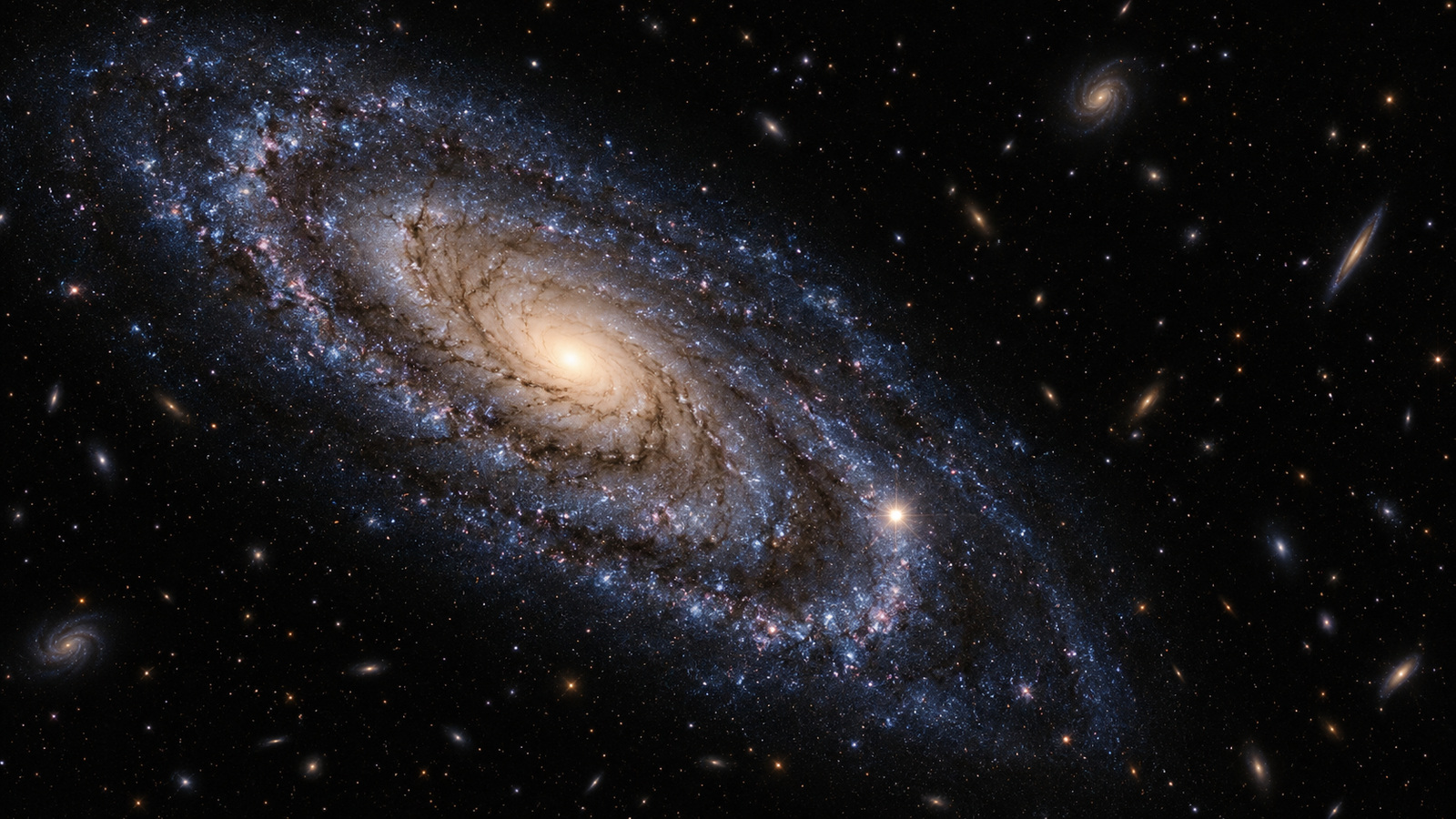
Two Universes, One Mystery
In cosmology, few questions ignite as much curiosity as the idea of the “Black Universe.” While the Observable Universe—scientifically estimated to stretch about 93 billion light-years in diameter—represents everything we can detect using light, radiation, and other measurable forms of energy, the Black Universe symbolizes something much deeper and more elusive: the unseen, unlit, and potentially infinite realm that lies beyond our current perceptual reach. Scientists often refer to this hidden domain through physical concepts like dark matter, dark energy, and cosmic inflation fields, but the “Black Universe” captures the imagination in a way that scientific terminology alone cannot. To understand the difference between the two, we must explore what defines “observable,” what “black” truly means in a cosmic sense, and how both interact within the great tapestry of spacetime. This isn’t just an academic distinction—it’s a journey into how we define existence itself.
1. Defining the Observable Universe
The Observable Universe is everything that human instruments can detect, either directly or indirectly, through the electromagnetic spectrum or gravitational effects. It is essentially a cosmic bubble defined by the maximum distance light has traveled since the Big Bang, roughly 13.8 billion years ago.
The Cosmic Light Horizon
Because light travels at a finite speed (about 299,792 kilometers per second), we can only see as far as light has had time to reach us. This forms a boundary called the cosmic light horizon. Beyond this horizon, light from more distant regions hasn’t yet arrived—meaning those areas exist, but remain invisible to us for now.
A Universe in Motion
Here’s where things become even more fascinating: the universe is expanding, and the rate of that expansion is accelerating. As a result, regions of space that were once visible may eventually move beyond our observational horizon, disappearing from view forever. This phenomenon gives the Observable Universe a constantly evolving edge—an invisible frontier that shifts with time.
2. The Scale of What We Can See
Our observable bubble contains approximately two trillion galaxies, each harboring billions or even trillions of stars. Within those galaxies are nebulae, quasars, pulsars, exoplanets, and cosmic microwave background (CMB) radiation—the faint afterglow of the Big Bang. Every photon from these structures tells a story billions of years old.
The Cosmic Microwave Background
Discovered in 1965 by Arno Penzias and Robert Wilson, the CMB represents the oldest detectable light in the universe, radiating from when the cosmos was only 380,000 years old. It provides a snapshot of the universe’s early conditions and gives cosmologists insight into its age, composition, and rate of expansion.
Limits of Detection
Despite our technological prowess—telescopes like Hubble, James Webb, and Planck—we can only see a fraction of the universe. Our instruments are tuned to light and radiation, meaning they’re blind to anything that doesn’t emit, reflect, or distort light in measurable ways. This blindness gives rise to the notion of the Black Universe—the unseen counterpart that dominates reality.
3. Enter the Black Universe
If the Observable Universe is everything we can see, then the Black Universe encompasses everything we cannot. It’s not merely the darkness between stars—it’s the realm of dark matter, dark energy, and the unknown portions of spacetime beyond the cosmic horizon.
The Universe of Darkness
Approximately 95% of the universe consists of invisible entities. Only 5%—ordinary baryonic matter—makes up the stars, planets, gas, and dust we recognize. The rest? That’s the black portion.
- Dark Matter (≈27%) – An unseen form of matter that exerts gravitational effects on galaxies and clusters but emits no light. It’s detected indirectly through its influence on visible matter.
- Dark Energy (≈68%) – A mysterious form of energy thought to be responsible for the accelerating expansion of the universe. It acts as an anti-gravitational force, pushing galaxies apart.
The “Black Universe” thus refers not only to what lies beyond the observable edge, but also to the dominant but invisible structure within the observable one.
4. Why “Black”? The Nature of Cosmic Darkness
The term “black” in cosmological context doesn’t simply mean “colorless” or “empty.” It signifies invisibility—a lack of emitted or reflected light detectable by human technology. Black holes, for example, are not black because they contain “nothing,” but because their gravity is so strong that light cannot escape. Similarly, the Black Universe isn’t an absence of reality—it’s an abundance of unseen phenomena.
Dark Doesn’t Mean Empty
Astronomers often say: “Darkness is information waiting to be revealed.” Each region of darkness could be filled with exotic particles, gravitational waves, or even parallel forms of structure. It’s not that the Black Universe isn’t there—it’s that we lack the sensory and instrumental bandwidth to perceive it.
The Language of Darkness
In the language of physics, darkness is just another wavelength we haven’t yet tuned into. Just as radio telescopes opened up invisible frequencies of the sky, future technologies—perhaps involving neutrino astronomy or quantum gravitational detectors—might one day illuminate the Black Universe.
5. Beyond the Horizon: The Invisible Universe
The edge of our observable cosmos doesn’t represent a physical wall—it’s simply the limit of our vision. Beyond that edge, the universe likely continues indefinitely, expanding into domains we’ll never observe directly. This continuation forms part of the conceptual Black Universe.
Cosmic Inflation and Hidden Regions
According to the theory of cosmic inflation, the universe expanded exponentially in the first fractions of a second after the Big Bang. This rapid expansion means that regions far beyond our observable horizon were stretched so far away that their light will never reach us. These regions, possibly infinite in number, remain part of the same universe—but forever black to us.
The Multiverse Possibility
Some interpretations of quantum cosmology and inflationary theory suggest that these distant regions might form distinct “bubble universes” with different physical constants or laws—a multiverse. If that’s the case, the Black Universe could represent not just unseen regions of our cosmos, but entire other universes inaccessible through any known means.
6. Gravity’s Shadow: The Hidden Structure of Space
Even though we cannot see most of the universe, we can feel its presence through gravity. Galaxies spin too fast for their visible matter to hold them together, implying the existence of invisible halos of dark matter. Similarly, the universe’s accelerating expansion hints at dark energy acting across vast scales.
The Cosmic Web
Computer simulations, supported by astronomical data, reveal that galaxies and clusters form along vast filaments of dark matter—creating what’s known as the Cosmic Web. Between these filaments lie immense voids, regions almost entirely empty of visible galaxies but rich in gravitational potential.
This invisible scaffolding is one of the defining features of the Black Universe. It shapes everything we can see, yet it remains imperceptible, like the black ink behind the stars.
7. The Observable and the Black: Two Halves of One Reality
Rather than treating them as separate universes, cosmologists view the observable and black universes as complementary halves of the same cosmic whole. The observable part is a temporary snapshot—an illuminated island within an ocean of darkness.
Light as a Limiting Tool
Everything we know about the universe is based on the detection of light or its distortions. The Black Universe challenges that foundation by suggesting that light-based observation may be inherently limited. Gravitational waves, neutrinos, and quantum fluctuations may offer the next steps in “seeing” the unseeable.
Seeing Without Light
Projects like the Laser Interferometer Gravitational-Wave Observatory (LIGO) and Event Horizon Telescope (EHT) already represent early steps toward this goal. They allow us to infer and visualize phenomena—like merging black holes or the shadow of Sagittarius A*—without relying solely on visible light. These glimpses bring us closer to understanding the Black Universe in physical, not just philosophical, terms.
8. Philosophical Dimensions: What Is “Observable” Anyway?
The contrast between the Observable and Black Universe invites deep philosophical reflection. What does it mean to “observe” something? Does existence depend on detection?
The Limits of Human Perception
Humans evolved to perceive a narrow slice of the electromagnetic spectrum. The cosmic truth extends far beyond visible light, from radio waves to gamma rays—and perhaps further still, into dimensions of energy and information we cannot yet conceptualize.
The Observer’s Paradox
Quantum theory teaches us that observation affects reality at the smallest scales. If this principle extends outward, the boundary of the Observable Universe might not just be a physical limit—it could be a perceptual one. The Black Universe, then, might represent not a lack of existence, but a lack of conscious interaction.
9. The Future of Discovery
Our understanding of the cosmos is evolving at breathtaking speed. New telescopes like the James Webb Space Telescope (JWST), Euclid, and Vera C. Rubin Observatory are designed to probe deeper into space—and time—than ever before.
Dark Energy Surveys
Projects like the Dark Energy Survey (DES) and Nancy Grace Roman Space Telescope aim to measure how dark energy shapes cosmic structure. By mapping millions of galaxies, these missions hope to distinguish whether dark energy is a property of space itself or a sign of new physics.
Particle Physics Meets Cosmology
At the same time, experiments in particle physics—like those at CERN’s Large Hadron Collider—search for dark matter candidates such as WIMPs (Weakly Interacting Massive Particles) or axions. Each discovery could peel back another layer of the Black Universe, turning invisible matter into measurable fact.
10. The Human Connection: Wonder and Imagination
The idea of a Black Universe touches something deeply human: our need to imagine the unseen. Just as early astronomers once mapped the heavens with naked eyes, today’s scientists chart the invisible with mathematics, simulations, and instruments. The difference between the Observable and the Black Universe reflects not just a cosmic divide—but an emotional one.
The Allure of the Unknown
Darkness, in a cosmic sense, is a mirror of our curiosity. It reminds us that every discovery opens new mysteries. The further we push the boundaries of observation, the more vast and unknowable the universe becomes. This paradox—knowing that we can never fully know—drives science forward.
Cultural Echoes
From myth to modern physics, humans have always woven narratives around the light and the dark. The Observable Universe is the story we’ve written in starlight; the Black Universe is the unwritten chapter still expanding beyond imagination.
11. Could the Black Universe Be Another Form of Reality?
Speculative physics suggests that what we call the “Black Universe” could correspond to different dimensions or parallel structures. Concepts like brane cosmology and string theory propose that our universe might be one of many “branes” floating in higher-dimensional space.
Mirror Matter and Hidden Symmetries
Some models even hypothesize a mirror universe—a reflection of our own, governed by opposite physical parameters but connected through gravity or quantum entanglement. If true, the Black Universe could literally be a mirrored twin, invisible to our light but dynamically intertwined.
Time’s Dark Twin
There’s also the concept of a “time-reversed” universe emerging from the Big Bang in the opposite temporal direction. In such a framework, the Black Universe might not just be spatially distant but temporally inverted—expanding backward in time relative to ours. Though purely theoretical, these ideas highlight how the invisible cosmos challenges the limits of both science and imagination.
12. Why the Black Universe Matters
Beyond the poetry, the Black Universe is central to modern physics. Understanding dark matter and dark energy isn’t just about filling gaps in equations—it determines the ultimate fate of everything.
The Fate of the Cosmos
If dark energy continues to dominate, the universe may expand forever in a “Big Freeze,” with galaxies drifting apart into darkness. If its strength changes, alternate fates—like the “Big Rip” or “Big Crunch”—may await. In every scenario, the unseen components of the Black Universe hold the deciding vote.
Scientific and Existential Stakes
Each discovery about the dark cosmos reshapes our understanding of reality itself. The boundary between known and unknown defines not just cosmology, but our place in the grand design.
13. The Eternal Frontier
The distinction between the Black Universe and the Observable Universe is, ultimately, a matter of perspective. As technology advances, what was once “black” may become visible, and new forms of darkness will emerge beyond it. The frontier moves outward, but the mystery remains.
The Expanding Horizon of Knowledge
Every telescope, detector, and equation we invent pushes the edge of observation further. Yet even as we illuminate more of the cosmos, the ratio of known to unknown continues to shrink. The Black Universe reminds us that ignorance is infinite—but so is curiosity.
A Universe of Questions
Will we ever “see” dark matter? Can we harness dark energy? Is our universe just one of many? The answers may lie in the darkness between the stars—waiting for the next generation of explorers.
Light and Shadow in the Same Sky
The Observable Universe represents humanity’s collective gaze—the bright hemisphere of cosmic understanding. The Black Universe, by contrast, is the vast and silent counterpart that dwarfs our comprehension. Together, they form the complete cosmos: half illuminated, half hidden, yet inseparably linked.
The difference between them isn’t just physical—it’s symbolic. The Observable Universe shows us what we know; the Black Universe shows us what we don’t. In that tension between light and shadow, knowledge and mystery, lies the true beauty of existence itself. And perhaps, as technology and imagination evolve, the “Black Universe” will someday become our next observable horizon—revealing that what we once called darkness was, all along, the richest light of all.