
Orion’s Blue-White Beacon Is a Supergiant
Rigel is easy to recognize once Orion’s three belt stars become familiar. It shines near one of the hunter’s feet, offering a cool blue-white contrast to the warmer appearance of Betelgeuse across the constellation. That simple visual comparison opens a much larger story. Rigel is more specifically a blue supergiant, an extremely luminous massive star whose present condition differs substantially from the Sun’s. It can look steady and uncomplicated to the unaided eye while its atmosphere changes, its interior supports pulsations, and fainter stellar companions occupy the same wider system. The point of light also helps illuminate nearby-looking reflection dust. Following those connections turns Rigel from a useful sky landmark into a case study in stellar evolution, measurement, and the difference between what eyes immediately reveal and what astronomical instruments can establish.
Finding the Star in Orion’s Pattern
Begin with the compact line of three stars that forms Orion’s belt. The surrounding bright stars create a larger figure, with Betelgeuse and Rigel on opposite sides of that familiar pattern. Rigel belongs near a foot of the traditional hunter figure, though the apparent orientation changes as the constellation rises, crosses the sky, and sets. Calling it simply the lower-right star works only for some views. A recognizable relationship to the belt is more dependable than a fixed direction on a page.
Orion lies close enough to the celestial equator to be visible from much of the inhabited world. The season of convenient evening viewing depends on hemisphere and date, and the height above the horizon depends on latitude. Rigel is especially familiar in Northern Hemisphere winter skies. In the Southern Hemisphere, the figure is seen from a different orientation. Those differences do not change the star; they change the observer’s perspective on the same sky geometry.
Rigel is bright enough that finding it does not require a telescope. A clear sky and an unobstructed view of Orion often provide the essential conditions. Instruments become useful when the observing goal changes from recognition to exploring companions or comparing detailed stellar measurements. Starting with the naked-eye landmark gives the later science an anchor. The bright point in a catalog or research paper is the same object you can identify in a familiar constellation.
Why Blue Supergiant Is the More Precise Description
The word ‘blue’ describes the star’s high effective surface temperature compared with a yellow-white star such as the Sun. It does not mean Rigel emits only blue light. A hot star radiates across a broad spectrum, with the distribution of that energy influencing its apparent color. ‘Supergiant’ identifies a stellar luminosity class associated with an extended, highly luminous atmosphere. It is more informative than using ‘giant’ as a general synonym for anything large. Rigel combines exceptional brightness with a radius and mass far above solar values. Its surface-temperature scale is concrete: NASA’s cosmic-temperature guide uses approximately 11,000 kelvin, nearly twice the Sun’s roughly 5,800-kelvin effective temperature. This compares temperatures on an absolute scale, rather than claiming that a blue-looking star is only twice as luminous. The amount of radiating surface also matters to its total output.
Spectral classification adds another layer of evidence. Absorption and emission features reveal temperature, atmospheric conditions, and motions that color alone cannot specify. A star’s spectrum lets astronomers distinguish objects that may look similarly blue-white to human eyes. Rigel is classified as a B-type supergiant, a description grounded in its measured light rather than a casual visual impression. NASA’s account of stellar life cycles identifies Rigel as a massive blue supergiant within the broader story of how stars evolve.
Brightness in the Sky Is Not the Same as Luminosity
Apparent brightness tells us how much light reaches our position, while luminosity describes how much energy a star emits. A nearby modest star can appear brighter than a distant powerful one. Rigel remains conspicuous despite lying hundreds of light-years away because its intrinsic output is enormous. Comparing it with the Sun therefore requires distance as well as the light we receive. The distinction is foundational: a bright sky point does not automatically identify a nearby object, and a faint point does not automatically identify a weak one.
Distance Sets the Scale of Almost Everything Else
Rigel’s distance is often summarized as roughly 850 to 900 light-years, but individual published determinations carry uncertainties and depend on the evidence used. Parallax measurements infer distance from a small shift in apparent position as Earth moves around the Sun. Other methods combine measurements of angular extent with physical models of the star. For a luminous supergiant, interpreting those models requires attention to the atmosphere and wind. A distance estimate is therefore a measured constraint, not a perfect label permanently attached to the object.
A 2022 study combining spectroscopy and intensity interferometry obtained a Rigel distance consistent with the Hipparcos scale under its adopted luminosity model. The study also examined how changing that assumed luminosity affected the inference. This is a useful example of scientific transparency: the investigators showed which input mattered rather than presenting a result without its dependencies. For readers, the broad lesson is that stellar numbers can be related to one another through the same observational and theoretical assumptions.
Distance uncertainty propagates into luminosity because a more distant star must emit more energy to produce the same apparent brightness. It can also affect an inferred physical radius when combined with angular measurements. Consequently, disagreements among published values may reflect a common underlying distance issue rather than separate failures to understand each property. Keeping those connections visible avoids false precision. Rigel is unquestionably an extraordinary supergiant even when its exact parameters remain subjects of refinement.
The Color Contrast With Betelgeuse
Rigel and Betelgeuse provide a convenient introduction to stellar temperature through a constellation that many people already know. Rigel appears blue-white, while Betelgeuse is commonly described as orange-red. The contrast reflects very different surface conditions, not simply different brightnesses. It can be easier to appreciate when the stars are high enough to avoid strong atmospheric distortion. A low-altitude star may flash several colors because moving air changes the path of its light, adding an effect that belongs to Earth’s atmosphere.
The comparison should not become a simplistic chronological diagram. A blue star is not automatically young in every relevant sense, and a red star is not automatically following one universal path that all stars share. Mass, rotation, mixing, and interactions shape stellar evolution. Rigel’s classification tells us something about its present atmosphere, while its internal history requires additional evidence. The two stars make an excellent visual lesson, but their complete biographies cannot be read from color alone.
A Familiar Point of Light With Subtle Pulsations
Precision observations show that Rigel is variable rather than perfectly constant. Changes in brightness and spectral line velocities can reveal pulsations that are too subtle or complicated for a casual observer to track. A study using MOST photometry and long-term spectroscopy reported multiple significant pulsation modes. Such measurements matter because oscillations respond to conditions within a star. Rigel’s bright surface can therefore carry indirect information about an interior that no telescope can simply photograph.
Stellar Seismology Looks Beneath the Atmosphere
Asteroseismology uses stellar oscillations to test internal structure. Different modes depend on the distribution of density, the character of internal layers, and the physical forces restoring displaced material. The method has a loose analogy with studying Earth’s interior through seismic waves, although the observations and governing conditions differ. For a massive supergiant, interpreting the oscillations can help distinguish evolutionary models that otherwise produce similar surface appearances. The goal is not to hear sound traveling through space to Earth, but to measure how the star’s light and spectrum change.
Rigel is especially interesting because massive stars can pass through complicated phases before core collapse. Their mixing, mass loss, and earlier interactions influence the structures that oscillations probe. One simple evolutionary track may not describe every observed blue supergiant. Researchers compare modeled mode patterns with measured ones to investigate those differences. The research on asteroseismology and the blue-supergiant problem explains why internal diagnostics can address questions that color and luminosity alone leave unresolved.
That work also illustrates why uncertainty is productive rather than embarrassing. Several models can agree with an obvious blue-white appearance while disagreeing about the interior. New observations are useful precisely because they can separate those possibilities. Rigel remains an accessible sky object and a demanding research target at the same time. Its familiarity to observers does not mean its internal state has become a solved elementary exercise.
The Wider System Hides Fainter Stars
Rigel’s brilliant primary dominates the naked-eye view, but the wider stellar system includes fainter companions. A telescope can reveal a nearby companion under suitable conditions, while closer subcomponents require more specialized evidence. The important observational difficulty is contrast. A companion may be detectable in isolation yet difficult to separate beside a much brighter source. Scattered light, telescope optics, and atmospheric steadiness all influence whether the faint point can be distinguished.
It is useful to separate visual proximity from physical association. Two stars can appear close together simply because they lie along similar directions. Establishing a real system requires evidence such as motion, distance, and orbital behavior. Likewise, the appearance of one faint point in a telescope does not guarantee it is a single star internally. Spectroscopy and high-resolution methods can reveal structure beyond an ordinary eyepiece view. Rigel’s system is a reminder that the sky’s apparent simplicity often reflects limited resolving power.
Lighting the Witch Head Without Creating Its Own Glow
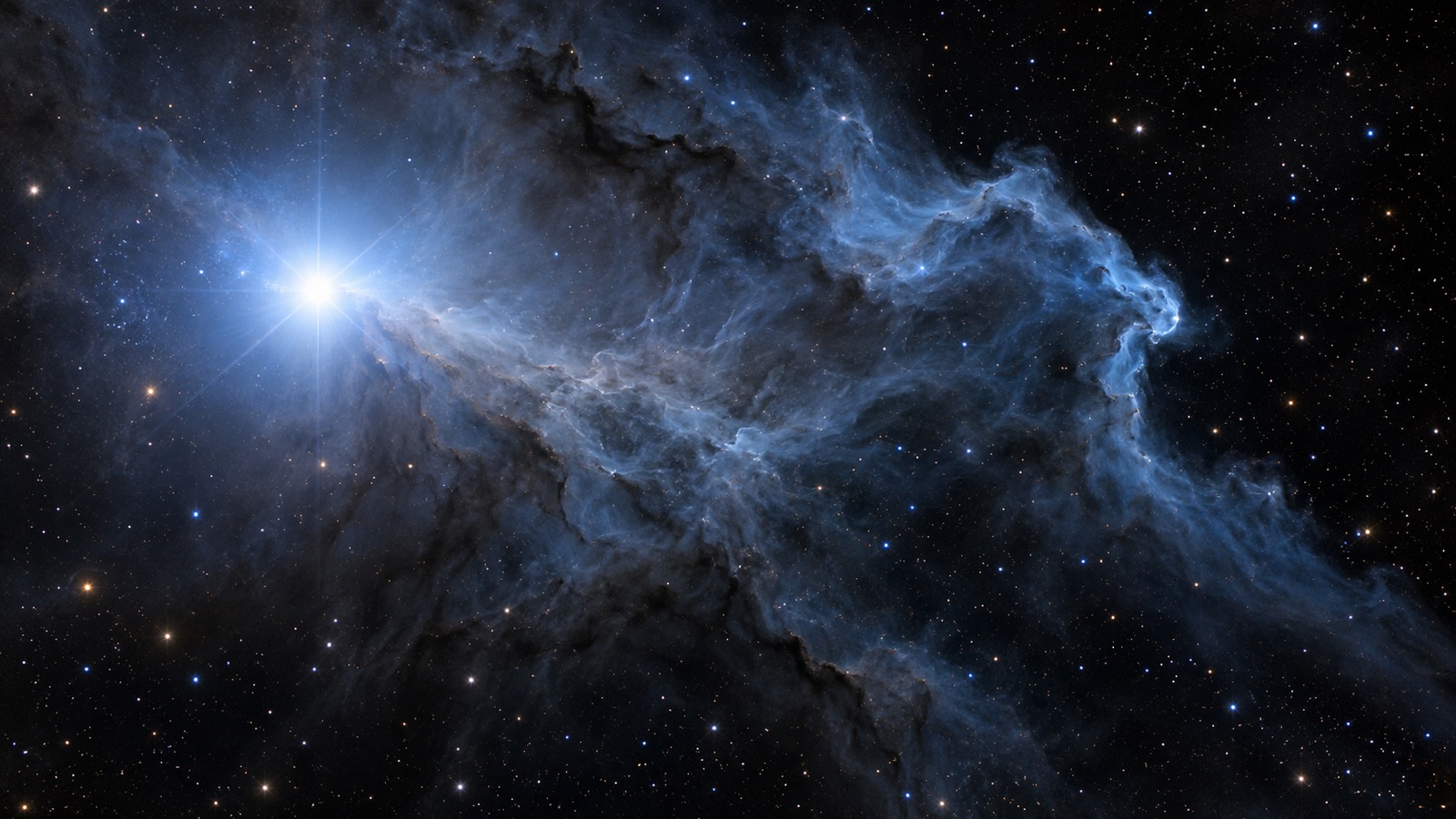
The Witch Head Nebula is a reflection nebula associated with Rigel’s illuminating light. Dust scatters incoming starlight, producing a visible structure rather than primarily generating its own emission through ionized gas. NASA’s description of the nebula explains its blue appearance through the illuminating star and the scattering behavior of dust. This is a different mechanism from the red hydrogen emission familiar in many nebula photographs. A bright nearby-looking star and a cloud can therefore form an optical relationship that requires more explanation than simply saying the cloud glows.
Its Future Is Not an Appointment on a Calendar
Rigel’s high mass places it in the class of stars relevant to eventual core-collapse supernovae. That broad expectation does not supply a reliable date for an explosion. The remaining evolution depends on its internal structure, mass loss, and earlier history, all of which require modeling. Saying it could end in a supernova is different from announcing that an event is imminent on a human timescale. A striking future does not justify a countdown unsupported by the measurements.
The same caution applies to predictions of the compact remnant. Stellar collapse can produce different outcomes depending on core properties and the explosion process. A general explainer should avoid presenting one exact remnant mass or fate as settled for Rigel without the corresponding evidence. The scientific interest lies in understanding which physical conditions determine those outcomes. Rigel contributes a nearby opportunity to investigate a massive star before the final stages, not a guaranteed preview with every future detail already known.
A Simple Observation With a Deeper Payoff
On a clear evening when Orion is well placed, begin by identifying the belt and then finding Rigel. Compare its appearance with Betelgeuse while noting the stars’ altitude and the steadiness of the air. That short exercise connects an immediate visual impression with a physical difference in stellar atmospheres. It also gives you a reason to distinguish intrinsic color from atmospheric flashing. You do not need to see a surface, resolve companions, or photograph faint dust for the observation to be meaningful. Then add the scientific layers one at a time: Rigel is a blue supergiant, its luminosity depends on a measured distance, its subtle variability probes its interior, and its wider environment contains companions and illuminated dust. Each layer answers a different question. Together they transform one of Orion’s easiest landmarks into a rich example of how astronomy works. A point of light can be familiar enough to find in seconds while still supporting research that takes years of careful observation and comparison.


