The Guiding Light of the Northern Sky
For as long as humans have gazed into the night sky, one star has held a place of unmatched significance — Polaris, known scientifically as Alpha Ursae Minoris. Commonly called the North Star, Polaris appears to hang motionless in the heavens, steadfast while every other star circles and shifts through the night. Its stillness has guided travelers, sailors, explorers, and dreamers for millennia. But why does this star remain fixed in place when everything else in the sky moves? The answer lies in the elegant geometry of Earth’s rotation and the precise position of Polaris in the celestial sphere. Understanding Polaris is to uncover one of the most beautiful intersections of motion, perspective, and cosmic alignment in our universe — a story that blends astronomy, navigation, and timeless wonder.
A Celestial Anchor: What Polaris Really Is
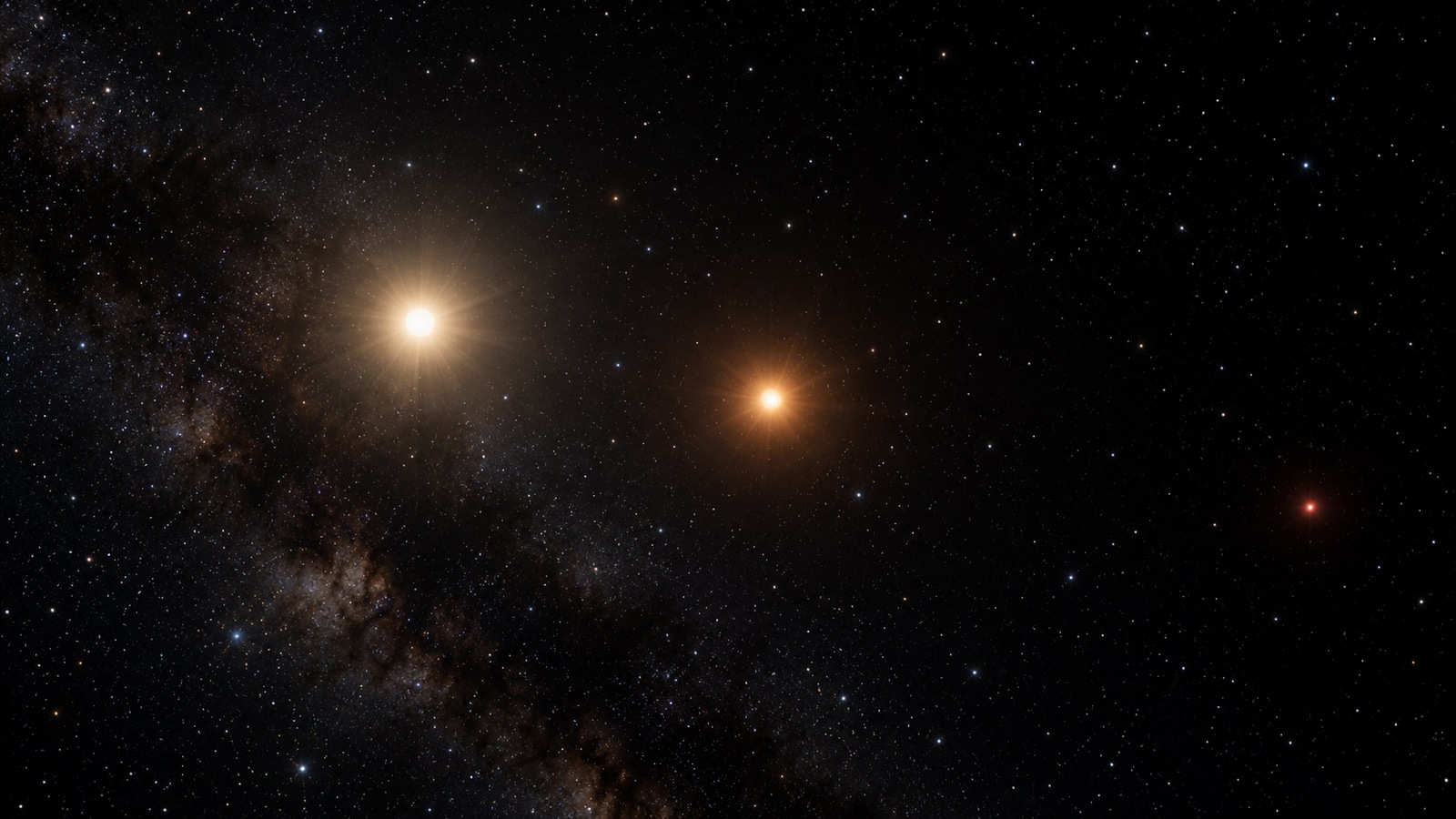
Polaris is not just any star; it’s a multiple-star system, a celestial family rather than a single glowing point. Located about 433 light-years away in the constellation Ursa Minor (the Little Bear), Polaris is actually made up of at least three stars: Polaris A, Polaris Ab, and Polaris B.
The primary star, Polaris A, is a yellow supergiant (F7 Ib) — much larger and more luminous than our Sun. It burns with a gentle golden hue and is estimated to shine roughly 2,500 times brighter than the Sun. Orbiting close by is Polaris Ab, a faint main-sequence companion, while Polaris B, a smaller and dimmer star, circles the pair at a much greater distance.
Through telescopes, this trio paints a striking image of complexity hidden behind what appears to be a single, steady light in our night sky.
The Cosmic Geometry of Stillness
The reason Polaris seems not to move is rooted in the geometry of Earth’s rotation. Our planet spins around an imaginary line that runs from the North Pole to the South Pole — the Earth’s rotational axis. If you extend that line infinitely into space, it points almost directly toward Polaris. As the Earth rotates, every star in the sky appears to trace a circle around the celestial poles. The farther away a star is from that pole, the larger the circle it seems to make. But Polaris sits less than one degree away from the north celestial pole, meaning its apparent circle is so small that, to the naked eye, it seems perfectly still. In truth, Polaris does move — ever so slightly. Over the course of the night, it traces a tiny circle, less than two degrees wide. Yet from our human perspective on Earth, this movement is imperceptible, and so Polaris has become the fixed point around which the heavens appear to turn.
The Ancient Navigator’s Star
For thousands of years, Polaris has served as the ultimate celestial compass. Long before magnetic compasses or GPS satellites existed, navigators relied on the stars to determine direction.
Because Polaris sits almost directly above the North Pole, it marks true north — a fixed direction on Earth’s surface. Travelers could find their bearings by locating Polaris in the night sky. By measuring its height above the horizon (its altitude), they could even estimate their latitude — how far north they were. For example, if Polaris appeared 45° above the horizon, the observer was at roughly 45° north latitude.
From Viking sailors crossing the North Atlantic to explorers mapping unknown continents, the North Star has been a beacon of reliability in a world of constant motion.
A Star With Many Names
Throughout history, different cultures have recognized Polaris’s importance and given it names rich with symbolism. In ancient Greece, it was known as Kynosoura, meaning “dog’s tail,” referring to its position in the tail of the Little Bear constellation (Ursa Minor). The Latinized version of that name later gave rise to the word “cynosure,” which came to mean “something that draws attention” — a fitting description of a star that commands the northern sky. To the Arab astronomers, it was called Al-Judda al-Shamaliyyah, the “Northern Pointer.” The Chinese knew it as Beiji Xing, the “Star of the North Pole,” and in traditional Navajo cosmology, it was Náhookǫs Bikòʼ, the “Central Fire,” the unmoving hearth around which the sky rotates. Every culture that studied the heavens noticed the same phenomenon — a single, unmoving point of light — and built its myths, navigation, and spirituality around it.
The Subtle Drift: Precession and Polaris’s Temporary Throne
Though Polaris appears unchanging, it hasn’t always been — and won’t always remain — the North Star. Earth’s axis itself slowly wobbles in a motion called axial precession, caused by the gravitational tug of the Moon and Sun on our planet’s equatorial bulge.
This precession makes the axis trace a slow circle through the sky, taking about 26,000 years to complete one full cycle. As a result, the position of the celestial pole changes over millennia, and different stars take turns being the “North Star.”
Around 3000 BCE, the star Thuban in the constellation Draco held the title. Ancient Egyptians aligned parts of their pyramids with Thuban, not Polaris. In about 12,000 years, the bright star Vega in Lyra will become the new North Star.
Polaris’s reign as the pole star is, astronomically speaking, temporary — a brief era in Earth’s long celestial cycle. Yet for our age, it shines as a steadfast symbol of orientation and constancy.
The Pulsing Heart of Polaris: A Variable Star
While Polaris looks unwavering to us, it is not entirely constant in brightness. The main star, Polaris A, is a Cepheid variable, a type of star that expands and contracts rhythmically, causing its brightness to fluctuate.
Cepheid variables are crucial in astronomy because their pulsation periods are directly linked to their intrinsic brightness. By comparing a Cepheid’s true brightness to its apparent brightness from Earth, astronomers can measure distances to faraway galaxies.
Polaris pulsates with a period of about four days, though its variation is subtle — only about 0.03 magnitudes, barely noticeable without sensitive instruments. Interestingly, observations have shown that its pulsation amplitude has changed over time, puzzling astronomers and suggesting that Polaris may be evolving rapidly for a star of its kind.
This combination — a fixed position but a variable heart — makes Polaris one of the most scientifically fascinating stars in the night sky.
The Science of Position: Celestial Coordinates and Alignment
To understand Polaris’s special position, astronomers use the celestial coordinate system, which maps the sky much like latitude and longitude map Earth. The north celestial pole marks the point directly above Earth’s North Pole, while lines of right ascension and declination track positions across the heavens. Polaris’s declination is approximately +89°, meaning it sits less than one degree from the pole itself. This near-perfect alignment is what makes it so stable in our sky. As Earth spins eastward, stars appear to rise in the east and set in the west, tracing circular arcs around the celestial poles. At northern latitudes, you can see these circles vividly in long-exposure photographs, with Polaris at the very center — a glowing pivot of celestial motion.
Finding Polaris in the Sky
Polaris may be the most famous star in the northern sky, yet it’s not the brightest — it ranks only about 49th in brightness overall. To locate it, you can use the Big Dipper (Ursa Major) as a guide. The two outer stars in the Big Dipper’s bowl — Dubhe and Merak — form a line that points directly toward Polaris. Follow this line upward, and you’ll find the tip of the Little Dipper’s handle, where Polaris shines steadily. From most locations in the Northern Hemisphere, Polaris is visible all year round, never dipping below the horizon. The farther north you travel, the higher it climbs in the sky, until at the North Pole it stands directly overhead. In the Southern Hemisphere, however, Polaris is never visible — a reminder of how deeply our perspective shapes our view of the cosmos.
How Polaris Helps Measure Latitude
The connection between Polaris and latitude is one of the most elegant in all of observational astronomy. Because Polaris lies nearly at the celestial pole, its angle above the horizon directly equals the observer’s latitude on Earth.
For example, if you stand in Miami at about 25° north latitude, Polaris will appear 25° above the horizon. In New York City, around 40° north, it rises 40°. At the North Pole, it’s straight overhead at 90°.
This relationship allowed ancient navigators to determine their position with remarkable accuracy using only a sextant or even a simple astrolabe. The star’s reliability was so precise that it became a natural compass in human exploration — an unwavering guide by which ships and caravans crossed unknown worlds.
The Cultural and Symbolic Power of Polaris
Beyond its navigational use, Polaris has long represented guidance, constancy, and truth. In literature, religion, and philosophy, it serves as a metaphor for a steady point in a changing world — the light that never fades, the truth that never moves. In American symbolism, Polaris guided enslaved people seeking freedom through the Underground Railroad, earning it the name “The Star of Freedom.” Travelers moving northward at night would follow its position to stay on course toward liberation. For Arctic explorers and northern cultures, it became a celestial reference for home and orientation. In some Native American traditions, it is the star that “holds up the sky,” keeping the cosmic order intact. The constancy of Polaris, both real and symbolic, continues to inspire poetry, music, and storytelling across the globe.
The Motion We Don’t See: Earth’s Dance Through Space
To truly appreciate why Polaris appears still, it helps to remember that everything is moving. Earth spins on its axis at over 1,000 miles per hour, orbits the Sun at nearly 67,000 miles per hour, and the entire solar system races through the Milky Way at roughly 514,000 miles per hour.
Despite this cosmic dance, Polaris remains nearly fixed in our sky because all those motions are relative. The alignment between Earth’s axis and Polaris happens to be so precise that, from our viewpoint, it anchors the heavens even as both star and planet hurtle through space.
Over tens of thousands of years, however, this illusion changes. As precession shifts the axis, Polaris will drift away from the pole, and another star will take its place. Our North Star’s apparent stillness is only a brief pause in the grand ballet of celestial mechanics.
A Star System in Transition
Modern astronomical observations have revealed much about the Polaris system’s complexity. Polaris A, the supergiant, and its small companion Ab orbit each other at a distance of roughly 20 astronomical units — about the distance from the Sun to Uranus. The outer companion, Polaris B, lies about 2,400 astronomical units away and takes tens of thousands of years to complete a single orbit.
Polaris A is in a transitional phase of its stellar life, having left the main sequence and expanded into a supergiant. It fuses helium in its core and may eventually shed its outer layers to become a white dwarf. This evolution will subtly alter its brightness and color over the next few million years — a blink of an eye in cosmic terms.
The system offers astronomers a rare laboratory for studying how massive stars evolve and interact within multiple-star systems.
Observing Polaris Today: A Star for All Skywatchers
One of the remarkable things about Polaris is how easy it is to observe. Even in areas with moderate light pollution, it can be found without difficulty. Amateur astronomers often use Polaris to align their telescopes with the celestial north — a process called polar alignment — ensuring that long-exposure astrophotography tracks the stars correctly. Through even a small telescope, you can sometimes spot Polaris B, the faint outer companion, separated by about 18 arcseconds. The contrast between the golden supergiant and its tiny partner offers a glimpse into the diversity of stellar scales. Observing Polaris is not just a scientific exercise; it’s an act of connecting with humanity’s shared history of skywatching. Every time you find that steady point in the night sky, you’re participating in a tradition that stretches back tens of thousands of years.
The Southern Counterpart: Sigma Octantis
While Polaris dominates the northern sky, southern observers have no equally bright star marking their pole. The southern celestial pole lies in a relatively empty region of the sky. The closest visible star to it is Sigma Octantis, sometimes called the South Star, but it is faint — barely visible to the naked eye at magnitude +5.5.
This lack of a bright southern counterpart makes Polaris all the more special. Its perfect alignment and easy visibility have made it the unrivaled symbol of celestial direction for northern observers throughout history.
The Future of the North Star
In about 26,000 years, Earth’s precession will carry the North Celestial Pole away from Polaris. Around 14,000 CE, Vega, one of the brightest stars in the sky, will take its place as the new North Star. Later still, the pole will wander through the constellations Cepheus and Cygnus before eventually returning to Polaris’s neighborhood around 28,000 CE. This slow celestial cycle — sometimes called the Great Year — reminds us that even the most fixed things in our sky are part of an ever-changing cosmic story. For now, Polaris reigns supreme, but like all things in the universe, its stability is only temporary.
The Eternal Guide: Science and Symbolism United
Polaris is a rare intersection of physical precision and human meaning. Scientifically, it teaches us about the Earth’s motion, the geometry of the heavens, and the life cycles of massive stars. Culturally, it represents guidance, steadfastness, and hope — a reminder that even amid constant change, some points of reference endure.
Its seeming immobility is an illusion created by perfect cosmic alignment, but its significance is very real. For humanity, Polaris is not just a star; it is a promise — a fixed light by which we’ve found direction, both literally and metaphorically, for thousands of years.
The Wonder Above: A Final Reflection
Stand beneath a clear northern sky and look up. Find the Big Dipper, trace its pointer stars, and follow the line to the end of the Little Dipper’s handle. There it is — Polaris, the North Star, glowing with ancient light. The photons reaching your eyes tonight left Polaris centuries ago, traveling through the darkness of space long before your great-grandparents were born. Yet they arrive now, steady and sure, just as the star itself has been for generations of humanity. Everything in the cosmos moves — planets spin, galaxies drift, even space itself expands — yet one light above seems still. That illusion of constancy, born from geometry and motion, has become a symbol of all we seek when we look upward: stability, purpose, and guidance in an ever-turning world. In a universe of endless motion, Polaris reminds us that direction is not found by standing still but by knowing what to hold onto as everything moves around us.