Gargantua’s Realism Depends on Which Scene You Mean
The black hole in Interstellar is unusually informed by theoretical physics, but that does not make every event around it equally realistic. Gargantua’s appearance draws on calculations of how light travels through the curved spacetime of a spinning black hole. Its dramatic clock differences use a genuine relativistic effect under exceptionally demanding conditions. Other parts of the film simplify the environment for visual clarity or enter openly speculative territory. A useful assessment therefore separates the exterior image, the nearby planetary setting, the travelers’ experience, and the later interior sequence. Each raises a different question. The result is more interesting than a yes-or-no verdict: Interstellar shows how rigorous calculations can produce a powerful cinematic image while a story still makes additional choices that observations have not established.
The Renderer Began With Curved Spacetime
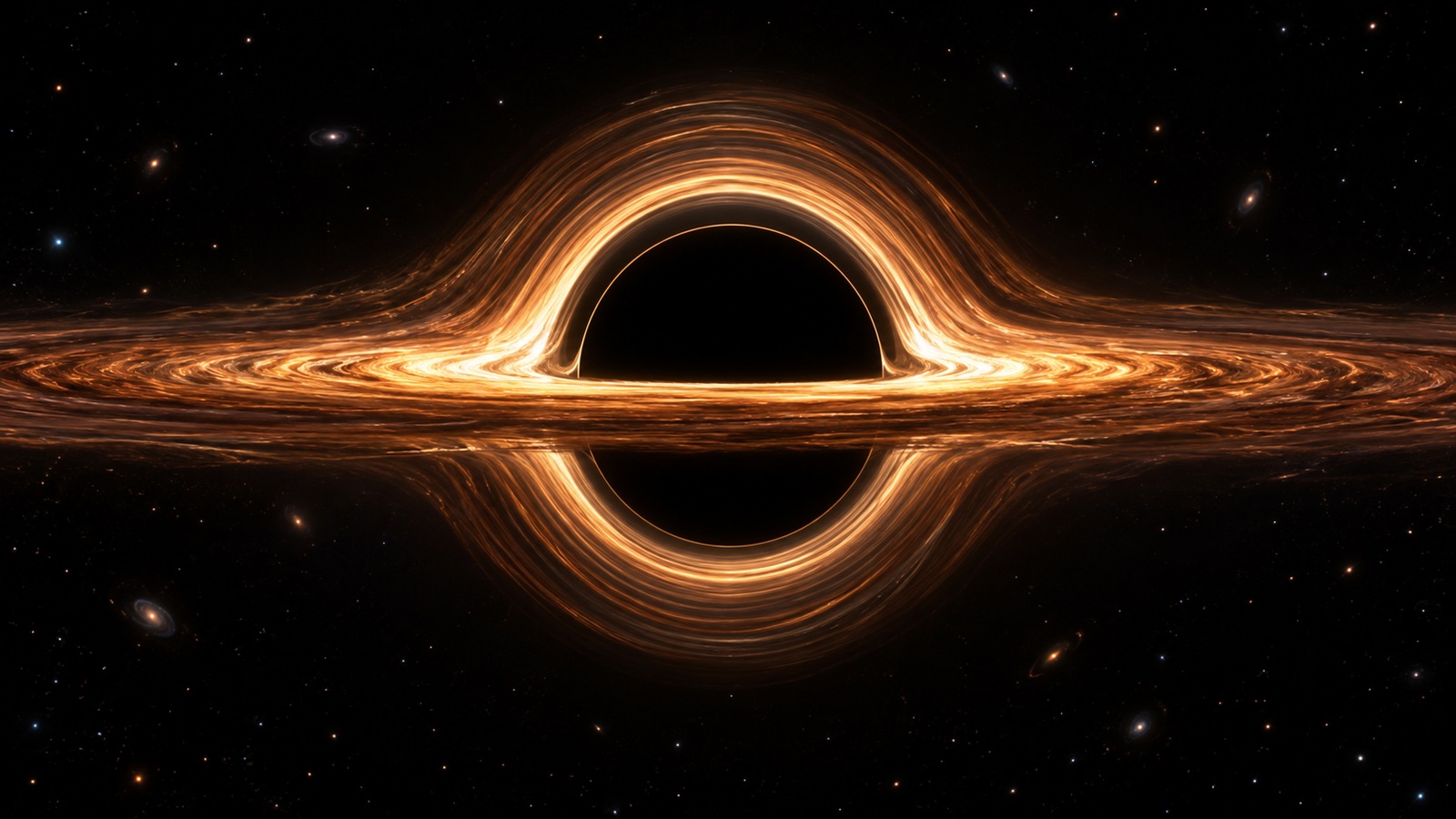
The visual effects team worked with physicist Kip Thorne to model light propagation near a rotating black hole. Their Double Negative Gravitational Renderer, abbreviated DNGR, calculated how bundles of light would reach a camera in that environment. The resulting image was not based solely on an artist sketching an impressive spiral. It incorporated a specific mathematical description of strong gravity and the observer’s position. That physical foundation explains why Gargantua’s appearance differs from a simple glowing whirlpool with a dark dot placed in its center.
The production’s technical paper on gravitational lensing describes both the calculation and filmmaking decisions. A renderer can predict an appearance for chosen inputs, but those inputs still need to be specified. The black hole’s spin, the camera’s motion, the disk model, and the handling of radiation all affect the result. Scientific computation therefore does not remove creative choice. It gives the team a disciplined way to understand what a choice implies and which visual effects follow from the underlying geometry.
That distinction is central to evaluating the movie. The images are physically motivated visualizations, not observations of an actual object named Gargantua. No telescope has measured its mass or photographed its disk. The film constructs a hypothetical system and calculates aspects of its appearance. Its success is a demonstration of what a particular model can look like, rather than evidence that nature has assembled that exact setting.
Why the Disk Appears Above and Below the Hole
A thin disk viewed close to edge-on would normally appear as a narrow band. Near a black hole, light from the disk’s far side can travel along strongly curved paths before reaching the observer. Parts of the disk can therefore appear above and below the central dark region, even though the emitting matter does not occupy those apparent positions in a simple Euclidean picture. The visible structure is an image formed by redirected light. It is not proof that material is arranged in several perpendicular disks.
This makes Gargantua a useful introduction to gravitational lensing. The audience can see that looking near a compact mass is not equivalent to looking through empty flat space. A familiar object, the disk, develops an unfamiliar apparent shape because the intervening spacetime changes the paths of its light. The same principle also affects background stars. Accurate interpretation starts by asking where the light originated and how it traveled, rather than assuming every bright feature lies exactly where it appears.
The Dark Silhouette Is Not a Solid Ball
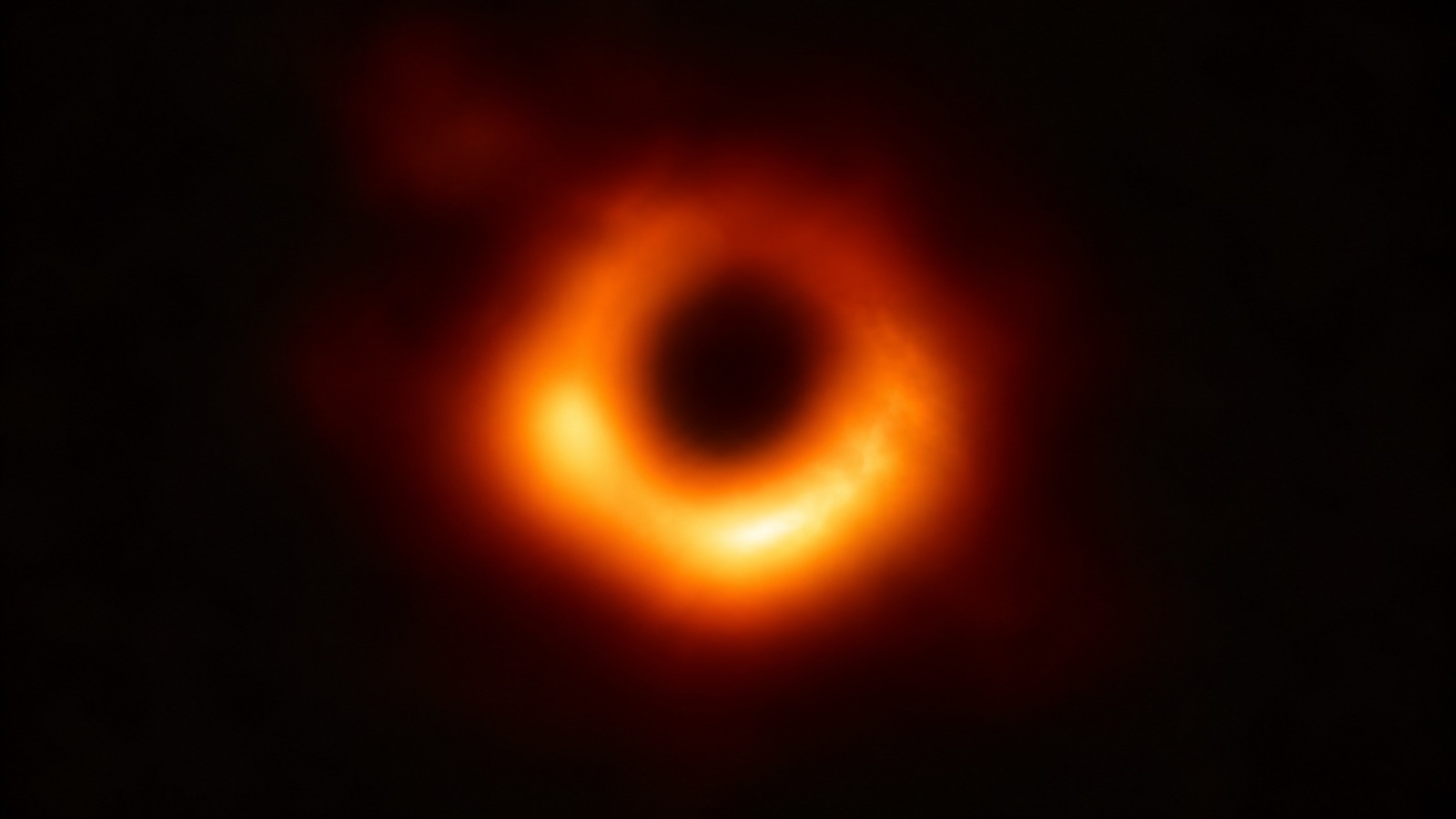
The central darkness is related to the capture of light and the absence of rays arriving from particular directions. A black hole has an event horizon, a boundary of escape, but no ordinary opaque surface that reflects ambient illumination. Its apparent shadow is shaped by surrounding radiation and gravitational lensing. The dimensions of the silhouette therefore cannot be read as a direct surface photograph with a ruler laid across it. NASA’s anatomy guide distinguishes the horizon, nearby emission, and other features that often become conflated in striking visualizations.
Brightness and Color Were Also Film Decisions
Fast-moving disk material can appear brighter on the approaching side and dimmer on the receding side because relativistic effects alter the observed radiation. Frequency changes can also affect the apparent spectrum. A fully specified physical rendering must account for those effects together with the emitted spectrum and camera response. The production paper discusses how the filmmakers adjusted the presentation to create imagery understandable to a broad audience. The result preserves important geometry while not presenting every radiative effect at its most conspicuous possible strength.
Consequently, the film’s nearly balanced glow should not be treated as a universal black hole appearance. Different viewing angles, flow structures, emission processes, and motions can yield different images. Even the same environment looks different at different wavelengths. A cinematic color palette is especially easy to mistake for a prediction of what human eyes would see. Evaluating the image requires keeping the physical light calculation separate from the choices that translate it onto a movie screen.
Those changes are meaningful compromises, but they do not cancel the lensing work. Scientific visualizations routinely select colors or simplify features to communicate a particular relationship. The useful question is which relationship survives the simplification and which does not. Gargantua effectively communicates light bending around a dark central region. It is less suitable as a complete reference image for the detailed brightness asymmetry, temperature, or spectrum of an arbitrary accreting black hole.
The Clock Effect Is Real, the Configuration Extreme
General relativity allows different observers to accumulate different elapsed times. Gravity and motion both contribute to comparisons between clocks, and a clock near a black hole can differ substantially from a clock farther away. Interstellar uses that fact to create the severe discrepancy associated with Miller’s planet. The film specifies seven Earth years for one hour on Miller’s planet, a ratio of roughly sixty thousand to one. The existence of unequal elapsed time is established physics; the demanding issue is the extraordinary configuration needed to obtain that ratio.
A primary calculation reproducing the film’s orbit problem studies equatorial circular orbits around a nearly extremal Kerr black hole. The dimensionless spin must approach its theoretical maximum, letting a prograde orbit lie exceptionally close to the horizon. A nonrotating black hole’s innermost stable circular orbit lies too far out to give the film’s ratio. Thorne’s own account calls the required spin much higher than seems reasonable astrophysically, while distinguishing that concern from a prohibition by relativity. The configuration is therefore mathematically motivated and extraordinarily specialized, rather than a typical nearby-planet environment.
Travelers Would Still Experience Their Own Seconds Normally
A person on the planet would not ordinarily perceive their own thoughts or heartbeat as dramatically slowed. Their local clock, chemistry, and bodily processes remain part of the same local physical frame. The discrepancy becomes evident when they compare elapsed time with people who followed different paths through spacetime. This is why the film’s accumulated messages are so effective: they turn an abstract clock comparison into a visible difference between lives. Describing the planet as a place where ‘time feels slow’ would lose that essential distinction between local experience and comparison.
A Planet Needs More Than a Permitted Orbit
Showing that a hypothetical orbit can produce a particular clock effect does not establish that a habitable planet can exist there. A world must also survive the tidal environment, retain its structure, and contend with radiation and incoming material. The surrounding accretion flow can be a major source of energy and danger. A bright disk makes a compelling background on screen, but a planetary environment beside such a source requires careful treatment. Orbital mechanics addresses one part of the setting, not the entire question of habitability.
The water walls require a separate fluid explanation; calculating the planet’s orbit does not derive an ocean’s behavior. Thorne describes the depicted waves as solitonic, meaning that nonlinear effects help a traveling disturbance maintain its shape. That is a proposed physical interpretation of the scene, not a demonstrated simulation of every height, period and breaking detail shown. Tidal forcing describes the gravitational driving; a moving water wall describes the fluid response, and one does not automatically specify the other. The appropriate verdict is that this spectacular wave sequence remains less firmly established than the exterior light-bending calculation, rather than an inevitable feature of any black-hole ocean.
Nor would a lack of immediate tidal destruction prove safety. Radiation exposure and interactions with a disk can remain severe even where gravitational gradients across a spacecraft are comparatively moderate. These dangers depend on the material outside the black hole. The hypothetical system must therefore be evaluated as an environment, not merely as an empty gravitational field with a planet added. The difference is especially important because the film makes that environment visually luminous while keeping the characters’ immediate problems focused elsewhere.
Supermassive Size Changes the Tidal Problem
Tidal stretching comes from differences in gravitational attraction across an extended object. For a very large black hole, the horizon lies at a much larger radius than for a stellar-mass black hole. That changes the gradient experienced near the boundary. It can be possible, in an idealized supermassive setting, to cross the horizon without an instant dramatic stretching event at that exact location. NASA’s explanation of tidal forces illustrates why mass and horizon scale matter together.
This does not supply a return ticket. Gentle conditions at the boundary and the ability to escape afterward are different questions. Inside a standard black hole horizon, the causal structure prevents outward communication to distant observers. A traveler cannot overcome that simply by having a stronger engine. Any story that allows information or a person to reemerge must introduce something beyond the ordinary exterior model. Interstellar’s choice of a supermassive black hole helps one part of its setup without establishing every later event.
The Wormhole Is a Separate Speculative Ingredient
The film’s wormhole provides a route to the distant planetary system and should not be confused with Gargantua itself. A traversable wormhole is a proposed connection between spacetime regions under special assumptions, rather than an observed automatic consequence of black hole formation. Its physical existence and stability remain unresolved. This matters because the film can portray a mathematically informed wormhole while still relying on speculative construction or intervention. Accurate black hole lensing elsewhere in the story does not convert that premise into an established astronomical capability.
The Interior Sequence Crosses Beyond Verified Physics
Later events inside Gargantua provide an imaginative structure for the film’s resolution. They serve relationships, communication, and the connection between different moments in the characters’ lives. Those scenes should be assessed as speculative storytelling rather than as a telescope-based account of a black hole interior. The event horizon prevents ordinary exterior observers from receiving signals from within. Our ability to write mathematical models does not mean that the film’s interior structures have been observed or demonstrated.
A theory also has limits of applicability. Classical descriptions encounter singular behavior in the interior, where a complete account may require physics not yet established. That uncertainty does not grant every imagined outcome equal scientific support. It identifies a boundary of current understanding. The film uses the boundary creatively, but a careful explainer must distinguish an unresolved problem from positive evidence for the specific solution depicted on screen.
The most balanced verdict is therefore specific. Gargantua’s exterior lensing is an unusually serious application of relativistic modeling; its visual brightness includes cinematic simplifications; its planetary time effect requires extreme assumptions; and its interior resolution is speculative. Those conclusions can coexist. Interstellar is valuable because it gives viewers memorable reasons to investigate real relativity, while its story also demonstrates how scientific consultation and artistic invention can operate within the same work without becoming the same kind of claim.