One Cosmic Object, Very Different Movie Jobs
A black hole can play several roles in a movie: a destination that tests human courage, a force that separates people across time, a weapon, or a passage into an invented history. Interstellar and Star Trek make that variety especially clear. Both draw on the cultural fascination with extreme gravity, but they ask the idea to serve different stories. Interstellar gives its black hole a striking visual identity and uses relativistic time as a source of emotional cost. The 2009 Star Trek film builds its crisis around fictional red matter, destruction, and travel into an altered timeline. Comparing them is more useful than assigning one blanket accuracy score. Each film combines established physics, speculative extensions, and deliberate inventions in different proportions, and understanding those layers lets an audience appreciate both the astronomy and the storytelling.
The Scientific Baseline Before the Special Effects
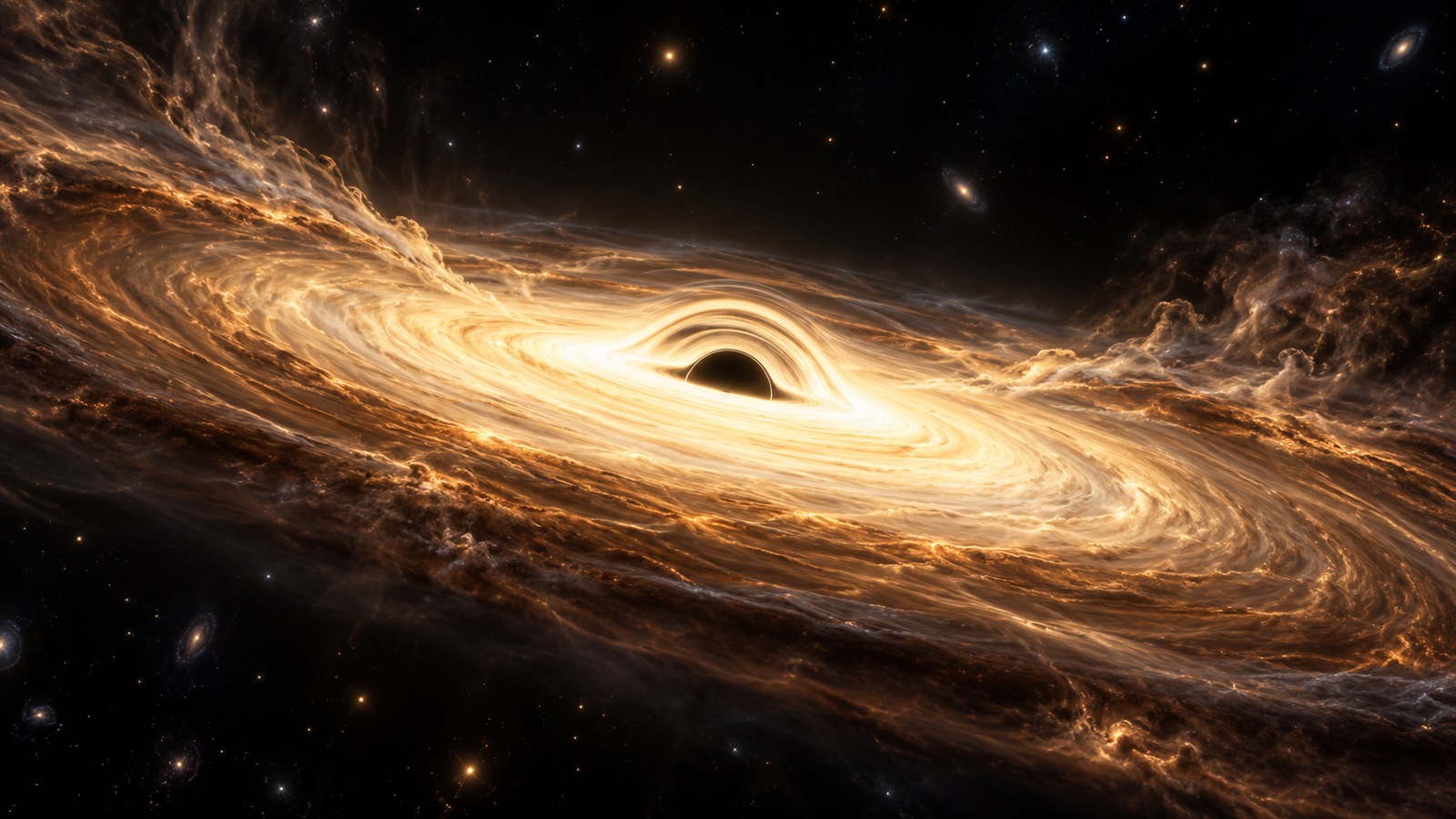
A black hole is a region bounded by an event horizon, beyond which light cannot escape to distant observers. Outside that boundary, gravity can bend light, affect clocks, and shape the motion of nearby material. Those effects offer filmmakers powerful visual and dramatic possibilities without requiring the black hole itself to glow. Bright gas around a black hole can provide a visible environment. A dark object in otherwise empty space might be far less spectacular than the fiery disks commonly shown on screen.
Black holes are also not universal cosmic vacuum cleaners. At a sufficiently large distance, the gravitational field follows the mass of the object rather than a special rule that pulls everything nearby into oblivion. An orbit can remain an orbit if the relevant mass and conditions allow it. The serious hazards arise from particular trajectories, tidal gradients, radiation, and crossing the horizon. This baseline helps identify when a scene uses recognizable physics and when it changes the rules for a dramatic outcome.
Interstellar Makes Time a Personal Price
Interstellar’s central black hole, Gargantua, functions as more than scenery. The story uses differences in elapsed time to turn a journey into a separation between people whose lives continue at different rates. That is an unusually strong narrative application of relativity because the consequence is not merely a technical obstacle. The travelers’ decisions become expensive in a human sense. On Miller’s planet, the story assigns seven Earth years to one local hour. The later playback of accumulated family messages turns that ratio into an immediate personal loss: lives continued while Cooper was elsewhere. Making urgency and absence part of the same physical premise gives the clock difference its dramatic force.
Gravitational time dilation is real, but the magnitude shown in the film requires a highly specialized environment. The cinematic setting should not be treated as a generic property of any planet near any black hole. Spin, orbital location, and the comparison between clocks all matter. Interstellar packages those conditions into a dramatic situation that can be understood quickly. The achievement is that a physical idea shapes the emotional structure of the film, even while the particular configuration deserves a separate scientific examination.
The film also distinguishes the experience of a local traveler from the passage of time elsewhere. A person does not ordinarily feel their own heartbeat slowing simply because a distant observer measures a different clock rate. Local processes remain ordinary in their own frame. The tension becomes apparent when records and people are compared again. This is a useful cinematic intuition, provided the audience remembers that relativity concerns relationships among observers rather than a visible substance called time that can be poured away.
Why Gargantua Looks So Unusual
The disk seen above and below Gargantua is not evidence that gas forms several disconnected rings in different planes. Strong gravity redirects light, allowing an observer to see distorted images of material whose direct position would otherwise be hidden behind the central object. The resulting appearance can resemble a disk folded around a dark sphere. Interstellar’s effects team developed a renderer based on light propagation through the spacetime of a spinning black hole. The paper by Oliver James, Eugenie von Tunzelmann, Paul Franklin, and Kip Thorne documents that work and the relationship between physical calculations and the final cinematic presentation.
Star Trek Uses Black Holes to Change History
In Star Trek’s 2009 film, the black hole idea supports a different narrative architecture. The fictional substance red matter creates the destructive and temporal events that bring characters into an altered timeline. The story can then reconnect familiar names while changing their circumstances. Here, the astronomical term provides an intuitive impression of immense power and a departure from ordinary space. The film is primarily interested in what the event does to a civilization and its characters, rather than in presenting a particular accretion environment for scientific inspection.
The official account of Nero’s story describes the destruction of Vulcan, red matter, and the arrival of characters from the future. Those are elements of the franchise’s fiction. No established astronomical process corresponding to red matter allows a small portable substance to create the film’s combination of black holes and usable time passages. Naming the invention clearly is more accurate than trying to retrofit every plot event into an accepted astrophysical mechanism. It also preserves the distinction between the film’s internal rules and the universe astronomers investigate.
A Black Hole and a Wormhole Are Different Ideas
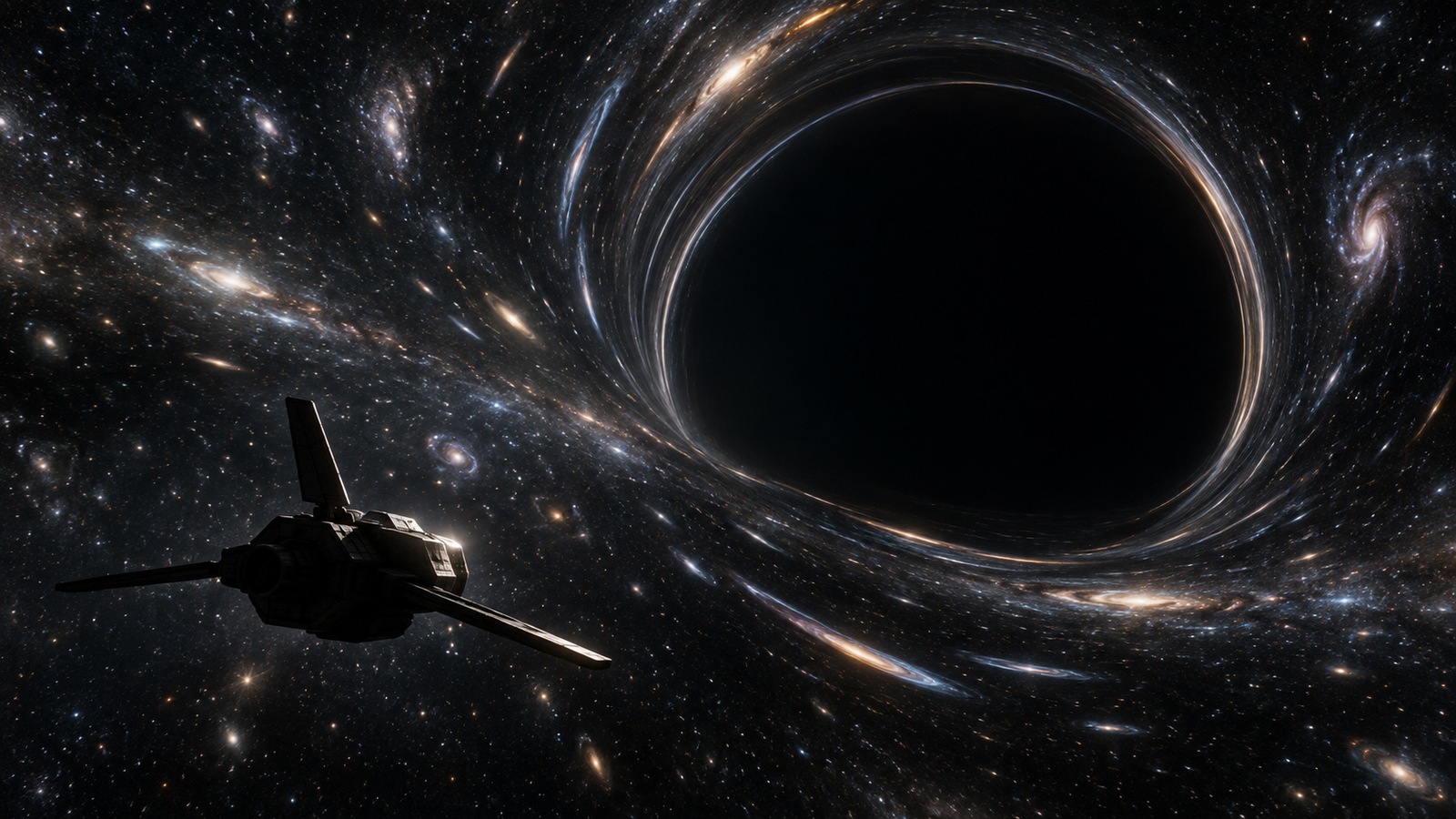
Movie dialogue often encourages audiences to treat any dark or distorted region as a doorway. A black hole’s event horizon, however, is not an established entrance to another accessible location. Crossing it does not provide a known route back to the exterior universe. A wormhole is a different proposed spacetime geometry that could connect regions under specific mathematical assumptions. Whether traversable wormholes can exist physically remains unresolved. Shared visual language does not make the two concepts interchangeable.
Interstellar itself presents a wormhole as a distinct part of the journey. Keeping that separate from Gargantua helps the story’s geography make sense and prevents the most common scientific conflation. The route into another region and the gravitational environment surrounding a black hole perform different functions. A film may connect them through speculative world-building, but the audience should not infer that black hole formation automatically creates a traversable bridge.
Star Trek’s time passage belongs to its invented mechanics. It is not a demonstration that falling into an astrophysical black hole produces a safe exit at an earlier date. That distinction does not prevent a viewer from enjoying the story. It simply identifies which premise is doing the fictional work. Good comparisons respect an imaginative device while resisting the temptation to present it as a discovery about nature.
Visible Drama Has Its Own Requirements
A filmmaker needs the audience to understand where danger is and what a ship is doing. A perfectly dark target against a crowded star field might be physically interesting but difficult to follow in a fast scene. Glowing matter, strong contrast, and a recognizable central silhouette provide visual orientation. These choices can be motivated by actual accretion physics, exaggerated for clarity, or entirely invented. Their scientific value depends on the relationship between the image and the underlying environment, not simply on whether the image looks impressive.
Sound is another familiar convention. Space scenes often use rumbling, impacts, or musical swells to make motion and scale legible. A vacuum does not transmit ordinary sound between separated spacecraft as air does on Earth. Yet a soundtrack can express the experience of machinery, vibration within a vehicle, or the emotion of a scene. Recognizing a convention avoids treating every cinematic sound as an assertion about the interstellar medium. The audience can distinguish a storytelling tool from a physical claim without losing immersion.
The Hazard Depends on the Particular Black Hole
The phrase ‘spaghettification’ refers to tidal stretching caused by differences in gravitational attraction across an object. Its onset is not identical for every black hole. A small stellar-mass black hole can produce extreme gradients near its horizon, while a supermassive black hole has a much larger horizon scale. An active accretion flow adds hazards from radiation and fast-moving matter. These differences mean that a scene cannot be judged solely by whether a character is close to something called a black hole. Mass, trajectory, and surroundings all matter, as NASA’s black hole anatomy guide helps explain.
Crossing the Horizon Changes the Story’s Rules
The horizon is a meaningful boundary even when no solid surface announces it. Outside it, a traveler may have routes that reach distant observers. Inside it, the familiar possibility of simply turning around and flying back out is absent in the standard black hole description. This is why a cinematic rescue from within the horizon requires an additional invention. Powerful engines alone do not remove the causal boundary. The issue is the geometry of possible future paths, rather than merely a need for extra fuel.
Interstellar’s later interior sequence moves into speculative narrative territory. Its visual form allows the film to resolve relationships and communicate information in a way that serves its ending. The exterior lensing calculations do not validate every event inside that sequence. A production can contain carefully modeled images in one part and deliberately imaginative mechanisms in another. Assessing the film scene by scene produces a much clearer account than assuming scientific consultation certifies the entire plot.
The same principle applies to Star Trek. The story uses invented technology to accomplish outcomes required by its timeline. Audiences familiar with the franchise already accept many such devices. A black hole label adds a connection to real astronomy, but the connection is selective. The accurate comparison identifies that selection rather than treating the plot as either a laboratory demonstration or a meaningless misuse of a scientific word.
Real Images Answer a Different Need
The Event Horizon Telescope’s M87* image provides an instructive comparison with cinematic black holes. It was reconstructed from measured radio data, and its soft orange ring represents emission surrounding a central shadow. A movie renderer instead predicts an appearance from a chosen model and then serves the requirements of a shot. Both involve computers, but their evidentiary roles are different. One reconstructs observed measurements; the other creates a controlled visual scene. The original EHT announcement explains the observational basis of the historic image.
A sharper-looking fictional image is therefore not automatically a more accurate observation. Fine detail can be a consequence of the model’s assumptions and the renderer’s resolution. Conversely, a blurred measured image can contain extraordinary scientific information. Comparing them productively means asking what inputs produced the picture and which conclusions those inputs support. The aesthetic quality of an image is separate from its status as evidence.
Two Different Ways to Make a Horizon Matter
Interstellar makes Gargantua a source of separation before it makes the black hole part of the resolution. The journey to Miller’s world imposes a cost that the characters cannot recover by returning to their spacecraft; elapsed years elsewhere are not undone. Star Trek instead places its invented black-hole mechanism inside a catastrophe that redirects the characters’ history. Nero’s attack on Vulcan uses red matter to serve a plot about destruction and a changed timeline. In both films the boundary makes human action feel irreversible, but it does so through different dramatic rules. That distinction is more revealing than expecting their black holes to perform the same scientific function. A spectator can appreciate Gargantua’s carefully modeled exterior and still recognize that the story eventually leaves demonstrated physics behind, just as Star Trek’s familiar astronomical label gives its invented mechanism a sense of scale rather than a tested operating manual.