An Enormous Black Hole With an Uncertain Crown
TON 618 often appears in astronomy headlines as the biggest black hole ever discovered. The description captures its extraordinary scale, but it also compresses a complicated measurement problem into a simple ranking. TON 618 is a luminous quasar whose central black hole has published mass estimates in the tens of billions of solar masses. Its bright surroundings make the distant engine detectable, while its spectrum helps astronomers infer the mass hidden at the center. Those estimates are not equivalent to placing the object on a scale, and different methods can produce different results. The careful conclusion is that TON 618 belongs among the most massive known black hole candidates. Understanding how that conclusion is reached gives the object a richer story than any uncontested championship title could provide.
The Quasar Is What We Actually Observe
A quasar is an exceptionally luminous active galactic nucleus. Its power comes from material accreting toward a supermassive black hole, rather than from a black hole shining from within its horizon. Gas releases energy as it moves through the surrounding environment, making the central region bright enough to stand out across vast cosmic distances. TON 618 is the designation of this observed quasar system. When popular accounts use that name for the black hole alone, they are shortening a distinction that remains important to the underlying science.
The light reaching our telescopes therefore carries information about an external environment. A continuum of radiation traces the energetic source, while emission lines reveal gas responding to that radiation. Astronomers study the brightness, wavelengths, line profiles, and variability together. They do not need to see a resolved black hole shadow to recognize an active nucleus. For a very distant quasar, a spectrum may supply more practical information than a picture that shows only an unresolved point.
That separation between engine and evidence also explains an apparent contradiction. A black hole is defined by a boundary from which light cannot escape, yet a quasar can be among the brightest objects in the universe. The radiation originates before material crosses that boundary. Brightness and darkness occupy different parts of the same system. The tremendous luminosity of the surroundings helps identify an object whose central horizon remains directly invisible.
Reading Motion From Broad Emission Lines
Gas moving toward or away from an observer changes the observed wavelength of its radiation. In a quasar’s broad-line region, many emitting parcels have different line-of-sight velocities, spreading a recognizable emission feature over a range of wavelengths. That width can serve as a measure of characteristic gas motion. Under an appropriate physical model, faster motion at a known distance from the center implies a larger central gravitational mass. Spectroscopy thus converts the shape of a light feature into information about a compact object that cannot be weighed directly.
The distance of the emitting gas from the black hole is essential. High speed alone does not uniquely determine mass, because gas close to a modest mass may move rapidly too. Researchers commonly estimate the broad-line region’s characteristic scale using relationships calibrated on other active nuclei. Combining a size estimate with a velocity estimate produces a mass inference. Each input brings uncertainties, and the calibration itself is not exact for every source. The useful measurement is consequently a range supported by assumptions, rather than an infinitely precise number.
Why Published Masses Can Differ
Different emission lines may trace gas with different dynamics. Some gas can participate in outflows, and the orientation of a flattened emitting region changes how much orbital motion projects along our line of sight. The relationship between luminosity and broad-line region size also carries intrinsic scatter. A method that works statistically across a population can still have a substantial error for one extraordinary quasar. Shemmer and colleagues’ near-infrared spectroscopy study discusses the complications of substituting one line-based mass estimator for another. Those cautions are particularly relevant when a headline depends on which individual object wins a close ranking.
Keeping the Famous Number in Context
A frequently repeated estimate places TON 618’s central black hole at approximately 66 billion solar masses. NASA’s 2023 black hole size comparison describes the object using a value above 60 billion solar masses. That establishes a clear source for the familiar scale, but it does not make every subsequent estimate or every competing object irrelevant. A number should travel with its measurement method, source, and uncertainty. Otherwise, an approximate inference can gradually turn into an apparently exact fact simply through repetition.
The proportional relationship makes uncertainty tangible. If a mass estimate fell from sixty-six billion solar masses to half that value, its calculated nonrotating horizon radius would also halve. The uncertainty would not merely alter a position in a record table; it would alter every scale comparison derived from the mass. An accretion disk could extend outside that boundary, and the lensed shadow would have a different diameter again. These are separate physical quantities, so a graphic comparing disks cannot be checked against a table of horizon radii without first reconciling their definitions.
The mass is not a count of intact stars sitting inside the object. A solar mass is a unit that expresses how much mass the black hole contains relative to the Sun. Material can arrive as gas, disrupted stars, or other black holes across its growth history. The final measurement does not identify which contribution supplied each part. Thinking in units of Suns is useful for scale, but imagining a pile of recognizable Suns inside a visible sphere would be misleading.
What Enormous Mass Means for Size
For an idealized nonrotating black hole, the event-horizon radius is twice the gravitational constant times mass divided by light speed squared. Using the approximately 66-billion-solar-mass estimate quoted in NASA’s black-hole overview, that gives an illustrative radius of about 1,300 astronomical units. One astronomical unit is Earth’s average Sun distance, so the diameter would span roughly 2,600 such distances. This is a calculation for a specified mass and nonrotating model, not a resolved measurement of TON 618’s boundary. A lower inferred mass would reduce the radius proportionally; spin changes the horizon geometry.
This is why dramatic illustrations need careful reading. Some graphics compare horizon diameters, others show shadow diameters, and still others emphasize an accretion disk that extends farther out. All can be useful when their definitions are explicit. Mixing them creates false disagreements or exaggerated ratios. The physical message remains impressive without that confusion: an extreme supermassive black hole has a gravitational boundary on a scale that dwarfs the central planetary region of our own solar system.
A Distant Source Is Also an Earlier Source
TON 618’s light has traveled for more than ten billion years before reaching Earth. We observe the quasar as it was during a much earlier cosmic epoch, not as it necessarily exists at this moment. Expansion complicates the meaning of ‘distance,’ because light-travel time and the present separation of distant regions are not interchangeable. A responsible account labels the quantity it uses instead of turning every time interval into a current distance. The long journey of the light is also part of the scientific attraction: this quasar documents an already enormous black hole in the universe’s distant past.
Growing a Giant Requires a History
Supermassive black holes can gain mass through accretion and through mergers with other black holes. Gas must lose enough angular momentum to move inward, while radiation and outflows can influence how much material ultimately reaches the horizon. The existence of an enormous black hole is therefore a problem about sustained growth and changing surroundings. A large reservoir of gas nearby does not automatically guarantee efficient feeding. The routes by which matter approaches the center matter as much as the available supply.
Mergers can add another part of the history when galaxies and their nuclei interact. Yet the present mass alone does not reveal a unique sequence of earlier mergers or accretion episodes. Many growth histories may lead to a similar endpoint. Astronomers investigate populations of quasars, host environments, and theoretical models to constrain those possibilities. TON 618 contributes an extreme case that such explanations must accommodate, rather than a complete biography written into a single spectrum.
The luminous quasar phase is also not necessarily permanent. Accretion can change as the surrounding gas supply evolves, and a central black hole can become much less conspicuous when feeding slows. An object observed in a brilliant active state may later look different. The distinction matters when interpreting enormous black holes as a class: the brightest observed systems are selected partly by their current behavior. Quiet giants can be harder to discover even when their masses are equally remarkable.
Would Bigger Automatically Mean More Dangerous?
The gravitational influence at a given large distance depends on mass, but the effects experienced near a horizon also depend on its size and the local environment. Tidal forces measure differences in gravitational pull across an object. At the horizon of a larger black hole, those differences can be gentler than at the horizon of a small stellar-mass black hole. That does not make crossing a horizon survivable as a return journey. It explains why an immediate stretching catastrophe outside the horizon is not universal across all black holes.
The quasar environment introduces its own hazards. Energetic radiation, fast-moving plasma, and interactions with surrounding material make a bright active nucleus very different from an empty mathematical spacetime. A cinematic voyage that considers only tidal forces omits much of that setting. TON 618 should not be pictured as a harmless giant doorway because its horizon is large. The geometry, the radiation field, and the inability to return from within the horizon are separate considerations that all shape the physical story.
Why a Quasar Image Is Not a Horizon Photograph
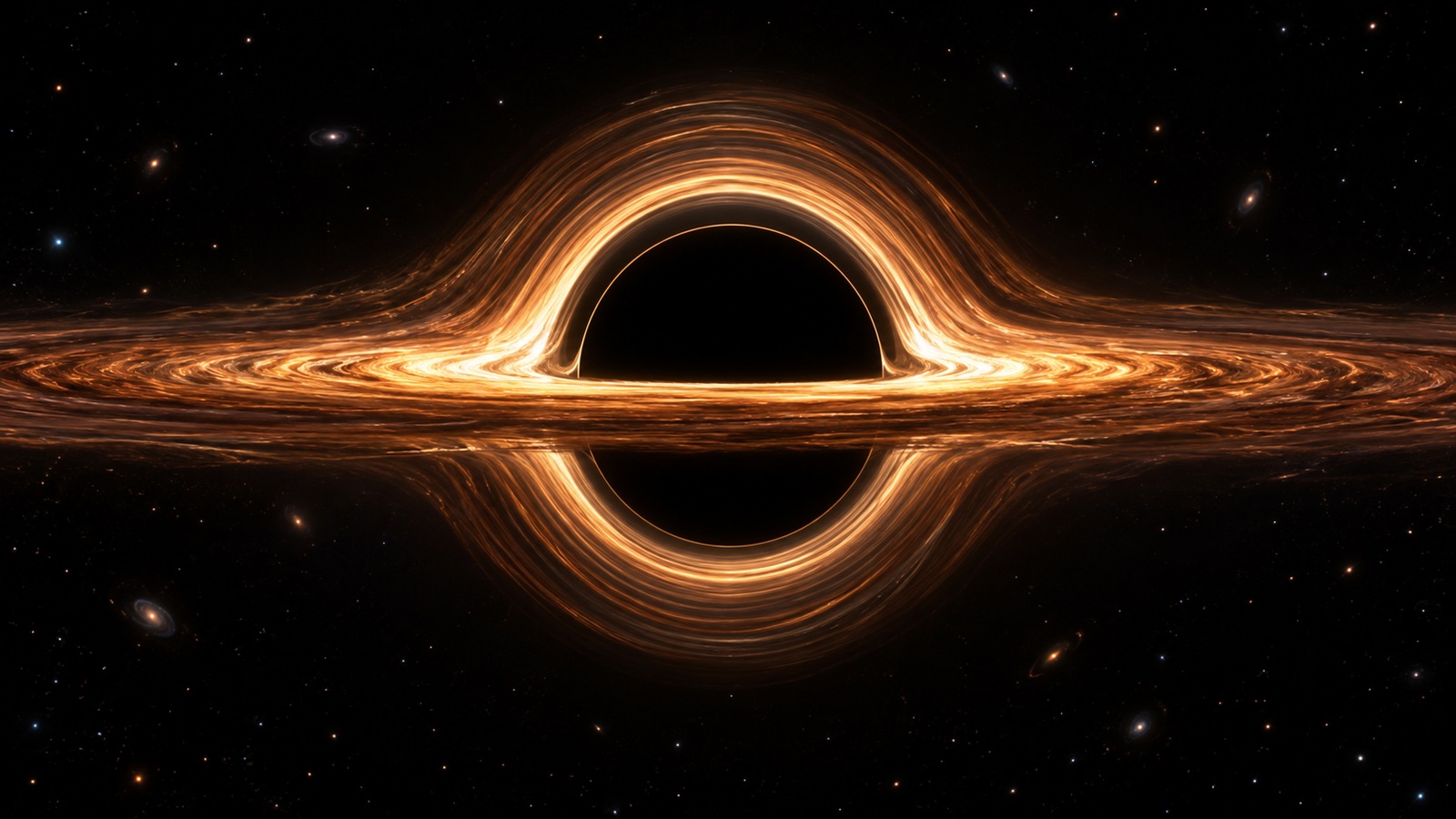
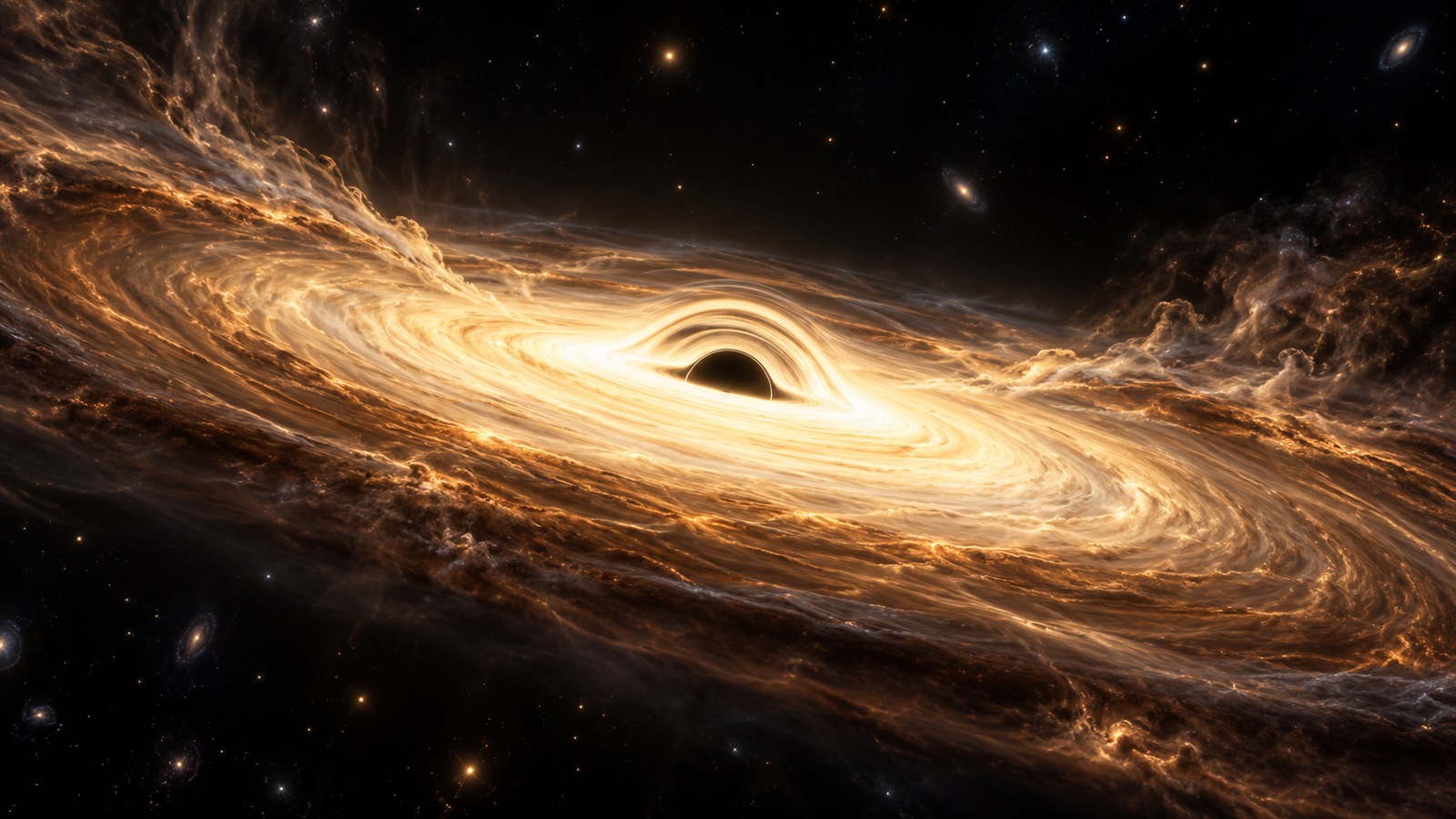
Detecting light from TON 618 does not mean resolving its event horizon. Angular size combines physical scale with distance, and the quasar’s remoteness makes its central structure exceptionally difficult to separate on the sky. The EHT’s image of M87* relied on a different combination of mass, angular size, wavelength, and observable emission. A large nominal mass alone cannot guarantee an image comparable to the famous orange ring. Photographs of TON 618 generally show its unresolved luminous source within a field of other objects, while close-up disk scenes are explanatory illustrations.
The Scale Is Impressive Even Without a Record Trophy
A solar-system-sized comparison can still underestimate the engine’s scale. Earth-Sun distances are normally used to describe planetary orbits, while the illustrative horizon diameter above uses thousands of those units. The surrounding luminous system extends farther, providing the radiation that enables a mass estimate from such a remote object. That relationship joins size with evidence: the very boundary we cannot resolve influences gas whose light we can measure. TON 618’s significance is not exhausted by whether another candidate eventually receives a larger nominal mass.
Its spectrum provides an accessible route into a compact central engine whose scale lies far beyond an ordinary stellar remnant. Better calibration or new measurements can revise the mass and the comparisons derived from it. The essential achievement remains the connection between observable gas motion and a distant gravitational source. That is what makes a quasar a physical measurement opportunity rather than merely a bright point with a dramatic number attached.