The Orange Ring That Made a Black Hole Visible
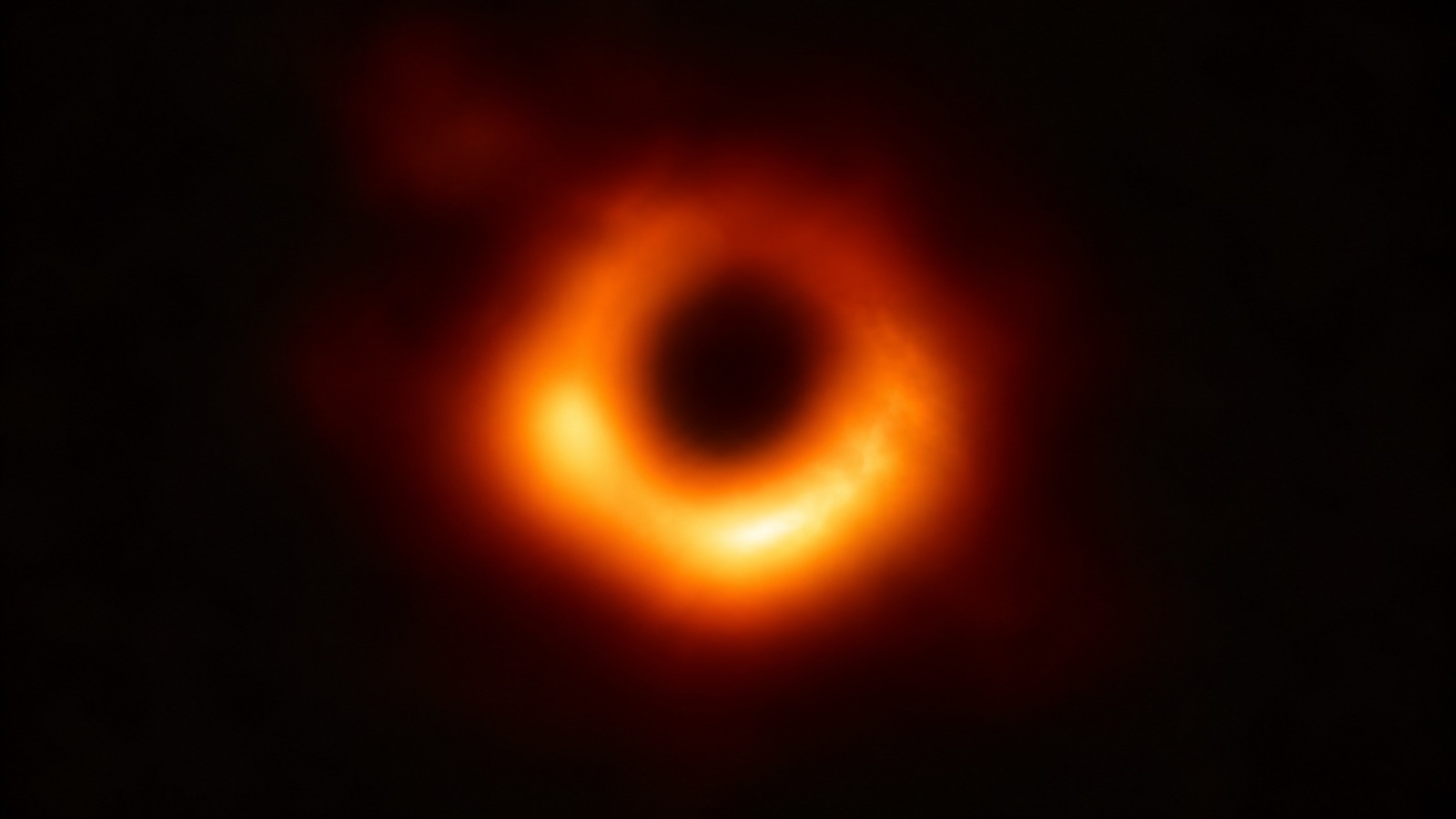
When astronomers unveiled the first image of M87’s central black hole in April 2019, the picture looked surprisingly simple: an uneven orange ring around a dark center. Its importance came from what that modest arrangement of light represented. A worldwide network of radio observatories had resolved the immediate surroundings of an object whose gravity prevents light from escaping once it crosses the event horizon. The black hole itself had not suddenly become luminous, and the image was not an ordinary camera exposure. It was a reconstruction of radio emission from extremely hot material near a supermassive black hole, with a central shadow shaped by gravity. Understanding those distinctions makes the achievement more impressive. M87* gave scientists a new way to examine strong gravity, compare observations with theoretical models, and connect a compact dark object to the enormous galaxy and jet around it.
A Giant in the Heart of an Elliptical Galaxy
Messier 87 is a large elliptical galaxy in the Virgo Cluster, roughly 55 million light-years from Earth. Unlike the familiar spiral appearance of the Milky Way, its visible stellar body resembles an immense, rounded concentration of stars. At its center lies M87*, where the asterisk distinguishes the compact black hole source from the surrounding galaxy. The Event Horizon Telescope collaboration’s original analysis inferred a mass of about 6.5 billion Suns. That enormous mass is concentrated within a region tiny compared with the galaxy, making the nucleus a particularly demanding target for direct imaging.
M87 was already important long before the orange ring appeared. Its nucleus powers a prominent jet, a narrow outflow of energetic material that extends far beyond the immediate black hole environment. Earlier observations could study that jet and the central concentration of light without resolving the shadow. The new image connected those familiar larger structures to a much smaller physical scale. A black hole that had been inferred through its influence could now be investigated through the appearance of light passing close to it. The EHT’s original announcement provides the historical distance, mass, and release context.
Why Something So Large Appears So Small
Physical size alone does not decide whether an astronomical object is easy to image. Apparent size depends on distance, just as a distant mountain can occupy less of your view than a nearby building. M87* is immense, but tens of millions of light-years separate it from our instruments. Its shadow occupies only a tiny angle on the sky. An ordinary optical telescope cannot resolve that scale, regardless of how familiar the galaxy may be in photographs. The challenge was to distinguish adjacent directions separated by far less than the apparent width of ordinary stars in a backyard telescope.
The Milky Way’s central black hole, Sagittarius A*, is much closer but also far less massive. Those competing factors make the two shadows comparable in apparent scale. This is why choosing M87* was not simply a matter of selecting the nearest black hole. Astronomers needed a target with a sufficiently large angular signature, radiation detectable at suitable wavelengths, and behavior that could be studied during a coordinated observing campaign. The distant giant offered an unusually favorable combination of those properties.
Resolution also differs from brightness. A source can be bright enough to detect while remaining too compact to show its internal structure. Seeing an unresolved point tells you where radiation originates; resolving a ring tells you how that radiation is distributed. The EHT was built to cross that divide. Its achievement therefore concerned the geometry of the source as much as the collection of additional light.
An Earth-Sized Instrument Without an Earth-Sized Dish
The Event Horizon Telescope combines observatories through very long baseline interferometry, a technique that compares precisely recorded radio signals collected at widely separated sites. The separation between stations supplies extremely fine angular information, while multiple station pairs sample the source from different directions. Earth is not covered by a continuous radio mirror, so the resulting measurements are incomplete and must be calibrated and reconstructed carefully. Atomic clocks, coordinated observing, reliable recording, and a detailed understanding of each telescope’s performance all contribute to that process. The phrase ‘Earth-sized telescope’ describes the longest effective baselines, not a single filled dish or a conventional camera positioned above the planet.
From Radio Measurements to a Picture
The observations underlying the historic image were collected in April 2017 at a wavelength of approximately 1.3 millimeters. At those wavelengths, astronomers can examine emission from the compact, hot environment close to the black hole. Suitable conditions must occur at observatories across the network because atmospheric water vapor can interfere with the measurements. Each participating station contributes part of a much larger experiment, and the useful result depends on how those contributions overlap. An especially productive night at one telescope cannot replace an absent baseline elsewhere.
Turning the measurements into an image required more than pressing a shutter button. Teams used different reconstruction approaches and tested how calibration choices and assumptions affected the recovered structure. A convincing result had to retain its key features across those methods rather than appear only under a convenient set of settings. The ring and central depression survived those comparisons. Small details were less certain, which is why the original image should not be treated as a finely resolved map of every turbulent feature. The collaboration’s imaging methods paper explains how the observed structure was tested against reconstruction choices.
The Shadow Is Larger Than the Horizon
The event horizon is the boundary beyond which future-directed light cannot escape to distant observers. It is not a solid shell, a glowing surface, or an object that a telescope can photograph from the inside. The dark center of the EHT image is associated with a black hole shadow, a related but different feature. Gravity bends nearby light paths, and some of those paths terminate at the horizon rather than returning to the observer. Against surrounding emission, that capture of light produces a central deficit whose apparent dimensions exceed those of the horizon itself.
This distinction changes how the famous image should be read. The edge of the dark patch does not provide a simple ruler placed directly across the physical horizon. Its appearance depends on light propagation, viewing geometry, and the emitting material. Scientists compare that combined appearance with relativistic models to infer the properties of the central object. The ring diameter therefore carries useful physical information, but interpreting it requires a theory of how the image formed. Calling the picture a black hole photograph is understandable shorthand, provided the shadow and surrounding plasma remain part of the explanation.
Nor does the darkness reveal a view of the singularity. In classical descriptions, a singularity signals where the theory reaches an extreme that cannot be described as an ordinary physical location with an observable surface. The EHT observes radiation that reaches us from outside the horizon. Nothing in the picture supplies a direct image of an interior region. Recognizing that limit protects the scientific result from claims it was never designed to support.
What Produces the Uneven Glow
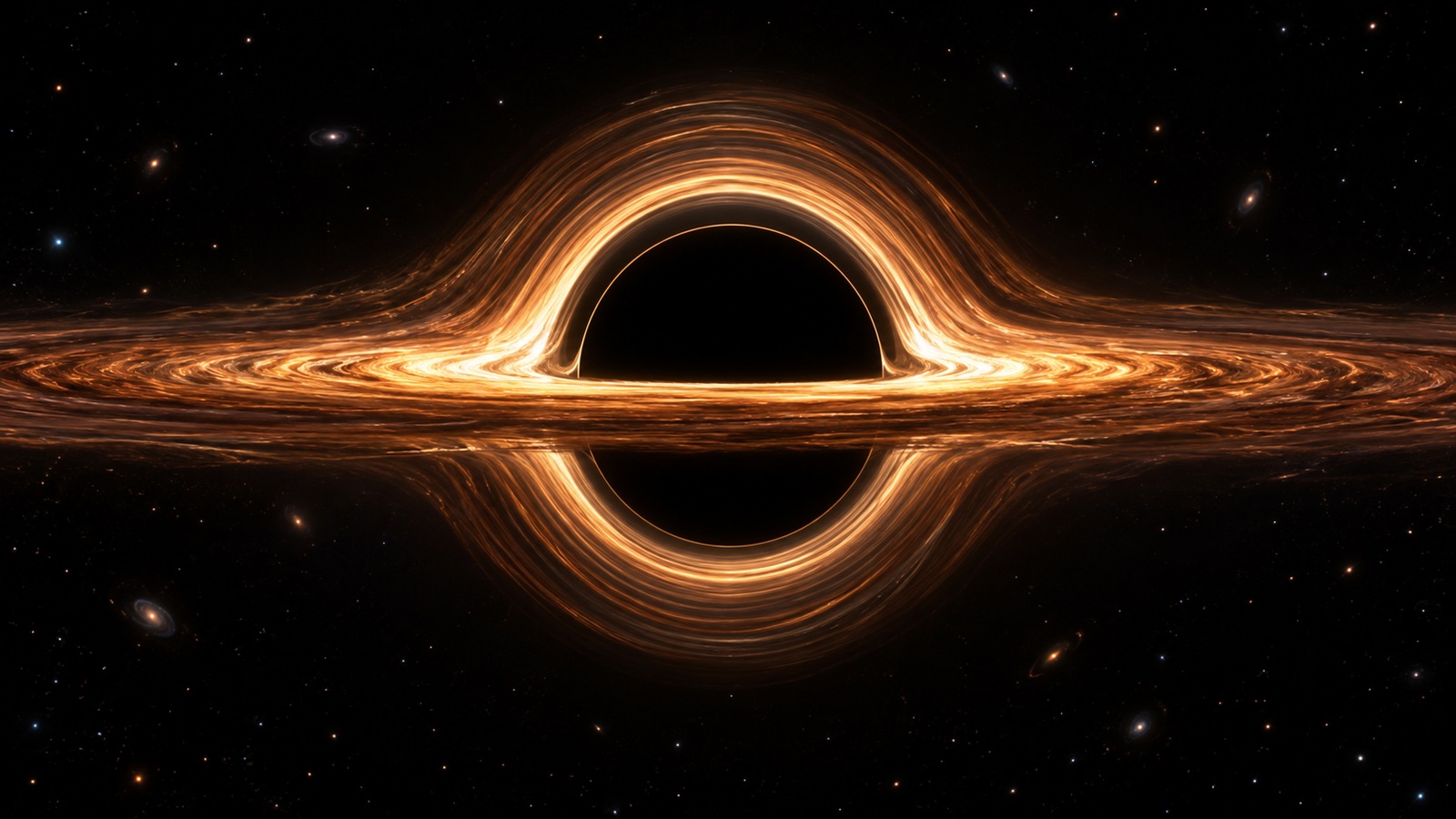
The bright emission originates in hot, magnetized plasma near the black hole. Charged particles interacting with magnetic fields produce radio radiation that can escape from outside the horizon. The surrounding material is dynamic rather than a fixed luminous ornament. Its motion, temperature, density, and magnetic organization influence what the telescope records. Gravitational lensing then changes which portions of that emitting environment appear in each direction on the sky.
The ring’s asymmetry is especially informative. Relativistic motion can make radiation from approaching material appear brighter than radiation from receding material, although the actual pattern also depends on the flow and viewing orientation. Consequently, one bright arc should not be interpreted as a permanent painted stripe on a black hole. It is part of a physical emission pattern that can change. Likewise, the displayed orange palette represents radio brightness, rather than a literal color an astronaut’s eyes would see. The image translates measured radiation into a visible form that people can study.
A Test of Gravity, With Specific Limits
The recovered shadow scale was consistent with the expectations for a supermassive black hole described by general relativity. That agreement was significant because light near the horizon samples gravity far more intense than the everyday conditions in which human intuition develops. Nevertheless, one image cannot prove every aspect of a theory or rule out every possible alternative. Scientists assess particular predictions, measurement uncertainties, and competing models. The original shadow analysis presents the mass inference and its relationship to relativistic simulations. Its value lies in a quantitative comparison, not a declaration that all remaining questions about black holes have been answered.
The Jet Extends the Story Beyond the Ring
A black hole’s jet does not emerge from inside the event horizon. The observable outflow is associated with material and electromagnetic fields in the surrounding environment. That distinction can be difficult to keep in mind when a single object is described as both swallowing matter and launching a jet. The useful picture is a central horizon embedded in a complicated system where some material falls inward while other energy and matter move outward. The flow around the black hole, rather than an escape route through its interior, connects those behaviors.
Studying the ring alongside the jet helps researchers investigate how magnetic fields organize that system. Observations at different wavelengths and resolutions probe different regions, from the compact nucleus to structures much farther away. No single image replaces all those perspectives. A detailed radio view may constrain the central geometry while another instrument follows energetic particles along the jet. The measurements become more useful when they refer to a coordinated period, because an active nucleus can change between observing campaigns.
M87* also illustrates why a small central region can matter to an enormous galaxy. Energy released by accretion and carried outward can influence surrounding gas, even though the black hole does not dominate the gravity of every star in the galaxy. The orange ring is therefore a close view of one component in a larger exchange of matter and energy. It is a starting point for investigating the nucleus, rather than a complete portrait of M87’s history or future.
Why a Giant and a Smaller Neighbor Both Fit the Telescope
M87* and the Milky Way’s Sagittarius A* illustrate why physical size alone does not determine a telescope target. M87* is roughly 1,500 times more massive but about 2,000 times farther away, according to the EHT’s science overview. Its much larger physical scale is almost canceled by that greater distance, leaving the two systems with comparable apparent sizes. This is the same everyday geometry that lets a distant large object resemble a nearer small one, applied to gravitational boundaries rather than ordinary surfaces. The network needed extraordinary resolution because both angular targets remain tiny, despite their very different masses.
The comparison gives the first image a concrete scientific sequel. Imaging another system of comparable apparent size lets researchers examine related predictions over a very different mass scale. They still need to account for the surrounding plasma and its variability when interpreting each ring. The result is an opportunity to test whether the same gravitational description works across two distinct environments. M87* became the first target successfully imaged because its angular scale and observable emission made the experiment feasible, not because it was the closest black hole or the only one large enough to matter.