
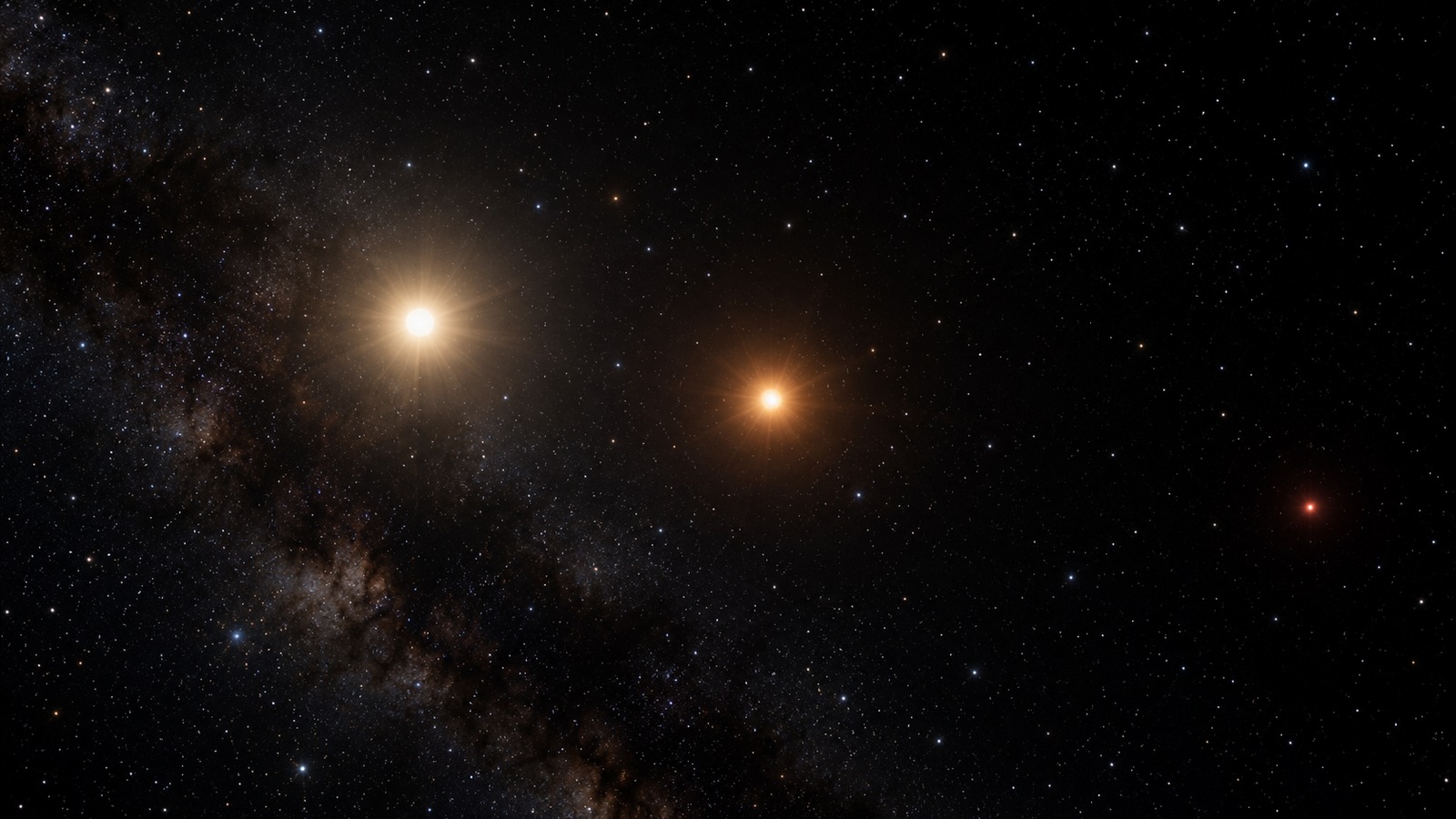
The Nearest Stellar System Is a Small Family
Alpha Centauri is often introduced as the star next door, but the name belongs to a system with more than one member. Its bright pair, Alpha Centauri A and B, forms a binary of comparatively Sun-like stars. A much fainter red dwarf, Proxima Centauri, belongs to the wider system and is currently the closest individual star beyond the Sun. Those distinctions explain why different answers appear when people ask for our nearest star, nearest visible star, or nearest stellar system. They also make the neighborhood scientifically valuable. It offers a nearby comparison between a bright binary and a small active companion, alongside difficult searches for planets. Being close by astronomical standards makes the system an attractive target, yet it leaves a distance far beyond the reach of ordinary journeys or simple direct inspection.
A and B Form the Bright Central Pair
Alpha Centauri A is a G-type star broadly comparable with the Sun, while Alpha Centauri B is a cooler K-type star. Neither should be described as an exact solar duplicate. Their masses, luminosities, and temperatures differ, allowing astronomers to compare how related stars behave under different conditions. To unaided eyes, the bright pair usually appears as one conspicuous source. The blended light hides the fact that two separate stars contribute to the familiar point in the southern sky.
The pair’s members orbit their common center of mass. A binary does not consist of a fixed primary with a companion circling a motionless point; both stars respond to the shared gravitational system. Their separation changes along an elliptical orbit, so a single quoted distance between them needs context. That orbit also changes how easy the pair is to separate through a telescope. The stars’ projected spacing on the sky is not always the same as their actual three-dimensional separation.
A long record of positional measurements provides information about the orbit and masses. Spectroscopy contributes the motion toward or away from Earth, while precise sky positions reveal motion across our line of sight. Combining those perspectives creates a more complete picture than either alone. Alpha Centauri is an excellent reminder that stellar companionship is measured through motion and geometry, not simply by finding two bright points near each other in an image.
Proxima Is the Closest Individual Member
Proxima Centauri lies a little over four light-years from us and slightly nearer than the bright A-B pair. It is a small red dwarf whose low luminosity makes it invisible to unaided eyes, despite its proximity. This often surprises people who expect the nearest star to dominate the sky. Brightness depends on intrinsic output as well as distance. A faint nearby red dwarf can remain much less conspicuous than a powerful star hundreds of light-years away.
Proxima’s relationship to the pair was once difficult to establish firmly because measuring its motion with sufficient precision was challenging. Research using accurate radial velocities found that Proxima and Alpha Centauri are gravitationally bound with high confidence. The ESO announcement of the result explains how improved measurements helped settle the question. The system therefore contains a close central binary and a distant third member, rather than three similar stars arranged side by side.
What a Light-Year Actually Tells You
A light-year is a unit of distance: the distance light travels in one year. Saying a star lies approximately four light-years away does not mean a spacecraft can reach it in four years with present technology. It means the radiation arriving now began its journey about four years earlier, with small qualifications associated with motion and exact distance. That scale is short beside the distances to many familiar stars, but immense beside the dimensions of the solar system. The nearest stellar neighborhood remains separated from us by an enormous expanse of mostly empty space.
The Binary Orbit Is Part of the Planetary Setting
A planet in a multiple-star system experiences a gravitational environment shaped by more than one star. It might orbit one component while the other acts as a distant perturber, or occupy a different configuration if the system permits it. Stability depends on orbital sizes, shapes, and orientations. It is not enough to say that binaries either always have planets or never can. The question must be asked for a specified arrangement and over a meaningful interval of time.
Alpha Centauri A and B complete their mutual orbit in about eighty years. The 2021 astrometric orbital solution implies a true separation ranging roughly from eleven to thirty-five astronomical units, calculated from its semimajor axis and eccentricity. An astronomical unit is Earth’s average Sun distance; the quoted range concerns the space between the stars, not their projected separation on a photograph. Individual-star planetary orbits must fit within this changing binary setting. At the same time, the companion star changes the conditions compared with an isolated solar system. Researchers examine whether hypothetical orbits remain stable and how earlier planet formation might have been affected. These are related but separate questions. A dynamically permitted orbit today does not prove that a planet formed there, nor that it has an atmosphere, water, or suitable surface conditions.
Proxima supplies another setting in the wider family. Its planets orbit the red dwarf rather than the bright central pair. A world close to Proxima is therefore not simply a planet illuminated chiefly by three nearby Suns. The distances among the stellar components matter to their relative effects. Keeping each orbit attached to its host star prevents a vivid but inaccurate picture of the system as a compact trio surrounding every potential planet.
Confirmed Worlds and Candidates Need Different Language
Proxima b was identified through a periodic radial-velocity signal associated with the host star’s gravitational response. The 2016 discovery announcement describes the observing campaign and the roughly eleven-day orbit. That result made the nearest system especially compelling for exoplanet research. It did not establish the planet’s surface appearance or detect living organisms. A minimum mass and an orbital period answer different questions from a radius, an atmosphere, or an image of a continent.
A specific example is the giant-planet candidate near Alpha Centauri A discussed in NASA’s August 2025 Webb announcement. MIRI observations from August 2024 revealed a faint source at a projected separation near twice Earth’s Sun distance; two subsequent observing epochs did not recover an equivalent source. Possible orbital motion was examined, but the announcement retained the word candidate. A 2026 primary follow-up study likewise discusses it as the Alpha Cen Ab candidate, rather than an established Earth-like world. The example shows the practical challenge: the nearby system improves angular access, while starlight subtraction, changing orbital position and repeat detection still determine whether a source can be confirmed.
The Habitable Zone Is a Starting Condition
A habitable-zone orbit describes a range in which a suitably equipped planet might maintain liquid water on its surface. It is not a certification that the planet has water, an atmosphere, or life. Different host stars place that range at different orbital distances because their luminosities differ. Red-dwarf activity introduces additional concerns about radiation and atmospheric loss. Those issues belong especially to Proxima’s planetary environment and require their own assessment. The useful distinction is between an orbit receiving a plausible amount of stellar energy and a world whose complete conditions are actually known.
Why the System Is an Exceptional Laboratory
Nearby stars give instruments stronger signals and larger apparent angular separations than comparable distant targets. Alpha Centauri’s members can therefore support detailed comparisons of stellar atmospheres, motions, and evolution. A and B also share a wider formation history, making their differences especially interesting. Researchers can investigate how related stars diverge with mass and temperature while retaining useful common context. The system’s scientific value does not depend entirely on finding a habitable planet.
Multiple measurement techniques can test the same physical picture. Stellar spectra reveal chemical and atmospheric information, positional data constrain orbits, and precise brightness records can identify variability. Models then connect those observations with internal structure and age. None of these steps is simply a close-up photograph of the stellar interior. The neighborhood is valuable because independent measurements can be brought into unusually productive comparison, allowing errors and assumptions to be examined more closely.
The system also offers a practical test for future instruments. Separating faint planetary light from a bright host demands strong control over glare, atmospheric disturbance, and detector behavior. A nearby target is attractive because a planet’s apparent separation can be relatively favorable. Yet a brighter star can expose subtle instrumental limitations. Success therefore requires both a promising astronomical target and careful engineering. The nearest neighborhood is an opportunity for measurement, not an automatic guarantee that every world will soon be visible.
Seeing the Pair Depends on Where You Live
Alpha Centauri lies well south of the celestial equator, so its visibility is strongly dependent on latitude. It is familiar to many Southern Hemisphere observers and inaccessible or poorly placed from much of the north. A bright star can still be impossible to see if Earth’s horizon blocks that direction. Observing advice should therefore begin with location rather than telescope size. A suitable sky map can show whether the pair rises and whether it reaches a useful altitude at the desired time.
Where the system is well placed, a telescope can separate the bright binary when its projected spacing and observing conditions permit. Atmospheric steadiness, magnification, and optical quality influence the result. Proxima is a different target: its faintness requires a reliable identification method among other field stars. Finding the bright pair does not mean the red dwarf has automatically been located too. A careful observing account treats recognition, binary separation, and Proxima identification as distinct goals.
Nearby Does Not Mean Ready for a Visit
Interstellar travel must confront distance, acceleration, propulsion, navigation, communications, and the destination encounter itself. A proposed fast flyby probe has different requirements from a spacecraft that brakes into orbit, and both differ from a crewed expedition. Passing through a system without stopping may collect information during a brief interval. Staying requires removing much of the craft’s incoming speed. A concept that solves one of these problems has not necessarily solved the others.
Communications also inherit the light-travel delay. Instructions sent from Earth would take years to arrive, and any reply would require additional years to return. A distant probe could not rely on immediate human control during a rapid encounter. It would need autonomous decisions and equipment suited to a long journey. Those constraints are physical consequences of the distance, even before questions about funding or construction enter the discussion. Alpha Centauri can be our nearest target while remaining an extraordinary engineering challenge.
Presenting that challenge clearly makes the system more interesting. It prevents a headline about a proposed propulsion concept from sounding like a departure announcement. Research into interstellar probes can illuminate real tradeoffs even when no such mission is ready. The neighborhood’s proximity provides a meaningful benchmark for those ideas. It asks how much capability would be needed to cross the smallest stellar gap available to us, rather than suggesting that the gap is already small in practical terms.
The Neighbor We Can Study in Layers
The simplest accurate picture begins with three distinct stars: the bright A-B binary and the much fainter Proxima companion. Add their different distances, luminosities, and orbital relationships before imagining any planets. That sequence gives every later discovery an appropriate place. A planet near Proxima is not a planet around A, a bright point seen outdoors is not necessarily one star, and a candidate signal is not an established habitable world. These distinctions make a complicated nearby system understandable without flattening it into a slogan.
Alpha Centauri ultimately matters because it links familiar questions to unusually accessible evidence. What is a Sun-like star? How do binaries behave? How can faint planets be detected beside bright hosts? What would crossing an interstellar distance demand? Each question can begin in this one neighborhood, but none has exactly the same answer for every member. The nearest stellar family is a destination for observation and thought long before it becomes a destination for travel.


