A Familiar Bright Star With an Unfamiliar View
Vega is one of the easiest stars to recognize in northern summer skies, but its familiar brightness conceals a surprisingly complicated object. We view the star from near its rotational pole, a perspective that helps hide the effects of its rapid spin. Around it lies a broad debris disk whose dust can be examined far more effectively with specialized instruments than with an ordinary telescope. Vega has also played an important role in defining astronomical brightness standards, making its physical peculiarities especially interesting. The same object that helped astronomers organize measurements is not a perfectly simple stellar reference. Its story connects rotation, temperature, dusty planetary environments, and the difference between the appearance of a point of light and the physical system responsible for that appearance.
Lyra’s Bright Anchor in the Summer Triangle
Vega belongs to the constellation Lyra and forms one corner of the Summer Triangle, alongside Deneb and Altair. The pattern gives observers a large, recognizable framework even when surrounding stars are harder to see. Its seasonal nickname refers to convenient Northern Hemisphere evening visibility, rather than to a time when the stars physically move into a triangle. Earth’s orbit changes which parts of the sky are visible at night. The relative arrangement remains available whenever the stars are above the horizon and the sky is dark enough.
The star lies roughly twenty-five light-years away, close compared with many prominent naked-eye stars. That distance helps make its intrinsic brightness accessible to our instruments. Vega’s light still requires decades to cross the gap, so the familiar point is a view of an earlier stellar state. Its proximity does not mean a telescope can casually reveal its surface or debris disk. Detection and detailed resolution remain different achievements, even for a bright nearby object.
Its Spin Is Easy to Underestimate From Earth
A rotating star’s spectrum can reveal motion because light from opposite sides of its surface is shifted in different directions. But the size of that observed effect depends on viewing angle. A star seen near its pole can rotate rapidly while showing a comparatively modest projected rotational velocity. This was part of Vega’s puzzle: the apparent simplicity of its light did not tell the whole story about its spin. Interferometric work using the CHARA Array investigated the rapidly rotating, nearly pole-on interpretation, connecting measurements of the star’s appearance to a physically distorted stellar model.
Rotation Changes More Than the Speed of the Surface
Rapid rotation affects the balance of forces within a star. Its equatorial regions can extend farther from the center than its poles, creating an oblate rather than perfectly spherical shape. Describing Vega as a spinning sphere therefore omits part of the important physics. The deformation can influence surface gravity and the distribution of emitted energy. A stellar model must account for those connected changes when translating observed light into properties such as radius and effective temperature.
The term gravity darkening describes the relationship between local surface conditions and brightness in a rotating star. In the relevant models, polar regions can be hotter and brighter than equatorial regions. Vega consequently does not present one uniform surface temperature in the same simple sense as an idealized nonrotating star. An observer looking near the bright pole receives a particular weighted view of the surface. A different observer near the equatorial direction would not necessarily infer identical properties from an equally simple interpretation of the light.
This is an unusually concrete lesson in perspective. The telescope does not see an objective temperature label hovering over the star; it receives radiation from the portions visible in a particular geometry. Researchers infer the physical distribution by comparing measurements with models. The more faithfully those models represent rotation and viewing orientation, the more meaningful the resulting parameters become. Vega’s brightness is real, but some of its apparent simplicity belongs to our vantage point rather than to the star itself.
Why a Brightness Standard Can Still Be Physically Complex
Astronomical photometry needs reference points so that measured brightnesses can be compared consistently. Vega has historically served an important role in calibrating magnitude systems, although modern systems use specific definitions that do not all reduce to a single star being exactly zero in every band. A useful standard is a carefully characterized source, not necessarily a perfectly featureless physical object. Vega’s rotation and dust therefore require attention without erasing its historical value. The practical question is how well a measurement system accounts for its reference, wavelength coverage, and calibration assumptions.
Infrared Light Reveals a Dusty Environment
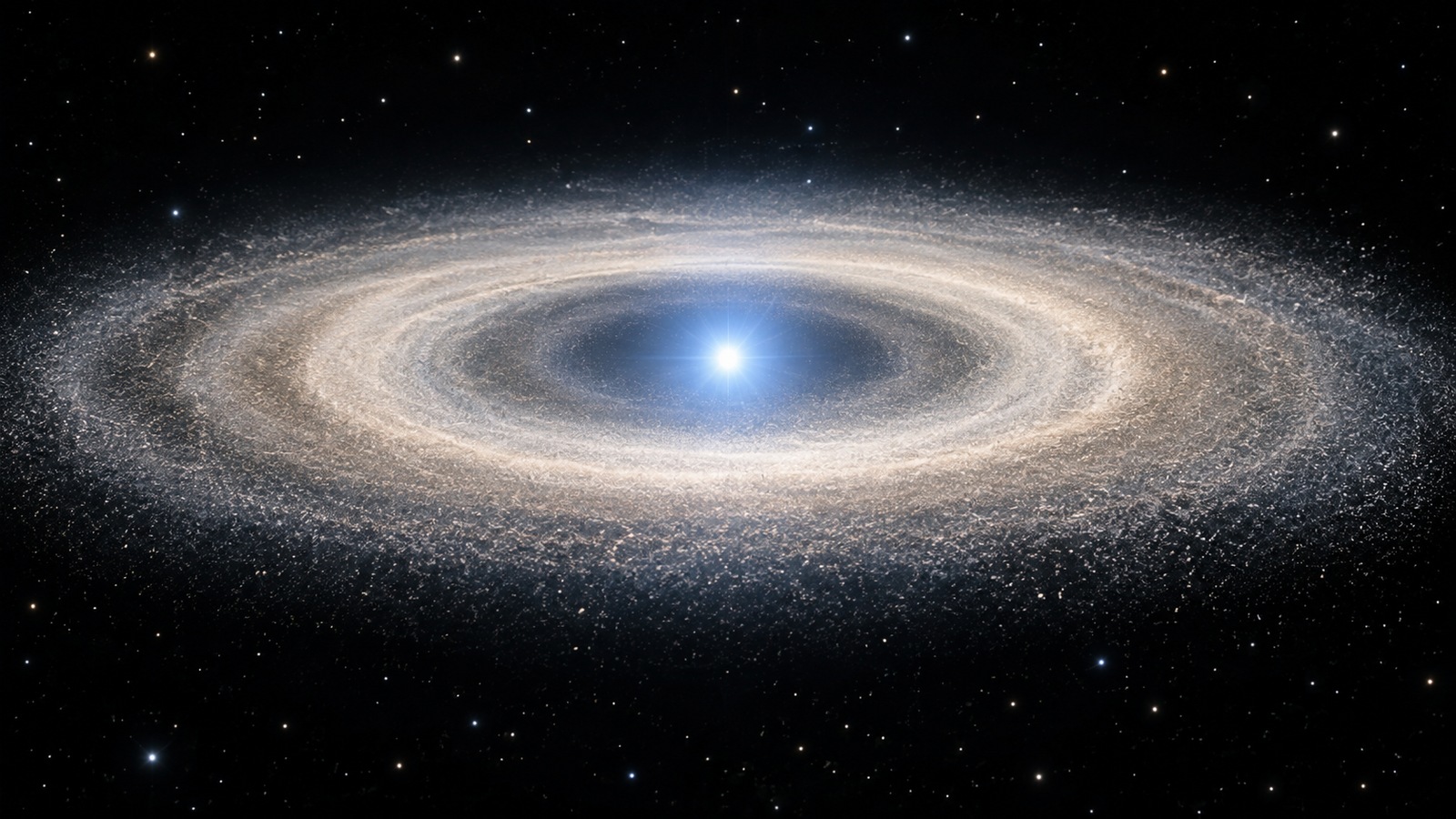
Vega’s stellar atmosphere does not explain all the radiation detected from the system. Excess infrared emission points to dust that absorbs energy and radiates it at longer wavelengths. This kind of evidence can reveal material around a star even when an ordinary optical view shows only a bright point. The dusty environment is called a debris disk because collisions among larger solid bodies can replenish particles. It should not automatically be imagined as the same gas-rich disk in which a very young star is still forming.
Different grain sizes interact with light differently. Some are especially effective at scattering incoming starlight, while others contribute strongly to thermal emission in a particular infrared band. Radiation pressure can also influence their motion. Observations at several wavelengths therefore need not show exactly the same disk boundary or texture. Comparing those views helps researchers distinguish a changing physical environment from a change in what an instrument is sensitive to. A disk image is a wavelength-dependent measurement, rather than a complete inventory of every surrounding body.
The Smooth Disk Is Interesting Because Structure Was Expected
Large planets can influence surrounding debris by perturbing orbits, creating concentrations, or clearing regions. Astronomers therefore examine disks for indirect signs of planetary architecture. A disk’s shape can be useful even when a planet is too faint to detect directly. Yet the connection between shape and planets is not one-to-one. Grain dynamics, collisions, observational resolution, and the age of the system also affect the visible distribution. A convincing interpretation considers more than a resemblance to a ring drawn in a textbook.
Hubble and Webb observations reported in 2024 found Vega’s disk notably smooth. The NASA account of the combined study explains the importance of comparing scattered-light and thermal-emission views. The lack of conspicuous large-planet disturbances was a constraint on possible architectures. It was not a declaration that every planet of every size had been ruled out. Non-detection is most useful when connected to the specific objects and locations the observations could have detected.
A relatively smooth disk can therefore be scientifically productive rather than disappointing. It tests expectations developed from more obviously structured systems. Perhaps the distribution of planets differs, perhaps some planets are too small or too close to reveal their influence clearly, or perhaps dust physics smooths features at the measured scales. Researchers examine those possibilities against the actual data. Vega becomes valuable as a comparison case precisely because it does not display every familiar sign associated with other debris disks.
The measured environment is enormous even without a detected planet. NASA’s description of the Webb view gives the debris structure a width near 100 billion miles, about 160 billion kilometers. Its different components are not one solid ring: scattered light emphasizes small grains, while Webb records thermal emission from warm dust. Seeing a smooth distribution over that scale lets researchers ask whether a large perturber has left an observable imprint. The view supplies a dust map with defined sensitivity, not an inventory of every possible small body hidden within it.
Dust Does Not Establish a Complete Planetary System
Debris implies an environment containing solid material and processes that produce smaller particles. It does not identify every parent body, reconstruct their exact orbits, or prove that a particular Earth-like planet is present. A dust grain can be evidence of collisions without being a visible fragment of a cataloged world. The inference proceeds from radiation and particle behavior toward a possible population of larger bodies. Several arrangements may explain the same broad emission pattern.
That distinction is useful whenever a headline links a dusty disk with planet formation. Different ages and disk compositions correspond to different physical stages. Vega is not simply a snapshot of our solar system at the moment all its planets were born. Comparisons can illuminate general processes while retaining meaningful differences. Its hotter star, rapid rotation, grain environment, and observational geometry make it a particular system, not a universal blueprint.
Color, Twinkling, and What an Eyepiece Can Show
Vega generally appears white or blue-white to observers, reflecting a spectrum associated with a hotter atmosphere than the Sun’s. Low-altitude twinkling can introduce rapidly changing colors that originate in Earth’s moving air rather than rapid changes in the star. A telescope can magnify the surrounding field, but it does not turn Vega into a readily resolved ball with visible polar and equatorial temperatures. Recognizing that limit makes the scientific measurements more remarkable. The rotation model and disk studies depend on capabilities far beyond simply enlarging the bright point in an eyepiece.
How Multiple Techniques Build One Stellar Picture
Photometry records how much radiation arrives in defined bands. Spectroscopy separates that light into wavelengths and reveals clues about temperature, chemistry, and motion. Interferometry can add fine angular information that a conventional image lacks. Disk observations extend the investigation to material around the star. These methods overlap without becoming interchangeable. Each contributes a different constraint, and a useful model must explain them together rather than selecting only the measurements that make one interpretation convenient.
The different views also explain why Vega’s surroundings cannot be characterized with one photograph. Small particles scatter the star’s light effectively, while their thermal emission depends on particle temperature and wavelength. Comparing the two distributions tests how dust moves and persists across the disk. On the star itself, interferometric shape and spectral line broadening test the rotation seen nearly pole-on. These complementary observations address specific physical components rather than simply collecting more pictures of the same blue-white point.
Vega’s role as a reference star makes this especially instructive. Familiarity is not a substitute for characterization. Astronomers can repeatedly use an object and still discover new complications in its physics. Progress comes from measuring those complications more effectively and updating the interpretation. A nearby bright star can thus remain a subject of active investigation rather than becoming scientifically exhausted because it has been observed for generations.
The Secret Is a Combination of Geometry and Evidence
Vega’s surprises become easier to organize once the star and its surroundings are kept separate. Rapid rotation changes the stellar shape and temperature distribution. Our pole-on perspective changes which portions of that distribution dominate the received light. The debris disk introduces a different set of questions about solid bodies, particle motion, and possible planets. Calibration history adds a human measurement story. These connections explain why one bright point can occupy several important roles without being physically simple.
For a skywatcher, the next clear view of the Summer Triangle offers a compact reminder of those layers. Vega is easy to locate, while its essential complications remain invisible to casual inspection. That contrast is part of astronomy’s appeal: simple observations can lead toward increasingly precise physical questions. The surprising secrets are not hidden because the star is obscure. They are hidden because understanding a familiar light requires more than seeing where it shines.