
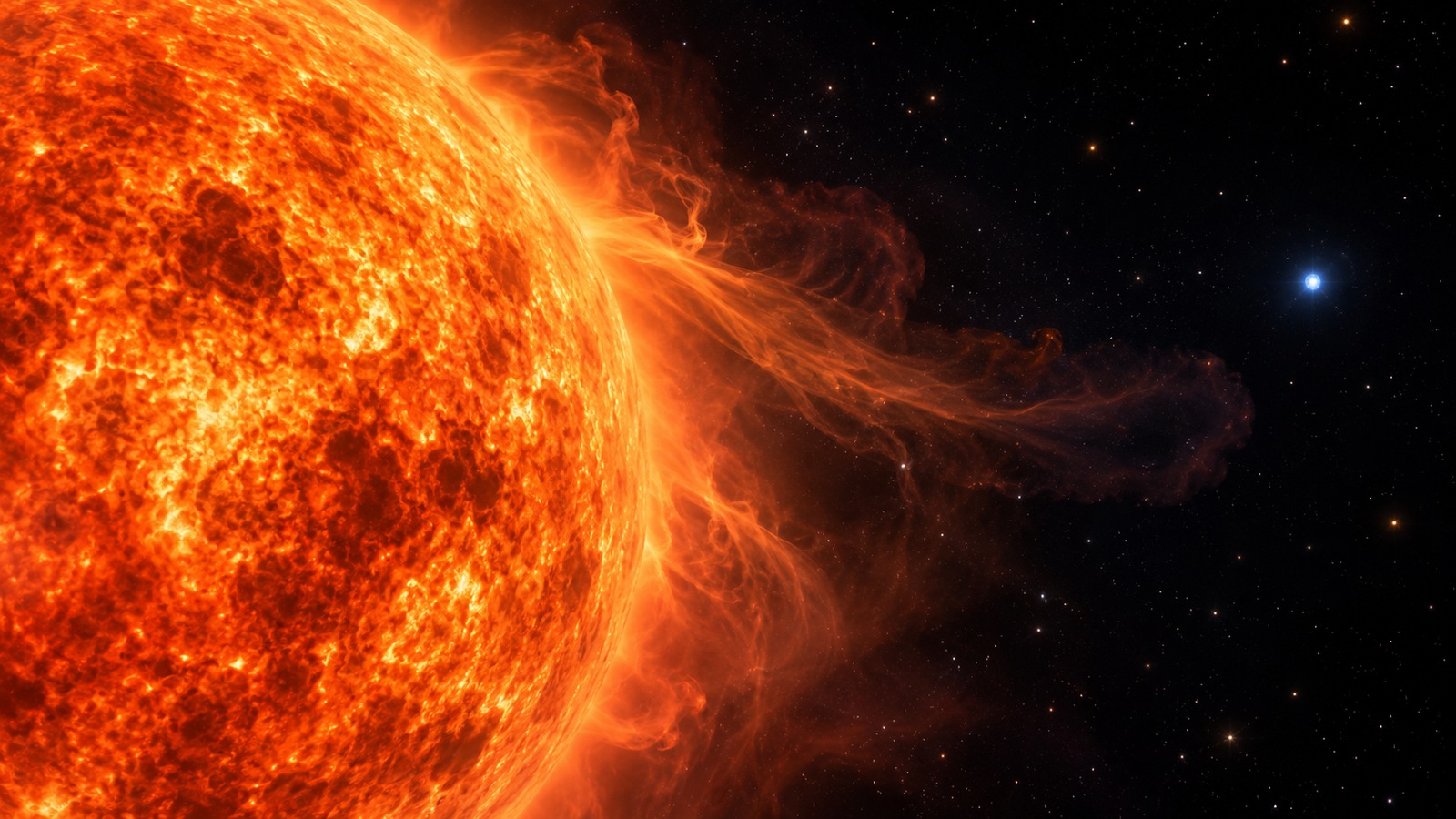
The Red Light at the Center of Scorpius
Antares gives the constellation Scorpius a distinctive warm center. To an observer outdoors, it is a reddish point of light within a recognizable stellar pattern. To astronomers, it is an enormous red supergiant whose extended atmosphere provides a difficult test of how massive stars shed material. The two views refer to the same object, yet they reveal very different amounts of information. Its color supplies a clue about its comparatively cool surface, while interferometry and spectroscopy expose motions that no unaided glance can distinguish. Antares is especially interesting because those measured motions do not fit every simple expectation about its atmosphere. Following that problem connects the familiar heart of the Scorpion with questions about stellar structure, mass loss, and the matter that an evolving star returns to its surroundings.
Finding a Star Rather Than a Moving Planet
Antares belongs to Scorpius, a southern constellation whose visibility depends on the observer’s latitude and the season. Its orange-red appearance can suggest Mars, but a planet changes position relative to the background stars over time while Antares remains part of the recognizable constellation pattern. A sky chart therefore provides a more dependable identification than color alone. In locations where Scorpius stays low, nearby buildings, terrain, and atmospheric disturbance can complicate the view. Farther south, the constellation can stand much higher, making its bright central star easier to examine.
The constellation association also supplies context without determining the star’s physical nature. Neighboring points in a constellation can lie at very different distances, so their arrangement on the sky does not imply that they share one local environment. Antares belongs in that apparent pattern because of the direction from which we observe it. Its red-supergiant classification comes from stellar measurements rather than from the Scorpion’s traditional shape. Separating those two kinds of description lets a familiar sky landmark lead naturally into an unfamiliar physical system.
A Cool Surface on an Immensely Luminous Star
Calling Antares comparatively cool refers to its effective surface temperature, not to an absence of intense heat. The outer visible layers remain far hotter than ordinary terrestrial conditions. Their spectrum differs from that of a blue supergiant, producing the warm impression familiar to observers. The term ‘red supergiant’ connects color and stellar classification, but neither word alone describes the entire physical structure. Antares has a huge emitting surface and a complicated interior beneath an extended atmosphere.
A large surface can radiate an enormous total amount of energy even when each unit area is cooler than the surface of a hotter star. This separates temperature from luminosity. A small hot source and a vast cooler source need not have the same overall output. The distinction helps explain why Antares remains prominent across a distance of hundreds of light-years. Its observed color is not a reliable shortcut to saying it is weak or energetically modest.
The apparent point also conceals size. Ordinary eyes cannot resolve the stellar disk, so a physically enormous star still looks like a tiny light. A telescope’s ability to detect that light does not guarantee the ability to separate details across its surface. Astronomers need exceptionally fine angular information to investigate those details. Antares demonstrates how a source can be familiar and bright while its atmosphere remains challenging to study directly.
The Extended Atmosphere Is Not a Hard Boundary
Pictures often present a star as a sharply bounded sphere. A red supergiant has layers in which density, temperature, opacity, and gas motions change with position. The apparent surface depends partly on which wavelength an observer measures. Light can originate from or be affected by regions at different depths. Consequently, a quoted stellar radius refers to a defined measurement or model rather than a solid shell with one universally obvious edge. An illustration can communicate overall scale while still simplifying that gradual transition.
The outer layers are particularly important because material can eventually leave the star. Understanding how gas reaches those heights and gains the conditions needed for escape is part of the mass-loss problem. A large atmosphere is not automatically an efficient wind. Scientists must identify the processes supplying support and outward momentum. The physical explanation therefore requires more than saying an aging star has expanded: it must connect the expansion with the motion and fate of its gas.
Mapping Motion Across a Distant Stellar Disk
Interferometry combines measurements from separated telescopes to obtain angular information finer than a single conventional aperture provides. For Antares, observations using the Very Large Telescope Interferometer enabled researchers to study spatial structure in the star’s near-infrared light. The technique does not place a spacecraft beside the star or produce a normal camera snapshot from nearby. It uses relationships among received light signals to reconstruct properties on the sky. The resulting images remain measurements with wavelength coverage, resolution limits, and modeling assumptions.
Spectroscopy adds motion information through the Doppler effect. Gas approaching or receding along our line of sight can shift familiar spectral features. Measuring those shifts at different resolved positions allows a map of relative velocities, rather than merely one average motion for the whole star. That is a powerful improvement because different regions can behave differently. A single blended spectrum may hide the spatial organization that helps distinguish competing explanations.
The ESO account of the 2017 Antares study describes the reconstructed atmosphere and velocity map as a milestone in spatially resolved stellar measurements. Its significance was not just a prettier star portrait. Combining location and motion created a way to test how an extended stellar atmosphere behaves. The method translated variations in light into physical constraints on gas around a star whose naked-eye image remains unresolved.
Those maps should nevertheless be read carefully. A red or blue plotting color can represent receding or approaching motion rather than the literal color of that region. A brightness map and a velocity map answer different questions, even when they cover the same apparent disk. Labels and captions establish which quantity is being displayed. Keeping that distinction prevents an informative scientific image from turning into a misleading claim about painted patches on the stellar surface.
Turbulence Raised a New Atmospheric Problem
The investigators found gas motions in the extended atmosphere that could not be explained by convection alone within the comparison used in that study. This does not mean convection never operates in Antares, or that the entire star lacks a known physical basis. It means one proposed mechanism did not account adequately for the measured conditions at the relevant heights. The associated research paper on vigorous atmospheric motion frames the result as a constraint on explanations of red-supergiant atmospheres. An unexpected measurement is most useful when its particular scope remains clear.
Three Telescopes Resolved Where the Atmospheric Gas Moves
The 2017 Antares result combined three Auxiliary Telescopes at the Very Large Telescope Interferometer with the AMBER instrument. ESO’s research announcement describes images made across a small range of infrared wavelengths. Those wavelengths sampled a carbon-monoxide feature as well as neighboring light. The arrangement turned spectral information into a spatial map, rather than reporting only one average velocity for the entire stellar disk.
A shift in the gas feature indicates motion toward or away from Earth along the line of sight. Comparing that shift at different positions reveals that atmospheric parcels do not all share one simple motion. A brightness feature alone cannot provide that directional information. This is the distinctive achievement of the Antares map: it ties local movement to resolved positions in the extended atmosphere, allowing a convection explanation to be tested against more than the star’s mottled appearance.
The physical scale makes the result striking. ESO gives Antares a diameter roughly 700 times the Sun’s, while its educational distance overview places the star approximately 600 light-years away. These are rounded comparisons rather than exact immutable dimensions of a pulsating atmosphere. At that distance, the giant still appears as a point to ordinary observers. Interferometry extracts fine angular information from combined telescope signals, connecting that familiar point with an immense moving gaseous environment.
Convection, Pulsation, and Winds Play Different Roles
Convection transports energy through moving material, with warmer and cooler parcels participating in a circulation. Pulsations involve organized variations in stellar structure and can affect the outer layers. A wind carries matter away from the star. These processes can interact, but they should not be treated as three interchangeable names for any moving gas. A circulation can move material without permanently ejecting it, and a temporary expansion can differ from sustained mass loss.
Models explore how energy and momentum reach the atmosphere and how gas couples to radiation or other influences. Observations help decide which mechanisms are sufficient under real stellar conditions. The aim is a quantitative account that reproduces the structure and motions, not a list of plausible-sounding effects. Antares is useful because spatial information can challenge a model that looked reasonable when only unresolved light was available. A more detailed measurement creates a more demanding test.
Why Losing Material Changes the Star’s Future
Mass loss alters both the star and its surroundings. Material leaving the atmosphere can change the envelope that remains around the interior, affecting the later evolution and the appearance of a future explosion. Surrounding gas can also become an environment with which later outflows interact. The present atmosphere is therefore connected to events that have not yet occurred. Determining how much matter leaves and how it is distributed improves predictions beyond the current bright red phase.
Massive stars also return processed material to the wider interstellar environment through winds and eventual explosive events. That material participates in a larger cycle of gas, dust, and later star formation. The contribution should not be reduced to an image of one star spraying ready-made planets into space. Enrichment and assembly are separate stages operating across different environments and timescales. Antares offers a local example of one part of that continuing exchange.
The relevant history cannot be reconstructed from color alone. Two red supergiants can differ in initial mass, rotation, mixing, and earlier loss of material. Their present atmospheres may look broadly similar while their internal structures differ. Measurements of motion, composition, and surrounding gas help constrain those differences. The scientific question is not merely whether Antares is old, but which physical path brought it to its current state and what that state permits next.
A Supernova Expectation Is Not a Countdown
Antares belongs to the massive-star class associated with eventual core collapse, but that broad expectation does not supply an exact explosion date. Stellar timescales do not translate conveniently into human predictions, and the interior cannot be watched with an ordinary camera. A responsible account separates the general evolutionary route from a claim of imminent change. The warm point may remain familiar for many observing generations. Uncertainty in timing is a physical limitation of the available evidence, rather than an invitation to invent a dramatic appointment.
The Most Useful Backyard Observation Is a Color Comparison
When Scorpius is well placed, look at Antares and compare it with nearby stars whose light appears whiter. Take account of altitude: low stars can flicker through many colors because the atmosphere refracts their light unevenly. A stable warm impression and a momentary flash are different phenomena. The exercise works best when the star is high enough and the air steady enough to reduce those distractions. It connects a simple observation with the reason astronomers use spectral information to classify stars.
A home telescope will generally preserve the impression of an unresolved bright point rather than reveal the intricate atmosphere mapped by professional instruments. That limit is useful to acknowledge before observing. The view provides identification, color, and a place in the sky; the research supplies size, motion, and evolutionary interpretation. Together they create a fuller understanding than either a casual glance or an isolated scientific figure. The heart of the Scorpion is both an accessible landmark and an example of how much physical complexity can fit inside a point of light.


