
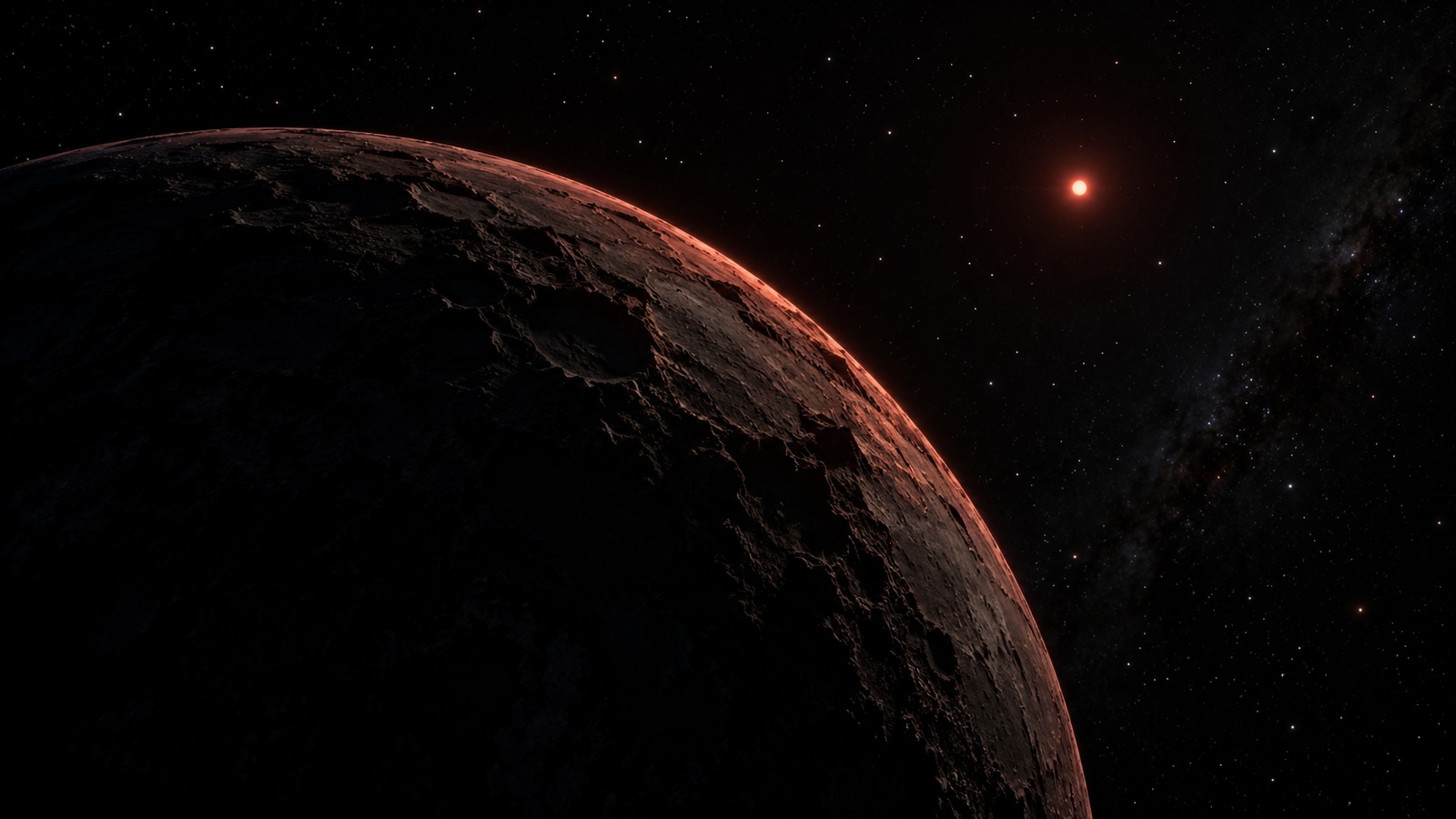
A nearby world with a largely blank map
Proxima Centauri gives the search for life a remarkably close address, but proximity has not supplied a photograph of a living planet. Its best-known planet, Proxima b, was discovered through the tiny motion it induces in its star. That measurement reveals an orbit and a lower limit on mass, while leaving much of the world itself hidden. We do not know whether it has oceans, a substantial atmosphere, bare rock, or conditions that changed dramatically over its history. The question of alien life therefore begins with several earlier questions: can an atmosphere survive, can water remain available, and can the surface or interior provide a stable environment? Following those questions in order makes this neighboring system more interesting, because each answer would change what the next investigation should look for.
What astronomers actually measured
In 2016, astronomers announced evidence for Proxima b from the radial-velocity method. A planet and its star orbit their common center of mass, so the star moves toward and away from Earth by a small amount. That motion shifts the wavelengths of stellar absorption lines. Repeated observations revealed a roughly eleven-day signal consistent with a planet circling Proxima. Detecting such a weak signal requires careful attention to the star’s own activity, which can also change its spectrum.
The orbital measurement is sometimes described as though it were a complete planetary inventory. It is much narrower than that. Radial velocity supplies a minimum mass because the orbit’s tilt affects how much stellar motion points toward us. Without a measured radius, astronomers cannot calculate the planet’s bulk density from mass and volume. A rocky interpretation is plausible for a world near Earth’s mass, but the discovery did not establish an Earth-like surface, atmosphere, or composition.
Proxima b has not provided the useful repeated transits that would reveal its size by blocking a measured fraction of starlight. That geometry matters beyond a missing radius. During a transit, some starlight can pass through an atmosphere and carry clues about its gases. A nontransiting nearby planet must be studied through other approaches, each with substantial observational challenges. Its closeness improves the prospects for future work without removing the difficulties of separating faint planetary light from the star.
Why eleven days can still place a planet in the habitable zone
An eleven-day year sounds like an orbit destined to roast a planet if the Sun is the reference point. Proxima is a small, cool red dwarf, however, and its luminosity is far lower than the Sun’s. A planet must orbit much closer to receive a comparable amount of energy. Proxima b’s orbit falls within commonly discussed habitable-zone estimates, where liquid water could be possible under suitable atmospheric conditions. This is an energy-budget statement, with assumptions attached, rather than an observation of water or a declaration that the planet is inhabited.
An atmosphere would be the central evidence
On Earth, an atmosphere redistributes heat, maintains surface pressure, and changes the balance between incoming and outgoing radiation. A world around Proxima would depend on those functions too, although its circumstances would differ. Surface water can evaporate or freeze depending on pressure and temperature. An atmosphere can also modify the climate through greenhouse warming and clouds. These effects mean that the same stellar energy can produce very different environments on planets with different atmospheric inventories.
Atmospheric composition is just as important as atmospheric presence. A dense blanket with abundant greenhouse gases might keep some locations warm while producing hostile conditions elsewhere. A thin atmosphere might offer little protection or transport little heat. The amount and placement of water would alter evaporation, cloud formation, and circulation. None of these properties can be filled in reliably by substituting Earth into a model and treating the result as a measurement of Proxima b.
Living beside an active red dwarf
Proxima is a magnetically active star that produces flares. A coordinated observing campaign recorded a 2019 flare that briefly brightened Proxima by a factor near 14,000 in ultraviolet light, as reported in NASA’s account of the measured event. The factor belongs to that wavelength range, not to a claim that all the star’s radiation increased by the same amount. This gives the hazard a measured scale while preserving the distinction between stellar output and exposure beneath an unknown planetary atmosphere. A planet so close to the star encounters an environment shaped by ultraviolet and X-ray radiation as well as other stellar activity. The radiation reaching the upper atmosphere is especially relevant to heating and possible gas loss. This is why a comfortable average energy input is insufficient by itself to settle the habitability question.
Researchers model atmospheric escape to explore how strongly this environment might affect a planet. A NASA study considered how an Earth-like atmosphere could fare in Proxima b’s orbit and found substantial reasons for concern under its assumptions. The study did not measure an atmosphere disappearing from Proxima b. Its result identifies a physical vulnerability that observations and improved models must investigate. Magnetic fields, atmospheric chemistry, and the changing stellar environment all influence how a particular case develops.
Flares also pose a more complicated biological question than a simple lethal-or-safe division. Radiation at the top of an atmosphere is different from radiation at the ground. Protective gases, water, rock, and habitat depth can change exposure considerably. Life beneath an ocean or below a surface would face different constraints from organisms exposed directly to the sky. Invoking sheltered environments does not demonstrate life exists there, but it prevents surface conditions from being mistaken for a complete account of every possible habitat.
Atmospheric replenishment belongs in the same discussion as atmospheric loss. Geological activity might release gases over time, while escape removes some fraction of them. A planet’s long-term state depends on the balance between those processes, its original inventory, and its history. There is no confirmed measurement establishing that Proxima b has sufficient replenishment, volcanism, or a protective magnetic field. These possibilities are research questions rather than accessories that can be added whenever a model needs a friendlier outcome.
The star’s early years may matter more than one modern flare
Red dwarfs can spend a lengthy early period evolving toward their mature state, with luminosity and activity histories that differ from the Sun’s. A planet that receives a potentially suitable energy input today may have experienced much harsher conditions earlier. If substantial water was lost during that period, a later improvement would not automatically restore an ocean. Researchers therefore examine the integrated history of irradiation and escape, rather than judging habitability from a contemporary snapshot alone. Initial water abundance and later delivery could change the outcome, but those quantities remain uncertain for this planet.
A permanent day side is a possibility, not a measured portrait
Close orbits make tidal effects important. A planet may evolve toward synchronous rotation, with one hemisphere facing the star, although its actual spin state depends on physical properties and orbital history. Proxima b’s rotation has not been directly measured. Popular pictures of a permanently bright hemisphere and a frozen dark hemisphere are therefore scenarios. They are useful for asking how heat would move, but they should not be presented as an established geographical map.
Even synchronous rotation does not guarantee that half a planet becomes unusable. An atmosphere and an ocean can transport heat away from the illuminated region. Climate simulations investigate whether circulation, clouds, and water distribution permit temperate locations under particular assumptions. Other assumptions can yield colder, hotter, or drier outcomes. The important lesson is that rotation interacts with the atmosphere and surface; it does not determine the full climate independently.
What the climate simulations can teach us
Computer models allow researchers to test combinations that cannot yet be observed directly. They can alter atmospheric pressure, greenhouse gases, ocean depth, land arrangement, and spin assumptions to see how circulation responds. Such experiments help identify conditions under which liquid water might persist. They also reveal which future measurements would eliminate large groups of possibilities. A model’s usefulness comes from exploring physical consequences consistently, not from selecting the most appealing simulated landscape.
NASA researchers have modeled potential climates for Proxima b, including ocean-bearing cases with different assumed conditions. Those experiments show that nearby red-dwarf planets deserve more careful treatment than blanket claims that tidal locking makes life impossible. They do not establish that Proxima b possesses the oceans used in the simulations. A reader should look for the inputs before looking at the output map. If pressure, water inventory, and composition were assumed, the resulting climate remains conditional on those choices.
The physical differences between simulated climates matter directly. Air transports heat through winds, while an ocean can store it and move it more slowly between regions. Clouds can reflect incoming radiation and alter the escape of outgoing heat, so changing their distribution affects the result even with the same orbit. A thin atmosphere, a thick atmosphere and an ocean-bearing surface need not produce the same day-to-night contrast. Climate experiments reveal those mechanisms; a future pressure or water constraint would help determine which mechanism belongs to the actual planet.
How a future observation could move the discussion forward
A confirmed atmosphere would change the debate immediately, even before its full composition was known. Measurements of thermal emission or reflected light could help constrain conditions if instruments can isolate the planet sufficiently. Spectroscopic evidence might then identify gases or restrict their abundance. Each step would narrow the family of allowable climates. The technical challenge is substantial because the star overwhelms the light of such a small neighboring world.
A claimed biosignature would require another level of scrutiny. Oxygen, methane, or other gases cannot be treated as automatic proof of biology without considering how they might arise through nonliving processes. The stellar ultraviolet environment can affect atmospheric chemistry and the interpretation of those gases. Multiple measurements, environmental context, and careful testing of alternative explanations would be needed. Life detection is a chain of evidence, not a single exciting spectral label.
Closeness changes the search, not the answer
At a little over four light-years away, Proxima is close on a galactic scale and immensely distant on a human travel scale. No spacecraft has inspected Proxima b, and proposed interstellar missions remain a separate engineering problem from telescopic evidence. Its distance makes it an especially valuable target for developing ways to study small exoplanets. That practical advantage is a reason to keep investigating, rather than a reason to assume the investigation has already succeeded. The system offers a nearby test of questions relevant to many planets around red dwarfs.
The strongest present answer to whether Proxima could host alien life is a conditional one. A planet is there, its orbit makes the energy question interesting, and its stellar environment presents serious challenges. Its atmosphere, water history, surface conditions, and biology remain unconfirmed. Those uncertainties are not interchangeable: establishing an atmosphere would resolve one major question while leaving others open. Keeping that order clear lets future evidence genuinely change the story, instead of merely being fitted into a picture of life that was drawn before the planet could be examined.
The next decisive step would not need to be a biological announcement. Evidence about an atmosphere would connect the measured stellar environment with a physical planetary response: what radiation is absorbed, how heat is transported and whether gas persists. An airless outcome would explain one route by which a close red-dwarf planet fails to resemble an imagined ocean world. An atmospheric outcome would provide a basis for narrower climate questions. Either would replace some of today’s assumed starting conditions with information about this particular nearby world.


