How a small central region reaches a much larger galaxy
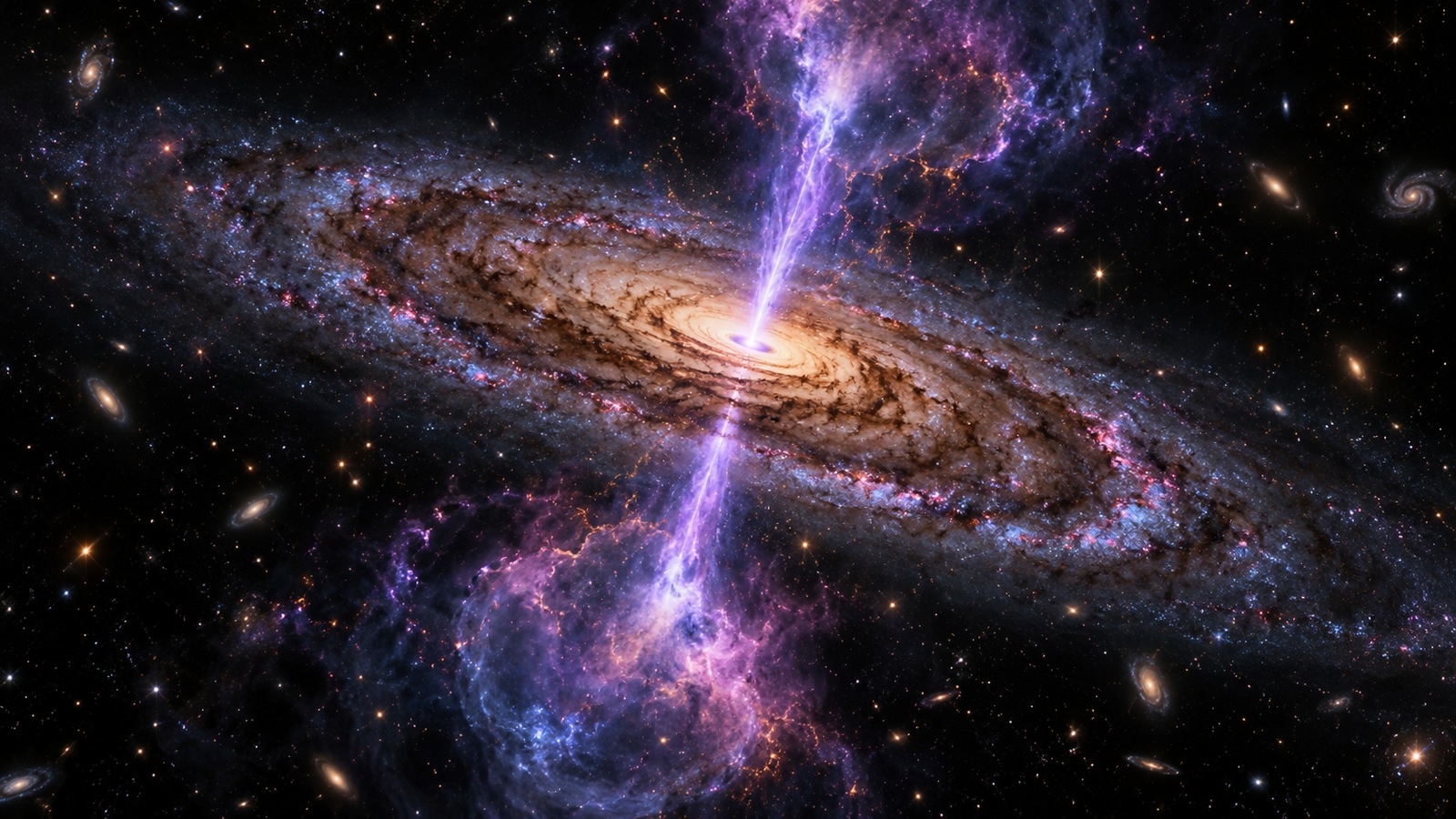
Gas approaches a galaxy’s central black hole, heats as it moves inward, and releases energy before some of it disappears beyond the event horizon. Part of that energy can travel outward through radiation, winds, or narrow jets. Far from the center, surrounding gas may become hotter, move away, or resist cooling into the dense clouds that form stars. This chain connects a very small central region with a much larger environment, but it does not mean the black hole supplies all the gravity holding the galaxy together. Stars, gas, and dark matter dominate much of that larger gravitational structure. Understanding a supermassive black hole’s role therefore requires following two different influences: its local gravitational pull and the energy that accretion sends into the galaxy around it.
The gravitational reach has boundaries
A supermassive black hole can contain millions or billions of solar masses while still representing only a small fraction of its host galaxy’s mass. Near the center, its gravity may dominate the motions of nearby stars and gas. At greater distances, the combined gravity of the surrounding stellar population, gas, and dark matter becomes more important. The relevant transition depends on the galaxy and black hole rather than following one universal radius. Astronomers call the region where the black hole strongly shapes local motions its sphere of influence.
This distinction prevents a familiar misconception. Galaxies do not need their central black holes to function like a pin fastening every star into a spinning disk. The large-scale gravitational field comes from distributed matter, and a star well out in the disk responds to that field. Evidence for dark matter in galaxy rotation is not explained away by adding a massive object at the center. A central black hole has a different spatial effect from an extended halo of gravitating matter.
Feeding requires more than having nearby gas
Gas must lose angular momentum before it can move deeply inward. Material orbiting the center does not simply fall straight into the black hole because gravity exists. Interactions, torques, and other processes can help redistribute angular momentum over several physical scales. Some gas may form stars or remain in orbit instead of reaching the innermost region. This makes black-hole fueling a transport problem connecting the galaxy’s available gas with conditions very close to the nucleus.
Galaxy interactions and mergers can disturb gas and help direct some of it inward, but they are not the only possible triggers for activity. Internal structures and processes can also alter gas flows. Different galaxies may feed their central objects through different routes at different times. A bright active nucleus should therefore not automatically be treated as evidence of one recent merger. Researchers compare observations of the host with models of the relevant transport processes.
The rate of feeding matters because it changes how much energy can be released. A black hole with little accessible fuel may remain relatively quiet even if it is enormous. Conversely, an actively accreting nucleus can be extremely luminous because material radiates as it approaches the event horizon. Black-hole mass alone is insufficient to predict a galaxy’s current nuclear brightness. The supply and state of surrounding matter are essential parts of the explanation.
Why the brightest light comes from outside the horizon
The event horizon is a boundary beyond which signals cannot return to distant observers, so the luminous engine is the material outside it. Gas in the accretion flow can become very hot and emit across a broad range of wavelengths. The surrounding environment may absorb and reprocess some of that radiation, changing how an active nucleus appears from different directions. Observations can consequently reveal a bright central source, an obscured one, or activity that is especially prominent in radio or X-rays. These are clues about accretion and its surroundings, not light escaping from the interior of the black hole.
Radiation, winds, and jets carry different effects
Radiation transfers energy and can exert pressure on surrounding matter. Its effect depends on the gas, dust, geometry, and wavelengths involved. A cloud that absorbs strongly will respond differently from material through which much of the radiation passes. Some nuclear outflows take the form of winds covering a relatively broad region. Other systems produce narrow jets associated with magnetized plasma near the central engine.
Jets can carry energy far beyond the region dominated by the black hole’s direct gravity. They may inflate lobes, drive shocks, or disturb gas as they interact with their environment. Their reach does not mean the black hole is gravitationally pulling distant material with unusual strength. Energy and momentum are being transported outward by the flow. This distinction explains how a compact nucleus can influence a much larger volume without providing most of the galaxy’s mass.
Not every accreting black hole produces the same visible structures. Activity can vary in strength, geometry, and duration, while viewing angle affects what observers recognize. A radio-bright jet is one type of evidence for an energetic nucleus, not a required feature of every active galaxy. Researchers combine wavelengths because one image can miss important components of the interaction. Dust-obscured radiation and hot gas, for example, may need different instruments to examine.
The term feedback describes the effect of this outgoing energy and momentum on the surrounding material. Its importance depends on whether that material actually absorbs enough energy or experiences enough disturbance to change its behavior. A bright nucleus does not guarantee a large effect everywhere in its host. Geometry, gas density, cooling, and the timing of the activity all matter. Measuring those connections is more demanding than identifying a black hole and assuming everything nearby follows from it.
Hot gas can delay the birth of new stars
Stars form from gas that becomes sufficiently dense and cold, so heating or removing that gas can reduce opportunities for star formation. An active nucleus may disrupt a cold reservoir directly or affect hotter material that would otherwise cool and replenish it. In a massive galaxy or galaxy cluster, maintaining a hot atmosphere can therefore influence star formation over extended periods. This is often called negative feedback because it restrains further growth through new stars. It does not mean the black hole reaches out and individually destroys the existing stellar population.
X-ray observations of galaxy clusters provide striking evidence that energetic activity can disturb hot gas. Cavities in the X-ray-emitting atmosphere may align with radio-emitting structures associated with jets. Inflating those cavities requires energy, allowing researchers to estimate the mechanical impact of an outburst. Systems such as MS 0735.6+7421 have offered dramatic examples of this process. The interpretation depends on the observed gas structures and their physical context, not simply on the visual drama of a central source.
Compression can sometimes encourage star formation
Energy injection does not always have the same consequence. A shock or expanding outflow can compress some gas rather than disperse every cloud it encounters. Under suitable conditions, that compression may promote cooling and collapse in particular locations. A specific case is the redshift-1.7 radio-galaxy group in the J1030 survey field described by Gilli and colleagues in 2019. Chandra detected diffuse X-rays near a radio lobe, while four star-forming neighboring galaxies lay along its edge and had unusually high specific star-formation rates compared with similar-mass galaxies. The authors proposed an expanding, shock-heated bubble that compressed those galaxies’ cooler gas. The spatial association and enhanced rates support that interpretation without directly filming clouds turning into stars. Here, the energy source would encourage local collapse by compression rather than only keeping a gas reservoir too hot to cool. Such positive feedback is a context-dependent possibility, not a rule that every jet creates new stars along its path.
The host galaxy and the black hole grow together imperfectly
Observations reveal relationships between central black-hole mass and properties of the surrounding stellar bulge, including stellar velocity dispersion. These relationships suggest that black-hole growth and galaxy evolution are connected over long periods. They do not show that the black hole single-handedly built the bulge or that every galaxy follows exactly the same history. A correlation constrains explanations but does not identify a unique causal pathway. Researchers examine feedback, fuel supply, mergers, and other processes to understand how such relationships arise.
Scatter around a relationship is scientifically valuable. Galaxies with unusual central objects or different structures can help test whether proposed explanations work across the population. Measuring black-hole masses is itself challenging, especially when the sphere of influence is difficult to resolve. Selection effects can shape the samples available for analysis. The strongest conclusions therefore come from understanding both the astrophysics and how the observations were assembled.
Small and low-mass galaxies introduce further questions about how commonly central massive black holes occur and how they began. Astronomers should not assume that every galaxy contains a supermassive black hole already confirmed by observation. The earliest seeds, subsequent growth, and survival through galactic encounters remain active research subjects. Present-day relationships provide part of the evidence but cannot reconstruct every starting condition. A complete account must connect early formation with the varied galaxies observed now.
A quiet nucleus still belongs in the story
Many central black holes are far dimmer than the spectacular active nuclei featured in illustrations. Quietness may reflect a limited fuel supply or an accretion state that releases relatively little observable radiation. The central object can still influence nearby orbits and retain a record of past growth. Evidence of earlier activity may also persist in surrounding gas after the nucleus becomes less luminous. Looking only at present brightness can therefore miss a galaxy’s longer history of interactions with its black hole.
The timing of activity matters because gas reservoirs respond over different timescales. A powerful outburst can be brief relative to the galaxy’s age, while its consequences last much longer. Feedback may influence later feeding by changing the amount or state of gas available near the center. This creates the possibility of a regulated cycle rather than continuous maximum activity. The details differ among environments, and a single image provides only one moment in that evolving relationship.
How observers test influence rather than assume it
A convincing feedback investigation begins with several connected measurements. Researchers seek evidence of nuclear activity, map the surrounding gas, and examine whether its motions or temperatures are consistent with energy input from the nucleus. They may estimate the energy required to make a cavity or drive an outflow, then compare it with what the active system can supply. This approach builds a physical argument linking cause and effect. It also helps distinguish nuclear feedback from other processes, including energy released by stars.
Different wavelengths answer different parts of the question. Radio observations can trace jets and lobes, X-rays reveal hot gas, and optical or infrared measurements can examine stars, dust, and cooler material. Combining those views can show whether the nucleus is heating a reservoir, accelerating gas, or interacting with star-forming regions. Interpretation still requires care because the components may represent different phases of activity. The aim is a coherent explanation across the available evidence rather than a conclusion drawn from the most striking image.
That evidence leads to a balanced picture of supermassive black holes in galaxies. They dominate certain local motions, grow when gas reaches their surroundings, and can influence distant gas through the energy released during accretion. Their effects may restrain star formation, encourage it in particular circumstances, or leave a quieter present-day nucleus after an earlier energetic episode. Meanwhile, the galaxy’s wider gravitational structure remains a property of its distributed matter. Keeping those roles distinct makes the central engine’s importance clearer and gives each new observation a precise place in the larger story.