
The Gaps Between Clusters Are Part of the Story
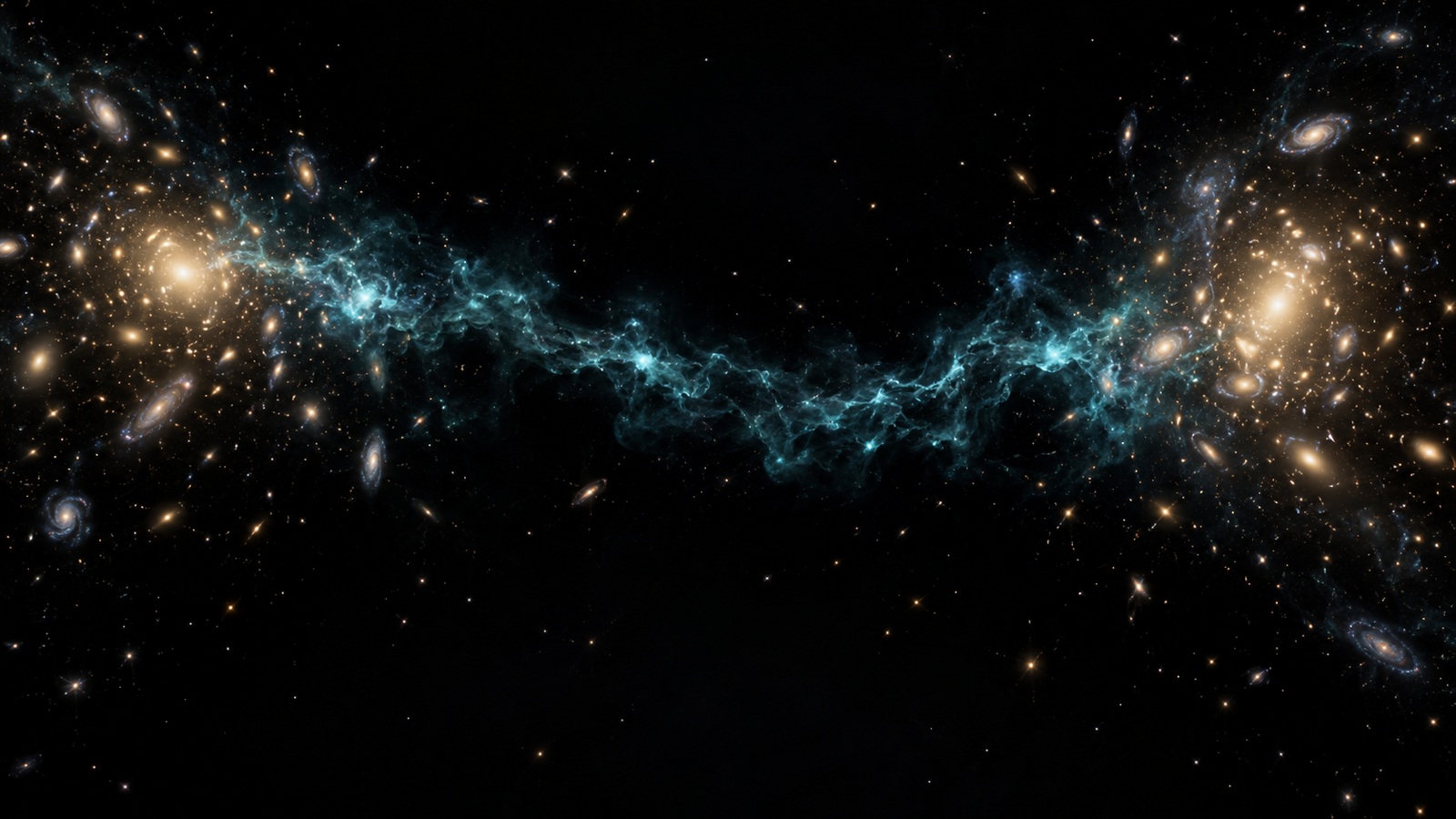
Two galaxy clusters can look like separate cities of light with little between them, yet the apparent gap may contain a vast bridge of gas. These filaments belong to the cosmic web, the uneven network into which gravity has organized matter over billions of years. Their material is so diffuse that it can hold an enormous total mass while producing only a faint signal across any small patch of sky. Finding that signal is a challenge in measurement as much as an exercise in cosmic imagination. It also addresses a practical mystery: where ordinary matter resides when astronomers add up stars, galaxies, and known gas reservoirs. The missing material has not necessarily disappeared; much of it may be difficult to see in precisely these sprawling connections.
Gravity Built a Web Rather Than a Uniform Fog
The early universe was not perfectly smooth. Small density differences supplied the starting points from which gravity gradually amplified concentrations of matter. Dark matter helped shape an underlying network of potential wells, while ordinary gas responded to gravity and additional physical processes. Matter flowed toward denser regions, and clusters developed near important intersections. The resulting web contains broad sheets, elongated filaments, dense knots, and comparatively empty voids rather than a regular lattice with identical links.
A filament is therefore a physical concentration, not a line that astronomers draw simply because two clusters appear nearby. Its true geometry is three-dimensional and can be curved, branched, or interrupted by denser structures. We view that distribution in projection, which can make unrelated material overlap. A pair of clusters in the same photograph may or may not share a gas bridge. Distances, spectra, and supporting measurements are needed before an attractive visual connection becomes a defensible physical claim.
The word bridge is useful but imperfect. It does not imply a solid roadway, a sharp cylindrical boundary, or gas moving from one cluster to another in a simple stream. Material can fall toward both ends and toward embedded groups, responding to several gravitational influences. Different parts can have different temperatures and histories. An accurate explanation treats the bridge as an extended environment with structure, rather than as a single rope stretched across the sky.
Thin Material Can Add Up to an Enormous Reservoir
Everyday intuition connects large mass with dense material, but cosmic filaments exploit volume. A small amount of gas in each enormous parcel of space can sum to a major reservoir across millions of light-years. The challenge is that an instrument measures radiation or its effects along particular sightlines, not a convenient total-mass label. Gas can be physically important while remaining observationally faint. Estimating its mass consequently requires a model of density, geometry, and temperature, with uncertainty in each of those ingredients.
Missing Baryons Are Ordinary Matter, Not Dark Matter
In astronomical accounting, baryons refer to ordinary matter associated chiefly with protons and neutrons. Stars, planets, and much of the gas familiar from chemistry belong to that category. Independent evidence from the early universe predicts an ordinary-matter inventory, but a census of readily observed nearby reservoirs historically fell short. The missing-baryon problem asks where that expected ordinary material is located. It is distinct from the dark-matter problem, which concerns a different gravitating component that does not behave like ordinary gas.
This distinction matters when a headline announces that missing matter has been found. Detecting a hot filament can add to the baryon census without discovering the particle responsible for dark matter. Both kinds of material may occupy related large-scale structures, but they are not interchangeable. Ordinary gas radiates, absorbs light, and interacts electromagnetically in ways dark matter has not been observed to do. The measurements used to inventory one component cannot simply be relabeled as a direct detection of the other.
Gas Heats Up as Structure Takes Shape
As gas falls into developing structures, compression and shocks can convert organized motion into heat. The resulting warm-hot intergalactic medium spans a broad range of temperatures, commonly discussed from roughly a hundred thousand to millions of degrees. Not every filament belongs entirely to that range, and colder or hotter phases can coexist nearby. Heating depends on local conditions and the history of accretion. A cosmic-web map should therefore not imply that all its connecting material has one universal temperature.
Cluster environments can complicate the picture further. Hot plasma near a cluster can extend into the region where a filament approaches, and an interaction between clusters can compress material in their bridge. Researchers need to distinguish a relatively ordinary intergalactic filament from gas modified strongly by a cluster encounter. The distinction affects what a detection tells us about the wider web. A particularly bright bridge may be easier to measure precisely because it represents an unusually heated or dense part of the network.
Temperatures are inferred through observations interpreted with plasma physics. Radiation at certain energies, or absorption by particular ions, can constrain the thermal state. But ion populations also depend on density, radiation fields, and whether the gas has reached equilibrium. Translating a spectral feature into a temperature requires assumptions that researchers must test. The filament is invisible to casual viewing, yet its constituent atoms and electrons can leave a measurable physical record.
Gas can also carry heavier elements produced inside stars and spread outward through winds and explosions. Those elements supply useful spectral tracers, but their abundance introduces another uncertainty in converting a signal into total gas mass. An oxygen feature measures oxygen in a particular state, not hydrogen directly. Estimating the whole reservoir requires a defensible relationship between the observed tracer and the unseen bulk. The bridge’s chemical history becomes part of the measurement rather than an incidental detail.
X-Rays Can Reveal a Faint Emission Bridge
Hot gas can emit X-rays through several processes, allowing space observatories to search between clusters. The signal from a tenuous filament is weak and competes with instrumental background, foreground emission, and unrelated sources. Researchers carefully mask or model contaminating objects and compare the bridge region with suitable surrounding areas. Long exposures help, but exposure time alone cannot correct an incorrectly identified foreground feature. A convincing result combines sensitivity with a careful account of everything else contributing to the measurement.
The published analysis of Abell 222 and Abell 223 found hot gas at about 0.9 kiloelectronvolt, equivalent to roughly ten million kelvin. Its inferred density was about 0.000034 particles per cubic centimeter under an assumed fifteen-megaparsec depth along our sightline. That is only about 34 particles in a cubic meter, yet the assumed path runs for almost fifty million light-years. The depth is a modeling assumption rather than a directly measured ruler length, and changing it changes the density estimate. This example explains how an extraordinarily sparse environment can still hold substantial material when its volume is enormous.
Absorption Turns a Background Source into a Probe
A bright object behind intergalactic gas can serve as a lamp. Some wavelengths are absorbed when its radiation passes through particular atoms or ions along the way. Spectroscopic measurements then look for the resulting dips and use their positions to help locate the intervening material. This approach can detect gas too faint to see easily in emission. It replaces the question of how brightly the bridge glows with the question of what signature it imprints on passing light.
Microwave Photons Offer Another Kind of Evidence
Hot electrons can scatter photons of the cosmic microwave background and slightly alter the observed microwave spectrum. This Sunyaev-Zel’dovich effect supplies information related to the gas pressure integrated along the sightline. In an appropriate bridge system, combining microwave and X-ray observations can constrain properties that either method alone leaves uncertain. X-ray emission has a different dependence on density from the microwave signal, so the measurements complement one another. Their relationship helps researchers reason about both thin material and its geometry.
Even this combination does not provide an assumption-free three-dimensional photograph. Material from the clusters’ outskirts can contribute along the same sightline, and the path length through the bridge can be uncertain. Researchers compare physically motivated models against the data and investigate alternative explanations. A result becomes stronger when the inferred gas properties remain plausible across reasonable variations in those models. Multiple methods reduce degeneracies rather than abolishing every uncertainty.
A completed example combines these methods in Abell 399 and Abell 401, clusters separated by about ten million light-years. Planck detected a microwave signature of their connecting gas; combining that signal with ROSAT X-ray observations indicated a temperature around eighty million degrees. The result gives two independent observational handles on a particular bridge, rather than merely proposing a future search. Its gas is exceptionally hot, so it should not be treated as a temperature template for every filament. The contrast with the cooler Abell 222/223 bridge shows why several techniques are needed to investigate the web’s different environments.
Stacking Can Measure a Population Without Showing Every Bridge
Some individual filaments remain below the sensitivity of a practical observation. Researchers can combine measurements for many suitably selected cluster or galaxy pairs, aligning their expected connecting regions. A signal that is too weak in each individual field can emerge statistically in the combined data. This technique is called stacking and is useful when selection and background treatment are controlled. Its result describes an average or population signal, not a newly resolved image of every included filament.
That limitation changes how a stacked detection should be explained. It may indicate that connecting regions contain gas with a consistent average property, while allowing considerable variation among individual systems. Some pairs may contribute strongly and others weakly. Incorrect alignments, chance projections, or selection biases can affect the result unless tested. A responsible account identifies whether the evidence comes from one especially informative bridge or from a statistical ensemble of much fainter connections.
Simulations Supply Hypotheses That Observations Must Test
Computer simulations model how gravity, gas dynamics, cooling, and energy input from galaxies can shape the web. They predict where filaments occur and what range of gas properties observers might encounter. Those predictions help design searches and interpret difficult measurements. They remain dependent on numerical resolution and physical assumptions, especially for processes that cannot be followed in full detail. A beautiful simulated filament is a model output whose reliability is assessed through comparison with real data.
Researchers can create synthetic observations from a simulation and ask how its gas would appear to a particular instrument. This step helps separate a physically substantial filament from one that should actually be detectable. It also reveals how projection and instrument sensitivity reshape the apparent scene. Comparing like with like is essential: a total gas-density map is not directly equivalent to an X-ray image. Each representation weights the underlying material differently.
Disagreement between a prediction and a measurement can expose missing physics, uncertain geometry, or an observational bias. It does not automatically invalidate the existence of the cosmic web. Nor does agreement in one bridge prove that every feedback prescription in a simulation is correct. The scientific exchange proceeds through specific properties and their uncertainties. Filaments are useful because they connect large-scale structure formation with the smaller-scale ways galaxies heat and redistribute surrounding matter.
A Connection with a Measurable but Uneven Future
Gas filaments help supply material to the dense regions where groups and clusters grow. Their flows are shaped by the evolving gravitational landscape, while heating and feedback alter how readily gas can later join a galaxy. The connections are therefore part of ongoing cosmic development rather than frozen outlines. A filament’s present existence does not establish that every cluster along it belongs to one bound system. Large-scale geography and eventual gravitational destiny remain different physical questions.
The central lesson is that apparently empty space can carry a major share of the universe’s ordinary material. Proving that requires weak signals, complementary instruments, and careful distinctions between detections, averages, and models. Each well-measured bridge improves the inventory without making the entire census complete. The faintness of the filament is not a failure of the idea; it is the observational consequence of spreading meaningful mass across an almost unimaginably large volume.


