
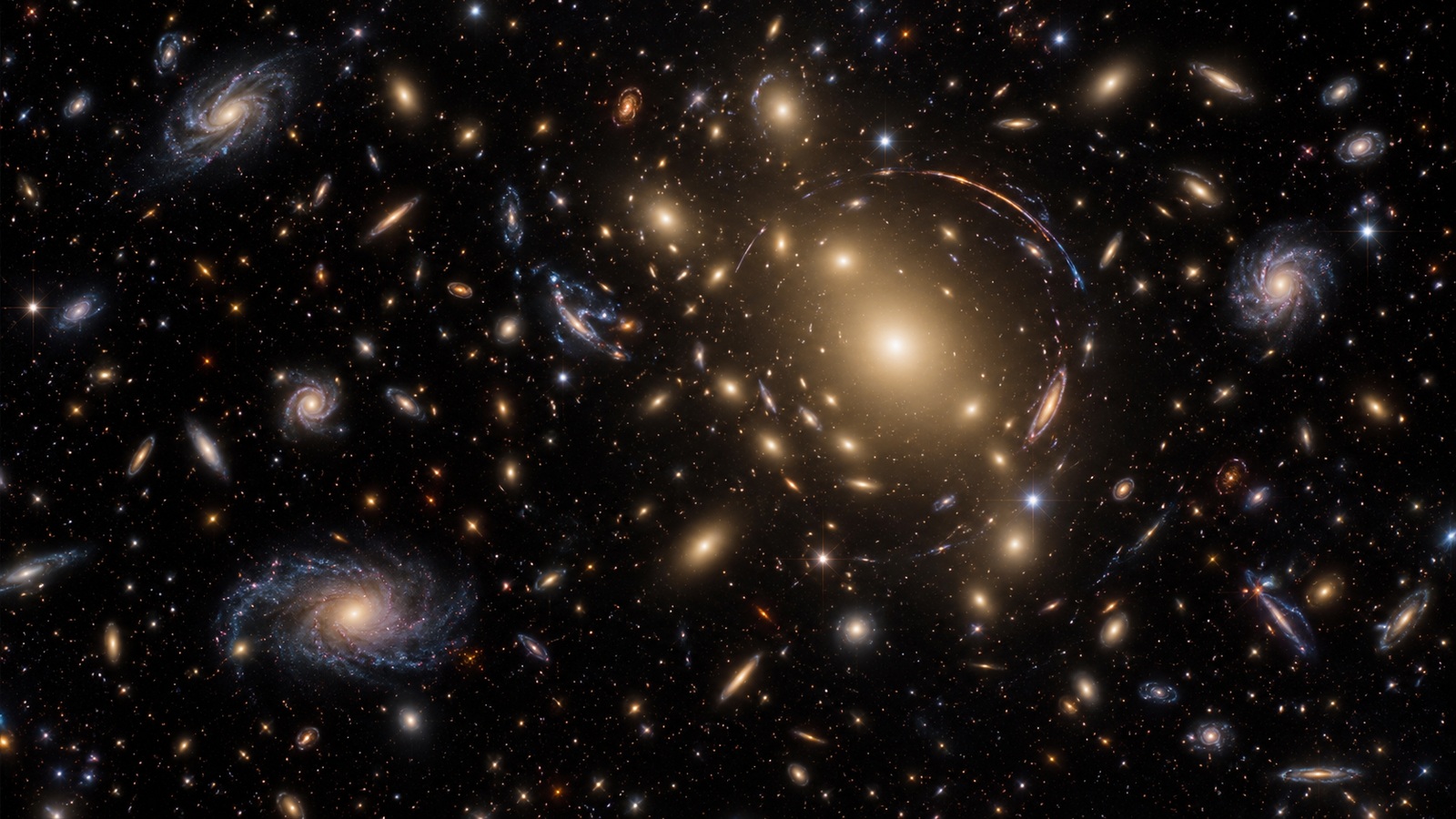
A Cosmic Address Has More Than One Meaning
A galaxy’s address can describe both its immediate companions and a much larger region of the universe. The Milky Way belongs to the Local Group, while broader maps place that group within an intricate landscape of clusters, filaments, and superclusters. Those names can sound like a tidy set of nesting boxes, but their boundaries do different jobs. A galaxy cluster is held together by gravity; a supercluster can describe an extended concentration whose distant parts do not share one bound future. Understanding that distinction turns a spectacular cosmic map into something more useful than a list of increasingly large objects. It reveals where galaxies interact, where hot material collects, and how astronomers connect local neighborhoods to the universe’s evolving large-scale structure.
Groups Are the Immediate Neighborhoods
Galaxies are enormous stellar systems, yet they often have company on scales far larger than their own disks. A group contains a relatively modest collection of galaxies linked by gravity. Our Local Group includes the Milky Way, Andromeda, Triangulum, and many smaller members. Its population is not a collection of equally sized islands: a few large galaxies dominate the light while numerous dwarfs contribute smaller, individually interesting systems. Describing the group therefore requires both the number of members and their very uneven distribution of mass.
Membership is established through evidence, rather than by drawing a circle around nearby points in a photograph. Astronomers examine distances, motions, and the gravitational environment to determine whether objects belong together. Two galaxies can appear close on the sky while lying at very different distances. Conversely, genuine companions can occupy a wide angular area because their system is nearby. A map of the Local Group combines measurements that restore some of the depth lost when we look at the sky as a flat dome.
A Cluster Is a Bound System with a Shared Gravitational Well
Rich galaxy clusters can contain hundreds or thousands of galaxies within an enormous common gravitational environment. Their members move through the cluster, rather than sitting at fixed addresses. A sufficiently massive cluster holds those motions within its gravitational well, much as a smaller bound system holds its own members. The details are more complicated than a family of planets circling one star: the mass is distributed across dark matter, gas, and galaxies, and a cluster may still be assembling through mergers. Binding describes the physical relationship, not a promise that every member traces a neat circular path.
There is no universally sharp numerical dividing line between a poor cluster and a rich group. Catalogs can emphasize different properties, including galaxy richness, X-ray emission, and inferred mass. That makes classification useful without making every borderline case identical. A label should be read alongside the method that produced it. The important physical point is that groups and clusters are gravitational systems, while the larger environment in which they appear can require a different definition.
Clusters also have internal histories. A relaxed-looking system may have had time to redistribute material after earlier encounters, whereas another can show distinct subclusters approaching or passing through one another. Galaxies, plasma, and dark matter respond differently during such collisions. These differences give researchers a way to study interactions that cannot be reproduced at full scale in a laboratory. A cluster is therefore a population of galaxies and a dynamic experiment in gravity and matter.
The Space Between Galaxies Contains Most of the Ordinary Matter
A photograph encourages us to focus on bright galaxies, but a cluster’s ordinary matter is largely found in diffuse gas between them. This material is extremely tenuous by everyday standards and extremely hot, commonly reaching millions to tens of millions of degrees. Its huge volume makes it important despite the low density. Electrons and ions move through this plasma, producing radiation detectable at X-ray wavelengths. The dark-looking gaps in an optical picture can consequently hold an immense reservoir that a different instrument reveals.
Invisible Mass Leaves Measurable Consequences
Dark matter supplies much of a typical cluster’s gravitating mass, although its physical identity remains unresolved. It is inferred through effects that cannot be adequately explained by the observed stars and gas alone. Member-galaxy motions provide one route: keeping fast-moving galaxies bound requires a sufficiently deep gravitational potential. Hot-gas temperatures and pressure offer another route because the plasma responds to the same underlying gravity. Each method involves assumptions, and a disturbed cluster can make those assumptions particularly important.
Gravitational lensing adds a complementary measurement. A cluster’s gravity changes the paths of light from more distant galaxies, sometimes producing obvious arcs and multiple images. Weaker distortions spread across many background sources can also be measured statistically. Researchers use those patterns to reconstruct the foreground mass distribution, including material that emits little or no detectable light. Lensing is not a direct photograph of a dark-matter particle; it maps how mass affects passing light.
Agreement among independent approaches makes the case stronger than a single striking image. Disagreement can be scientifically productive too, pointing to complex geometry, merger activity, or limitations in a mass estimate. Looking along the line of sight can combine structures that appear simpler in projection. An honest cluster map therefore includes uncertainties and a description of how its mass was inferred. The result remains powerful precisely because different observations can test one another.
Collision systems sharpen these comparisons by separating components in space. Plasma can slow through interactions while galaxies move more freely through the encounter. Lensing can then reveal where the main gravitational mass lies relative to the visible gas. Such observations do not settle every proposed dark-matter model, but they constrain what an explanation must reproduce. They show why a neighborhood of galaxies can answer questions about matter more fundamental than the appearance of any one member.
Superclusters Describe a Wider Cosmic Geography
A supercluster is an extended concentration of groups, clusters, and surrounding galaxies. These structures occupy the denser regions of the cosmic web, where filaments link prominent concentrations and large voids separate them. The term is not simply a guarantee that all the listed members are bound to one another. Much of a supercluster’s outer territory can continue participating in the universe’s expansion. Smaller bound islands can survive within a region that will never collapse into a single larger object.
Different definitions can draw different supercluster boundaries. A galaxy survey might identify an overdensity above a chosen threshold, whereas a map of galaxy motions might delineate a basin of large-scale flow. These are meaningful measurements of related features, but they need not trace identical outlines. The name Laniakea, for example, is associated with a mapping of nearby cosmic flows rather than a claim that the entire named region is one permanently bound system. Cosmic geography depends partly on what relationship the map is designed to show.
Expansion Does Not Pull Every Neighborhood Apart
Cosmic expansion describes the changing large-scale separation of unbound regions; it does not act as a simple force stretching every object equally. Bound galaxies, planetary systems, and established galaxy clusters retain relationships governed by their local dynamics. A supercluster can contain both these stable gravitational islands and wider separations that grow. There is consequently no contradiction between an expanding universe and a cluster whose galaxies remain neighbors. The distinction is a matter of scale and physical binding, not of choosing one description over the other.
The long-term fate of any particular association requires more than its impressive name. Researchers need mass estimates, distances, velocities, and a cosmological model to assess whether material can eventually collapse together. Accelerated expansion makes it especially important to distinguish present-day concentration from future binding. A bright chain on a map may record shared formation history without guaranteeing shared destiny. These limits keep a useful geographical label from being mistaken for a prediction about the whole region.
This also changes how we imagine the far future. Individual bound systems can continue evolving through mergers and internal processes even as distant unbound structures become more isolated observationally. The present web is not a rigid scaffold preserved forever at the same proportions. Its dense parts and tenuous links have different physical trajectories. Astronomy uses today’s map to reconstruct that evolution rather than treating the current arrangement as a permanent architecture.
Cluster Life Changes the Galaxies Inside It
A galaxy entering a dense environment encounters conditions unlike those of an isolated system. Moving through intracluster plasma can strip away gas, reducing the supply available for future star formation. Close gravitational encounters can disturb a galaxy’s shape or redistribute its material, while repeated interactions accumulate over time. These processes vary with the galaxy’s orbit, mass, and gas content. The Virgo spiral NGC 4522 supplies a concrete example: Hubble observations show gas being displaced as the galaxy moves through the cluster environment, with newly formed star clusters in some stripped material. Stars and gas need not respond identically, because a largely collisionless stellar population and a gaseous disk interact differently with the surrounding plasma. The remaining galaxy can lose part of its fuel even as pockets of removed gas form stars. This is why one environmental encounter can redistribute star formation instead of merely switching it off everywhere at once.
Building the Map Requires Several Kinds of Light
Optical and infrared surveys locate galaxies and characterize their stellar populations. Spectroscopic redshifts help organize those galaxies in depth, although local motions complicate the conversion from redshift to distance. X-ray observations reveal hot plasma and its structure. Radio measurements can identify energetic particles and magnetic environments that become important during mergers. No single wavelength supplies the entire neighborhood census, because different physical components announce themselves in different ways.
Microwave observations offer another handle on cluster gas. Hot electrons alter a small fraction of the cosmic microwave background photons passing through a cluster, creating the Sunyaev-Zel’dovich effect. Combining this signal with X-ray measurements helps constrain the plasma, rather than merely adding a prettier color to a composite picture. NASA’s large-scale structure overview offers an accessible starting map of groups, clusters, superclusters, and the cosmic web. Its illustrations are best read with the wavelength and measurement method kept in view.
Every Survey Samples a Defined Part of the Neighborhood
A catalog’s detection method selects which systems enter the map: an X-ray survey favors clusters with detectable hot plasma, while a galaxy survey depends on brightness, coverage and distance measurements. Those limits matter when comparing the abundance of structures, but they do not require treating every mapped boundary as mysterious. Researchers can estimate a selection function and compare predictions with the population the instrument could actually record. The map then supports a specific test of cluster growth or spatial distribution. Its practical value comes from a defined sample, rather than from a claim to contain every galaxy at one shared cosmic moment.
Reading Our Address Without Losing the Distinctions
The Milky Way’s immediate group, the nearby Virgo Cluster, and wider named supercluster regions belong to different levels of description. The Local Group is not inside the Virgo Cluster merely because both enter a broader regional map. Recognizing that prevents a common mistake in cosmic-address diagrams. The jump in scale is substantial. NASA describes the Local Group as roughly ten million light-years across and places the Virgo Cluster about fifty-four million light-years away. Its account of Laniakea gives that broader flow-defined region a span near five hundred million light-years. These figures compare a group’s width, a cluster’s distance and a larger region’s width, rather than three interchangeable nested diameters.
The most useful cosmic address therefore says what each label establishes. A group identifies immediate gravitational neighbors; a cluster marks a larger bound concentration with abundant gas and dark matter; a supercluster describes an extensive pattern whose boundary and future depend on its definition. These distinctions leave room for both awe and precision. The universe has neighborhoods at many scales, and understanding how they connect is more rewarding than assuming that every larger name is just another box around the last.


