
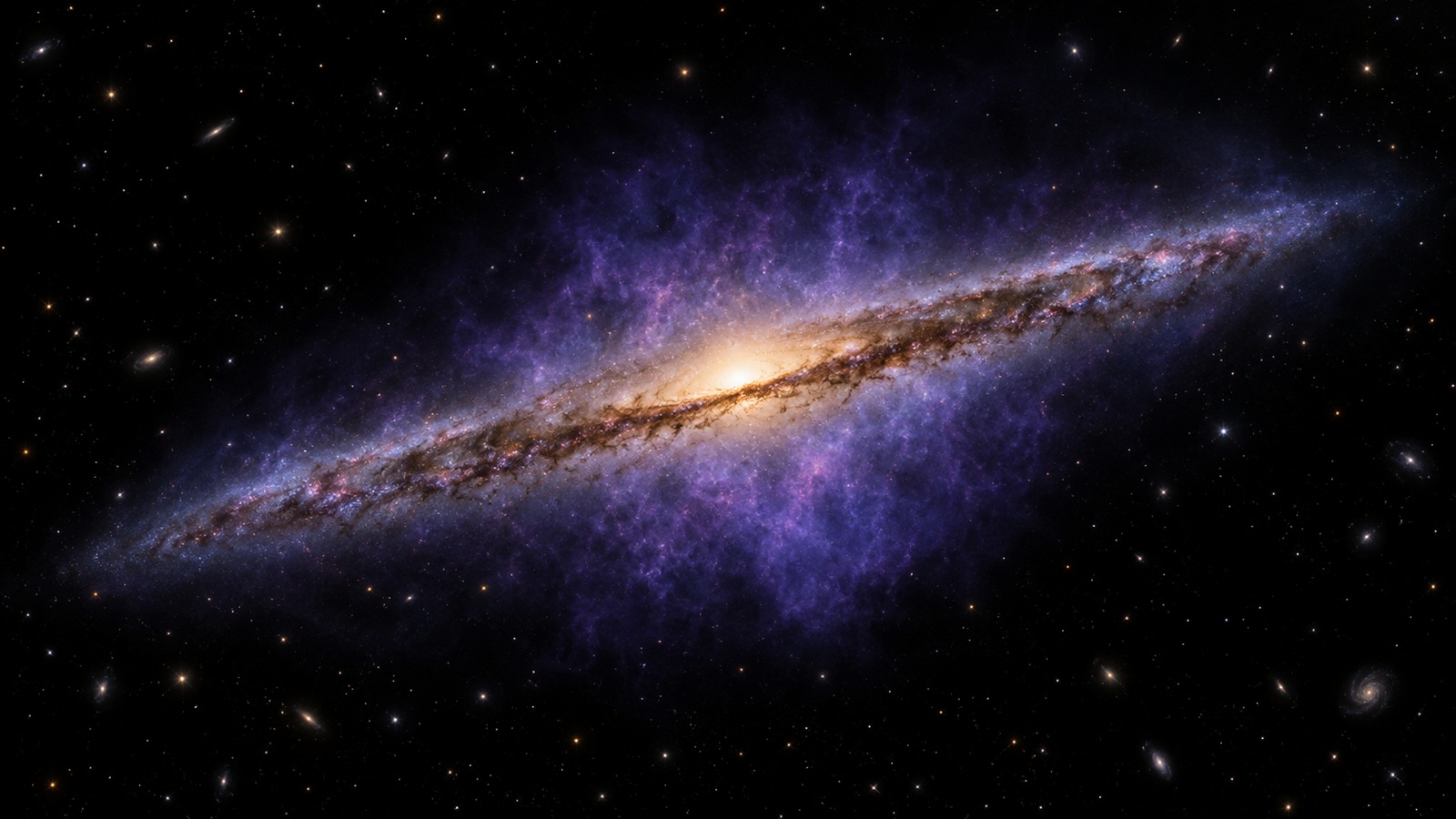
A Galaxy Extends Beyond Its Bright Stellar Disk
Switching from visible light to radio wavelengths can change where a galaxy appears to end. Around some spiral galaxies, faint radio emission rises above and below the bright disk, exposing energetic particles and magnetic environments that ordinary photographs scarcely suggest. Astronomers call this extended emission a radio halo, but the same term also describes much larger diffuse sources associated with entire galaxy clusters. The shared name does not make them the same object. A galactic halo can illuminate the movement of particles away from star-forming regions; a cluster halo can reveal energy circulating through the plasma between many galaxies. Keeping those scales distinct allows a radio image to tell a precise physical story instead of turning every surrounding glow into one interchangeable cosmic feature.
Halo Names Identify Different Physical Components
A galaxy can have several kinds of halo at once. Its stellar halo contains stars distributed beyond the bright disk, often including old populations and remnants of past accretion. Its gaseous surroundings contain material in different thermal states. Its dark-matter halo describes an inferred gravitational component extending well beyond the most conspicuous starlight. A radio halo identifies a distribution of emission at radio wavelengths. These descriptions can overlap spatially while tracing different ingredients and answering different scientific questions.
Consequently, a radio halo is not a photograph of the dark-matter halo. The radiation ordinarily comes from known charged particles interacting with magnetic fields, sometimes accompanied by other radio-emission processes that analysts separate. Dark matter may influence the wider gravitational environment, but that does not make it the direct source of the observed glow. Nor does a radio halo necessarily follow the stellar halo’s exact shape. The wavelength selects a physical process rather than outlining every component beyond the disk.
Fast Electrons Produce Synchrotron Radiation
The central mechanism in much diffuse galactic radio emission is synchrotron radiation. Electrons traveling at relativistic speeds are deflected by magnetic fields and emit radiation as their paths curve. Across astronomical magnetic environments, that radiation can appear strongly at radio wavelengths. The detected brightness therefore depends on both the energetic-particle population and the field through which it moves. A bright patch can reflect changes in either ingredient, making interpretation more complicated than measuring the number of ordinary gas atoms alone.
The term cosmic ray includes high-energy particles rather than only electromagnetic rays. In a radio-halo analysis, the relevant emitters are especially energetic electrons, even though protons can carry much of the wider cosmic-ray energy. Instruments measure the radiation those electrons produce, not the individual particles directly arriving at Earth from the halo. Their light allows a distant population to be investigated. This distinction explains why a radio telescope can study particle physics across a galaxy without collecting that galaxy’s actual electrons.
Synchrotron emission generally spreads across a range of frequencies rather than appearing at just one sharply defined spectral line. Its spectral behavior carries information about the distribution and evolution of particle energies. The observed spectrum can change as electrons lose energy or encounter different environments. Researchers compare maps at several frequencies to explore those changes. A single radio image may reveal where emission occurs, but a frequency comparison is needed to ask how that emitting population has developed.
Radio observations can also contain thermal emission from ionized gas and compact sources powered by accreting black holes. Separating these contributions is essential before assigning every detected signal to the halo’s cosmic-ray population. Spectral characteristics, morphology, and supporting observations help make that separation. The result is a physical analysis of several overlapping signals. An appealing smooth envelope in a finished image may rest on substantial work to distinguish diffuse emission from unrelated or compact features.
Star Formation Supplies Energy to the Galactic Environment
Massive stars and their explosive deaths inject energy into a galaxy’s surroundings. Supernova remnants are important sites of particle acceleration, while stellar winds and clustered activity help disturb interstellar gas. Cosmic rays and magnetic fields then become part of an interconnected environment above the disk. The relationship is not a simple rule that twice as much star formation always creates a halo twice as tall. Transport, field strength, losses, and the galaxy’s geometry all influence the observed result.
Getting Above the Disk Requires a Transport Story
Energetic particles can move away from their birth environments through diffusion and through bulk outflows. Diffusion describes spreading mediated by interactions with magnetic irregularities; it is not necessarily free motion in straight lines. Advection describes particles carried with a moving plasma flow, such as a galactic wind. Real galaxies can combine these mechanisms in proportions that vary with height and location. A radio halo supplies evidence that particles occupy extraplanar regions, while the detailed transport route requires additional inference.
Edge-on galaxies provide a useful perspective because the disk and material above it can be separated visually on the sky. Researchers measure how radio brightness changes with height and compare those profiles at several frequencies. Models of diffusion or advection can then be tested against the profiles and spectra. The inferred transport speed or diffusion coefficient depends on assumptions about magnetic structure and losses. A halo’s thickness is a valuable clue, but it is not automatically a direct wind-speed reading.
Galaxy inclination complicates the measurements. A system that is almost, but not perfectly, edge-on can mix disk emission into an apparent vertical profile. Line-of-sight integration also combines material from different locations within the galaxy. Researchers account for these effects when connecting a two-dimensional image to a three-dimensional flow. A careful interpretation therefore keeps projection in view even when the halo looks beautifully symmetric.
Radiative Losses Place Limits on an Electron’s Journey
Synchrotron radiation itself removes energy from an emitting electron. Inverse Compton scattering, in which energetic electrons transfer energy to lower-energy photons, adds another important loss mechanism. These processes change which electrons remain capable of producing radiation at a chosen frequency. Comparing the cooling time with the distance traveled helps constrain transport scenarios. If a model requires particles to reach a region faster than its assumed mechanism permits, the model needs revision or an additional source of energy.
Lower-frequency observations can reveal populations that are less conspicuous at higher frequencies, although the exact relationship depends on the magnetic environment. A steepening spectrum can support an aging interpretation, but it must be evaluated alongside mixing, injection, and field variations. The radio color in a displayed image is usually an assigned visual palette rather than a color human eyes would see. Scientific information comes from the frequency-dependent measurements underneath that palette. A violet glow in an illustration represents the phenomenon without measuring an electron’s age.
Polarization Helps Probe Magnetic Order
Synchrotron radiation can be polarized, meaning that its electric field has a preferred orientation. Polarization measurements help infer the ordered component of magnetic structure projected onto the sky. The inference includes conventions and corrections, rather than allowing us to read every field direction directly from a decorative line. Turbulent fields and unresolved variations can reduce the measured degree of polarization. A weak polarization signal does not automatically imply that the magnetic field is absent.
Faraday rotation supplies complementary information when polarized radiation passes through magnetized plasma. The amount of rotation depends on wavelength and on a combination of electron density and the magnetic-field component along the line of sight. Measurements across frequencies help separate this effect from the intrinsic source orientation. The resulting maps can probe field reversals and foreground contributions. They still combine material along the sightline, which limits a naive three-dimensional interpretation.
A named example is NGC 4631, the edge-on Whale Galaxy. Radio observations analyzed by an international team traced organized magnetic structure far above and below its disk, including an alternating pattern in the line-of-sight magnetic component. The researchers described these structures as giant magnetic ropes: the term represents organized fields, rather than solid cords stretched through space. Polarization and its wavelength-dependent rotation made this feature measurable where ordinary starlight alone could not reveal it. This specific halo therefore provides a useful case of a galaxy carrying magnetic order beyond its bright disk, without imposing its pattern on every spiral.
Magnetic fields also influence the particles used to trace them, so the relationship is reciprocal. Charged-particle trajectories respond to fields, while moving plasma can reshape field structure. Radio data allow this coupled environment to be constrained rather than observed as an isolated magnet suspended in space. Measurements of gas motion, star formation, and high-energy emission add useful context. The richer picture emerges when the halo is studied as part of a galaxy’s overall energy circulation.
A Cluster Radio Halo Occupies an Entirely Different Scale
In a galaxy cluster, the term radio halo usually refers to diffuse synchrotron emission distributed through the intracluster medium, often across a large central region. Its emitting electrons and magnetic fields belong to the environment between many galaxies rather than simply the envelope of one spiral disk. Such halos can extend over scales of roughly a million parsecs, or about 3.3 million light-years. The NRAO overview of the Coma radio halo emphasizes the combination of relativistic particles, magnetic fields, and faint extended emission. The shared radiation mechanism links galactic and cluster halos, while their environments remain distinct.
Cluster mergers release enormous amounts of energy into the intracluster medium. Turbulent motions are an important proposed way to reenergize electrons that would otherwise lose their radio-emitting ability. Models also consider secondary particles produced through interactions involving cosmic-ray protons. Researchers test these ideas with spectra, spatial structure, and observations at other wavelengths. A cluster halo reveals an energetic nonthermal component, but it does not supply one universally settled acceleration story for all clusters.
Halos, Relics, and Jets Should Keep Their Own Names
A cluster radio relic is commonly an elongated diffuse source associated with a peripheral region and merger-related shocks, whereas a giant halo tends to occupy a more central volume. A radio galaxy can produce jets and lobes through activity near its central black hole. Smaller cluster minihalos form another category associated with particular central environments. These sources can coexist or overlap observationally, so morphology alone is not always decisive. Their separate names help organize different mechanisms rather than merely labeling differently shaped purple patches.
Faint Structure Is Easy for an Instrument to Miss
A radio interferometer combines signals from separated antennas, and its sampled spacings determine which angular scales it measures well. Extended, low-brightness emission can be difficult to recover even when compact sources are detected clearly. Missing suitable short antenna separations can suppress a broad halo in the reconstructed image. Observers also confront noise, contamination, and dynamic-range limits near bright compact objects. A nondetection has meaning only in relation to the instrument’s actual sensitivity to the expected structure.
Comparisons between galaxies or clusters consequently need consistent observing limits. A deeper low-frequency survey may uncover halos absent from an older catalog without demonstrating that the objects recently switched on.
Likewise, a source can be conspicuous in total integrated flux while faint per resolution element. Researchers must distinguish integrated strength from surface brightness. Those practical distinctions explain why diffuse radio astronomy depends on observing design as much as on collecting a visually impressive image.
What the Surrounding Glow Allows Us to Conclude
A galactic radio halo establishes that energetic particles and magnetic environments extend beyond the region emphasized by bright stellar light. With suitable frequency coverage and supporting data, it can constrain transport, losses, and the connection between disk activity and extraplanar space. A cluster halo instead probes nonthermal processes within a much larger intracluster volume. Neither should be presented as a direct picture of dark matter or a literal visible envelope. Its importance rests on a specific radiation process translated into a carefully tested physical explanation.
That translation is what makes radio halos so useful. The apparent boundary of a galaxy changes when our instruments become sensitive to another component, and the space between galaxies becomes active when viewed on cluster scales. A complete account names the object, the emitting particles, the measurement, and the remaining uncertainty. The faint glow then reveals something concrete: galaxies and clusters exchange and redistribute energy far beyond the bright points that first attract our attention.


