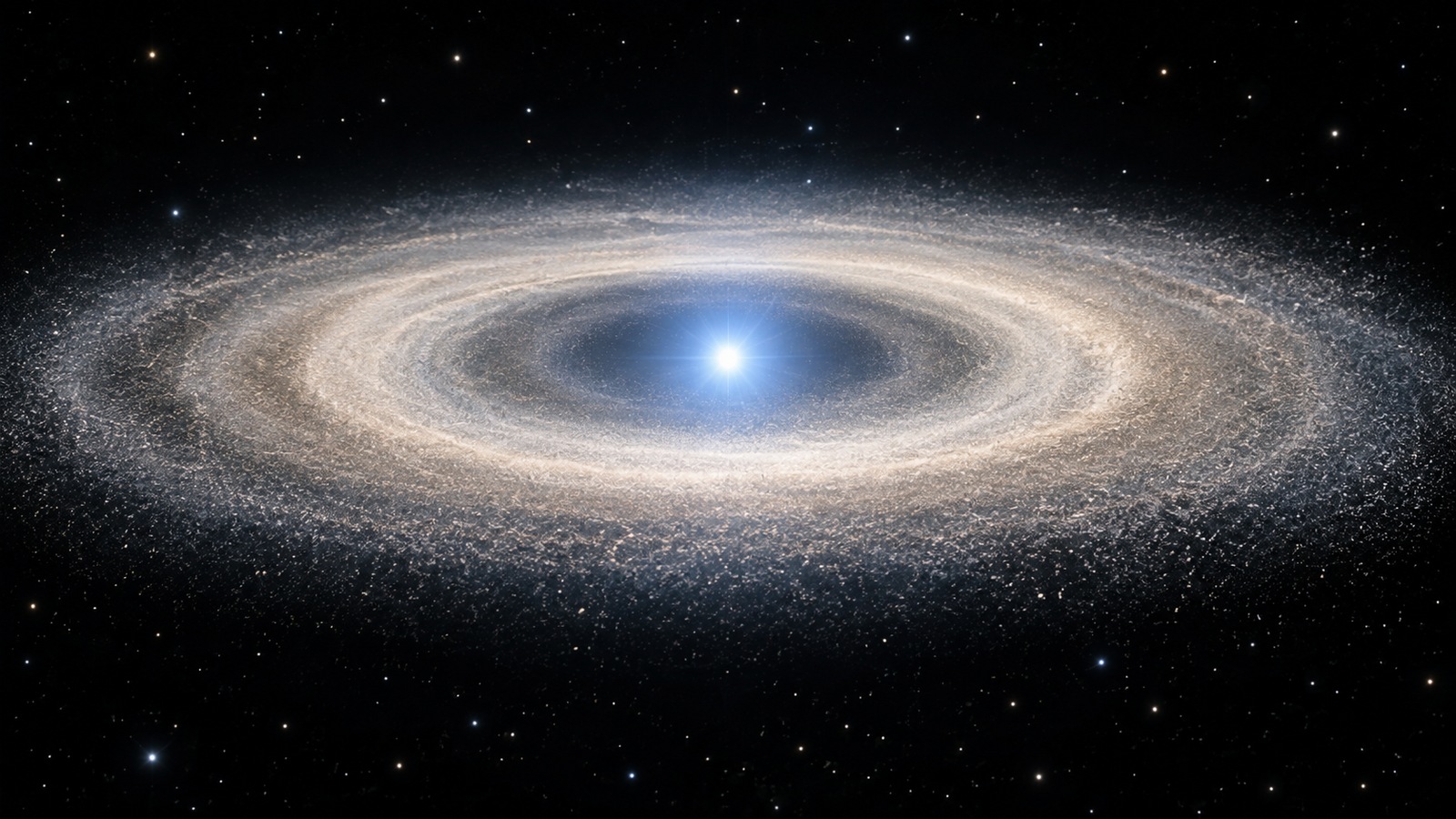
What Makes Stars Shine? The Power of Nuclear Fusion
When you look up at the night sky, each star twinkling above is a massive sphere of plasma, burning with light and heat that travels across the cosmos. What makes these stars shine is not magic, but physics: a process called nuclear fusion, known scientifically as thermonuclear fusion. This process occurs deep inside their cores, where extreme temperatures and pressures cause atoms to merge, releasing staggering amounts of energy. Understanding why stars shine opens a window into the life cycles of stars, the origins of elements, and the very energy that sustains planets and life itself.
The Source of a Star’s Light
For centuries, philosophers and scientists wondered what powered the Sun and stars. Before the discovery of nuclear processes, many believed stars burned like colossal fires. The problem was that such fires, even if fueled by something like coal, could not last for billions of years. The breakthrough came in the twentieth century, when scientists realized that the energy of stars comes from the fusion of hydrogen into helium in their cores.
Fusion is not just burning in the ordinary sense. While combustion releases energy by breaking chemical bonds, fusion releases energy by altering the very nuclei of atoms. This change unlocks vastly more power, allowing stars like our Sun to shine steadily for billions of years. Every sunrise is powered by nuclear fusion occurring 150 million kilometers away, a reminder of the scale and endurance of this cosmic engine.
The Conditions Needed for Fusion
Fusion requires extraordinary conditions. In the core of a star, temperatures reach millions of degrees Kelvin, and pressures rise so high that atoms are forced together despite their natural repulsion. Hydrogen nuclei, which are simply protons, normally repel one another because they carry the same positive charge. Only under extreme heat and pressure can they collide with enough force to overcome this barrier, allowing the strong nuclear force to bind them together into helium. The Sun’s core, for example, is about 15 million Kelvin, a temperature unimaginable on Earth. At this heat, particles move so rapidly that collisions between protons become inevitable, and fusion begins. Pressure from the Sun’s immense gravity ensures that the material in the core remains dense enough to sustain these reactions. Without both heat and pressure, fusion cannot occur. That is why smaller bodies, like planets or brown dwarfs, never achieve stable fusion.
The Proton-Proton Chain Reaction
In stars like the Sun, the dominant process that powers fusion is known as the proton-proton chain. This reaction involves a series of steps where hydrogen nuclei collide, fuse, and eventually form helium. Along the way, positrons, neutrinos, and gamma rays are released, carrying energy outward. The overall result is that four hydrogen atoms combine to form one helium atom, with a small amount of mass converted directly into energy.
This conversion is described by Einstein’s famous equation, E=mc², where mass becomes energy. Though the mass difference is tiny, the amount of energy released is enormous. In the Sun alone, about 600 million tons of hydrogen are fused into helium every second, releasing enough energy to light and heat our solar system. This chain reaction is why the Sun and other stars can shine for billions of years without running out of fuel quickly.
Hydrostatic Equilibrium: The Balance of a Star
The energy produced by nuclear fusion is not only what makes a star shine but also what keeps it stable. The outward pressure from the heat and radiation of fusion balances the inward pull of gravity. This balance is known as hydrostatic equilibrium. Without it, a star would collapse under its own gravity or expand uncontrollably. In this way, fusion is both a light source and a stabilizing force. For most of a star’s life, this balance keeps it steady, glowing in the phase astronomers call the main sequence. Stars spend the majority of their lifetimes in this equilibrium, quietly fusing hydrogen into helium while shining steadily in the night sky.
The Role of Mass in Stellar Fusion
The mass of a star determines the details of how fusion operates within it. Smaller stars, with less mass, fuse hydrogen more slowly, making them cooler and dimmer but extraordinarily long-lived. Red dwarfs, the most common type of star in the galaxy, may shine faintly, but they can last trillions of years because their fusion is slow and efficient.
Massive stars, on the other hand, burn through their fuel at an incredible rate. Their higher mass means greater pressure and temperature in their cores, allowing them to fuse hydrogen much faster. These stars shine brilliantly but live much shorter lives, sometimes only a few million years. The difference in stellar mass is therefore the difference between gentle persistence and explosive brilliance.
Beyond Hydrogen: Fusion of Heavier Elements
As stars exhaust their hydrogen, their cores contract and heat up further, igniting new phases of fusion. Helium can fuse into carbon and oxygen, and in the most massive stars, fusion continues to produce even heavier elements like neon, magnesium, silicon, and eventually iron. However, fusion cannot go on indefinitely. Iron is the endpoint because fusing it does not release energy; instead, it requires energy. Once a massive star’s core fills with iron, fusion can no longer sustain the outward pressure, and the star collapses under gravity. This collapse often triggers a supernova, one of the most powerful explosions in the universe. In that cataclysm, elements heavier than iron, such as gold and uranium, are created and scattered into space. Thus, nuclear fusion not only powers stars but also builds the elements that make planets, oceans, and even living beings.
Energy Transport: From Core to Surface
The energy created by fusion in a star’s core does not immediately escape into space. It must travel outward through the star’s layers, a journey that can take thousands to millions of years. In the radiative zone, photons of light are absorbed and re-emitted countless times, zigzagging outward in a slow random walk. Beyond this lies the convective zone, where currents of hot plasma carry energy upward more efficiently, much like boiling water.
Eventually, the energy reaches the surface, or photosphere, where it radiates into space as the light and heat we see and feel. The Sun’s steady glow is the product of a process that began in its core millions of years earlier. Each ray of sunlight is the end of a long journey, a messenger of the power of fusion deep within.
The Sun: A Fusion Laboratory
Our Sun is the closest and most familiar example of nuclear fusion at work. As a G-type main sequence star, it provides a stable, long-lasting energy source. Its proton-proton chain reaction is efficient, and its hydrostatic equilibrium ensures a steady shine. Studying the Sun has allowed scientists to confirm theories of stellar structure and nuclear physics, making it both a cosmic power plant and a laboratory for understanding the universe.
Solar observations also reveal the importance of fusion to life on Earth. Without the Sun’s steady output, our planet would be cold and barren. Photosynthesis, weather patterns, and the climate itself are all driven by solar energy. The Sun is not just a distant ball of plasma—it is the heartbeat of our solar system, sustained by nuclear fusion.
Massive Stars and the CNO Cycle
While the proton-proton chain dominates in stars like the Sun, massive stars with higher temperatures rely on a different process known as the carbon-nitrogen-oxygen cycle, or CNO cycle. In this reaction, hydrogen is still fused into helium, but carbon, nitrogen, and oxygen nuclei act as catalysts, speeding up the process. The CNO cycle is more temperature-sensitive than the proton-proton chain, which is why it dominates only in larger, hotter stars.
The result of the CNO cycle is the same—hydrogen becomes helium and energy is released—but the pathway differs. This highlights the adaptability of fusion processes in different stellar environments, ensuring that stars of various sizes can shine, each according to its mass and temperature.
Stellar Lifetimes and Fusion Rates
The rate at which fusion occurs is the key to how long a star will live. Smaller stars, with slower fusion, shine faintly for unimaginable timescales, potentially trillions of years. Medium stars like the Sun last for billions of years, while massive stars, despite their brilliance, may live only a few million. Fusion therefore serves as a cosmic timer, dictating the rhythm of stellar lifespans. When stars evolve, their changing fusion processes leave signatures that astronomers can detect. By studying the light and spectra of stars, scientists can infer their internal fusion processes, ages, and futures. Fusion is not just the power behind starlight—it is the key to reading the universe’s timeline.
White Dwarfs, Neutron Stars, and Fusion’s End
Eventually, nuclear fusion ceases. In stars like the Sun, when fusion stops, the star expels its outer layers and leaves behind a white dwarf, a dense, cooling remnant. These objects shine not through fusion but through residual heat. In massive stars, the collapse after fusion halts can create neutron stars or black holes, remnants of extraordinary density and gravity. Fusion’s end marks not failure but transformation. The material created inside stars during their fusion lives is expelled into space, becoming the raw material for new stars, planets, and life. Thus, even when fusion ceases in one star, it seeds the conditions for new generations of starlight.
Fusion and the Elements of Life
Every atom in your body heavier than hydrogen was forged in the heart of a star. The carbon in your cells, the oxygen you breathe, the calcium in your bones—all were created through fusion in previous generations of stars. When those stars died, they scattered their elements into space, enriching interstellar clouds that later formed new stars and planets. Fusion is therefore not only the reason stars shine but also the reason we exist. It is a bridge between the physics of nuclear reactions and the chemistry of life. To understand fusion is to understand our own cosmic origins, as living beings literally made of stardust.
Observing Fusion’s Evidence
Although we cannot see fusion directly, its effects are visible everywhere. The light and heat from stars, the spectral lines in starlight, and the neutrinos that reach Earth all bear the signature of fusion. Neutrinos, in particular, are elusive particles created in vast numbers in the Sun’s core. Detecting them confirms that fusion is happening as theory predicts. Space telescopes and ground-based observatories continue to refine our understanding of how fusion works in stars. Each discovery strengthens the connection between theory and observation, showing that nuclear fusion is the universal engine of starlight.
Fusion as a Cosmic Constant
Throughout the universe, fusion operates as a constant force of creation. From the smallest red dwarf to the most massive blue giant, stars shine because fusion sustains them. It sets the rhythm of galaxies, powers the recycling of elements, and shapes the very possibility of life. By studying fusion, we are not only learning about stars but also about the forces that govern the cosmos itself. Fusion links the small, invisible world of nuclear particles with the vast, visible world of galaxies and planets. It is the common thread running through the story of the universe.
Humanity’s Pursuit of Fusion
The understanding of stellar fusion has inspired humanity to try to replicate it on Earth. Unlike fission, which splits atoms, fusion promises nearly limitless clean energy by mimicking the process that powers the Sun. Scientists build reactors that attempt to confine superheated plasma with magnetic fields or lasers, striving to achieve the same balance of heat and pressure that exists in stars. While we have not yet achieved sustained, practical fusion, each experiment brings us closer. If successful, fusion energy could provide humanity with a power source as enduring and efficient as the stars themselves. The pursuit of fusion is thus a testament to our desire to bring the light of the stars down to Earth.
The Everlasting Light of the Stars
Stars shine because nuclear fusion allows them to convert matter into energy, balancing gravity with outward pressure, and fueling their brilliance for millions to trillions of years. From the gentle glow of red dwarfs to the fiery blaze of blue giants, every star is a testament to the power of fusion. Fusion is not simply an astrophysical process but the very heartbeat of the cosmos. It shapes galaxies, forges the elements of life, and illuminates the universe. Each star in the sky is a beacon of fusion at work, a reminder that the universe is alive with energy, creation, and transformation.
Space Products Reviews
Blast off with Lyra Street’s ultimate guide to the Top 10 Best Space Products Reviews! From high-powered telescopes to stellar star maps and astronomy gear, we explore the most impressive cosmic tools available today. Dive into detailed reviews and an easy-to-navigate comparison chart to find the perfect gear for your stargazing adventures or space-inspired lifestyle.