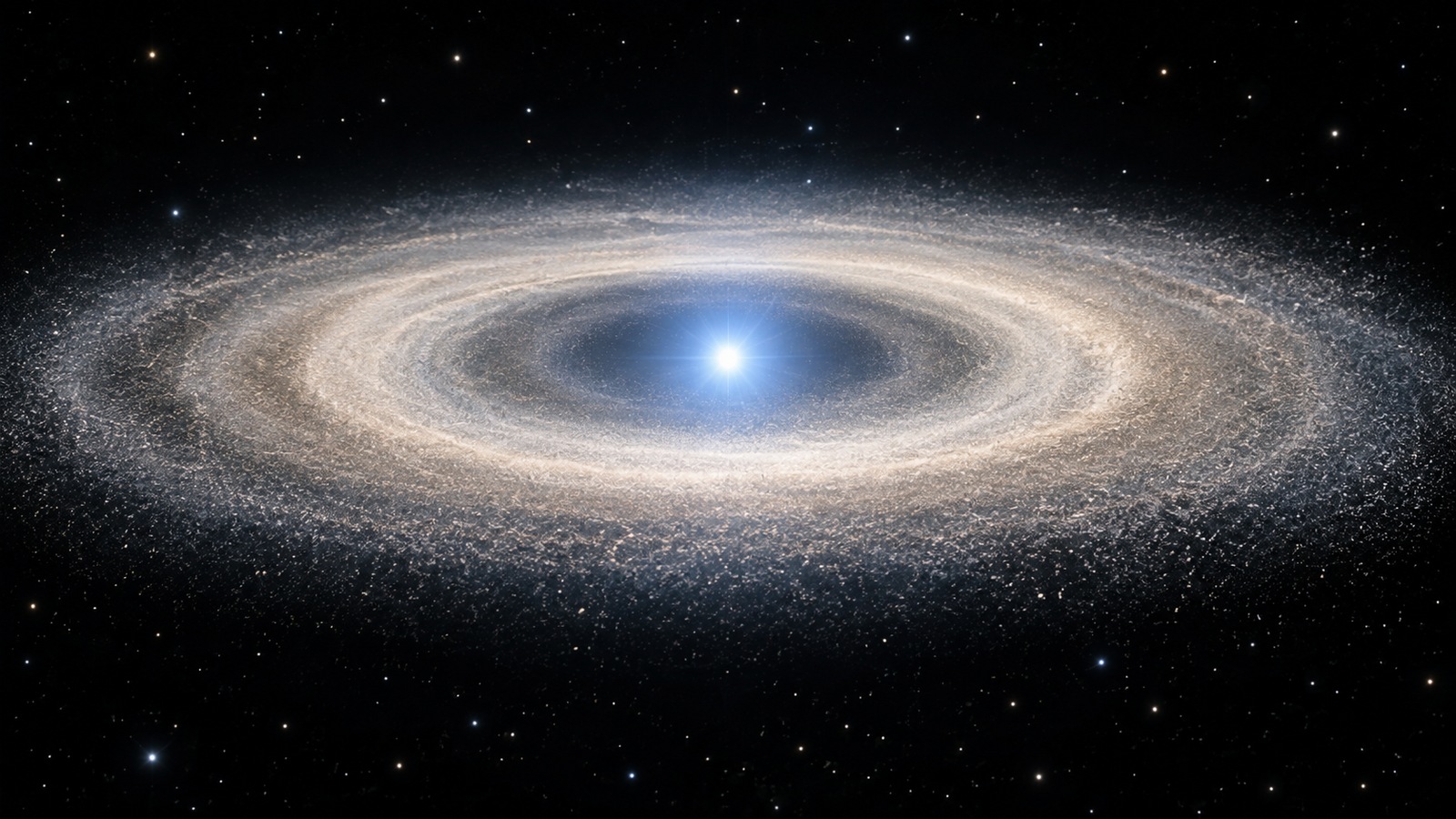
Titans of Density in the Cosmos
Among the most mysterious objects in the universe are neutron stars, known scientifically as degenerate neutron remnants. These cosmic marvels are formed when massive stars collapse under their own weight, squeezing matter to extremes that defy imagination. Though only about 20 kilometers across, they pack more mass than the Sun into that tiny sphere, making them the densest stable objects known. Neutron stars are often described as cosmic paradoxes. They are small yet massive, violent yet enduring, terrifying yet awe-inspiring. Their very existence demonstrates what happens when gravity wins against nearly everything but quantum mechanics. They are stellar survivors, born in explosions, glowing with intense radiation, and spinning at extraordinary speeds. In them, we glimpse the limits of matter itself, pressed to conditions beyond Earthly comprehension.
The Journey from Star to Neutron Star
The story of a neutron star begins with a massive star, at least eight times the mass of the Sun. Such stars burn quickly, consuming hydrogen, helium, and heavier elements in a furious cycle of fusion. Over millions of years, their cores become layered like onions, with iron forming at the center. When fusion reaches iron, no further energy can be extracted, and the star’s balance collapses. In an instant, gravity takes over. The outer layers of the star crash inward, rebounding off the core in a cataclysmic explosion known as a supernova. This blast hurls material across the cosmos, enriching galaxies with heavy elements. What remains at the center depends on mass. For some, the collapse creates a neutron star: a core crushed to densities where protons and electrons merge into neutrons, creating an object unlike anything else in the universe.
Quantum Pressure Against Gravity
Neutron stars exist because of a delicate quantum balance. In white dwarfs, electron degeneracy pressure halts collapse, but in neutron stars, electrons and protons are forced together, creating neutrons. Here, it is neutron degeneracy pressure that provides resistance, stopping gravity from crushing the core further. Without this quantum safeguard, the star would continue collapsing into a black hole.
This neutron pressure is astonishing in its strength. It holds back a mass greater than the Sun in a sphere barely larger than a city. The neutrons are packed so tightly that they resemble the conditions inside an atomic nucleus, but on astronomical scales. Neutron stars are, quite literally, giant atomic nuclei, stabilized by the rules of quantum mechanics against gravity’s relentless pull.
The Size and Weight Paradox
To appreciate a neutron star is to embrace extremes. Though their diameter is typically only 20 kilometers, they can hold up to two solar masses. This means their density is unimaginable: a sugar cube of neutron star matter would weigh as much as a mountain. Such numbers push human comprehension to its breaking point, showing what matter becomes under unimaginable compression. Their gravity is equally mind-bending. A person standing on the surface of a neutron star—if such a thing were possible—would weigh billions of times more than on Earth. Escape velocity exceeds half the speed of light. These paradoxes make neutron stars some of the strangest yet most important laboratories in the universe, where the laws of physics are pushed to their limits.
Pulsars: Lighthouses of the Universe
One of the most extraordinary features of neutron stars is their rapid spin. Many rotate dozens or even hundreds of times per second. Combined with strong magnetic fields, this rotation produces beams of electromagnetic radiation that sweep through space like lighthouse beams. When one of these beams crosses Earth, we observe it as a pulse, giving rise to the name “pulsar.” Pulsars are among the most precise natural clocks in existence. Their regularity rivals atomic clocks, allowing astronomers to measure cosmic phenomena with incredible precision. They were first discovered in 1967, and their rhythmic pulses were initially so regular that scientists jokingly called them signals from “little green men.” Today, pulsars remain key tools in astronomy, helping to study gravitational waves, test general relativity, and map the interstellar medium.
Magnetars: Masters of Magnetism
Some neutron stars are even more exotic: magnetars. These rare objects possess magnetic fields trillions of times stronger than Earth’s. Such fields are so intense they can warp atomic structures and produce bursts of high-energy radiation capable of disrupting satellites and communication on Earth, even from thousands of light-years away.
Magnetars are unstable, often releasing sudden flares of X-rays and gamma rays. These violent bursts can outshine entire galaxies for brief moments. Despite their destructive power, magnetars provide invaluable insights into magnetism under conditions that cannot be replicated anywhere else. They remind us that neutron stars are not just dense—they are diverse, each variant revealing another face of the extreme universe.
The Supernova’s Legacy
Every neutron star carries the signature of a supernova, the cosmic explosion that gave it birth. These explosions are among the most energetic events in the cosmos, briefly outshining entire galaxies. They scatter heavy elements like gold, uranium, and platinum across space, seeding future stars and planets. Without supernovae, the universe would lack many of the elements essential for life. The supernova remnant, a glowing cloud of gas and dust, often surrounds the neutron star like a halo of memory. The Crab Nebula, for example, is the remains of a supernova observed in 1054, with a pulsar still spinning at its heart. Such remnants are both tombstones and nurseries—memorials to the death of a star and the birthplace of new materials for the next generation of cosmic growth.
Spin Beyond Comprehension
Newly formed neutron stars often rotate at incredible speeds. Some spin dozens of times per second, while the fastest—called millisecond pulsars—can rotate hundreds of times per second. This rapid rotation is a result of conservation of angular momentum, the same principle that makes a figure skater spin faster when pulling in their arms. Over time, neutron stars gradually slow down as they radiate energy into space. But even as they lose speed, they remain among the fastest-spinning objects in the universe. Their incredible rotations generate enormous energy, powering magnetic fields, emitting radiation, and shaping the environments around them. They are cosmic dynamos, turning rotation into power on unimaginable scales.
Collisions That Shape the Universe
When two neutron stars spiral together and collide, the result is one of the most dramatic events in the cosmos. Such mergers release gravitational waves—ripples in spacetime predicted by Einstein and first directly detected in 2015. In 2017, the collision of two neutron stars produced gravitational waves and light, marking the first multi-messenger observation in astronomy. These collisions also forge heavy elements. The gold in jewelry and the platinum in electronics were born in neutron star mergers billions of years ago. By smashing together, these stars enrich the universe with materials essential for planets, technology, and life. They are catastrophic events with creative outcomes, turning destruction into cosmic alchemy.
Gravity’s Relentless Grip
The surface gravity of a neutron star is staggering. A person standing there would be crushed instantly, as gravity pulls billions of times more strongly than on Earth. Light itself bends under the star’s grip, warping space so much that photons must fight to escape. Their gravitational fields are second only to black holes in strength.
This makes neutron stars powerful laboratories for testing Einstein’s general theory of relativity. By observing how light and matter behave near them, astronomers confirm predictions about spacetime and explore conditions that challenge even our best theories. Neutron stars, in their quiet intensity, remain relentless reminders of gravity’s dominance in the universe.
Exotic Interiors of Dense Matter
Inside a neutron star, matter reaches densities so extreme that atoms cannot exist as we know them. The outer crust is a solid lattice of nuclei and electrons, but deeper layers crush protons and electrons into neutrons. Below the crust, conditions may produce exotic forms of matter, such as superfluids or even strange quark matter, where quarks roam freely outside nucleons.
The true interiors of neutron stars remain one of physics’ greatest mysteries. Laboratory experiments cannot reproduce such pressures and densities, so astronomers rely on indirect observations. Each neutron star offers a glimpse into physics at extremes, helping us explore the frontier where known laws begin to blur. They are natural experiments that push the boundaries of science itself.
The Limits of Stability
Not every neutron star can endure. The most massive ones eventually collapse under their own weight, crossing the threshold into black holes. This boundary, known as the Tolman–Oppenheimer–Volkoff (TOV) limit, is still uncertain but is thought to be around two to three solar masses. Beyond this, not even neutron degeneracy pressure can resist gravity. This limit divides neutron stars from black holes, two of the universe’s most mysterious entities. Understanding where one ends and the other begins is crucial for astrophysics. Each discovery of a massive neutron star helps refine the boundary, pushing our understanding of matter and gravity to sharper clarity.
Heat, Light, and Fading Glow
Although neutron stars are born hot, with surface temperatures of millions of degrees, they cool over time. In their youth, they radiate intense X-rays, but as they age, they fade into invisibility. Their lifespans as observable objects are long but finite, their heat gradually leaking away into the universe. Even in their cooling, neutron stars remain active. Some accrete material from companions, reigniting bursts of energy. Others retain heat longer than expected, puzzling astronomers and hinting at unknown physics inside. Their cooling curves become records of time, marking billions of years of cosmic history as they transition from fiery youth to silent old age.
Beacons Across the Galaxy
Despite their tiny size, neutron stars are incredibly luminous in radio, X-rays, and gamma rays. Pulsars, in particular, sweep the galaxy with beams detectable across vast distances. Their signals allow astronomers to map interstellar gas, measure galactic structures, and even navigate spacecraft with cosmic precision.
Neutron stars are also used to study gravitational waves and test relativity. By monitoring pulsars in binary systems, scientists can measure how spacetime itself ripples. In their precision, they become tools of discovery, enabling us to explore realms of physics that no laboratory could reach. Their presence in the galaxy is a beacon not only of light but of knowledge.
Humanity’s Connection to Neutron Stars
Although distant, neutron stars connect deeply to our existence. The heavy elements we depend on—gold, platinum, uranium—were forged in neutron star collisions. Without them, Earth would lack many of the materials essential for technology and life. In a sense, neutron stars are part of our own history, their violent deaths woven into our origins. They also inspire our imagination. The extremes they represent—density, gravity, magnetism—push human thought to its limits. They remind us that the universe is not just vast but extreme, filled with conditions beyond comprehension. In studying neutron stars, we do not only learn about distant objects but about the very boundaries of physical possibility.
Silent Testimonies of the Cosmos
Neutron stars are the universe’s densest stable objects, the survivors of stellar collapse, and the creators of cosmic treasures. They push physics to extremes, test theories of gravity, and illuminate galaxies with their beams. Though small in size, they carry immense importance, shaping both matter and knowledge across cosmic time. They are not merely remnants but testimonies to the power of the universe. Each neutron star is a monument to a star that once blazed, a survivor of violence that still influences galaxies today. Their silence speaks volumes, reminding us that the cosmos preserves its stories not only in explosions but in the endurance of objects born from collapse.
Space Products Reviews
Blast off with Lyra Street’s ultimate guide to the Top 10 Best Space Products Reviews! From high-powered telescopes to stellar star maps and astronomy gear, we explore the most impressive cosmic tools available today. Dive into detailed reviews and an easy-to-navigate comparison chart to find the perfect gear for your stargazing adventures or space-inspired lifestyle.