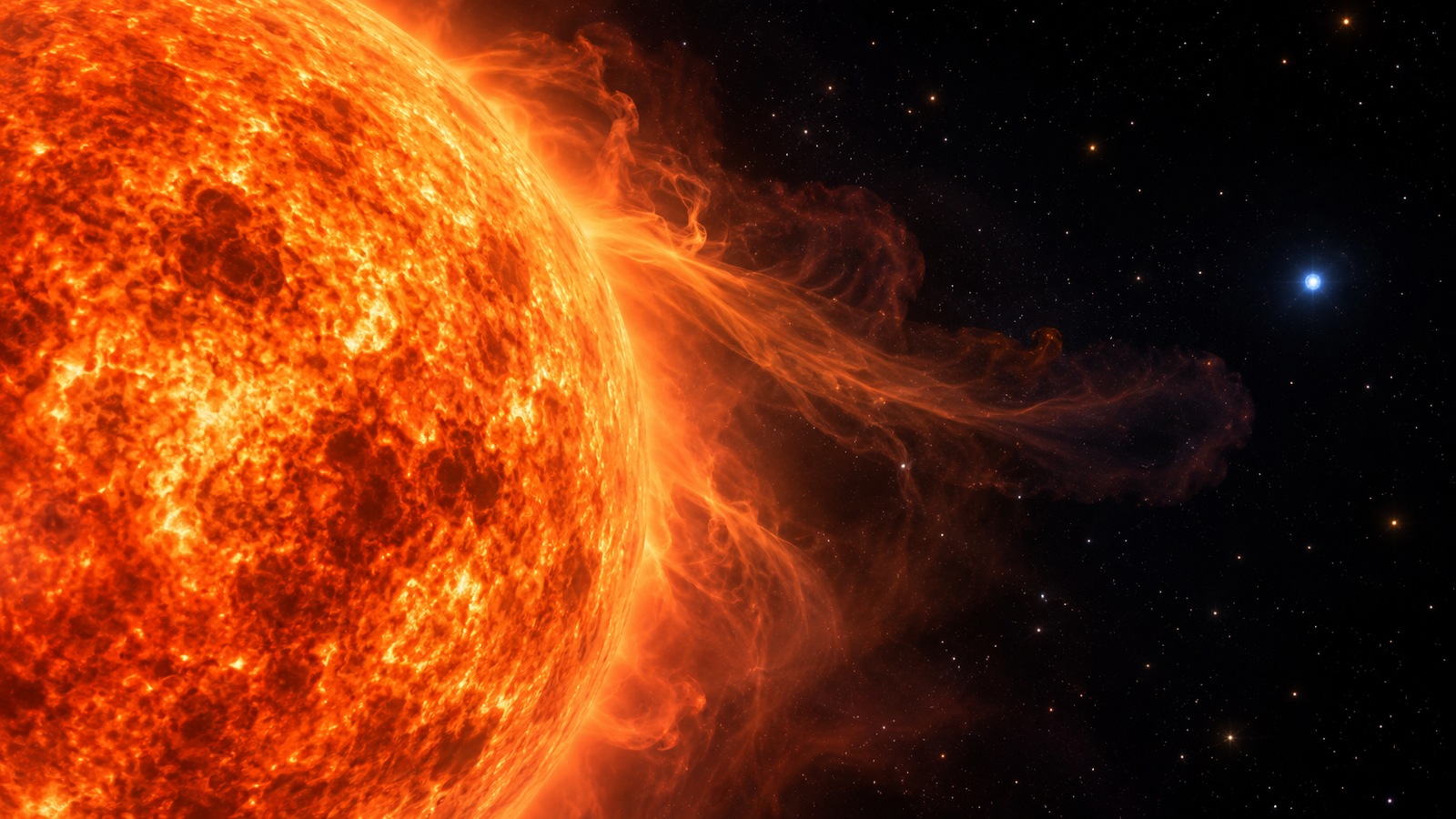
Red Dwarfs: The Universe’s Most Common Stars
When we look into the night sky, our eyes are drawn to the brightest stars—the blazing blue giants, the golden glow of the Sun, or the glittering constellations. Yet the real story of the universe is written not by these bright stars but by their faint, humble cousins known as red dwarfs. Scientifically called M-type stars, red dwarfs are the most common stars in the galaxy. Though small and dim compared to the Sun, they outnumber all other stars combined and play an outsized role in shaping the cosmos. To understand red dwarfs is to understand the quiet backbone of the universe.
What Defines a Red Dwarf
A red dwarf is a low-mass star, generally less than half the mass of the Sun. Its surface temperature is comparatively cool, ranging from about 2,000 to 3,700 Kelvin, which gives it a reddish color and much lower luminosity. To the naked eye, most red dwarfs are invisible, even when close by, because their light is too faint to pierce our atmosphere in significant numbers. Despite their small stature, red dwarfs are fully fledged stars. Like all stars, they shine because of nuclear fusion in their cores. Hydrogen atoms fuse into helium, releasing energy that radiates outward. But unlike larger stars, their fusion is slow and steady, a candle compared to the bonfire of a blue giant. This efficiency makes them extraordinary: while massive stars burn out in a few million years, red dwarfs can survive for trillions of years, longer than the current age of the universe itself.
The Physics of a Small Star
Red dwarfs exist in a balance between gravity pulling inward and pressure pushing outward. Their low mass means that gravity is weaker compared to larger stars, so their cores never reach the extreme temperatures found in stars like the Sun. Instead, fusion proceeds gently through the proton-proton chain reaction, converting hydrogen into helium at a modest rate. One of the most fascinating features of red dwarfs is that they are fully convective. In larger stars, fusion products like helium sink to the core and remain trapped. But in a red dwarf, hot plasma circulates throughout the star, mixing material evenly. This means red dwarfs use nearly all of their hydrogen fuel, unlike stars like the Sun, which only use a fraction. This efficiency explains their incredible lifespans and ensures they shine steadily without dramatic fluctuations.
How Red Dwarfs Differ From the Sun
At first glance, red dwarfs may seem like miniature versions of our Sun, but the differences are profound. The Sun’s surface temperature is nearly 6,000 Kelvin, producing a yellow-white glow visible across vast distances. A red dwarf’s cooler surface gives it a dim red hue, and its brightness is only a fraction of the Sun’s. Proxima Centauri, the closest star to Earth besides the Sun, is a red dwarf. Yet despite being only 4.2 light-years away, it is so faint that it cannot be seen without a telescope. The difference in brightness means that red dwarfs, despite their abundance, are largely hidden from casual stargazers. They represent the quiet workhorses of the galaxy, unseen by the human eye yet essential to the story of stellar evolution.
Lifespans Measured in Trillions
Red dwarfs are remarkable for their longevity. A typical red dwarf can live for up to 10 trillion years or more, compared to the Sun’s expected 10 billion. Because their fusion is so efficient, they burn fuel slowly and steadily, without the unstable phases that larger stars endure. This longevity has profound implications for the universe. The cosmos is about 13.8 billion years old, which means no red dwarf has yet reached the end of its life. Every red dwarf ever born is still shining somewhere today. If time could be accelerated, astronomers believe that red dwarfs will one day end as white dwarfs, but this remains a theoretical future since the universe has not yet lived long enough for it to occur.
Abundance Across the Galaxy
If you were to take a census of the Milky Way, the overwhelming majority of stars would turn out to be red dwarfs. Estimates suggest that about 70 to 80 percent of all stars in our galaxy fall into this category. While massive stars dominate our imagination because of their brilliance, it is red dwarfs that fill the galactic neighborhoods. Their abundance is part of what makes them so important for studies of planetary systems and the search for life. Statistically, if planets are common around stars, then most planets in the galaxy must orbit red dwarfs. Understanding these stars is therefore essential to understanding the broader architecture of the cosmos.
Famous Red Dwarfs Near Earth
The closest star to our solar system, Proxima Centauri, is a red dwarf in the Alpha Centauri system. It is faint but notable because it hosts at least one planet in its habitable zone, where liquid water could theoretically exist. Barnard’s Star, another famous red dwarf, is only six light-years away and is one of the fastest-moving stars in the sky relative to Earth. These nearby examples show how red dwarfs dominate even in our stellar backyard. Though they escape unaided observation, telescopes reveal their quiet persistence, glowing faintly but reliably just next door in cosmic terms.
Red Dwarfs and Exoplanets
One of the most exciting areas of astronomy today involves studying exoplanets around red dwarfs. Because these stars are small and dim, the transit of a planet across their disk blocks a larger fraction of their light, making detection easier. This is why so many of the Earth-sized planets discovered so far orbit red dwarfs.
Their habitable zones, however, are very close to the star, because the star itself emits less energy. This creates challenges. Planets orbiting close may become tidally locked, showing the same face to their star at all times. In addition, red dwarfs often produce powerful stellar flares that could strip planetary atmospheres or make conditions hostile to life. Yet these same factors make them scientifically compelling, because they challenge our ideas of what habitability means.
Stellar Flares and Magnetic Activity
Despite their faintness, red dwarfs are not quiet stars. Many exhibit intense magnetic activity, producing stellar flares that can outshine the star’s normal brightness for short bursts. These flares are caused by tangled magnetic fields snapping and releasing energy, much like solar flares on the Sun but on a more dramatic scale relative to the star’s size. For planets orbiting in the habitable zones of red dwarfs, such flares could be devastating, exposing them to high levels of radiation. Some astronomers argue that this makes red dwarfs poor candidates for life. Others suggest that atmospheres and magnetic fields on planets could mitigate the danger, or that life could adapt to such conditions. Either way, stellar flares make red dwarfs dynamic and unpredictable.
Why Red Dwarfs Are Invisible to the Naked Eye
It may seem strange that the most common type of star is largely invisible to us. The reason lies in brightness. A red dwarf’s luminosity is often only a fraction of a percent of the Sun’s. Even when close, they appear faint compared to brighter stars that dominate our night sky. For example, if Proxima Centauri were replaced by a star like Sirius, the sky would be dominated by its brilliance. Instead, Proxima is hidden from view without telescopic aid. This invisibility makes red dwarfs scientifically rich but visually modest, stars that influence galaxies without demanding attention.
Red Dwarfs in Galactic Evolution
Although small, red dwarfs have a major influence on the long-term story of galaxies. Their extreme longevity means that as massive stars die off, galaxies will gradually be dominated by the faint red glow of dwarfs. In the far future, when all bright stars have burned out, the universe will be filled almost entirely with red dwarfs, shining dimly but persistently across the cosmic dark. This makes them the ultimate survivors. While blue giants blaze and vanish, red dwarfs endure, carrying the torch of starlight into the deep future of the universe.
The Role of Red Dwarfs in Stellar Physics
Red dwarfs are not just important statistically—they challenge theories of stellar physics. Their fully convective interiors blur the neat distinctions between stellar layers found in larger stars. Studying them helps refine models of how stars generate and transport energy. They also provide insight into magnetic activity, stellar flares, and the formation of planets in low-energy environments. As astronomy continues to develop, red dwarfs serve as laboratories for understanding fundamental processes. Their simplicity and abundance make them indispensable to our grasp of the cosmos.
Searching for Life Around Red Dwarfs
One of the most tantalizing questions is whether red dwarfs can host habitable worlds. Because they are so common, the odds suggest that if life exists elsewhere, much of it could be orbiting red dwarfs. The discovery of potentially Earth-like planets in the habitable zones of stars like Proxima Centauri and TRAPPIST-1 fuels this speculation.
Yet the challenges are real. Tidal locking, stellar flares, and close orbits may make such planets hostile. But habitability is complex. Some scientists argue that atmospheres and oceans could redistribute heat on tidally locked worlds, or that life could thrive underground or underwater, shielded from radiation. Red dwarfs may not host life as we know it, but they broaden our imagination of what life could be.
Observing Red Dwarfs With Modern Telescopes
Technological advances have made red dwarfs more accessible to study. Space-based observatories like Kepler and TESS have revolutionized the detection of exoplanets around them. Ground-based telescopes equipped with adaptive optics and spectrographs reveal details about their flares, rotation, and atmospheres.
The James Webb Space Telescope is expected to further transform our understanding, as its infrared sensitivity is perfectly suited for studying these cool, dim stars. For the first time, scientists may be able to probe the atmospheres of planets orbiting red dwarfs, searching for chemical signatures that hint at life.
Red Dwarfs and the Fate of the Universe
In the unimaginably distant future, when larger stars have burned out and galaxies have aged, red dwarfs will dominate the night sky of any surviving observers. Their faint glow will persist long after the Sun and its peers have faded into white dwarfs. In this sense, red dwarfs represent the future of the cosmos, the last guardians of starlight in a universe slowly growing darker. The fact that they burn so slowly means they will be among the last sources of energy for potential civilizations trillions of years from now. Their endurance makes them not just stars of the present but of the far future.
Why Red Dwarfs Matter to Us
For all their faintness, red dwarfs shape the destiny of galaxies. They outnumber all other stars, they last longer than any, and they may host countless planets. Though invisible to the naked eye, they dominate the universe in quiet strength. Their physics challenges our theories, their planets fuel our imagination, and their endurance ensures that they will shine long after brighter stars fade. When we speak of the universe’s most common stars, we are speaking of red dwarfs, the modest workhorses of the galaxy. They may not dazzle, but they endure. And in that endurance lies the story of the cosmos itself—one not of brief brilliance, but of persistence and quiet power.
From Faint Embers to Cosmic Giants
So why do red dwarfs matter? Because they are the backbone of the stellar population, shaping the structure of galaxies and offering countless opportunities for planetary systems. They are modest embers compared to giants, but they burn steadily for trillions of years. From Proxima Centauri to TRAPPIST-1, they remind us that the universe is not only about brilliance and spectacle but also about quiet resilience. In their faint light, we glimpse the true nature of the cosmos: not a universe of brief explosions, but one built on endurance. Red dwarfs are the quiet stars that will write the final chapters of cosmic history, glowing faintly as the universe slips into darkness, the last sparks of light in an infinite night.
Space Products Reviews
Blast off with Lyra Street’s ultimate guide to the Top 10 Best Space Products Reviews! From high-powered telescopes to stellar star maps and astronomy gear, we explore the most impressive cosmic tools available today. Dive into detailed reviews and an easy-to-navigate comparison chart to find the perfect gear for your stargazing adventures or space-inspired lifestyle.