
The bright head is not the solid comet
A comet can look like a luminous ball pulling a long streamer through the night sky, yet the solid object responsible for that display may be only a few kilometers across. Much of the visible head is a diffuse envelope of material released from a darker nucleus. Farther away, tiny dust grains and electrically charged gas respond differently to sunlight and the solar wind, creating tails with different shapes and behaviors. A useful anatomical picture therefore follows material outward rather than treating the whole apparition as one glowing rock. The nucleus stores the ingredients, heating helps release them, the coma surrounds their source, and the tails show how the environment reorganizes them. Once those components are separated, familiar questions about color, direction, brightness, and size become much easier to answer accurately.
The nucleus holds the material inventory
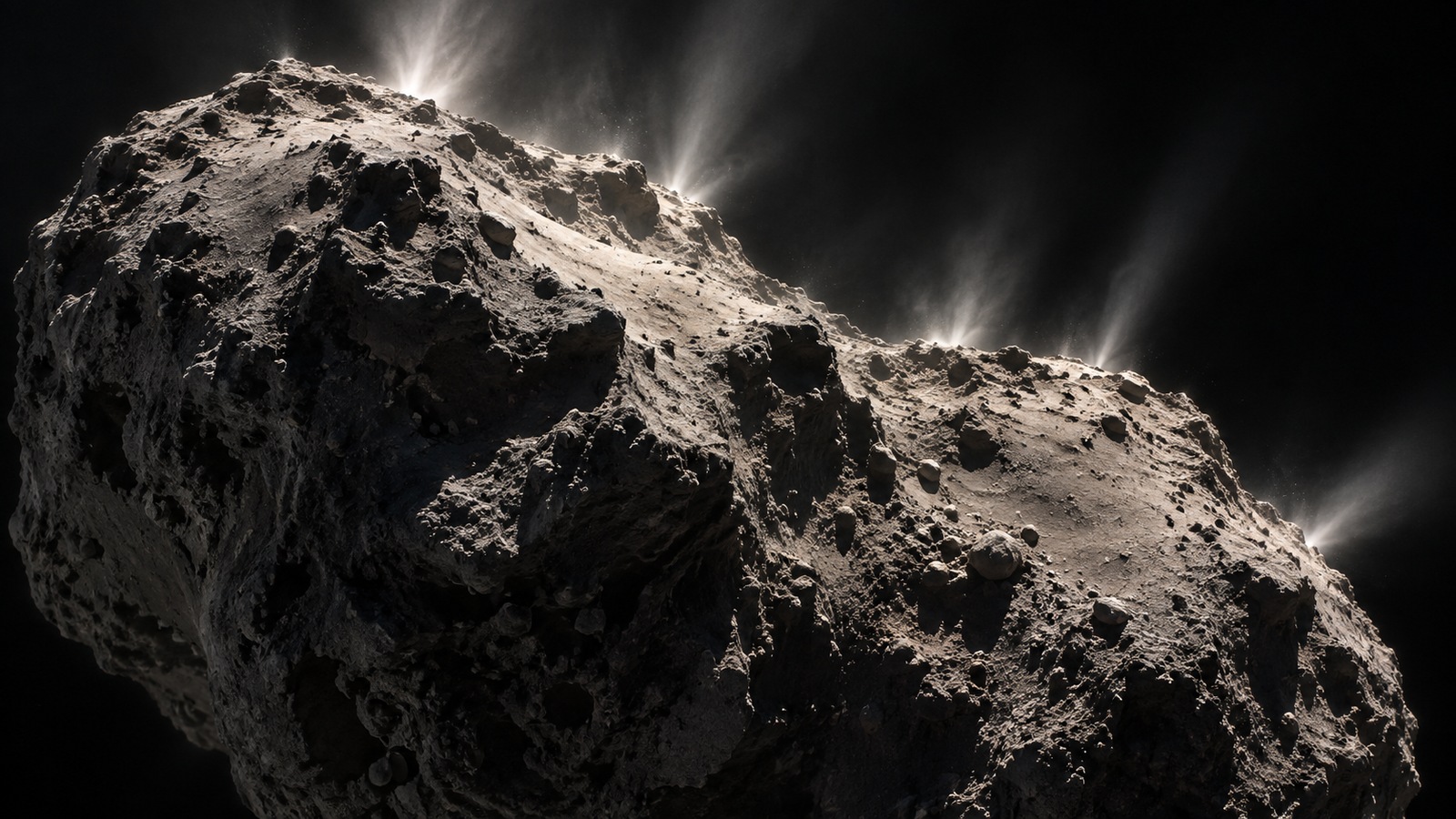
The nucleus is the solid body at the center of an active comet. It contains a mixture of frozen volatile substances and refractory material, including dust and rocky components. Water ice is important, but other ices can also contribute to activity under different conditions. The mixture is not necessarily a clean snowball with a smooth icy exterior. Spacecraft have encountered dark, irregular surfaces where exposed terrain and accumulated material complicate that simple picture.
Calling a nucleus solid does not require it to be a dense, monolithic rock. Cometary material can be porous, with low bulk density and a structure shaped by how smaller pieces assembled. Surface layers may differ from the material underneath them because repeated heating and erosion alter the outermost regions. A cratered or fractured-looking surface cannot by itself reveal the complete internal arrangement. Measurements of mass, volume, composition, and physical response are needed to constrain that structure.
The size of a nucleus and the extent of its visible atmosphere belong to different measurements. An unresolved bright head can cover a large apparent area without exposing the nucleus directly. Astronomers may use observations obtained during weak activity, infrared measurements, or spacecraft encounters to estimate the solid body’s properties. Treating the visible coma’s diameter as the diameter of the nucleus would therefore produce a very misleading picture. The central source is much smaller than the display it can maintain.
Heating releases gas without requiring liquid streams
As a comet moves into a warmer environment, sufficiently exposed ices can change directly from solid to gas through sublimation. That process does not require a river of liquid water running across the surface. Gas escapes through or from active regions and can carry dust along with it. How readily material escapes depends on temperature, composition, illumination, and the arrangement of the surface and subsurface. Different volatile substances respond at different temperatures, so water ice alone does not explain every activity pattern at every solar distance. The comet’s changing energy input helps drive the display, but the material inventory determines how that energy is used.
Activity is patchy rather than perfectly uniform
A rotating nucleus brings different terrain into sunlight. Its shape can create shadows, and its spin-axis orientation influences which regions receive sustained heating during an orbit. Local conditions may therefore produce activity that changes with rotation or season. A bright jet in an image identifies material moving outward in a particular configuration, not necessarily a permanent hole spraying at a constant rate. Repeated images help reveal whether that feature persists, shifts, or becomes hidden by geometry.
Rosetta made this unevenness tangible at 67P/Churyumov-Gerasimenko. The comet has two unequal lobes joined by a narrower neck, rather than a smooth spherical nucleus. ESA’s early mission results describe cliffs, pits, smooth deposits, and a roughly 500-meter crack near that neck. Different surfaces receive sunlight at different angles, and some lie in shadow while others warm. Following this changing terrain helped investigators connect local activity with the surrounding gas and dust. A jet therefore comes from a particular physical setting, not a uniformly evaporating snowball, and does not necessarily represent the nucleus’s complete output.
The coma is an expanding environment
The coma is the cloud of gas and dust around the active nucleus. It can become enormously larger than the solid body supplying it. Material spreads outward while interacting with sunlight and the surrounding space environment. Its appearance depends on how much is released and how different constituents emit or scatter light. The familiar bright head is therefore a changing distribution rather than a rigid shell attached to the comet.
Dust often contributes by scattering sunlight. Gas can contribute through emission associated with physical processes such as excitation and fluorescence. Different instruments isolate different parts of that mixture, so the same comet may look unlike itself in visible, ultraviolet, or infrared observations. A broad-band image combines contributions that a spectrum can help disentangle. Understanding the coma requires identifying the source of the measured light before interpreting its brightness as a direct measure of one substance.
The density generally becomes lower farther from the source, but the actual distribution need not be perfectly symmetrical. Jets, rotation, solar illumination, and viewing geometry can introduce structure. Processing an image may emphasize that structure without making it a sharply bounded physical object. A feature visible after contrast enhancement should be interpreted with the processing method in mind. Images and spectra together can distinguish real behavior from assumptions encouraged by an attractive display.
The coma also changes chemically after material leaves the nucleus. Solar radiation and other interactions can break molecules apart or ionize them. Consequently, detecting a species in the surrounding cloud does not always mean that the identical species was stored intact in the same form in the nucleus. Researchers model the pathways connecting released parent material with observed products. That distinction matters when using the atmosphere as a window into the comet’s original ingredients.
The dust tail follows many individual grains
Dust particles released by a comet continue moving under gravity while sunlight exerts radiation pressure on them. The balance differs with particle size and properties, creating a distribution of trajectories rather than one solid ribbon. As the comet travels, newly released and older particles occupy different positions. Together they can form a broad, curved dust tail that reflects sunlight. Its curve records the motion and release history of a population of grains, so describing it simply as smoke trailing behind a moving object misses the controlling physics.
The ion tail belongs to a magnetized interaction
Some gas becomes electrically charged after leaving the nucleus. Those ions interact with the solar wind and the magnetic field carried through interplanetary space. Their behavior differs from the dust grains that mainly follow gravity and radiation pressure. An ion tail often looks narrower and straighter than a dust tail, although real configurations can be complicated. It is the plasma component of the comet’s environment rather than a second stream of identical dust.
ESA’s Rosetta discussion of solar-wind interaction connects measurements near the comet with the processes shaping its ionized surroundings. The solar wind is not uniform, and changes can alter the tail’s appearance. Some comets show striking disruptions or detached-looking tail structures as their plasma environment changes. Such events need not mean the nucleus has broken apart. The fate of the tail and the integrity of the solid body are different questions.
A useful comparison therefore separates the mechanisms before comparing photographs. Dust tails reveal a distributed population of particles responding to sunlight and gravity. Ion tails trace charged material interacting with a flowing magnetized environment. Both draw on material released from the comet, but they are not interchangeable anatomical labels. Distinguishing them explains why one apparition can display two tails with different orientations and textures.
Tail direction is not a reliable motion arrow
The solar environment strongly influences the direction of the tails. In broad terms, they extend away from the Sun, with the dust tail often curving as particle trajectories and orbital history enter the picture. This means a comet leaving the inner solar system can have material extending in a direction that does not resemble a familiar trail behind a vehicle. The visible streamer is not a simple pointer to where the comet has just been. To determine the object’s actual motion, observers compare its position against stars over time or use an orbital solution.
Our viewing angle adds another complication. Dust spread through an orbital plane can appear to project in a surprising direction when Earth sees that plane nearly edge-on. An apparent anti-tail does not require the Sun to reverse its usual effects on dust. It can be a perspective effect involving the location of material and the observer. A two-dimensional image is therefore an incomplete guide to the three-dimensional arrangement.
Color reveals light processes rather than a painted surface
Some comet images show a greenish coma and a differently colored tail. Those colors can reflect emission from particular species and the way dust scatters sunlight, as well as instrument filters and image processing. The solid nucleus is not thereby established as a brilliant green object. Nor should every colored photograph be treated as an exact naked-eye view. A useful caption identifies the wavelengths or processing involved, allowing the color to become evidence about the surrounding material rather than an unsupported description of the hidden surface.
Brightness combines activity with observing geometry
A comet’s distance from the Sun affects heating, while its distance from Earth affects how bright and large it appears to us. The viewing angle can change how much scattered light reaches the observer. Outbursts and variations in released material can further change the display. These influences make brightness harder to forecast than the object’s position. An orbital prediction can be reliable while the promised spectacle remains uncertain.
The same distinction matters when comparing two comets. A larger nucleus does not automatically produce the brighter visible apparition. Activity, composition, particle properties, and geometry can outweigh a simple size comparison. A small source with favorable conditions may produce an impressive coma, while a larger but weakly active one remains difficult to see. The anatomy supplies several contributors to brightness, not one universal ranking variable.
Observers also need to separate apparent extent from surface brightness. A large diffuse coma may spread its light over a wide area and become hard to detect against a bright sky. Photographs can accumulate light and show structure that an eye does not readily see. A sharp point source and a broad cloud with the same total light are not equally easy to notice. Understanding that difference helps turn realistic anatomy into realistic observing expectations.
Following the material gives the clearest complete picture
The anatomical sequence begins with the nucleus’s stored mixture and continues through heating, gas release, dust entrainment, and outward expansion. Beyond the coma, the environment sorts those materials into different behaviors. Dust grains reveal trajectories shaped by gravity and sunlight; ions reveal interactions with plasma and magnetic fields. Each component carries information about both its source and what happened after release. None can be read accurately as a decorative addition to an otherwise ordinary rock.
This perspective also improves the interpretation of future comet images. First identify whether the image resolves the nucleus or mainly shows its surrounding cloud. Then separate dust structures from plasma features and ask which wavelengths produced the view. Finally, account for changing illumination and viewing geometry before turning an apparent shape into a physical claim. A comet’s beauty remains immediate, but its anatomy explains why that beauty can change dramatically even while the underlying object continues along a predictable orbit.


