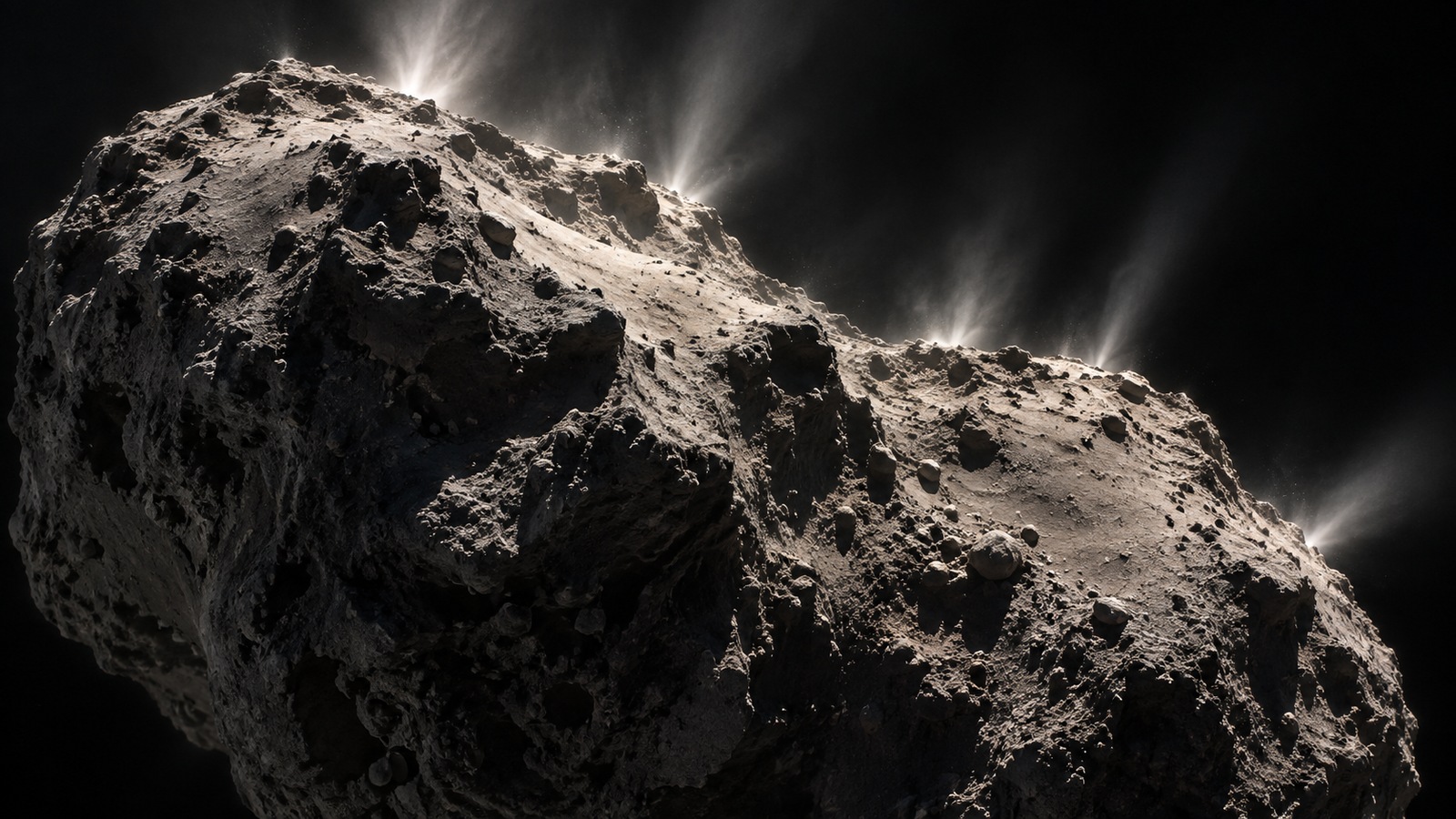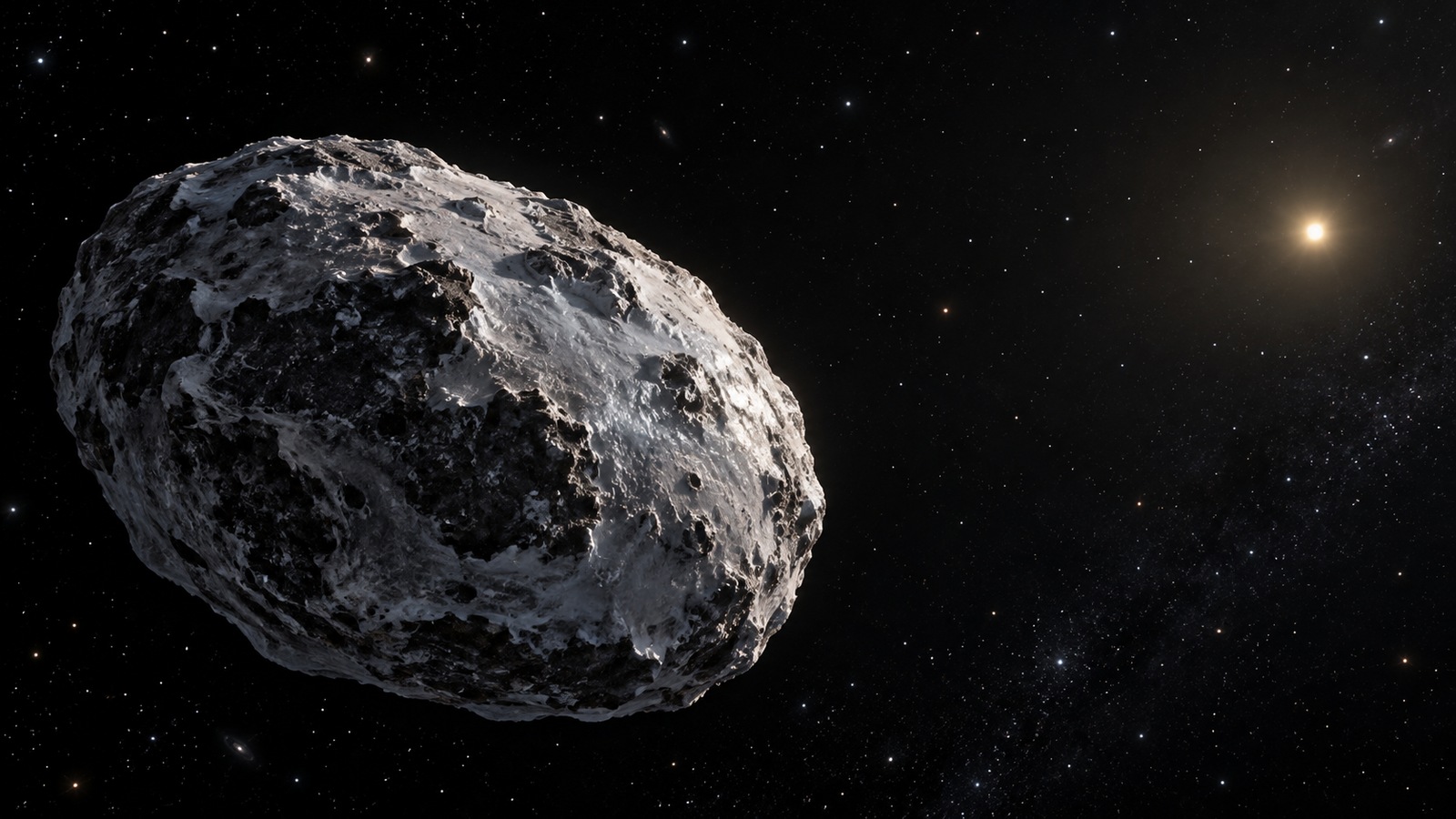
An arriving comet carries an incomplete address
When a comet becomes visible near the Sun, astronomers see the latest part of a journey that may have begun in a distant reservoir. Its present orbit provides clues, but gravity can have changed that orbit along the way. A familiar comparison places the Kuiper Belt beyond Neptune and the Oort Cloud much farther out, then assigns short-period comets to one and long-period comets to the other. That comparison is useful as an introduction, yet it leaves out the scattered disk, differences among periodic comet families, and the distinction between where an object formed and where it spent most of its lifetime. Understanding origins requires following those distinctions together. The question is not simply which remote region contains ice, but how objects are stored, disturbed, and transported into the planetary neighborhood.
The outer reservoirs preserve early solar-system material
Comets contain material inherited from the era when the solar system assembled. Their frozen volatile substances are easier to retain in cold environments than near the Sun. Distant storage therefore helps explain how ice-rich objects can survive long enough to produce present-day comets. Survival does not mean every layer remains untouched. Radiation, collisions, internal processes, and earlier close approaches can alter an object before astronomers encounter it as an active comet.
A reservoir is consequently a population with a dynamical history, not a warehouse of identical pristine samples. Objects may differ in composition, size, structure, and exposure to heating. Some remain in comparatively stable orbits, while others occupy routes susceptible to disturbance. A source population can feed the inner solar system over time even if most of its members never become bright visitors. The transport pathway is as important as the presence of stored ice.
The Kuiper Belt is a region with directly observed members
The main Kuiper Belt occupies a region about 30 to 50 astronomical units from the Sun. One astronomical unit, or AU, is approximately Earth’s solar distance: 150 million kilometers. Neptune marks the main belt’s inner neighborhood at about 30 AU, while its outer limit is not the boundary of all trans-Neptunian material. Astronomers directly observe numerous bodies with different orbital arrangements there. NASA’s Kuiper Belt overview distinguishes this main region from the farther-reaching scattered disk. The belt is not a dense wall; individual objects remain separated by immense distances.
Pluto helps make the region recognizable, but it does not represent every kind of member. Orbital resonances with Neptune, relatively stable populations, and more strongly disturbed bodies tell different dynamical stories. A picture of one neat circular band can hide that variety. Measurements of inclination, eccentricity, and orbital period reveal how individual members move. Those properties help researchers distinguish populations rather than treating everything beyond Neptune as one uniform collection.
Directly observing a body is also different from knowing its complete physical composition. Brightness can depend on both size and reflectivity, while spectra reveal only some aspects of surface material. More distant or smaller objects are harder to detect, so an observed catalog is incomplete. Astronomers account for those selection effects when estimating population properties. The mapped portion of the Kuiper Belt is a starting point for reconstruction, not a perfect census of every object.
The scattered disk provides an important transport connection
Neptune’s gravitational influence has placed some outer bodies on elongated orbits that extend well beyond the main belt’s familiar setting. This scattered population is particularly important when explaining routes toward Jupiter-family comets. Over time, interactions can bring an object into the giant-planet region, where further encounters reshape its path. Saying a comet came from the Kuiper Belt can therefore serve as a broad regional shorthand while concealing a more specific scattered-disk history. The distinction improves the physical explanation without requiring every reader to memorize a rigid list of population boundaries.
The Oort Cloud is inferred from comet behavior
The Oort Cloud is a proposed much more distant reservoir. NASA’s overview gives an approximate range of 5,000 to 100,000 AU, while its boundaries and inner structure depend on models. Even that illustrative inner distance is a hundred times the main Kuiper Belt’s outer distance; 100,000 AU is about 1.6 light-years. These scales describe an inferred reservoir, not a measured fence around a completed census. Its population has not been mapped by directly imaging all its members. Long-period comet orbits, arrival directions, and dynamical calculations supply the principal evidence, so an artist’s shell-like cloud remains an explanatory picture rather than a photograph.
Long-period comets can approach from widely different directions rather than remaining close to the plane shared by the major planets. Their orbital energies and large inferred orbital extents support a distant source population with a broadly distributed geometry. A flattened belt alone would not naturally reproduce all of those features. Models explore how distant storage and external gravitational disturbances can deliver suitable orbits. Several connected observations and physical arguments support the reservoir rather than one image revealing it outright.
Its boundaries and detailed population remain uncertain. Popular diagrams often give the cloud a crisp inner and outer edge, but those edges summarize models and estimates rather than a surveyed fence. An object’s attachment to the Sun becomes increasingly vulnerable to outside influences at great distances. Researchers may distinguish inner and outer parts with different dynamical behavior. Such distinctions are useful precisely because the whole region cannot be represented adequately as one uniformly populated spherical surface.
A specific delivery route begins when a passing star changes the motion of a distant, weakly bound nucleus. A modest change can lower the orbit’s closest solar approach while leaving its outer reach extremely large. The body may then enter the planetary region, where another gravitational encounter can shorten its orbit or eject it. This sequence connects distant storage with an observable visitor through identifiable changes in motion. It also explains why the orbit measured after a planetary encounter need not preserve the comet’s original reservoir signature unchanged.
Objects were scattered outward before being stored
A reservoir’s present location need not be the place where all its members originally formed. Interactions during the early solar system could move small icy bodies outward from regions influenced by the giant planets. Some objects were ejected, while others remained bound on distant orbits. Additional gravitational influences could change inclinations and help establish a more broadly distributed population. The resulting Oort Cloud is therefore part of a history of transport and survival, rather than a claim that a spherical shell of comet nuclei condensed exactly where it is imagined today.
The early architecture of the planetary system also matters. Giant planets did not necessarily remain in one unchanging configuration throughout formation, and simulations examine how their evolution affected small bodies. Different starting arrangements can yield different surviving populations. Observations of today’s reservoirs help constrain those histories but do not provide a recording of every encounter. Researchers seek models that join formation, scattering, and current orbital distributions into a compatible account.
External gravity can send distant objects inward
A distant object moves under the Sun’s gravity while also experiencing weaker influences from the surrounding galaxy and passing stars. Over long intervals, those influences can change the orbit enough to bring its closest approach nearer the Sun. The relevant change is not always a simple push straight toward the center. Altering angular momentum can change the orbit’s perihelion while the object continues following a gravitational trajectory. This supplies a route from distant storage into the region where planetary encounters and solar heating become important.
The giant planets can redirect the incoming route again
An object entering the planetary region can encounter a giant planet and exchange orbital energy and angular momentum. Its new orbit may have a shorter period, a different orientation, or an escape trajectory. Several encounters can produce a complicated history rather than one direct transfer between two named locations. Jupiter’s large gravitational influence is especially important to many periodic comet populations. However, that influence can eject objects as well as help shape bound routes.
This is why an orbit measured after a comet passes through the inner solar system may differ from the orbit it had before those encounters. Researchers can distinguish an incoming orbital solution from the present or outgoing one when tracing origins. The choice of reference frame and the inclusion of perturbations matter in detailed work. A simple statement that an orbit looks hyperbolic at one moment is not enough to settle whether an object arrived from another star. A robust classification requires the relevant orbital history and uncertainties.
Comet activity can add smaller non-gravitational effects too. Uneven outgassing produces forces that may matter when fitting precise trajectories. These forces do not replace gravity as the main architecture of the journey, but they can affect the best orbital solution. Repeated observations help identify and constrain them. Origin studies therefore combine a dynamical framework with attention to how a real active object behaves.
Period labels are helpful but not complete origin certificates
The conventional division between short- and long-period comets often uses two hundred years as a boundary. That definition organizes observed orbital behavior rather than independently proving a reservoir. Jupiter-family comets and Halley-type comets have different characteristic orbital distributions, despite both fitting within a broad short-period category. Halley-type objects can be associated with Oort Cloud pathways instead of the simplified rule that every periodic comet came directly from the Kuiper Belt. A period is one clue that must be combined with other orbital properties.
Inclination, eccentricity, and the object’s history among the planets provide additional information. Researchers also investigate transitional populations, including objects moving through the giant-planet region. These categories help describe stages and pathways rather than fixed identities that never change. An object can move from one dynamical setting into another. The scientific value lies in reconstructing how that happens, not merely assigning a familiar label to the latest orbit.
Interstellar visitors ask a different origin question
Some small bodies arrive on paths that support an origin outside the solar system. Such objects are not automatically members of either local reservoir just because they display comet-like activity. Their orbital evidence must distinguish a genuinely unbound incoming path from one modified by encounters or measurement uncertainty. Composition can add context without replacing the dynamical argument. The existence of interstellar visitors expands the origin question beyond two solar reservoirs, while leaving the Kuiper Belt and Oort Cloud central to the explanation for many ordinary comet populations.
A reliable source story joins observation with transport
The strongest comparison begins with what each reservoir’s evidence actually establishes. The Kuiper Belt has directly observed members, while the Oort Cloud is reconstructed chiefly from comet dynamics and models. Their geometries, distances, and mechanisms for delivering inward-moving objects differ. Within the outer planetary population, the scattered disk supplies an important connection to particular periodic families. Those distinctions make the familiar two-reservoir summary more useful, because each term points to a specific physical role.
When a new comet is announced, an accurate origin account should state how well its incoming orbit is known and which population it resembles. It should distinguish a likely storage region from an original formation site. It should also allow for planetary encounters, outgassing, and the possibility of an interstellar path when the evidence supports it. A comet’s address is reconstructed through motion, not read from the glow of its tail. Following that reconstruction reveals a solar system connected across distances much larger than the bright planetary neighborhood we usually picture.