A comet can make history in several different ways
A spectacular tail can make a comet famous, but lasting importance often comes from something less obvious. One visitor helped demonstrate that celestial appearances could return on predictable orbits. Another produced unexpected X-rays, while a fragmented comet let scientists watch impacts unfold on Jupiter. Later missions deliberately struck a nucleus or accompanied it through months of changing activity. These achievements belong to different chapters of astronomy, so a list ordered only by visual brilliance would miss much of the story. The six comets below earned their places through prediction, discovery, experimentation, and sustained observation. Their histories show how the same broad class of small icy bodies can become a cultural landmark, a physical laboratory, or a demanding spacecraft destination, depending on what observers are equipped to ask.
Halley turned separate appearances into a returning object
Edmond Halley’s important contribution was not being the first person to notice the comet that now carries his name. He compared recorded appearances and calculated their orbits using the gravitational framework associated with Newton. In 1705, he argued that the comets seen in 1531, 1607, and 1682 were appearances of one returning body. A prediction then gave that interpretation a future test. The return observed in 1758 occurred after Halley’s death and strengthened the case for treating certain comets as periodic members of the solar system.
The historical importance lies in the change from recognizing a remarkable sight to identifying a persistent physical object. Old observations could become evidence about one orbit instead of disconnected descriptions of alarming lights. NASA’s Halley history also connects the comet with records spanning more than two millennia and its depiction in the Bayeux tapestry. Such cultural traces preserve human responses without supplying the dynamical explanation by themselves. Calculations, repeated appearances, and historical records contributed different pieces to the comet’s identity.
Hyakutake opened an unexpected high-energy window
Comet Hyakutake became a striking visitor in 1996, but a spacecraft observation added a discovery that eyes could not supply. The ROSAT observatory detected unexpectedly strong X-ray emission associated with the comet. NASA’s archive of the Hyakutake observation documents that surprising result. A cold-looking icy body had become the setting for a high-energy signal. Explaining it required considering the surrounding environment rather than assuming the solid nucleus itself was an extremely hot X-ray source.
The explanation involves solar-wind charge exchange. Highly charged ions carried outward from the Sun capture electrons from neutral cometary gas; the captured electrons then drop to lower energy states and release photons, including X-rays. Researchers’ simulations of Hyakutake’s observations connected this process to the measured high-energy glow. The comet did not need a uniformly furnace-hot nucleus to produce it. The discovery opened an observational window on interactions between an ordinary comet’s released gas and the solar wind, giving a familiar bright apparition a new physical role.
That distinction is useful when reading a retrospective. The X-ray discovery should not be translated into a claim that Hyakutake was dangerous because it looked bright, or that every comet’s visible tail is an X-ray beam. Instrumental detection, physical interpretation, and human viewing conditions are separate issues. Its place in history rests on a measurable surprise and the questions that surprise created. A celebrated comet can matter most for light outside the range that made it celebrated.
Hale-Bopp combined public visibility with a long observing campaign
Hale-Bopp, discovered independently by Alan Hale and Thomas Bopp in 1995, became the Great Comet of 1997. Its prominence gave observers a sustained opportunity to follow an active comet rather than rely on one brief glimpse. Professional observations tracked changes as its solar distance decreased, while public viewing made it a memorable shared sky event. NASA’s 1997 report on Hubble and ultraviolet monitoring describes investigations of changing activity and volatile material. The scientific advantage was not merely beauty: repeated measurements allowed comparisons across different conditions. Its fame illustrates how visibility can enlarge an observing campaign, even though public recognition and a particular scientific result remain distinct achievements.
A long campaign also permits researchers to revisit an early interpretation when later measurements reveal a different pattern. An isolated outburst might initially seem representative, then prove exceptional within a broader sequence. Tracking solar distance and observing conditions helps separate a change in the comet from a change in the view. That is a methodological advantage of sustained access to one target. The public’s memorable appearance and the researchers’ comparison over time can therefore come from the same visitor while serving different purposes.
Shoemaker-Levy 9 made planetary impacts observable in real time
Shoemaker-Levy 9 followed a very different route to fame. The comet had fragmented before its pieces collided with Jupiter in July 1994. Astronomers could prepare observations of an event whose target and approximate timing were known. NASA’s account of the collision describes the succession of fragments and the observing effort. Instead of reconstructing an ancient impact solely from a surviving scar, researchers watched a sequence of fresh atmospheric disturbances develop.
Different instruments and vantage points supplied complementary information. Visible and infrared observations investigated evolving effects, while the Galileo spacecraft provided a perspective unavailable from Earth’s location. The planet’s rotation and the geometry of the impacts influenced what could be seen at particular times. A single dramatic image was only part of a much larger data set. Combining those observations helped turn an extraordinary collision into a physical investigation.
The event also made fragmentation and impact consequences concrete. A comet need not remain one intact body throughout an encounter with a giant planet. A succession of fragments can produce a series of effects rather than one simple explosion. Jupiter’s atmosphere then responds through heating, expanding material, and evolving dark features. Understanding those responses requires separating the incoming objects from the planet’s reaction.
Its historical significance should not be turned into the claim that Jupiter permanently shields Earth from every comet. Planetary gravity can redirect, capture, or eject small bodies in different circumstances. The observed collision established what happened to this particular fragmented object. Broader statements about impact rates require population studies and dynamics. A famous example makes a process vivid without settling every question about that process elsewhere in the solar system.
Tempel 1 became the target of a controlled encounter
NASA’s Deep Impact mission introduced an experimental element to comet exploration. On July 4, 2005, an impactor struck Tempel 1 while a separate flyby spacecraft observed the result. The goal was to investigate material and physical properties that ordinary surface viewing could not fully reveal. NASA’s mission account describes this effort to probe beneath a comet’s exterior. The visible plume represented newly disturbed material, giving researchers a deliberately created event to study.
A controlled collision does not make interpretation effortless. Dust can obscure part of the immediate view, and measurements need to connect brightness, composition, and motion with physical properties. Observations from other telescopes supplied additional perspectives. Later investigation of the same target could add context to the immediate encounter. Tempel 1’s importance lies in joining a planned intervention with remote measurements, illustrating how a mission can ask a question that an undisturbed distant comet would answer less directly.
67P made a comet an evolving destination
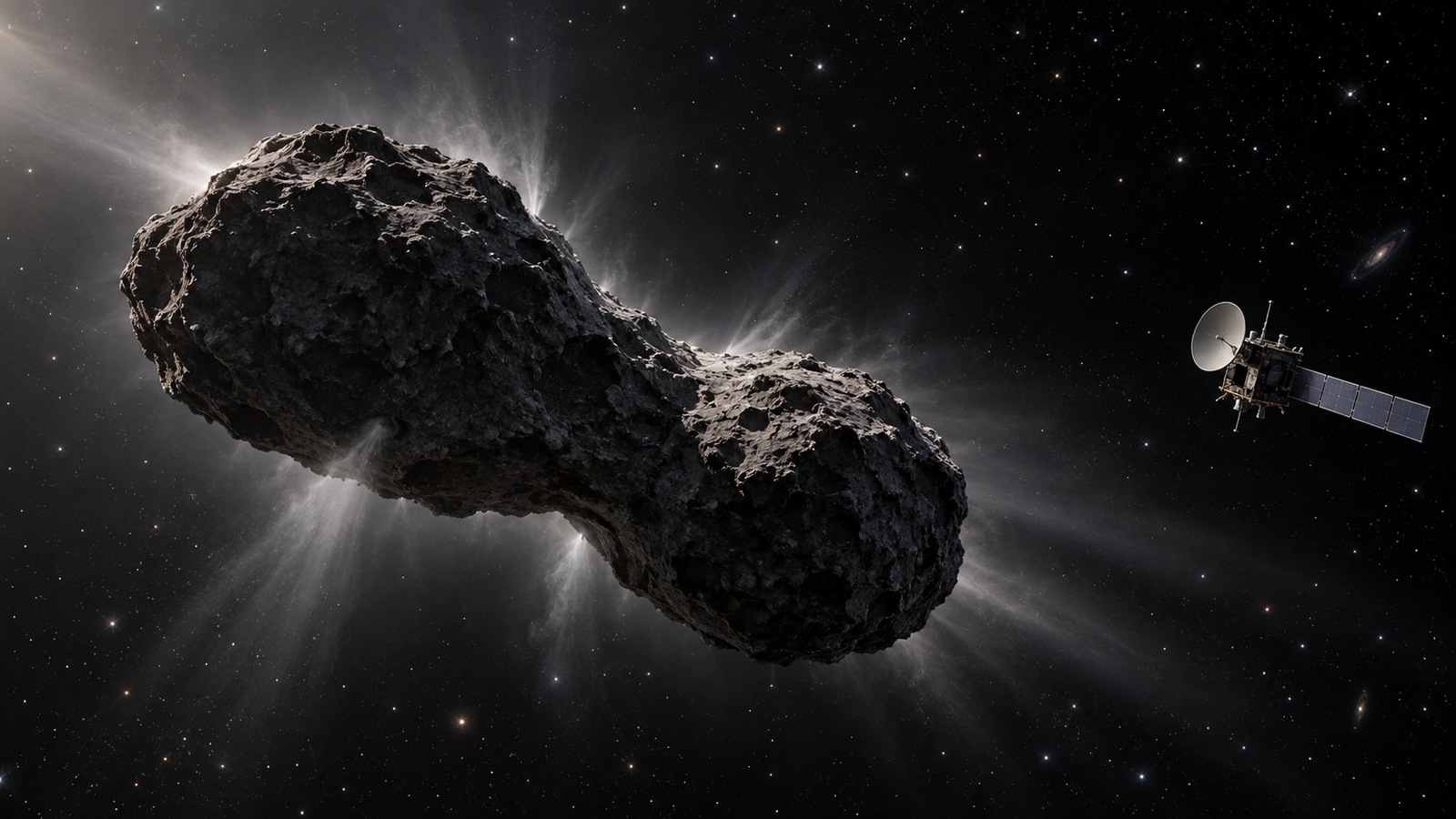
ESA’s Rosetta mission reached comet 67P/Churyumov-Gerasimenko in 2014 and studied it over an extended interval. Philae’s landing attempt and surface measurements added another dimension to that exploration. The mission followed the comet as illumination and activity changed, connecting the nucleus with the environment it produced. This differed fundamentally from passing one body quickly and carrying away a short snapshot. Sustained proximity allowed investigators to relate measurements obtained at different stages of the orbit.
Rosetta’s observations showed why a comet deserves study over time. The nucleus has terrain, shadowing, rotation, and localized activity, while dust and gas respond to changing conditions. Measurements near the object and remote images address different physical scales. A mission accompanying the comet can follow those connections repeatedly instead of assuming every observation represents a permanent state. ESA’s description of the observing program emphasizes the investigation of material leaving the nucleus and interacting with its surroundings.
The mission also changed the public’s image of what a cometary body can look like. An irregular, dark, structured nucleus is very different from a smooth glowing snowball. That visual correction supports a larger scientific correction: the bright sky apparition and its small solid source are not the same object at the same scale. Rosetta’s legacy joins detailed surface familiarity with measurements of an active environment. Its famous images were valuable because they belonged to an organized program of physical investigation.
Cultural memory and scientific evidence tell different histories
A comet can appear in art, chronicles, personal recollections, and public reporting without every associated interpretation being physically correct. People have connected unusual sky events with political change, fear, wonder, or collective curiosity. Those responses are meaningful subjects of cultural history, but they do not establish that the comet caused the events occurring beneath it. A responsible account can preserve the human story while keeping causal claims separate. The scientific history asks what was observed, what was calculated, and what evidence changed an explanation; cultural history asks how people interpreted and remembered the appearance.
Historical fame is not a forecast for the next appearance
A returning comet does not necessarily reproduce the same display for every generation. Its location relative to Earth and the Sun changes the observing geometry. Activity may also vary, and local sky conditions influence what a person sees. A famous name is therefore not a promise of a spectacular naked-eye show. The history of an earlier apparition gives context, while a current observing plan needs current orbital and brightness information.
The distinction becomes especially important when photographs from different eras are compared. Exposure length, filters, instrument sensitivity, processing, and the apparent size of the comet can differ. One image may show a close spacecraft nucleus, another a wide tail across the sky, and another an atmospheric impact effect. They are not equivalent views of one standard cometary feature. Identifying the physical scale and observing method makes a historical gallery informative instead of merely dramatic.
The shared legacy is a change in what could be tested
These six examples form a sequence of different scientific capabilities. Halley made a return into a prediction test. Hyakutake showed that a familiar object could reveal an unexpected phenomenon at another wavelength. Hale-Bopp supported extended monitoring, and Shoemaker-Levy 9 made a collision available for coordinated observation. Tempel 1 enabled a planned intervention, while 67P became a destination whose activity could be followed. None needs to win an all-time brightness contest to justify its historical place.
The sequence also shows why apparently small bodies deserve attention. Comets connect stored early material with present solar heating, planetary encounters, and the space environment. Studying them can inform formation history while also testing how fragile objects release and transport matter. Their physical variety prevents one celebrated example from standing in for all the rest. A broad historical account should therefore use fame to introduce the differences rather than smooth them away.
The next historically important comet may not be the next one that dominates casual sky photographs. It could be a difficult spacecraft target, an unusual visitor with a well-measured orbit, or an object whose faint signal exposes an unexpected process. Its importance will depend on the quality of the evidence and the question that evidence resolves. Looking backward through these famous examples makes that possibility easier to recognize. The enduring story is not simply that comets appeared, but that observers learned how to make their appearances answer increasingly precise questions.