
A returning object on a generational timescale
For many people, Halley’s Comet offers the possibility of one memorable appearance within a lifetime rather than an event that comes around every observing season. Its roughly seventy-six-year orbital timescale connects accounts made by different generations, yet the returning body is the same physical comet moving through a changing gravitational environment. That combination gives Halley an unusual identity: it is a recurring landmark in human records and a small, dark object whose activity can be measured. The famous name therefore covers more than a beautiful tail. It joins a prediction made centuries ago with modern spacecraft observations, a trail of particles encountered by Earth, and an expected return in 2061. Understanding those pieces makes the next appearance meaningful without promising that every location will receive the same view or that the comet runs on an exact calendar clock.
A long ellipse brings Halley into different environments
Halley’s orbit is highly elongated, carrying it from the inner solar system to distances beyond Neptune’s orbit. Near its closest solar approach, the comet experiences much stronger sunlight than during its long distant portion. That changing environment helps explain why the familiar display is concentrated around an inner-system visit. The nucleus persists through the orbit, while the amount of surrounding gas and dust can change greatly. Calling it a returning visitor describes the visible phase from Earth’s perspective rather than implying that the physical object vanishes between appearances.
The period is an orbital outcome rather than a timer
The commonly quoted interval of about seventy-six years is a useful summary, but successive returns do not obey an exact fixed countdown. Gravity from the planets perturbs the orbit, and uneven outgassing can contribute smaller changes to precise motion. Calculating a return requires following those influences instead of adding one identical interval forever. Historical observations also have different accuracies, so reconstructing older paths involves evaluating the quality of the records. A regular astronomical identity does not require mathematically identical intervals between all apparitions.
Its retrograde orbit supplies another distinctive feature. Halley moves around the Sun in the opposite general direction from the major planets. The orbital plane is also inclined relative to the planetary arrangement. Those properties affect encounter geometry and distinguish it from the more familiar picture of objects circulating together in a flat planetary disk. They help define a dynamical history rather than providing a reason to regard the comet as outside the laws governing other bodies.
Precise calculations can predict positions much more reliably than they can promise a particular visual spectacle. Brightness depends on how the nucleus releases material, the lighting and scattering geometry, and the distance to the observer. A sound orbital prediction therefore does not eliminate every uncertainty about a visible tail. This distinction is especially useful decades before a famous return. The calendar can identify the event while the actual view remains dependent on several other physical and local conditions.
Its identity was recognized through old observations
Edmond Halley compared the orbital evidence associated with appearances in 1531, 1607, and 1682. He argued in 1705 that they belonged to one returning object and predicted another visit in 1758. That interpretation depended on a gravitational framework and the recognition that different recorded appearances could share an orbit. The prediction was fulfilled after his death. The achievement changed how certain comets could be understood, although he was not the first human to observe this particular body.
NASA’s history of the comet connects later reconstructions with records extending over more than two thousand years. Its representation in the Bayeux tapestry is one well-known cultural trace of an earlier appearance. Such evidence is valuable when its purpose is kept clear: an artwork records a response to a sky event, while calculations help establish the event’s modern identification. The comet’s enduring name brings these different kinds of evidence together. It should not blur them into the claim that every associated belief became an astronomical fact.
The luminous apparition conceals a dark nucleus
The active comet’s bright head and tails are made largely from material released around its small solid source. Halley’s nucleus itself is dark and irregular rather than a brilliant self-luminous ball. Sunlight helps drive the release of volatile material and dust, which then contribute to the surrounding display. The apparent head seen from Earth does not directly give the nucleus’s size or show all of its terrain. This difference between source and environment is central to interpreting both historical sightings and modern images. A dramatic sky photograph can show an enormous atmosphere while still leaving the solid object unresolved.
The 1986 visit supported an international encounter campaign
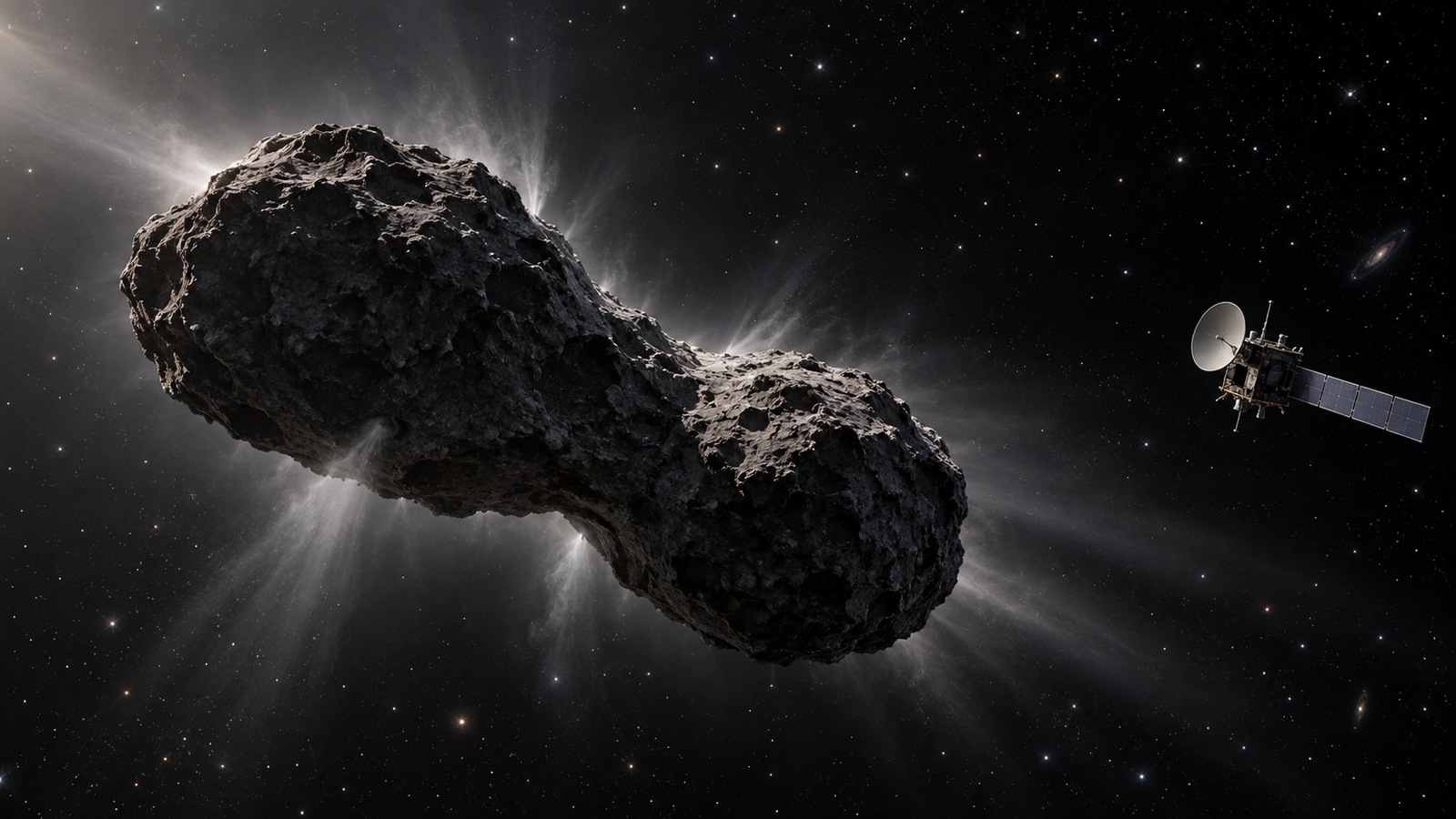
Halley’s 1986 return brought an international spacecraft campaign close to the object beneath its bright coma. Giotto, the Soviet Vega probes, and Japanese missions approached different parts of the comet’s environment. Their close observations transformed the solid nucleus from an unresolved source into a body with measurable shape and activity. The encounter was especially revealing because the visible apparition had always made the comet seem far larger and brighter than its actual surface. Comparing nucleus images with surrounding material could finally connect that small source to the spectacle observed from Earth.
Giotto’s camera revealed an elongated, roughly potato-shaped nucleus. ESA’s results summary gives dimensions about fifteen kilometers long and nine kilometers across, with only two to four percent of incoming light reflected. The surface was therefore remarkably dark despite the brilliant coma it supplied. Those numbers separate the nucleus’s physical scale and reflectivity from the much larger glow of dust and gas. Halley became a concrete example of how a dark body can generate a conspicuous sky object without shining like a star.
The environment also made close investigation difficult. Dust grains moving at high relative speed can threaten a spacecraft, so trajectories and shielding are part of the scientific mission design. Instruments must measure the surrounding material while surviving the conditions that make the material interesting. This is a different challenge from photographing a quiet rocky body from a comfortable distance. The success of comet exploration depends on combining observing goals with realistic limits on the encounter.
The images also showed two major bright jets on the sunward side, while only a relatively small part of the nucleus appeared active. Activity was patchy rather than evenly distributed across a clean ice sphere. Gas and dust measurements examined what that active surface released, connecting the visible jets with the surrounding material. Combining the close observations with other data indicated a low bulk density, under 0.6 gram per cubic centimeter in ESA’s account. Shape, darkness, localized jets, and density together supplied a far more specific physical picture than the old smooth-snowball shorthand.
Repeated visits gradually alter the source
Every active inner-system passage can remove some material from a comet and change parts of its exposed surface. Dust can accumulate in some locations while activity exposes or erodes others. Rotation, illumination, and local structure influence those changes. Halley’s persistence over many returns therefore does not imply a completely unchanged surface. The same identified body can continue to evolve physically.
That evolution also limits simplistic predictions about its far future. A comet can lose volatile material, fragment, or change its activity through processes that do not reduce to one uniform rate applied indefinitely. Researchers use observations and models to examine possible histories, but a famous periodic orbit does not grant unlimited certainty about survival. The present focus on the next return is more defensible than an exact invented timetable for the comet’s eventual disappearance. A responsible account separates the measured past from speculative long-term extrapolation.
Earth encounters the debris through meteor showers
Halley’s influence on the sky is not confined to the year of a prominent return. Material left along its orbital route forms streams that Earth can encounter. Small particles entering the atmosphere at high speed produce luminous meteor trails. The visible streak is an atmospheric interaction involving debris rather than a tiny image of the distant comet itself. This connection allows a body on a long orbit to have a much more frequent observational legacy.
The Orionids, associated with October, and the Eta Aquarids, associated with May, are linked to Halley’s debris. Their names refer to the directions from which shower meteors appear to radiate on the sky, not to locations where the comet formed. An observing guide for a particular year must account for timing, moonlight, location, and conditions. The physical association remains useful even when any individual observing night is disappointing.
A shower is not evidence that the comet’s nucleus is passing close beside Earth at that time. The planet is meeting material spread along a trajectory over earlier passages. That distinction separates the source body’s current position from the location of its abandoned particles. It also explains why a meteor shower can recur much more frequently than the nucleus’s bright apparition. The debris stream and the parent comet share a history without remaining packed together as one object.
2061 is a return date, not a universal viewing guarantee
Halley’s next expected inner-system return is in 2061. Planning around that date is reasonable, but predicting a universally identical naked-eye experience is not. The object’s location relative to Earth, solar elongation, activity, and the observer’s latitude will affect opportunities. Local weather and light pollution add practical limitations. Later observing forecasts will refine those details using the relevant ephemerides and measurements. The date identifies a scientific and cultural occasion while leaving the actual experience dependent on where, when, and how it is observed.
A comet visit needs a different observing plan from a point star
An active comet may spread its light over a diffuse coma and tail. That makes total brightness an incomplete guide to visibility against the sky. A long exposure can reveal an extended structure that eyes or a modest instrument do not readily show. Images also vary in field of view and processing. Comparing an anticipated view with a famous photograph requires recognizing those differences instead of assuming the photograph is a standard visual promise.
Current positional information is essential during an actual apparition because the comet moves against the background stars. A printed historical chart or a remembered constellation is insufficient for a date decades later. Observers need an up-to-date map and a safe viewing opportunity with adequate separation from the Sun. The physical orbital story explains why those updates matter. Familiarity with the name should make preparation more informed, not less careful.
A physical legacy lasts beyond one spectacular night
Halley’s enduring significance comes from linking several different timescales. An orbital period connects generations of human observers. Surface activity develops over rotation and the changing solar environment. Dust left behind can meet Earth’s atmosphere during recurring meteor-shower seasons. Historical identification joins records separated by centuries. Each scale contributes to the same physical story without requiring every observation to occur during a brilliant return.
Its debris gives that history a yearly presence even during Halley’s long absence. Earth passes through streams containing material released along earlier orbits, and small grains create brief luminous trails as they encounter our atmosphere. The meteors are not miniature comets glowing permanently in space. Their light comes from a rapid atmospheric encounter, linking a fleeting streak overhead with material shed by a body now elsewhere in its orbit.
A future return will bring those scales together again: a dark nucleus, an expanding environment of released material, and a trajectory recognizable across generations. The exact view will depend on geometry and activity, but the object will continue the same physical history. Halley’s fame lasts because a single returning body connects old records, spacecraft discoveries, and meteor showers watched between its visits.


