For This Telescope, Too Much Light Is the Starting Problem
Most astronomical telescopes gather faint light from distant objects. A solar telescope faces a different challenge: its target is intensely bright, constantly changing, and capable of delivering dangerous amounts of energy through an optical system. Observing the Sun therefore requires control of the light before it can harm an observer or damage equipment. The instrument may use carefully designed filters, specialized optics, cooling, and detectors that select particular wavelengths. Different designs reveal different parts of the solar atmosphere, so a sunspot view and a dramatic image of glowing loops need not come from the same kind of telescope. Understanding those differences explains both the extraordinary pictures produced by research observatories and the strict safety requirements that apply to any personal attempt to observe our star.
Solar Observation Starts with an Appropriate Complete System
A solar telescope is an instrument designed or properly equipped to observe the Sun. Some are dedicated instruments built around a specific solar observing method. Others are ordinary telescopes fitted with a suitable solar filter and used according to the equipment manufacturer’s instructions. In either case, safety comes from the complete optical system, not from a component that merely looks dark. The incoming light includes ultraviolet and infrared radiation as well as visible light. An acceptable view must control harmful energy across the relevant spectrum while preserving useful image quality.
For conventional telescopes, binoculars, and camera lenses used for direct solar viewing, a proper solar filter must be securely mounted over the front aperture before the instrument is aimed at the Sun. Eclipse glasses are for direct unaided viewing and must never be worn as a substitute for that optical filter. A dark filter screwed into an eyepiece is unsafe because concentrated sunlight can heat and break it. The American Astronomical Society’s solar-filter guidance for optics explains these distinctions. Equipment with a dedicated engineered solar optical train must be used exactly as its manufacturer specifies.
White-Light Views Reveal the Photosphere
A suitable white-light solar system reduces the incoming energy while providing a broad visible-light view of the photosphere. Sunspots appear darker than their surroundings because they are cooler, although they remain intensely bright in absolute terms. With sufficient resolution and favorable atmospheric conditions, an observer can distinguish a dark umbra, surrounding penumbra, and fine photospheric texture. These features are tied to solar magnetic activity. A white-light instrument does not automatically show the dramatic atmospheric prominences visible in many narrowband images, because it emphasizes a different part of the Sun’s emission.
Hydrogen-Alpha Instruments Select a Narrow Spectral Window
Hydrogen-alpha observations isolate a narrow region around a hydrogen spectral line near 656.3 nanometers. A properly designed solar H-alpha instrument can show structures in the chromosphere, including filaments and prominences that stand out from the background differently than in white light. A prominence seen against dark space near the limb can appear bright, while related material projected against the disk may look like a dark filament. The difference reflects the viewing geometry and contrast. It does not mean that one image shows a different element simply because the feature has changed apparent brightness.
A dedicated system uses precision filtering to isolate that spectral window while rejecting dangerous unwanted radiation. An astronomical H-alpha filter sold for photographing faint nebulae is not a solar safety filter and must never be used by itself for viewing the Sun. The wavelength name alone says nothing about whether the entire instrument safely handles concentrated sunlight. Specialized solar systems may include energy-rejection and blocking components that are essential to their operation. Removing or substituting a component can invalidate the system’s safety and performance, even if the resulting image still appears dim.
The narrow passband also affects what structures become visible and how much surrounding emission is admitted. Tuning and instrument design influence contrast, but they do not turn the view into a complete portrait of every atmospheric layer. Solar images can look dramatically different because they select different light, not because the Sun changed between every exposure. The National Solar Observatory’s telescope overview places specialized instruments within a wider scientific observing program. Choosing a method begins with the physical information sought, rather than simply choosing the most striking color.
Heat Management Matters Before a Camera Records Anything
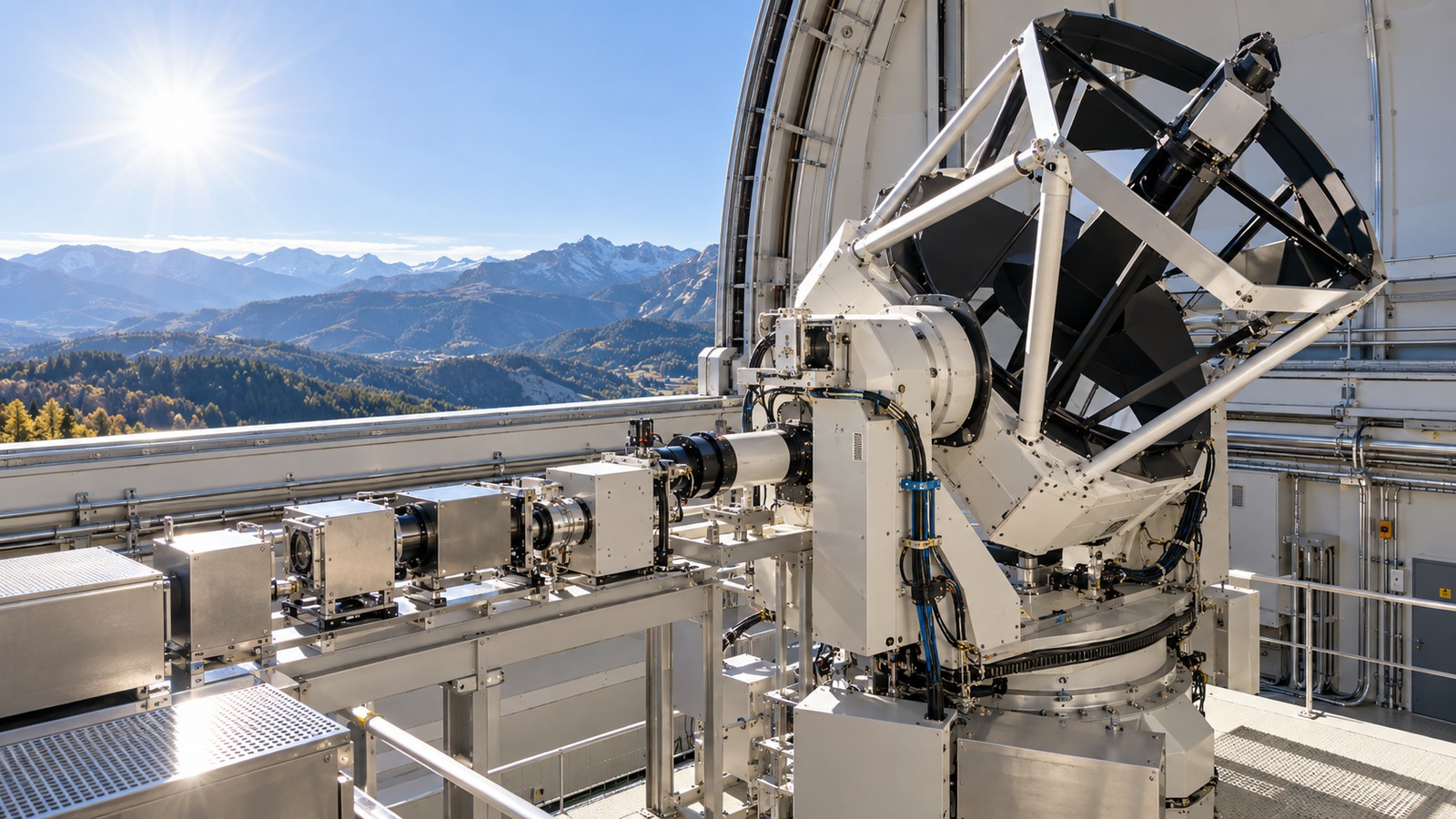
Concentrating sunlight creates a substantial engineering problem in large professional telescopes. Optical surfaces and structures must handle absorbed energy without developing distortions that ruin image quality. Instruments can use heat stops and cooling systems to reject unwanted energy and stabilize critical components. Those systems are part of a deliberately engineered beam path. They should not be imitated through improvised modifications to a consumer telescope. A professional observatory’s ability to manage a large solar beam depends on specialized design, operation, and monitoring.
Heat also affects the air around the instrument. Warm surfaces can create local turbulence that blurs the image before the light reaches a detector. Observatory design therefore considers airflow, thermal behavior, and the observing environment as well as mirror quality. A beautifully polished optic cannot deliver its theoretical resolution when surrounding air is continuously distorting the beam. The Inouye Solar Telescope overview introduces these interacting demands alongside its large collecting mirror and instrument suite. Solar observing is an exercise in controlling the whole path of the photons.
A Clear Sky Can Still Blur Fine Solar Detail
Ground-based telescopes look through Earth’s atmosphere, where changing air temperature and motion alter the optical path. Astronomers call the resulting image distortion seeing. In daytime, solar heating makes these effects particularly relevant. The disk may look sharp for a moment and then soften or shimmer even though there is no cloud in view. Larger aperture offers greater potential resolution, but that potential can be limited by the atmosphere. This is why an instrument’s mirror diameter alone cannot predict the detail in every observation.
Professional adaptive-optics systems measure distortions and adjust a deformable mirror to reduce them. The correction must operate rapidly enough to follow changing atmospheric conditions. Its effectiveness depends on the observing arrangement and the region over which correction is useful. Adaptive optics does not remove every possible source of blur, and it is not the same as sharpening a photograph afterward. It changes the incoming optical wavefront before the final measurement. That distinction matters when interpreting extremely fine detail in research images.
Repeated exposures and appropriate image analysis can help distinguish persistent solar features from momentary atmospheric distortion. However, processing cannot guarantee that any attractive small pattern is physically real. Researchers consider resolution, calibration, and repeatability when making claims about structure. A displayed image should therefore be evaluated as the outcome of an observing system with known limits. The finest pictures are valuable because those limits are investigated, not because a photograph is automatically a transparent window into every microscopic feature on the Sun.
Spectra and Polarization Add Information beyond Appearance
A solar telescope can feed instruments that spread light into a spectrum or measure its polarization. Spectral lines contain information about physical conditions and motions; polarization can help constrain magnetic fields when interpreted with suitable models. These techniques turn the telescope into more than a camera with a large lens. A technical description of Inouye’s Visible Spectro-Polarimeter shows how a dedicated instrument collects this information. The resulting scientific products may be maps of inferred properties, not ordinary color photographs, and their meaning depends on the measurement and analysis method.
Space Instruments Open Atmospheric Windows
Earth’s atmosphere blocks much of the extreme-ultraviolet and X-ray light that reveals hot solar plasma. A telescope above the atmosphere can observe those wavelengths and avoid ground-based seeing. That access comes with other constraints, including launch requirements, thermal control, power, detector aging, and limited opportunities for repair. A space observatory is therefore not simply a ground telescope moved upward. Its design responds to a different environment and a particular scientific mission. Wavelength access is often as important as angular resolution when explaining why a mission exists.
The Solar Dynamics Observatory combines instruments that investigate complementary aspects of the Sun. Its Atmospheric Imaging Assembly records multiple wavelength channels, while the Helioseismic and Magnetic Imager supplies different information about photospheric motions and magnetic properties. The official SDO instrument descriptions explain those roles. A bright ultraviolet loop image and a magnetic-field map can come from the same spacecraft while representing different measurements. Combining them helps researchers connect visible atmospheric activity with the magnetic and dynamic conditions underlying it.
Scientific Color Needs Its Wavelength Explained
Many famous solar images use false color because the instrument measures light outside ordinary human vision or because a palette helps display intensity. An orange ultraviolet image is not a promise that the corona would appear orange through an eyepiece. Likewise, a magnetic map may encode field direction or strength rather than visual brightness. The color is a communication choice tied to a specific quantity. Reading the wavelength and display convention lets a viewer appreciate the structure without confusing a scientific visualization with an unaided-eye appearance.
Resolution, field of view, and cadence are also distinct. A close high-resolution image can reveal fine structure while covering only a small region. A full-disk survey can track broad changes without resolving the same tiny features. Rapid cadence captures evolution, while a slower measurement may provide more detailed spectral information. Research programs balance these properties against the question being asked. There is no single best solar image for every purpose, just as a city map and a detailed photograph of one intersection serve different needs.
For an eruption, researchers may need a wide movie to follow expanding structures and additional close measurements to study the source region. For a quiet photospheric feature, fine spatial detail and magnetic diagnostics may matter more. Comparing instruments becomes meaningful when these goals are stated. Otherwise, a dramatic color picture can be mistaken for better science simply because it is visually impressive. The relevant comparison asks what the instrument measured, over which region, how often, and with what uncertainty. That approach turns a collection of pictures into an observing strategy.
A Beginner’s Goal Should Match the Instrument’s View
Someone interested in tracking sunspot groups does not need to expect the same scene shown by an extreme-ultraviolet spacecraft. A correctly filtered white-light system addresses that goal, while a dedicated solar H-alpha instrument supports different atmospheric observations. Before using equipment, consult its instructions and reputable solar-safety guidance rather than infer safety from a previous successful session. Inspect filters as directed, ensure secure mounting, and prevent access to an unfiltered finder or other unintended optical path. If the system’s suitability is uncertain, use an established observatory demonstration or public scientific imagery instead.
Personal observing also benefits from realistic expectations about atmospheric conditions and image scale. A feature’s appearance can vary with seeing, aperture, passband, and location on the disk. Comparing an observation with a research image requires accounting for those differences. The Sun is rich enough that a modest, safely obtained view can still reveal change over time. Solar telescopes make that study possible by controlling hazardous light and selecting useful information. Their greatest achievement is not simply enlarging the star, but turning its overwhelming brightness into measurements that expose a dynamic physical world.