A Sweeping Solar Disturbance with an Ocean-Inspired Name
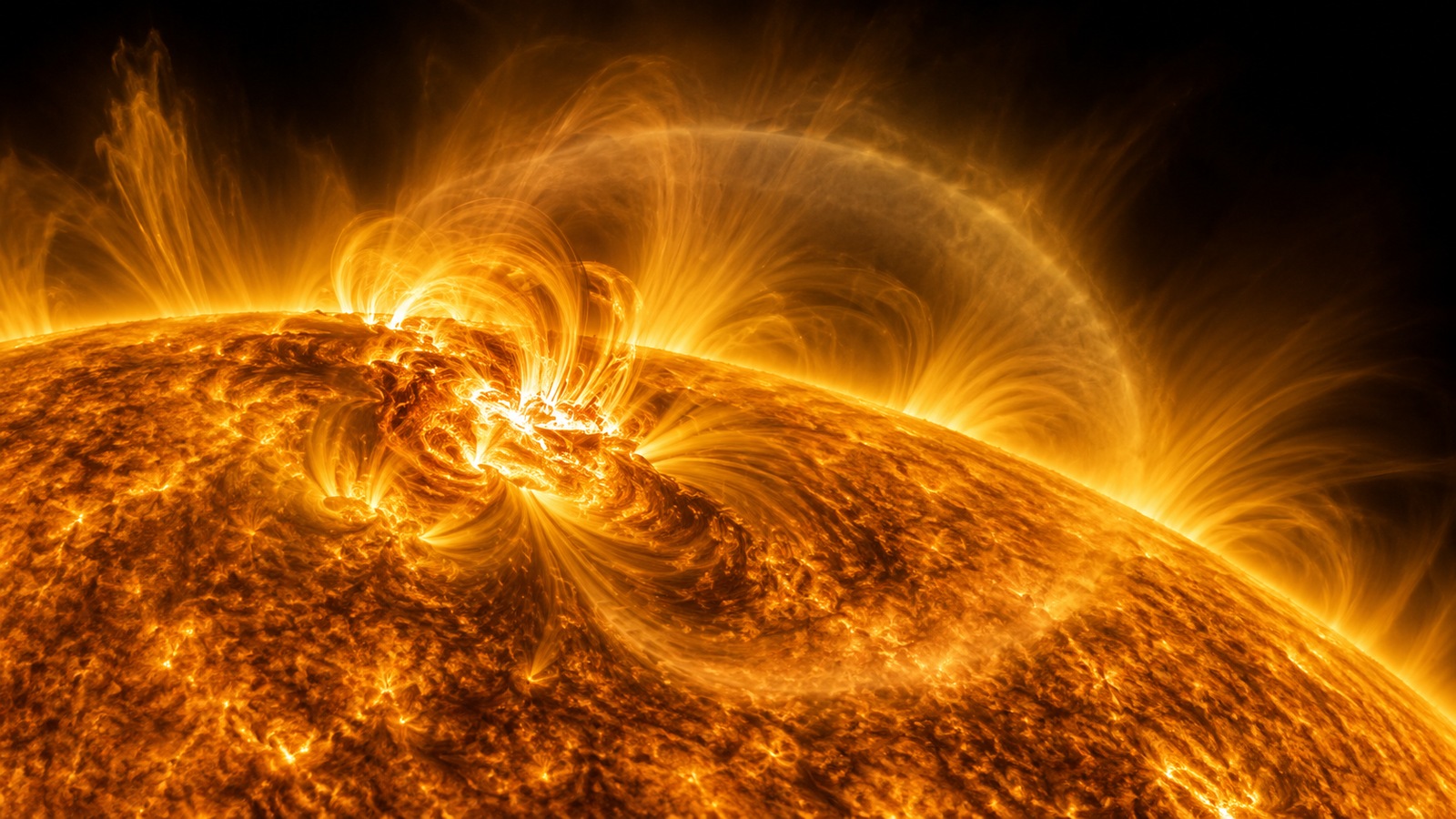
A bright front expands away from an eruption, crossing a large part of the Sun in a sequence of satellite images. It looks enough like a spreading wave to earn the nickname solar tsunami. The resemblance is useful, but the name can create the wrong picture if taken literally. There is no sea pouring across a solid solar shore. The disturbance travels through a hot, magnetized atmosphere, especially the corona above the visible surface. Its motion can reveal how that atmosphere transmits energy and responds to an eruption. Understanding the phenomenon means separating a propagating wave from the changing structures that accompany it, and separating events on the Sun from material that may later travel toward Earth. The real physics is more interesting than the frightening nickname alone.
The Visible Surface Is Not the Whole Setting
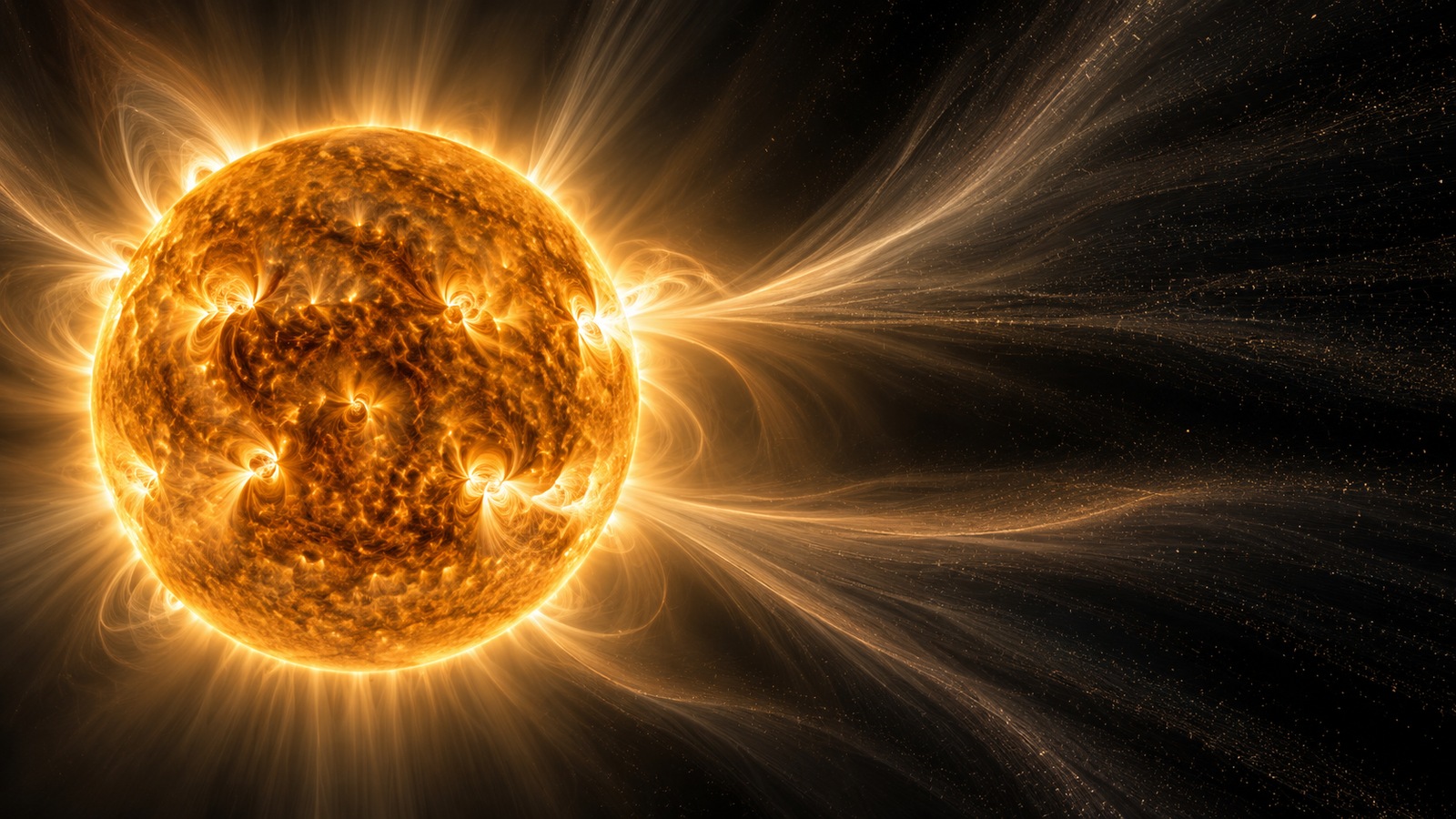
The Sun’s apparent surface is the photosphere, the layer from which much of its visible light escapes. Above it lie additional atmospheric regions, including the chromosphere and the extended corona. These regions differ in temperature, density, and emission. A solar tsunami shown in an extreme-ultraviolet image is usually associated with coronal structures, not a wave of photospheric liquid. The title’s phrase across the surface describes its apparent sweep across the solar disk. Physically, the disturbance occupies a three-dimensional atmosphere above that disk.
The corona is plasma: material containing electrically charged particles whose collective motion interacts with magnetic fields. Those fields are not a decorative extra drawn over an otherwise ordinary gas. They influence what kinds of waves can propagate, their speeds, and how neighboring structures respond. The environment can therefore transmit disturbances through mechanisms that differ from waves on water. Although a broad front can look smooth in a low-resolution movie, it moves through a complex atmosphere with changing density and field geometry. That complexity shapes the observed event.
Images from different wavelengths emphasize different temperatures and structures, so there is no single universal appearance for the wave. An expanding front may be bright in one channel, subtle in another, and surrounded by other eruption-related changes. Interpreting the movie requires knowing what the instrument measures. A dramatic false-color palette displays scientific information rather than the color an unaided observer would see. The apparent front must therefore be interpreted using the channel and timing of the observation.
An Eruption Can Launch a Large-Scale Disturbance
Many large coronal waves accompany solar eruptions that include rapidly expanding magnetic structures and coronal mass ejections. An expanding eruption can push on its surroundings and launch a disturbance through the ambient corona. The eruption and the wave are related, but they are not identical. Material may move outward with the eruption while a wave propagates beyond it through neighboring plasma. A useful comparison is the difference between a moving object and the disturbance it creates around itself. The comparison explains separation, though the actual solar mechanism involves magnetic and plasma forces rather than an ordinary fluid alone.
A Moving Bright Front Is Evidence to Interpret
A series of images can show a front advancing away from an active region. Researchers measure its changing position, brightness, and shape to estimate motion and investigate the cause. An apparent expanding ring in a projected image is not sufficient by itself to establish every aspect of the physics. The visible pattern could contain changes associated with expanding magnetic structures as well as a freely propagating wave. A robust interpretation uses additional behavior, such as how the front interacts with obstacles or excites structures away from the eruption.
Scientists debated whether broad extreme-ultraviolet fronts always represented genuine waves. NASA’s STEREO account of a February 2009 event describes the disturbance; NASA’s 2009 mission chronology records a height about 100,000 kilometers and a speed roughly 250 kilometers per second. The separated spacecraft supplied views of its three-dimensional character, helping distinguish a coronal wave from a pattern projected onto a flat-looking disk. Those attributed dimensions make the scale tangible: the disturbance rose through a deep atmospheric region while spreading rapidly around the Sun. This case strengthened the wave interpretation without implying that every eruption movie shows the same height, speed, or combination of processes.
Magnetized Plasma Has Its Own Wave Physics
One important interpretation involves a fast-mode magnetohydrodynamic wave. The long term combines magnetic forces with the fluid-like collective behavior of plasma. Such a wave can compress the local material and magnetic field as it propagates, changing conditions that affect emission. Fast-mode does not mean traveling at the speed of light. It identifies a mode within the plasma’s wave physics, whose characteristic speed depends on the magnetic field, density, and thermal conditions. That dependence helps explain why the front can change speed across different coronal environments.
A sufficiently strong disturbance can become a shock, involving abrupt changes in plasma properties. Not every visible front is equally strong, and a reader should not substitute shock for wave indiscriminately. The observational signature also evolves as the eruption expands and the disturbance weakens or interacts with structures. Researchers examine timing, speed, and emission changes to identify the appropriate description. The wave interpretation connects a visible pattern with an underlying physical process, but the connection must be tested rather than assumed from the most dramatic frame of a movie.
Changes in brightness are likewise more complicated than brighter equals more matter. Extreme-ultraviolet emission depends on temperature, density, and the instrument’s sensitivity to particular emissions. Compression can enhance a signal, while heating can shift plasma into or out of a channel’s strongest response. An analysis therefore considers several wavelength channels and the thermal behavior of the material. This is a good example of why a scientific image is a measurement with a defined response. It is informative precisely because its relationship to physical conditions can be modeled.
Coronal Landscapes Bend and Interrupt the Front
A coronal wave encounters regions with different magnetic and density conditions. It may change direction, slow or speed up, reflect, or transmit differently at a boundary. Coronal holes and active-region structures can shape its apparent path. These interactions are more revealing than a perfectly circular expanding front would be. They show that the disturbance is responding to the medium it crosses. A front that disappears in a particular area might have weakened, changed thermal visibility, or interacted with the magnetic environment; disappearance alone does not identify which possibility occurred.
Distant coronal loops can oscillate after a passing disturbance. Their motion supplies evidence that energy reached a region beyond the immediate eruption. Researchers can use such responses to investigate the properties of the surrounding plasma and magnetic structures, an approach broadly related to coronal seismology. The analogy with terrestrial seismology concerns inferring a medium from its response, not drilling into a solid solar crust. Solar structures are dynamic, magnetized, and observed remotely. The inference depends on models of those structures as well as the measured oscillations.
Moreton Waves Connect with a Different Atmospheric Layer
Some disturbances have counterparts seen in the chromosphere, historically called Moreton waves. Their relationship with coronal waves illustrates how one event can affect more than one layer of the solar atmosphere. A coronal disturbance can influence lower structures under suitable conditions, but not every EUV wave produces a clear chromospheric signature. The geometry and strength of the eruption matter. A research study on coronal and Moreton-wave connections examines why those lower-atmosphere imprints are uncommon and how eruption orientation can affect them.
Satellite Movies Need Timing and Geometry
The interval between images controls how well an observer can follow a rapidly advancing front. If the cadence is too slow, a disturbance may seem to jump between positions, and its relationship to other moving structures becomes difficult to establish. Resolution and exposure also affect which parts are visible. Researchers compare event sequences rather than treating one still frame as the whole phenomenon. NASA’s STEREO gallery of a 2007 wave event provides an example of the expanding pattern that becomes clearer through motion.
Difference images subtract or compare frames to emphasize changes. They can make a faint advancing front much easier to see, but they also display changes that are not new solid objects. Bright and dark patterns may reflect increases and decreases relative to the comparison image. A viewer needs to know whether the movie shows direct intensity, a running difference, or another processed representation. Processing does not make the observations unreal; it changes which aspect of the measured behavior is highlighted. The interpretation should remain attached to that display method.
Projection adds another challenge. A disturbance spreading over a curved atmosphere can appear to have a different speed or shape when viewed from a different direction. Multiple spacecraft perspectives help separate apparent motion across the disk from the actual spatial geometry. A visible arc near the limb may offer height information that a straight-on view lacks. Combining these views strengthens the analysis because a physical model must account for all of them. The event remains three-dimensional even when the website presents it in a rectangular movie window.
The Ocean Analogy Has a Clear Boundary
The nickname captures broad propagation, but the mechanism belongs to a different environment. An ocean tsunami is a gravity-driven disturbance in water; the coronal wave moves through plasma whose magnetic field contributes to its restoring forces. That distinction determines which speeds, reflections, and interactions a model must reproduce. The analogy can help readers recognize a spreading front, while the actual explanation comes from magnetized-plasma physics.
Another misleading extension imagines the same wave leaving the Sun and rushing across space to strike Earth. The observed global front describes a disturbance in the solar atmosphere. An associated mass ejection may travel outward through interplanetary space, and flare radiation reaches Earth rapidly, but those are separate parts of the eruption. Their possible terrestrial impacts need dedicated observations and forecasts. A solar wave movie alone does not establish that an Earth-directed CME exists, predict its arrival time, or determine whether a geomagnetic storm will occur.
Wave Behavior Can Probe an Atmosphere We Cannot Visit Freely
Researchers cannot place sensors throughout the corona in the way weather stations sample a terrestrial landscape. Remote observations of a disturbance offer another route to information. Propagation speeds, reflections, and induced oscillations can constrain physical conditions when interpreted with appropriate models. The result is an indirect measurement rather than a magical readout of the entire magnetic field. Its uncertainty depends on geometry, background structure, and how well the model represents the event. Even with those limits, a passing front provides an unusually useful experiment performed by the Sun itself.
Reading the Next Solar-Tsunami Headline
Begin with the observation’s wavelength and the region it shows. Then look for a sequence demonstrating outward motion, rather than assume that a single bright arc is a wave. An account should explain whether researchers identify a propagating disturbance, expansion of eruption structures, or a mixture of effects. Claims about Earth should introduce the evidence for Earth-directed ejecta or arriving radiation separately. This reading approach gives the image its proper scientific value while keeping the nickname from deciding the interpretation before the data are examined.
The broad sweep across the disk is impressive, but the most revealing details may be subtle. A front bending around a region, a distant loop beginning to oscillate, or a different view revealing height can test the physical explanation. Solar tsunamis are therefore more than spectacular eruption accessories. They illuminate how the corona transmits energy and how observers infer unseen magnetic and plasma conditions from changing light. The nickname draws attention; careful measurements turn that attention into an understanding of the dynamic atmosphere surrounding our star.