A moon whose direction preserves a clue to its past
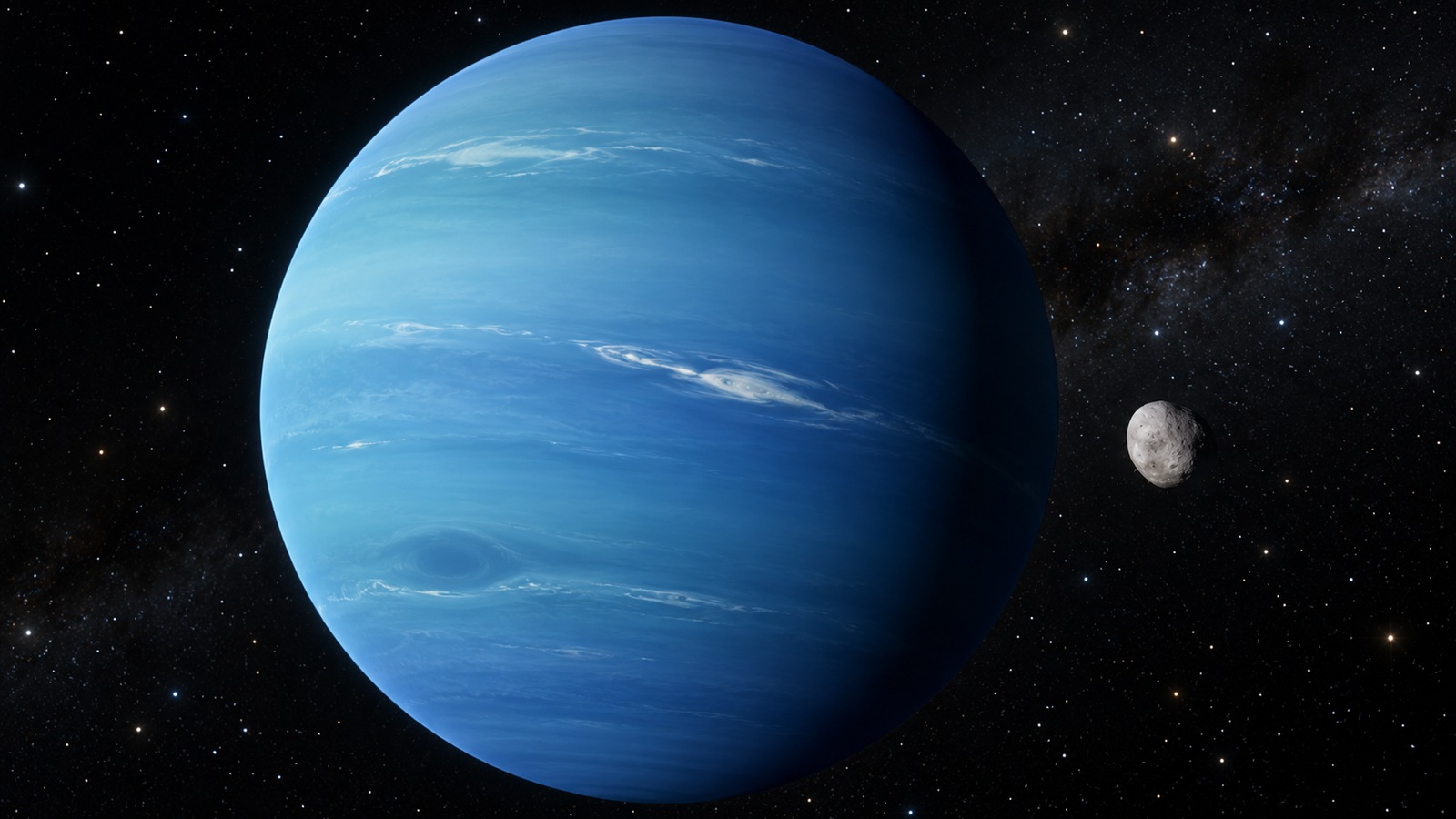
Triton travels around Neptune in the opposite direction to the planet’s rotation. That makes the large icy moon a striking exception among the solar system’s major satellites, which generally follow the prograde pattern expected from material assembling around a young planet. Its unusual direction is not an illusion caused by Earth passing another world. It is a real property of Triton’s orbit, and it helps explain why scientists think the moon was captured after first traveling around the Sun. Capture, however, is only the beginning of the story. An arriving object must lose or redistribute orbital energy to remain bound, and its early orbit must evolve into the much rounder one observed today. Tides, possible encounters with earlier moons, and the evidence on Triton’s surface connect that backward journey with a much larger history.
Backward has a precise planetary reference
Retrograde describes orbital motion opposite to the rotation of the planet being orbited. It does not mean that a moon violates gravity, travels backward in time, or sometimes reverses because of how it looks from Earth. Triton’s inclined orbital plane and direction are measured properties of its motion around Neptune. The direction should be defined relative to the planet’s spin rather than to the arbitrary clockwise orientation of a picture. Turning a diagram upside down changes a visual convention without changing the physical relationship.
Its Modern Orbit Is the Endpoint to Explain
Material rotating around a growing giant planet usually gives its locally assembled moons the same broad orbital direction. Jupiter’s large satellites and the major moons of Saturn and Uranus broadly illustrate that inherited pattern. Triton instead travels against Neptune’s spin, making capture a better starting explanation than quiet growth within a normal circumplanetary disk. The contrast concerns measured motion, not whether the moon looks round or has interesting geology. Small irregular satellites can also be retrograde, but acquiring a body as substantial as Triton would have greater consequences for the host system.
Triton completes an orbit in about 5.88 Earth days at a characteristic center-to-center distance of approximately 354,800 kilometers. JPL’s satellite mean elements give those scales and show a nearly circular path with a retrograde inclination. The present distance is slightly less than the Earth–Moon separation, providing a useful comparison for the orbit’s physical size. Its almost circular shape matters as much as its direction: a newly captured traveler would ordinarily need substantial subsequent evolution to end on this comparatively regular track. The modern orbit is therefore the final condition that an origin explanation must reproduce.
The proposed sequence has three steps. First, Triton approaches as a body that previously traveled around the Sun; an encounter changes its energy enough for it to remain Neptune-bound. Second, the newly acquired orbit can be elongated and disruptive, passing through parts of the earlier satellite system. Third, tides and possible encounters dissipate or redistribute energy until the path becomes much rounder. The measurements favor the broad captured history, while the binary-disruption model supplies one workable explanation of the first step. Later sections describe how the other steps connect the orbit with heating and neighboring moons.
Gravity must do more than temporarily bend a passing path
A passing object can be strongly deflected by Neptune’s gravity and still depart again. For a lasting capture, its energy relative to the planet must be reduced or redistributed in an appropriate way. Merely entering a region where Neptune’s gravity is strong does not automatically create a permanent moon. This is the central mechanical requirement behind capture models. They must account for how an initially solar-orbiting body becomes bound while respecting energy and angular momentum for the full interacting system.
Possible mechanisms involve additional participants or dissipative effects. An interaction with another body can carry away energy; tides can convert mechanical energy into heat; collisions or gas can alter motion under suitable circumstances. Different proposed histories require different environmental conditions. The task is not to choose whichever sounds most dramatic, but to test whether it can occur plausibly and lead to a system resembling today’s Neptune. The present orbit places requirements on both the initial acquisition and the later evolution.
A disrupted binary offers an effective capture route
A prominent model proposes that Triton approached Neptune as one member of a binary: two bodies already bound to each other while orbiting the Sun. During a sufficiently close encounter, Neptune could disrupt the pair. One member could depart with a changed energy while the other became bound to Neptune. The exchange allows capture without requiring that a solitary passing Triton somehow lose the necessary energy to empty space. It is a three-body process whose different outcomes can be investigated through numerical calculations.
Agnor and Hamilton’s 2006 study developed this binary-disruption explanation and compared it with earlier capture difficulties. Its appeal is a physically workable route, not a photograph of Triton’s lost companion. A primordial population containing suitable binaries would make such encounters possible. Researchers must still examine encounter probabilities, initial paths, component masses, and the subsequent orbit. In the encounter, the departing companion carries away part of the energy exchange that allows the captured member to remain bound.
The former companion remains unidentified. The binary mechanism does not require us to name a present dwarf planet as that partner; it explains how the energy exchange could occur. Nor would the first captured path have to match the modern circle immediately. Acquisition and circularization are separate stages, with tides and the surrounding satellite system supplying the later evolution. This distinction keeps the capture mechanism connected to the orbit it ultimately needs to explain.
Its present round orbit does not disprove a violent arrival
Tides arise because gravitational influence varies across an extended body. Repeated deformation and internal dissipation can convert orbital or rotational energy into heat, changing the system over time. For a highly eccentric captured moon, conditions differ strongly between close approach and the more distant part of the orbit. A long period of such evolution can reduce eccentricity. The present nearly circular path can therefore represent a processed outcome rather than the initial shape of the captured orbit.
Tidal heating connects orbital history with the interior
Energy lost from mechanical motion must go somewhere, and internal dissipation provides a heat source. A moon undergoing vigorous early tidal evolution could have experienced much warmer internal conditions than its current frigid exterior suggests. This connection makes capture relevant to geology rather than merely to the direction of a dot around a planet. Changes in internal temperature can influence material behavior, while material behavior affects the strength of dissipation. The orbital and thermal histories must consequently be considered together.
Quantitative heating histories depend on properties such as rigidity, viscosity, structure, and how the tidal response changes with temperature. Those quantities are not all directly measured for Triton. Research models can investigate plausible outcomes, but their results retain dependence on the chosen material assumptions. A predicted ancient melting episode is not identical to a confirmed present ocean. The important robust connection is that tidal evolution provides a substantial possible source of past energy, while its precise distribution and consequences need stronger constraints.
A captured giant can reshape the surrounding moon system
An initially extended, eccentric Triton orbit could pass through regions occupied by earlier satellites. Gravitational encounters would alter their trajectories, and some collisions or losses could follow. This creates a system-level constraint: a successful capture history must be compatible with the smaller moons that remain, not merely with Triton’s orbit alone. A calculation that reproduces one world while destroying every companion expected to survive may require a different timing, faster evolution, or another mechanism.
An Icarus reassessment of Triton’s origin investigated binary capture followed by tides and highlighted difficulties concerning the irregular satellites. Such tensions are valuable because they expose what a simple story leaves out. A model can explain the retrograde direction yet struggle with the precise present distance or the preservation of other bodies. Scientists then test variations rather than treating the original idea as complete. Broad support for capture can coexist with unresolved details of the post-capture system.
Rufu and Canup’s work on a primordial Neptunian satellite system examined interactions between a newly captured Triton and earlier moons. Those interactions can alter the speed and route of orbital evolution. The study shows why a realistic setting with additional satellites differs from an isolated two-body tide calculation. It does not identify the entire original moon inventory observationally. Present satellites and their properties serve as constraints on competing reconstructions rather than a perfectly preserved museum of the initial system.
This history can also complicate assumptions about the smaller moons’ origins. Some present material might have survived, been redistributed, or assembled after destructive encounters. Those alternatives require physical tests through dynamics, composition, and observation. The phrase Neptune captured Triton should not be taken to mean that Neptune’s neighborhood remained unchanged afterward. Capture of such a large body is potentially an event that reorganizes the system, leaving both surviving orbits and altered material as evidence.
Geology supplies context without filming the capture
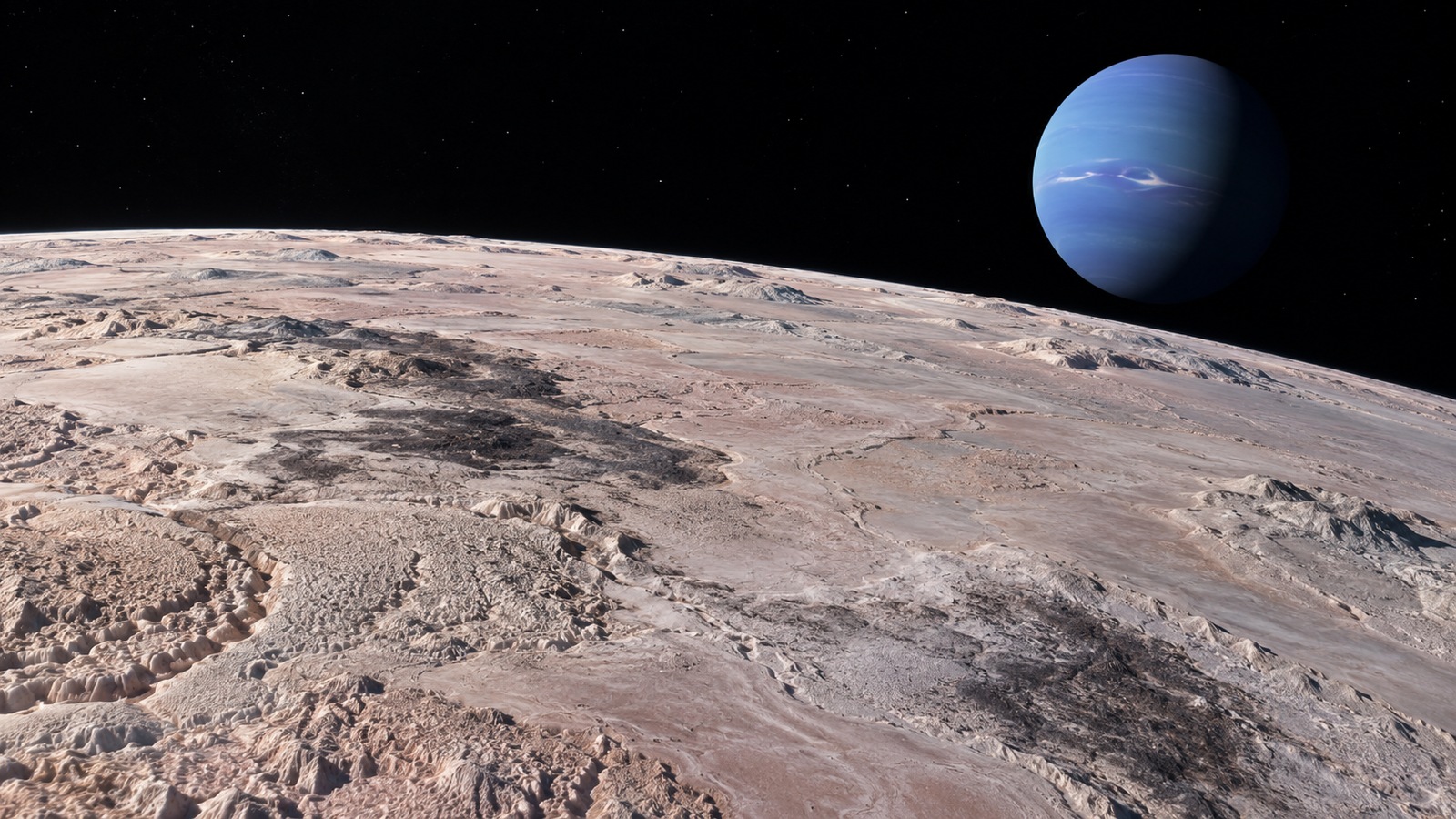
Voyager 2 observed Triton during its 1989 encounter, revealing an icy world with varied terrain and active plumes. Nitrogen frost, a thin atmosphere, and distinctive surface structures make it more than a passive orbiting rock. These observations can constrain geological activity and volatile behavior, but they do not by themselves date the acquisition by Neptune. A current plume is not automatically residual heat from a particular ancient encounter. Present seasonal effects and other possible energy sources must also be considered.
Surface mapping can nevertheless test consequences of competing thermal histories. The distribution of terrain, evidence for resurfacing, and relationships between deposits provide clues about geological sequences. A future mission could compare those observations with better measurements of gravity, magnetism, and atmospheric behavior. The result would be a more constrained account of the world that acquired the unusual orbit, rather than an attempt to infer every interior event from direction alone. Orbital evidence and geological evidence become most useful when their distinct limitations remain visible.
The backward direction gives tides a distant future consequence
Triton’s retrograde relationship with Neptune affects the long-term tidal transfer of orbital energy and angular momentum. Models predict gradual inward evolution rather than the familiar outward migration often illustrated by Earth’s Moon. If that trend continues sufficiently far, the moon could eventually reach a region where Neptune’s differential gravity disrupts it. The timescale is enormously longer than ordinary observing or human historical intervals. It is a conditional future calculation, not a warning of a near-term collision.
The published tidal-evolution analysis archived by NASA gives different long-term timescales under different assumptions about Triton’s rotational state and response. That dependence is a reason to avoid presenting one number as an exact countdown. The qualitative distinction between inward and outward evolution can be explained clearly while leaving the distant endpoint qualified. A planet-moon system is not required to remain unchanged for the rest of the solar system’s history.
Triton’s backward orbit thus answers a larger question than why one moon is unusual. It indicates an acquisition history different from ordinary local moon formation, demands an energy-exchange mechanism, and connects subsequent orbital change to heating and disruption of companions. The binary-capture route is a leading physical explanation, while timing and later evolution continue to be tested. A modern orbit preserves evidence of earlier events, even after tides have transformed the shape of the path that first brought the world to Neptune.