
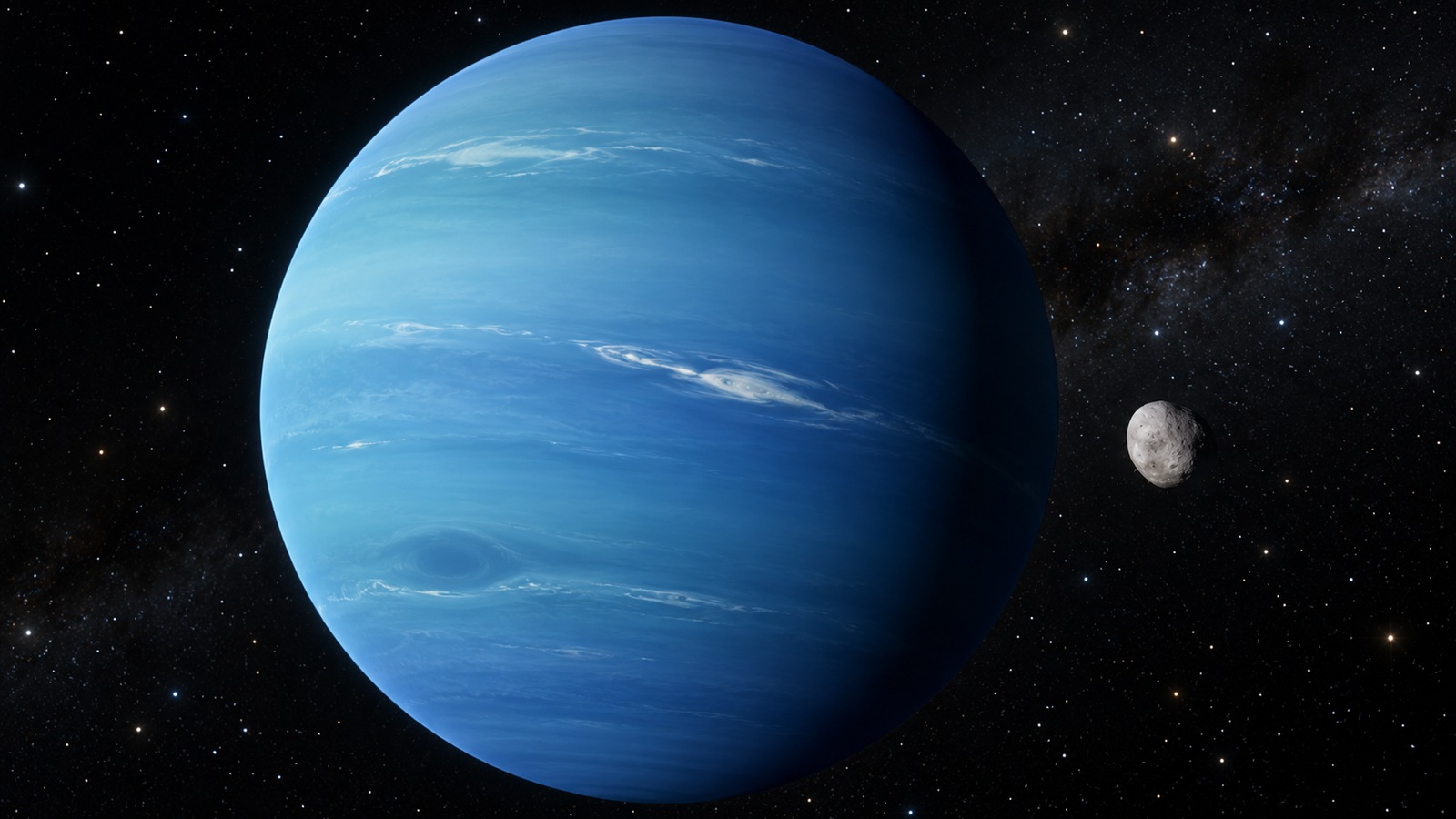
A planetary name that does not describe a frozen shell
Neptune looks like a blue planet wrapped in gas, yet astronomers usually classify it as an ice giant rather than grouping it with the gas giants Jupiter and Saturn. The apparent contradiction comes from reading ice as an everyday description of its present temperature and surface. In planetary science, the term also identifies a family of compounds and a distinction in the inferred makeup of giant planets. Neptune can have a hydrogen-rich atmosphere while containing a much larger fraction of heavier material than Jupiter. Its depths can be extremely hot while those materials retain their historical ice-category name. The classification is useful, but it is not a complete chemical inventory or proof of a neatly layered interior. Understanding its meaning requires keeping atmospheric appearance, bulk composition, material state, and uncertainty separate.
The Four Giants Do Not Share One Bulk Recipe
Neptune’s upper atmosphere contains abundant hydrogen and helium, but that visible gas does not describe its entire mass. The deeper planet includes a much larger share of heavier material than the hydrogen-helium-dominated Jupiter and Saturn. This difference is the basis of the conventional gas-giant and ice-giant families. It concerns the whole planet, rather than assigning a permanent physical state to every layer or using blue cloud color as a composition measurement.
| Planetary family | Members in our Solar System | Bulk distinction |
|---|---|---|
| Gas giants | Jupiter and Saturn | Hydrogen and helium dominate the mass, with heavier material also present |
| Ice giants | Uranus and Neptune | A larger fraction of heavier constituents; the deep rock-versus-volatile balance remains uncertain |
The two kinds of composition evidence answer different questions. Atmospheric spectra identify gases at accessible levels, while gravity, radius and material physics constrain possible arrangements throughout the interior. A hydrogen-rich spectrum can therefore coexist with a heavy-element-rich bulk model. Methane contributes to Neptune’s spectral appearance without proving that the whole planet has a methane-rich inventory. Combining the measurements explains how the familiar upper atmosphere fits inside a chemically and physically different deeper world.
Neptune’s overall scale supplies a useful check on the word ice. It has about seventeen Earth masses but a radius roughly 3.9 times Earth’s, using JPL’s measured masses and mean radii. The corresponding spherical volume is about fifty-nine Earth volumes, giving a bulk density only around three tenths of Earth’s. This average combines the less dense outer material with the much more compressed interior. It describes neither a block of ordinary frozen water nor a dilute gas throughout. The planet’s large volume relative to its mass is one reason the amounts and arrangement of different constituents matter when explaining its structure.
Planetary ices are a chemical grouping
Water, ammonia, and methane are commonly discussed as ices in models of planetary formation and composition. The grouping reflects their volatile chemistry and behavior in cold formation environments, distinguishing them from hydrogen-helium gas and from refractory rock. It does not demand that every molecule remain frozen inside the present planet. Water can be grouped with planetary ices while occupying a hot dense state at high pressure. The context of the term matters more than the household image of a transparent cube pulled from a freezer.
Jupiter and Saturn retain much more hydrogen and helium
Jupiter and Saturn are usually called gas giants because hydrogen and helium account for a dominant part of their bulk mass. Neptune and Uranus are smaller, with much larger inferred fractions of heavier constituents. The important contrast is therefore compositional and structural, rather than blue versus yellow or cold versus warm. NASA’s explanation accompanying Webb’s Neptune observations highlights the relative enrichment in heavier elements. A related-looking atmosphere does not erase this substantial difference in the planets beneath it.
Mass and radius help constrain that contrast because they determine an average density, but density alone cannot give a unique list of materials. Compression changes density, and different mixtures can produce similar totals under suitable conditions. A larger planet also compresses its interior differently from a smaller one. Scientists combine size and mass with gravity, rotation, thermal emission, atmospheric evidence, and material models. The comparison is a multi-measurement reconstruction, not a classification made by simply weighing a bucket of planetary gas.
Pressure and heat change familiar substances
Deep inside a giant planet, temperatures and pressures are far outside everyday laboratory conditions. Materials can become dense fluids, dissociate into different chemical forms, or occupy phases unlike ordinary liquid water or crystalline household ice. Calling a compound water-bearing does not establish that it forms a recognizable ocean with a sky above it. Nor does saying icy imply that a frozen crust covers Neptune. The words need to be tied to the physical conditions where they are being applied.
Laboratory experiments help test how relevant mixtures behave when strongly compressed and heated. They can supply material properties that planetary models need, although an experiment does not reproduce an entire planet’s history or every mixture at once. The relationship is complementary: observations constrain the planet, experiments constrain possible matter, and models connect them. A successful experiment can eliminate an assumption or favor a process without proving that all of Neptune occupies precisely the tested state.
The possibility of diamond formation illustrates that distinction. Carbon-bearing material can undergo changes under extreme conditions, and experiments have demonstrated diamond formation in relevant mixtures. SLAC’s account of the measurements describes a test of deep-material physics. It does not make sparkling diamonds the defining ingredient of the ice-giant category. The scientific value lies in understanding chemical separation and its possible consequences for interior structure and energy transport.
A planet’s thermal history is part of this problem. Formation leaves heat, and subsequent cooling depends on how efficiently energy moves through the interior and escapes. Composition can influence that transport, while transport can affect the temperature profile used to infer composition. This interdependence explains why a cartoon with isolated colored layers can be convenient but incomplete. A real interior is governed by interacting thermal, chemical, and mechanical processes rather than a set of unrelated materials stacked like a dessert.
The familiar layered diagram is not a measured cross-section
Illustrations often show a hydrogen-helium envelope, a broad region of water-ammonia-methane material, and a rocky core. This arrangement communicates the traditional distinction from Jupiter and Saturn, but the sharpness of the boundaries can overstate the evidence. Materials may mix or vary gradually with depth. Different assumed arrangements can fit some of the same available observations. A label placed on a diagram should consequently be read as a model description, not a sample returned from that location.
The 2025 review by planetary scientist Ravit Helled emphasizes uncertainty in the rock-to-water ratios and in how the constituent materials are distributed. It even cautions against treating water dominance as established. This does not make the ice-giant label unusable. It makes the label a conventional family name with limitations, rather than a guarantee that a particular volatile-rich reconstruction has been uniquely verified. Readers should retain that qualification when comparing supposedly definitive cutaways.
Observations constrain models without sampling the center
Gravity measurements reveal information about how mass is distributed, while atmospheric spectra constrain some accessible constituents. Magnetic measurements add clues about conducting regions and motions within the planet, and heat emission tests its energy output. Each observation narrows the range of models in a different way. Neptune’s existing data remain limited compared with those for giants visited by long-duration orbiters. Voyager 2 supplied a crucial flyby, but a short encounter cannot deliver every measurement needed for a unique interior reconstruction.
Uranus is a comparison, not a duplicate
Uranus shares Neptune’s conventional ice-giant category and occupies a broadly similar range of mass and size. That resemblance makes comparison useful, but their rotation geometry, observed atmospheric behavior, and energy output differ. A category is not a promise that all its members have identical layer boundaries or evolutionary histories. Two planets can begin with related ingredients and follow different thermal or dynamical paths. Their differences are part of the evidence for understanding the category itself.
Magnetic fields reinforce the need for a physical account beyond a frozen globe. Conducting material and its motion can generate planetary fields, while the measured field geometry constrains possible dynamo arrangements. Uranus and Neptune have unusual fields that are not simple copies of Earth’s approximate large-scale dipole. An interior model must be compatible with those properties as well as with mass and radius. Composition alone is only one part of explaining why a planet behaves as it does.
Formation history introduces further alternatives. The growing planets accumulated material from their surroundings while the solar system was young, but the timing, location, and proportions remain subjects of investigation. Migration and energetic encounters can complicate a simple story of planets quietly growing exactly where they are today. The term ice giant should not be used as shorthand for one settled formation scenario. A family resemblance in current bulk properties does not uniquely identify the entire route by which those properties developed.
A Neptune-sized exoplanet need not copy Neptune
Planets around other stars are often described by size or mass categories that refer to familiar solar-system examples. A Neptune-like radius can be useful for comparison without establishing the same atmospheric composition, temperature, or interior material ratio. Irradiation, age, and evolutionary history vary greatly among systems. NASA’s overview of Neptune-like exoplanets places the category in that broader context. A convenient name is the start of characterization, not a substitute for measurements of the individual planet.
Consider two hypothetical planets with the same radius of four Earth radii, one weighing ten Earth masses and the other twenty. Their volumes are equal, so the second has twice the first’s average density. That difference immediately rules out treating radius alone as a complete account of the interior. Hydrogen-helium envelope thickness, rock content and the distribution of volatile-derived material can all influence the result. Researchers compare the measured mass and radius with physical structure models to narrow those possibilities. A Neptune-size measurement is consequently a useful starting scale, while density supplies another independent clue.
The label becomes stronger when its limits are stated
Calling Neptune an ice giant captures a useful contrast with the hydrogen-helium-dominated Jupiter and Saturn. It reminds us that giant planets are not one uniform class and that heavier material plays a larger role in the smaller outer pair. The term also connects present planets with the compounds considered in formation models. It should be understood at this level rather than mistaken for an immediate visual description of the clouds or an accessible frozen surface.
Future observations and missions can refine the inventory and test whether common interior pictures are too simple. Better gravity and magnetic measurements, more detailed atmospheric abundances, and improved material experiments would constrain different pieces of the same puzzle. Researchers outlining ice-giant orbital science explain why sustained exploration would improve on brief flybys. The goal is not merely a sharper blue portrait, but a better connection between the visible atmosphere and the hidden mass beneath it.
The most accurate answer therefore has two layers. Neptune is conventionally an ice giant because its inferred bulk structure and enrichment differ substantially from the gas giants. But ice is a planetary-chemistry term here, and the exact deep balance of rock and volatile-derived material is still uncertain. Its upper atmosphere is gaseous, its depths are hot and compressed, and its interior is not a fully measured stack of frozen shells. Keeping those statements together makes the name informative without asking it to prove too much.


