The jewel effect is sunlight arranged by a planetary system
Saturn earns its jewel nickname through a combination that is unusually striking: a pale golden globe encircled by broad, bright rings, with light and shadow making the arrangement look almost sculptural. The comparison is poetic rather than an official scientific rank. Saturn is not a polished gemstone, and the rings do not glow by themselves in an ordinary visible-light view. Sunlight scatters from icy material while the changing positions of Earth, the Sun, and Saturn determine how much of the system we see. That physical explanation adds to the beauty rather than reducing it. The rings can open wide, narrow toward an edge, brighten near opposition, or cast dramatic shadows. Behind the familiar silhouette lies a moving atmosphere, a diverse moon population, and a record of exploration that turns an attractive planet into a remarkable scientific destination.
A distinctive silhouette makes Saturn instantly recognizable
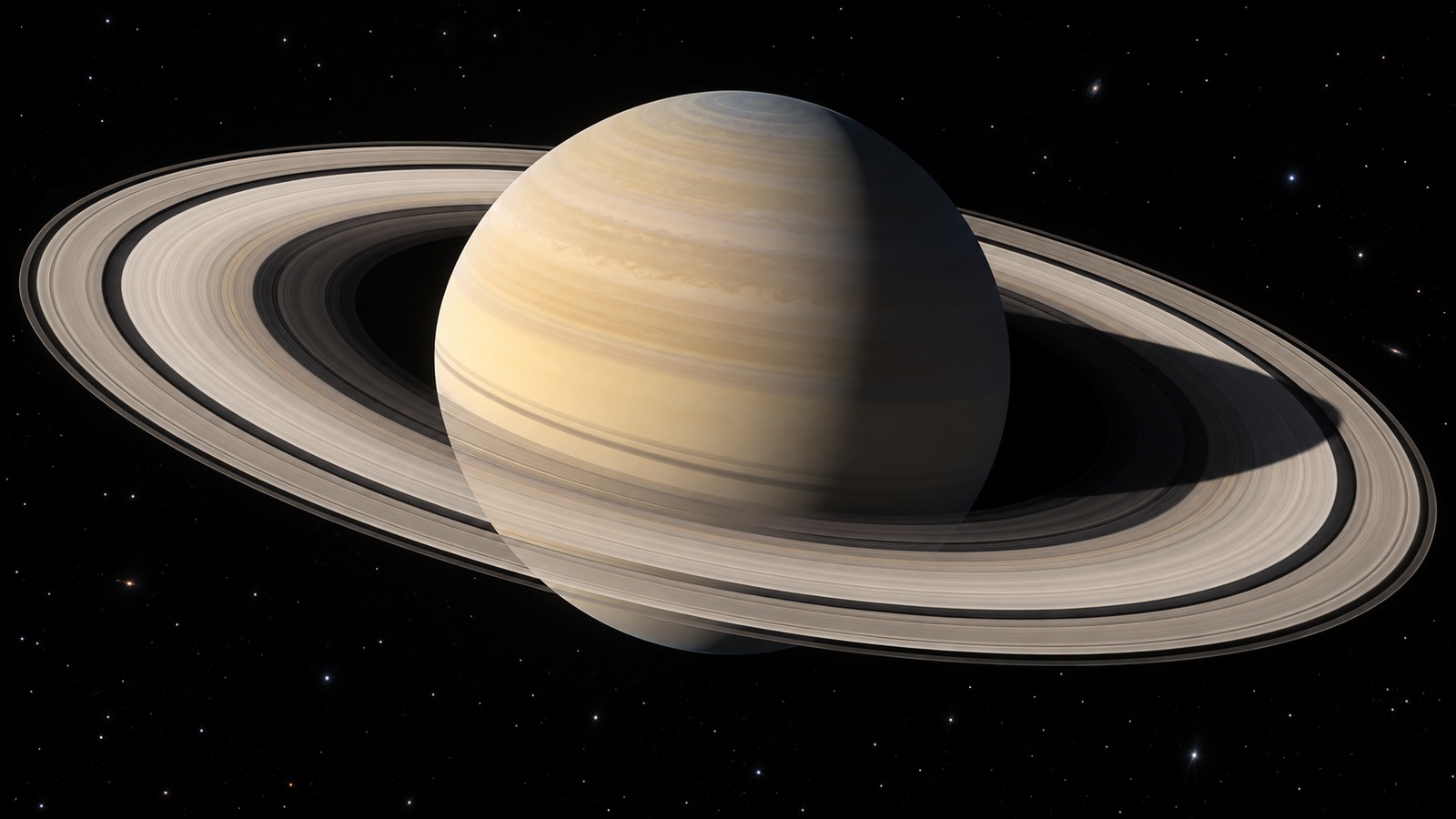
Most planets look approximately round when resolved in ordinary images, but Saturn’s main rings extend far beyond the globe and create a recognizable outline. Their symmetry contrasts with the curved atmosphere and gives the scene a visible sense of organization. Even a modest telescopic view can reveal the separated ring shape when geometry and conditions are favorable. The visual surprise matters: what first appears as an unfamiliar object in the eyepiece is recognizably a real planet rather than a simplified symbol on a classroom wall.
The nickname does not imply that Saturn has the only rings. Jupiter, Uranus, and Neptune also possess ring systems, but their ordinary visible-light appearance is far less conspicuous. Saturn’s broad bright main rings dominate its familiar portrait. NASA’s Cassini ring overview places that exceptional prominence within the wider family of ringed planets. The useful distinction is conspicuousness and structure, not the claim that rings themselves are unique to Saturn.
Ice returns sunlight without making a solid ornament
The main rings contain enormous numbers of separately orbiting particles, with water ice important to their composition and reflectivity. Together those particles return enough sunlight to appear as continuous luminous bands at ordinary resolution. The effect resembles a single object only because individual pieces are too small and numerous to resolve from a distance. A bright smooth-looking ring is therefore a collective optical appearance. Its apparent elegance is produced by a particulate system, not by a rigid polished hoop placed around the planet.
Particle surfaces, contamination, size, and mutual shadowing affect the reflected light. Brightness is not simply a direct measure of how much material occupies a region, because material can scatter or block light differently. A dense-looking band and a faint-looking one can also behave differently when illumination changes. This is why scientists examine spectra and viewing geometry alongside photographs. The visual brightness that inspires the jewel comparison contains information, but it must be interpreted through the physical behavior of the particles.
A visible-light portrait puts the pale globe and reflective rings together in one recognizable design. An infrared view can emphasize different cloud or ring properties because it records a different part of the spectrum. Compare where the ring crosses the globe: the overlapping band, the dark shadow and the curved outer edge give three separate depth cues. Those relationships survive even when an image uses assigned colors. They help explain why a simple drawing with one flat oval often feels less convincing than a spacecraft photograph of the same system.
Changing tilt changes the apparent design
Saturn’s ring plane is approximately aligned with its equatorial plane, and the planet’s tilted axis maintains its broad orientation as Saturn proceeds around the Sun. From Earth, that creates a long cycle of changing apparent ring opening. Sometimes a wide ellipse surrounds the globe; at other times the rings appear as a thin line. The particles have not vanished whenever the outline narrows. The view has changed because a flat system presents much less projected area when seen nearly from its edge.
That changing silhouette also provides an unusually approachable astronomical comparison. A pair of dated sketches can show an opening difference even if neither resolves fine ring structure. Keeping the magnification and drawing conventions similar makes the comparison easier to read. The visible change does not require the observer to measure particle motion or understand every orbital influence. It simply demonstrates that a famous planetary form is a projection seen from a moving location, not a permanent flat emblem with one fixed outline.
The observer and the sunlight have different angles
Seeing the rings edge-on from Earth and illuminating them edge-on from the Sun are related seasonal geometries but not identical events. Earth moves around the Sun, so the direction from which we view Saturn differs somewhat from the solar direction. At Saturnian equinox, sunlight approaches the ring plane closely, making the illumination unusual. A ring-plane crossing describes our viewing line instead. Keeping those definitions separate explains why the ring appearance can change in ways that a single tilt number does not fully predict.
Saturn’s roughly twenty-nine-and-a-half-year orbit gives this changing orientation a timescale far longer than Earth’s familiar seasons. The changing ring presentation becomes noticeable across years, making repeated observations a useful demonstration of geometry. A childhood view of widely open rings may differ substantially from a later one. Neither is a less authentic Saturn. An illustration choosing an especially dramatic angle captures one possible perspective, rather than prescribing the view for every observer on every date.
Picture two observing sessions with the same telescope: in one the rings are nearly edge-on, and in the other they form a wider ellipse. The second view exposes more of the bright ring area and separates its outline from the globe more clearly. Moving closer to opposition can brighten either view, but it cannot change the ring tilt on demand. A haze-free night with Saturn high above the horizon may show a sharper division than a technically brighter night with poor seeing. The jewel metaphor comes from the combination of those visible details: luminous ice, an open outline, a contrasting globe and shadows that give the arrangement depth.
Spacecraft views add perspectives unavailable from a backyard. An orbiter can move above or below the ring plane, view the planet at high phase angle, or examine the system while Saturn blocks the Sun. These positions reveal structure through scattered light and shadows that ordinary Earth-based viewing does not reproduce. The Cassini portrait titled Jewel of the Solar System illustrates how a carefully situated viewpoint can emphasize the planet’s graceful spatial arrangement.
Shadows make the system visibly three-dimensional
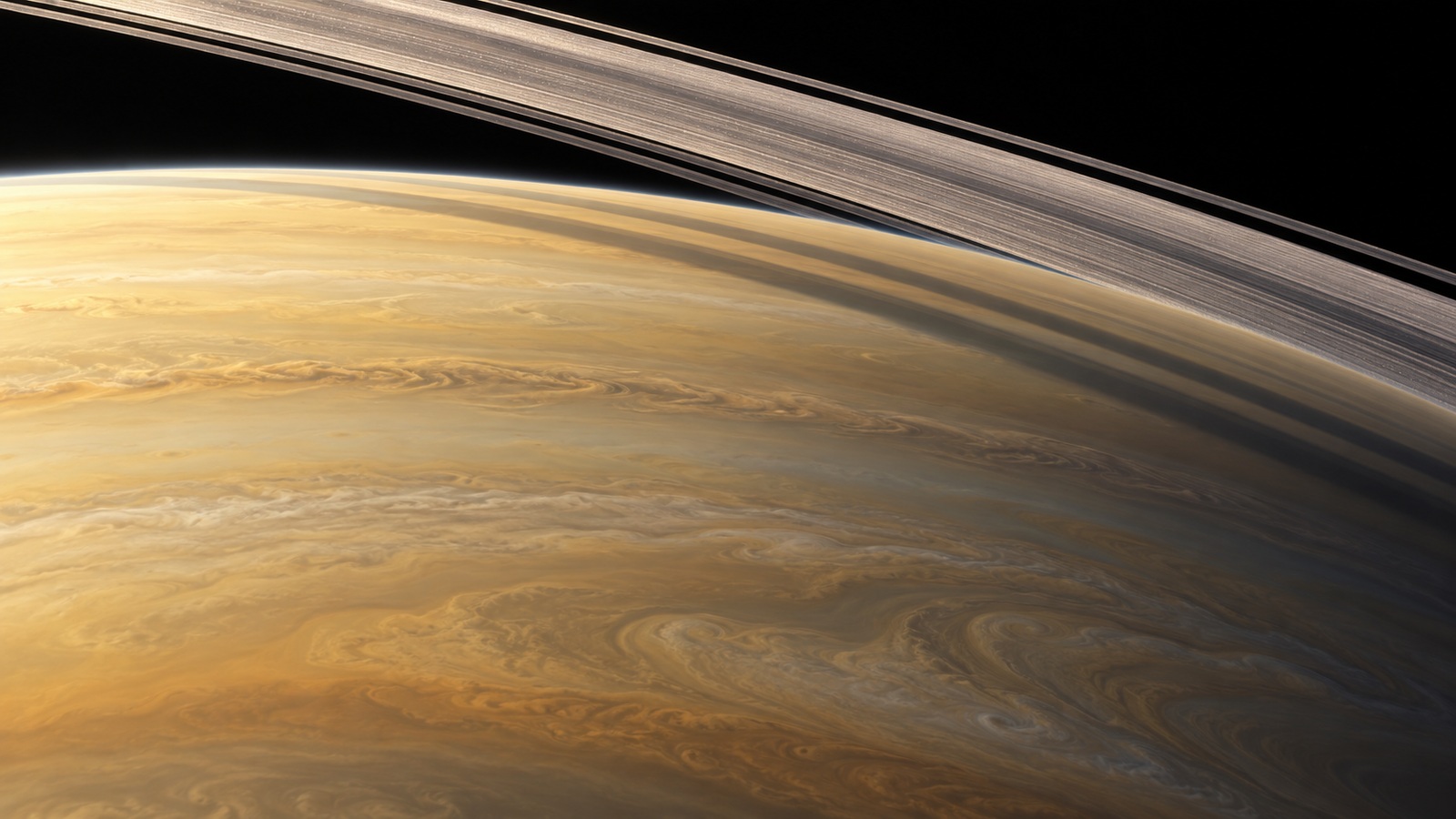
Saturn can cast a dark region onto its rings, while the rings cast bands across the cloud tops. Those shadows reveal where the structures sit relative to the Sun and each other. They also make the globe appear curved and the ring plane distinct, adding much of the depth in familiar images. A shadow is a geometrical measurement as well as a visual accent. Its position depends on the season, viewing direction, and the arrangement of the material intercepting sunlight.
Near equinox, sunlight reaches the ring plane at a shallow angle, so small vertical structures can cast long shadows. Cassini used this unusual illumination to reveal departures from an ideal perfectly flat sheet. NASA’s description of shadows on the A ring explains how moons and perturbed ring edges became informative silhouettes. The same lighting that makes an image dramatic can therefore expose structure otherwise difficult to recognize. Beauty and measurement arise from the same physical configuration.
Opposition can produce an additional brightness surge
When the Sun lies close to the direction behind the observer as seen from Saturn, the ring particles can show an opposition effect: enhanced brightness around a small phase angle. Reduced visibility of shadows and scattering within the particulate surfaces contribute to the behavior. Research using Hubble observations separates relevant components rather than assigning the entire effect to a single simple cause. The rings have not suddenly generated extra visible energy internally; their response to the illumination-observer geometry has changed.
The globe supplies a quieter contrast to the rings
Saturn’s atmosphere often appears in subdued yellow, cream, brown, and gray tones rather than Jupiter’s stronger broad-band contrasts. Haze and clouds affect how sunlight is scattered and which deeper structures remain visible. That soft appearance makes the bright ring system seem especially distinct. It should not be interpreted as calm weather. Beneath the smooth photographic impression, atmospheric jets and storms continually organize and alter the cloud patterns.
The northern polar hexagon is a striking example of structure that escapes a simple jewel portrait. It is an atmospheric wave associated with a jet stream, not a hexagonal mountain ridge or a solid polar cap boundary. Cassini’s observations of the hexagon show a moving physical pattern rather than a decorative shape added to an otherwise inactive globe. The planet’s elegant overall outline contains atmospheric dynamics that need their own instruments and models to understand.
Saturn itself has no ordinary rocky surface on which a visitor could stand. Its outer gases lead into denser interior conditions, with pressure and temperature rising below. This fact gives the familiar globe another layer of meaning: the apparent surface in a visible image is an atmospheric view. A polished-looking planet remains a deep fluid world. Recognizing that distinction keeps the aesthetic comparison connected to its actual physical subject.
The surrounding moons turn the jewel into a system
Titan and Enceladus make clear why Saturn is scientifically compelling beyond its main-ring silhouette. Titan has a substantial atmosphere and surface liquid hydrocarbons, while Enceladus ejects water-rich material from its southern region and has evidence for an internal ocean. These are different kinds of environments with different questions about chemistry and activity. NASA’s Cassini moon overview shows the system’s diversity. Interesting chemistry and water-related evidence should not be confused with a detection of life.
Connections among components also matter. Material from Enceladus contributes to the diffuse E ring outside the bright main rings, linking moon activity with Saturn’s surrounding debris. Smaller moons perturb nearby material, and charged particles interact with the planet’s magnetic environment. The system is therefore not a stationary planet accompanied by unrelated decorations. Its parts exchange material, energy, and gravitational influence. The ring portrait is visually simple while the physical relationships behind it are richly interconnected.
Exploration changed admiration into detailed evidence
Early telescopic observers could see that Saturn was unusual without immediately understanding the ring configuration. Galileo described puzzling extensions, and improved observation allowed Huygens to interpret the surrounding ring. NASA’s exploration chronology places those changing interpretations in their historical sequence. The episode is a reminder that a real observation can be valid even when its first explanation is incomplete. Better optics and repeated viewing refine what an unfamiliar silhouette means.
Cassini measured the relationships behind the beautiful portrait
Voyager flybys and the Cassini-Huygens mission subsequently transformed the level of detail. Cassini repeatedly studied Saturn, its rings, moons, and surrounding environment over thirteen years in orbit, while Huygens investigated Titan directly. Repeated views under different geometries turned isolated features into physical relationships and temporal records. The mission overview describes this sustained exploration. The enduring scientific achievement goes well beyond supplying spectacular images suitable for a nickname.
For a visual observer, Saturn’s ring outline remains one of astronomy’s most approachable surprises. The precise appearance depends on ring opening, atmospheric steadiness, and a correctly focused instrument, so it need not look like a large spacecraft portrait to be meaningful. A small view connects the observer with the same particulate rings and atmospheric globe studied by missions. The jewel metaphor works best when it invites that connection: bright ice, changing geometry, real shadows, and a diverse planetary system make Saturn remarkable without turning it into a literal ornament.