A Protected Platform Would Reveal a World Without Ground
You cannot stand naturally on Saturn: its clouds lead into a deep fluid planet, not a rocky surface. But a carefully defined imaginary visit can still show what makes the world distinctive. Imagine a sealed, heated observation capsule held at the one-bar atmospheric reference level, with its support and life-support machinery supplied by the thought experiment. You would have weight, extremely cold hydrogen-rich air outside, clouds that could hide the horizon, and a ring view determined by your latitude. Now remove that artificial support, and the capsule begins moving through increasingly compressed material. Following those changes explains Saturn more vividly than treating its low average density as a promise of safety or its rings as a place to walk.
A Landing Needs Something to Push Back
Standing is a mechanical arrangement. Gravity pulls a person toward the planet, while a supporting surface supplies a force in the opposite direction. On Earth, solid ground provides that support, and the resulting balance lets us remain at rest relative to the landscape. An atmosphere does not automatically provide an equivalent platform. Saturn’s gravitational pull is real, but the cloud layer in a photograph is not a structure that can hold boots and a spacecraft.
A cloud can look solid because it scatters enough light to hide what lies behind it. That optical property says little about whether it can bear a load. A dense terrestrial fog can obscure the ground without becoming the ground. Saturn’s visible cloud system similarly creates a planetary portrait rather than a geological floor. Its colors and boundaries identify atmospheric conditions, while the practical question of support concerns the material underneath and the forces acting within it.
For the rest of this visit, the observation capsule supplies the missing upward force and keeps its occupants warm and breathing. Assume it can hold position relative to a chosen atmospheric level and look through transparent windows; those abilities are fictional engineering provisions. Inside, boots press against the floor because that floor pushes back. Outside, there is no equivalent floor hidden just below the clouds.
Low Average Density Is Not a Local Environment
Saturn’s average density is about 687 kilograms per cubic meter, below that of ordinary liquid water. Average density divides total mass by total volume. It does not mean that every layer is a thin mist, or that the deep interior has lower density than water. The planet’s outer volume and highly compressed interior contribute very differently to that average. NASA’s Saturn fact sheet supplies the bulk measurement alongside other properties that need their own definitions.
The familiar claim that Saturn would float in an enormous bathtub is a comparison of averages, not a realistic planetary experiment. Such a bathtub would introduce its own enormous gravity, pressure, and material problems. The slogan can communicate a density ratio, but it cannot predict a visitor’s buoyancy at cloud level. Buoyancy depends on the local fluid displaced by an object. An average calculated across an entire planet cannot replace the local density needed for that calculation.
The Planet Is Massive Despite Its Light Average
Saturn contains roughly ninety-five Earth masses. Its low average density accompanies an enormous volume, so it does not imply weak overall gravity or an insubstantial planet. The distinction between mass and density is especially useful when comparing it with Earth. A less dense object can contain far more total material if it is much larger. The gravitational consequences depend on the mass distribution and distance from the center, not on one adjective such as light.
At the one-bar reference, NASA’s fact sheet lists effective acceleration of about 8.96 meters per second squared at the equator and 12.14 at the pole. Those are roughly 0.92 and 1.23 times the corresponding Earth values. On our supported floor, the same person would therefore press down somewhat less strongly at the equatorial reference than at the polar one. Rotation and Saturn’s flattened shape help explain that difference. The numbers concern defined atmospheric reference locations, not a universal weight at every depth.
Saturn rotates rapidly and has a prominent equatorial bulge. Rotation contributes to differences in effective acceleration between equatorial and polar locations, while the non-spherical shape also matters. A neat round globe on a worksheet omits those relationships. The NASA Cassini introduction links the low bulk density and rapid rotation to the planet’s shape. The result is a fluid world whose geometry and gravity deserve more care than an Earth-like floor with a different color.
Looking through the capsule’s window would not restore an Earth-like landscape. An observer could see local cloud structures and whatever distant atmosphere remained visible between them, but would not see a stable shoreline or a mountain horizon. Within an opaque cloud, the view could collapse into nearby haze even though the planet looks beautifully banded from orbit. The capsule’s orientation would matter too: down points toward denser material and the planetary center, while up leads through decreasing atmospheric pressure. The window reveals a weather environment rather than a golden country.
Pressure Coordinates Replace Ordinary Elevation
Because Saturn lacks an accessible crust, researchers often describe atmospheric locations by pressure rather than by height above ground. A one-bar reference offers a consistent level for selected comparisons. It is a coordinate convention within the planet’s fluid environment, not an invisible pavement. The Cassini press kit explains this reference in connection with the absence of a distinct surface. Reading a radius or a cloud-level value therefore requires asking which atmospheric convention accompanies it.
The Atmosphere Does Not Offer Earth-Like Living Conditions
The initial station’s pressure is comparable in scale to Earth’s sea-level air pressure, but the resemblance stops there. The same NASA table gives a representative one-bar temperature near 134 kelvins, about minus 139 degrees Celsius, and an atmosphere dominated by hydrogen with helium. An oxygen mask alone would not supply thermal protection or make the external gas suitable for ordinary life. Move upward to the table’s 0.1-bar reference and its representative temperature is lower still. They establish why a complete heated enclosure is part of the scenario from the beginning, even before any deeper descent.
Weather also complicates a stationary view. Saturn has bands, strong winds, and large atmospheric systems, while a cloud-level observer would experience local conditions rather than the entire beautiful disk seen from space. A distant image emphasizes broad patterns that could disappear from sight within opaque clouds. Some features depend on wavelength or processing as well. Describing the scene as though a visitor could simply look across a quiet golden plain mistakes an atmospheric map for a landscape.
Compression Does Not End at an Ordinary Ocean Shore
Descending beneath the visible layers increases the amount of overlying material and the pressure. Hydrogen becomes denser, and conditions depart farther from familiar low-pressure gases. Temperature and composition help determine its state. These changes do not produce a simple coastline dividing air from a terrestrial-style ocean with a walkable bottom nearby. The gas-giant label describes broad composition without requiring the entire interior to remain a dilute gas.
At greater depths, electrically conducting hydrogen becomes important to internal magnetic processes. The word metallic refers to conducting behavior under extreme conditions rather than an accessible metal shell. Saturn also contains heavier material, but its distribution is a subject of interior modeling. The hidden region cannot be inferred merely by imagining the everyday density of the elements. Pressure changes material properties, and the observational evidence constrains distributions that may be less neatly layered than classroom cutaways suggest.
A core label is particularly tempting in a landing story. It sounds like a solid destination at the end of a long descent, but the interior conditions would make that interpretation useless for an actual visitor. Temperature, pressure, and depth put the region beyond feasible human access. The presence of heavier material does not establish a surveyed solid boundary, much less a livable one. A central compositional region and a planetary walking surface are different physical ideas.
NASA’s Saturn overview summarizes the planet as a gas giant without a true landing surface. That simple statement is consistent with a complex and very dense interior. It does not mean Saturn is hollow or that a spacecraft could pass through it unharmed. The absence of ordinary ground removes a familiar destination while the increasing fluid pressure supplies formidable obstacles of its own.
The Rings Cannot Serve as a Substitute Floor
Saturn’s rings are made of separate particles on orbits, predominantly water ice with other material. They are not a rigid sheet attached to the equator, and neighboring particles do not create a stable promenade. A spacecraft meeting them would confront orbital dynamics and collision hazards, not a convenient place to disembark. NASA’s ring explanation makes the particulate structure explicit. Shifting the imagined walk from the planet to its rings therefore changes the problem without solving it.
A Ringed Sky Depends on Where the Observer Is
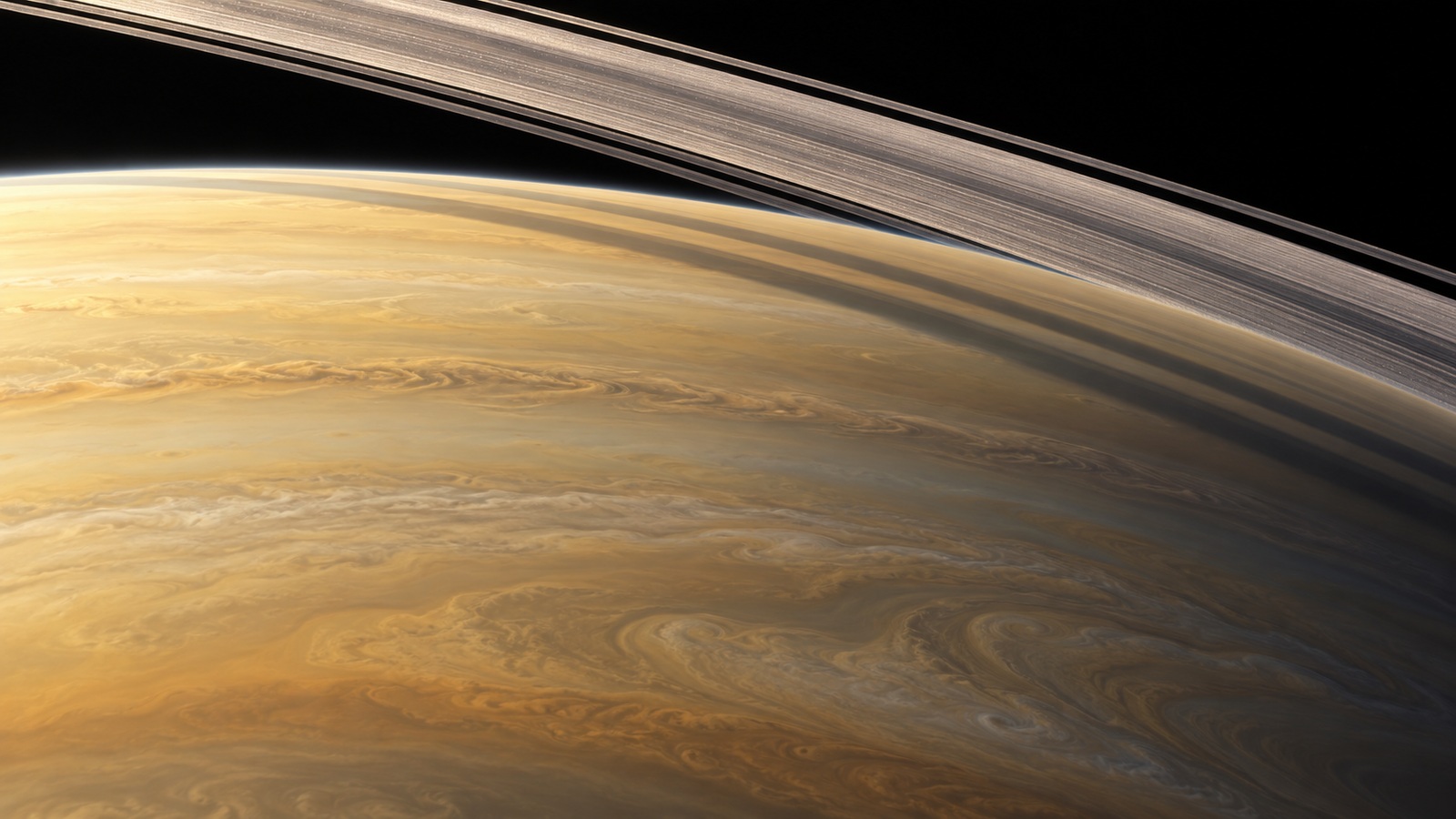
Saturn’s rings lie approximately in its equatorial plane. From a hypothetical supported point at a particular latitude, their appearance would depend on the geometry, atmospheric visibility, illumination, and obstruction by the planet itself. They would not necessarily resemble the familiar tilted ellipse shown in whole-planet portraits. At equatorial viewpoints, a thin system viewed close to its plane can be especially unlike the broad open ring shape seen from above or below that plane.
Ring shadows can fall across the atmosphere as solar geometry changes. Those shadows provide real evidence of the three-dimensional relationship between planet and rings, but they are not strips of dark rock on a surface. An observer immersed in clouds might not see the same pattern that an orbiting camera records. A distant orbital view is therefore more reliable for enjoying the complete ring-and-globe arrangement than a fictional seat inside the atmospheric haze.
Consider moving the protected station away from the equator while keeping the atmosphere sufficiently transparent for the view. The ring plane would no longer be viewed from nearly within its own thin edge. More of its projected span could become visible, although the planet’s curvature would still hide some directions and clouds could obscure the rest. Changing sunlight would move the shadows cast across the atmosphere. A clear orbital station would be a better vantage point for seeing the full arrangement than a capsule immersed in cloud.
Cassini Entered Saturn Without Making a Landing
Cassini ended its mission with a deliberate atmospheric plunge on September 15, 2017. It transmitted scientific measurements while it could maintain the required pointing and communications. Increasing atmospheric forces ultimately ended the spacecraft’s operations. NASA’s final timeline distinguishes those last observations from the earlier images returned before entry. The ending was an atmospheric disposal and investigation, not a touchdown on unseen terrain.
The spacecraft had not been designed as a long-lived deep atmospheric lander. Its final record therefore cannot be extended into direct measurements all the way to Saturn’s core. The mission team chose the ending in part to protect scientifically valuable moons from a later uncontrolled impact. NASA’s mission-ending report describes that context. The achievement belongs to measured exploration within engineering limits, rather than an imagined indefinite descent.
The Honest Saturn Visit Is an Orbital One
A spacecraft in orbit can examine the planet’s clouds, rings, moons, and fields without requiring a solid Saturnian floor. Atmospheric probes can add direct local information for a finite interval. Remote observations and material models investigate deeper conditions. These methods are complementary ways of studying a world that cannot be approached as a terrestrial landscape. The lack of a place to stand changes the exploration strategy, not the planet’s scientific richness.
Release our capsule’s artificial support and its weight is no longer balanced by a floor held in place. It begins descending, with the surrounding fluid exerting drag and buoyancy that depend on local conditions and the capsule’s changing shape. Greater pressure would challenge the hull while a different thermal environment would challenge its insulation. There is no simple final step where the clouds part over a welcoming continent. A real probe would instead transmit temperature, pressure and composition measurements for as long as its hardware and communication link survived. The meaningful endpoint is an engineering limit in a measured atmospheric profile, not a touchdown.
The imaginary station gives four concrete impressions: appreciable weight, bitter cold at the chosen initial level, an unbreathable external atmosphere and a sky whose ring view changes with geometry. A descent replaces the supported view with changing fluid forces and increasingly demanding conditions. Cassini’s final entry shows the real exploration strategy: collect measurements while the vehicle remains functional, then let the atmosphere end the encounter. Saturn needs no hidden golden continent to be extraordinary. Its familiar gravitational scale, enormous fluid volume and separate orbiting ice already combine into a world that would feel unlike any place a person can stand on Earth.