Saturn’s Moons Offer Habitats to Test, Not Life to Announce
The most promising place for life in Saturn’s system may be somewhere sunlight barely reaches: water beneath an icy moon’s surface. Enceladus sends material from its interior into space, allowing scientists to investigate a hidden environment through plume chemistry. Titan offers a different puzzle, with a dense atmosphere, carbon-rich material, and surface liquids made of hydrocarbons rather than water. These discoveries give researchers meaningful reasons to ask whether life could exist, but none establishes that a moon is inhabited. The question involves more than finding one appealing ingredient. A habitat needs a suitable medium, usable energy, necessary chemistry, and conditions that persist long enough for relevant processes. Comparing Enceladus with Titan shows how those requirements can be investigated while preserving the difference between a supported possibility and a detected organism.
The First Question Is Which Kind of Habitat Is Proposed
Life known from Earth uses liquid water and complex carbon chemistry. Researchers therefore begin with environments where those requirements might coexist with usable energy. That starting point is an evidence-based search strategy rather than proof that all possible life must be identical to Earth’s. A proposal involving a different liquid must establish how essential biological functions could work there. The mere word liquid cannot transfer every property of water to another substance.
A moon can also contain several environments with very different prospects. Its frozen surface, a buried liquid region, and an erupting plume are not interchangeable locations. Temperature, radiation, nutrients, and chemical exchange can differ between them. Identifying the proposed habitat keeps a general statement about a whole moon from implying that organisms could thrive everywhere on it. The most valuable comparison concerns particular environments rather than a league table of entire worlds.
Enceladus Made Its Interior Chemically Accessible
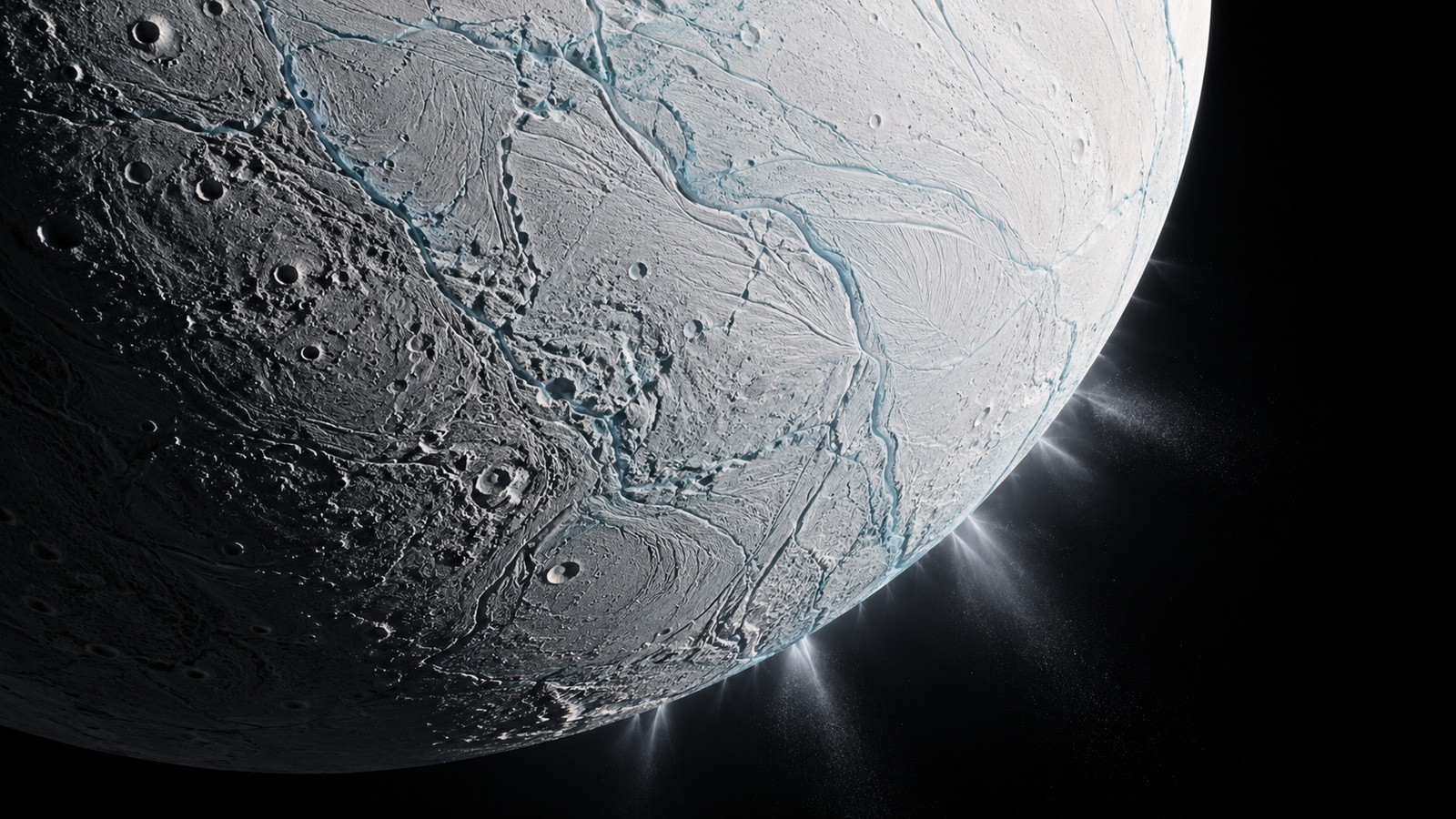
Enceladus is a small icy moon with active jets near its south pole. Cassini observed water vapor and icy particles escaping through fractures, and its instruments measured constituents in that material. Gravity and rotational evidence, together with the plume findings, support a global subsurface ocean beneath the ice. The ocean itself was not photographed as an exposed blue sea. Different observations combine to make the hidden-water interpretation strong.
The plume is valuable because it moves material out of an otherwise difficult-to-reach environment. A spacecraft can investigate that material without first drilling through the whole ice shell. But the sample still undergoes changes as it rises, freezes, and disperses. Plume composition is therefore a record requiring interpretation, not a perfect unchanged bottle from every part of the ocean. Researchers ask which particles retain the most useful connection to their source.
NASA’s Enceladus discovery timeline shows how evidence accumulated over multiple encounters. The sequence matters because early surface observations and later chemical results answered different questions. Habitability did not emerge from a single striking geyser image. It developed from a network of measurements linking an active surface to liquid water, chemistry, and energy below.
Water–Rock Chemistry Can Supply Energy in Darkness
Life does not always require direct sunlight. On Earth, some microorganisms exploit chemical reactions involving substances supplied by rock and water. Enceladus offers evidence relevant to analogous possibilities. Cassini detected molecular hydrogen in plume material, consistent with water reacting with rock under suitable conditions. Such reactions can maintain chemical differences that hypothetical organisms might exploit.
Usable chemical energy involves an opportunity for reactions to proceed, not simply the presence of one element. A habitat needs reactants and conditions that provide a sustained energy yield. Hydrogen-rich chemistry can be promising while leaving questions about supply, mixing, and competing reactions. The Earth analogy helps identify what to measure rather than guaranteeing that a corresponding ecosystem exists. An environment can supply energy without having developed a way to use it biologically.
NASA’s summary of hydrogen and habitability makes the conditional connection explicit. The finding supports a possible energy source for life if life is present. It does not turn hydrogen into a biological detection. Nonliving geological processes are central to the interpretation, which is why the source of a molecule must be considered before assigning an organism to it.
Hydrothermal models also need to explain how activity can persist. Tidal deformation, internal structure, and water circulation contribute to proposed energy budgets. NASA’s discussion of Enceladus’s internal power examines a porous-core model that could sustain heating. That model links orbital forcing to conditions within the moon. Its ability to support long-lived activity is important without making the exact duration or detailed seafloor arrangement directly observed.
Phosphorus Added an Important Chemical Constraint
In 2023, analysis of Cassini data identified phosphates in some ice grains associated with Enceladus. Phosphorus is important to terrestrial life, including molecules involved in genetics and cellular energy transfer. Finding a chemically available form helped address a previously uncertain part of the ocean’s nutrient inventory. NASA/JPL’s phosphorus report explains the measurement and laboratory-supported interpretation. The advance concerns ingredient availability, not the recovery of DNA or a cell.
Organic Molecules Describe Chemistry Before They Describe Biology
Organic compounds contain carbon in relevant chemical structures, but many form without organisms. Space chemistry, radiation-driven reactions, and geological processes can produce them. Their detection increases the range of processes an environment might support. It does not establish that a living system assembled them. This distinction is especially important when a headline compresses complex organic chemistry into the phrase building blocks of life.
A 2025 analysis of freshly ejected Enceladus grains identified additional organic compounds and strengthened the connection between complex chemistry and the ocean source. ESA’s report of the fresh-grain analysis distinguishes these particles from material exposed longer in Saturn’s E ring. The comparison helps test whether processing in space created the measured chemistry. It makes the source interpretation stronger while retaining the need for separate evidence of biology.
Titan Poses a Different Surface-Life Question
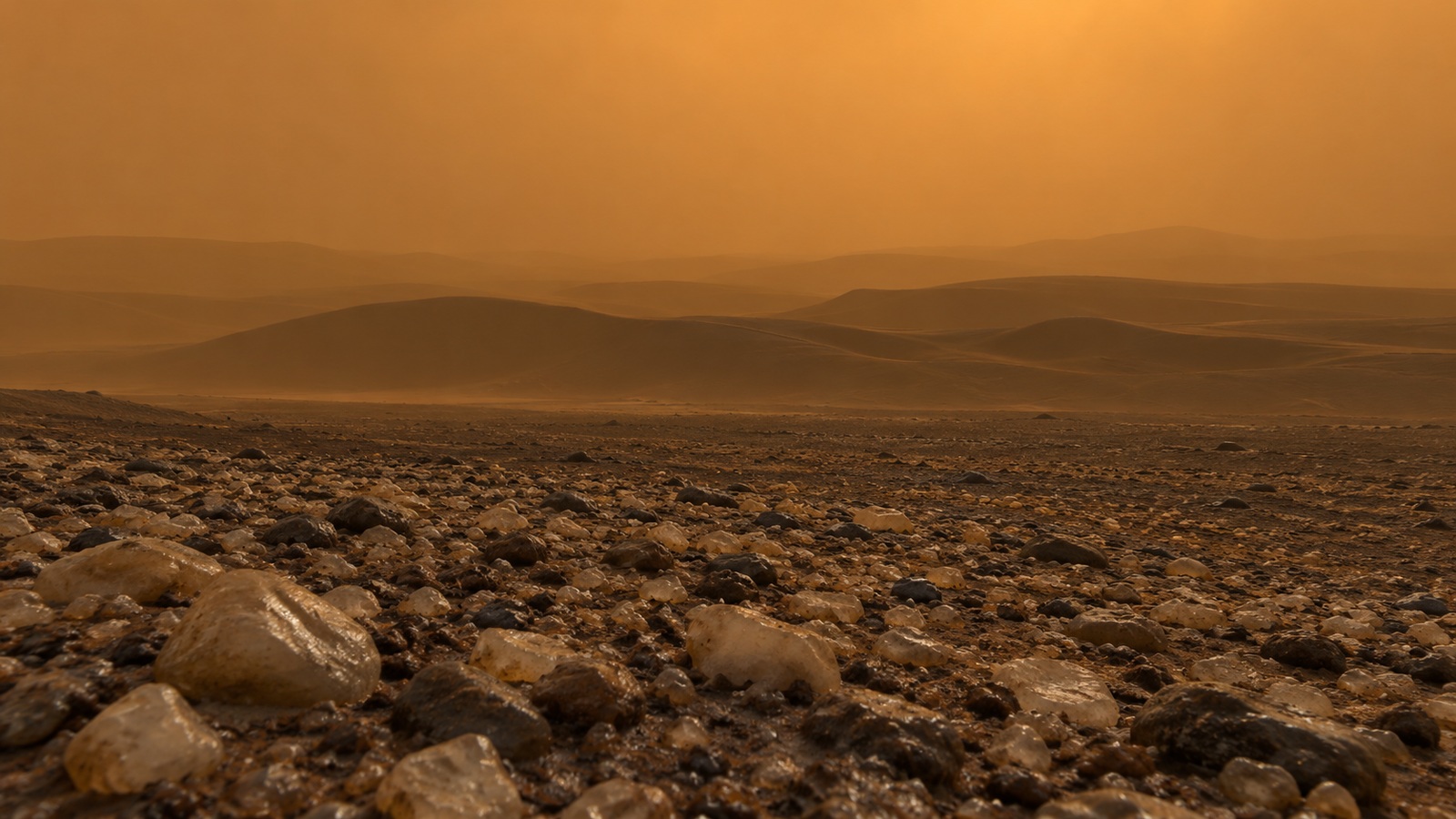
Titan’s dense atmosphere and extensive carbon chemistry provide a very different setting. At its cold surface, methane and ethane can exist as liquids, while water ice behaves as a durable solid material. Lakes and seas create tempting analogies with Earth. But hydrocarbon liquids have different solvent properties from water, and the temperature changes the behavior and rates of chemical reactions. A surface habitat proposal must confront those differences directly.
Scientists can model possible chemical structures and reactions suited to Titan-like conditions. A physically plausible component is not equivalent to a complete self-maintaining, reproducing system. The pathway from interesting chemistry to an organism requires many connected functions. No methane-lake life has been detected. Titan’s surface remains valuable precisely because it offers a setting where the boundaries of chemical possibility can be studied without presuming a biological answer.
NASA’s Titan facts explains its atmosphere, surface liquids, and water-ice landscape. Those facts establish the environmental setting. They should not be extended into a confident statement that Titan’s lakes contain unfamiliar creatures. Analogy identifies a research question; measurements must decide whether the proposed chemistry is present and whether it supports the required functions.
Titan’s Interior Now Requires a More Qualified Picture
For years, many accounts described Titan as containing a global liquid-water ocean beneath its ice. A NASA-led reanalysis reported in December 2025 challenged that picture, favoring ice and slushy layers with smaller warm-water pockets near the rocky interior. The NASA/JPL study report presents a revised interpretation of Cassini data. It changes the proposed habitat’s geometry and physical context rather than proving either the presence or absence of life.
Habitability Depends on Connections Between Ingredients
A buried liquid pocket could offer promising temperature conditions while remaining short of nutrients or usable energy. A surface rich in organic material could have abundant ingredients that rarely encounter liquid water. A chemically energetic region could be too transient or too isolated for a proposed pathway. The research question is therefore whether requirements meet in the same place at the same time. Listing them separately for a whole moon is only a preliminary inventory.
Transport matters because ice, liquid, rock, and atmosphere can exchange material at different rates. A thick high-pressure ice layer might alter the connection between water and rock, while impacts could briefly create warmer surface environments. The relevance of such processes depends on scale, duration, and location. A momentary warm patch is not automatically a persistent habitat. Specific models are useful when they identify which exchanges must occur and what observations could test them.
The same reasoning applies to Enceladus despite its stronger ocean evidence. Chemical measurements must be connected to ocean circulation, seafloor processes, and the way plume particles form. The moon is a compelling target, not an already completed ecological map. Research can identify progressively better-supported environments while remaining uncertain about their occupants. That combination of confidence in some physical conditions and uncertainty about biology is a strength of the scientific account.
NASA’s 2023 chemical-energy study illustrates this approach by examining additional molecules and reaction possibilities. The results broaden the potential chemistry rather than declaring an inhabited ocean. Different proposed metabolisms require different reactants and environmental conditions. Distinguishing those possibilities makes a habitat assessment more useful than repeatedly calling the moon promising without identifying the reason.
A Life Search Needs More Than Cassini’s Ingredient Inventory
Cassini’s instruments were designed before Enceladus’s plumes and ocean became major discoveries. They transformed knowledge of the environment but did not provide every measurement required for a comprehensive life-detection experiment. A future investigation must consider chemical specificity, sample alteration, contamination, and nonbiological alternatives. Several independent indicators would make an interpretation stronger than one ambiguous molecule. A credible detection claim needs an explicit account of why ordinary chemistry cannot explain the signal sufficiently well.
Negative results also require care. An instrument may miss a signal because the sample contains little source material, the relevant compounds were altered, or the sensitivity is inadequate. A nondetection in one plume encounter would not automatically demonstrate that every part of the ocean is lifeless. Search design must state what a measurement can exclude. The limits matter for both optimistic interpretations and sweeping declarations that life is impossible.
Future Exploration Will Refine the Question
NASA’s Dragonfly mission is being developed to investigate Titan’s chemistry, geology, and atmosphere across multiple sites. As described in the March 2026 integration update, launch is planned no earlier than 2028. That is a future investigation, not a record of discoveries already made on Titan. Its mobility can connect chemical measurements with different geological settings and test how ingredients interact.
The Best Answer Is a Specific, Testable Possibility
An especially useful next step would be to sample fresh Enceladus plume material repeatedly rather than rely on a single favorable grain. Investigators could compare gas abundances, dissolved constituents carried in ice, and the distribution of larger organic molecules across samples. Repetition matters because a vent can sort material during transport, and different ocean or rock processes can supply overlapping chemical products. A proposed biological explanation would need to account for the whole pattern better than those alternatives. That turns the life question into a set of testable comparisons: which reactions can operate, what they should produce, and whether the ocean-to-plume pathway preserves the products a spacecraft can actually collect.
Life could conceivably exist in a suitable environment associated with Saturn’s moons, but the supporting arguments differ strongly between them. Enceladus has a well-supported subsurface ocean, evidence of relevant nutrients, and chemical-energy possibilities. Titan offers abundant carbon chemistry and very different surface liquids, while its hidden-water structure remains under renewed investigation. These are reasons to explore. They do not justify treating the entire Saturnian system as inhabited.
The strongest research programs separate environmental discovery from biological discovery and identify the remaining measurements needed. Water, energy, and ingredients must coexist and remain accessible, while any proposed life signal must survive tests against nonliving processes. Saturn’s moons make those questions unusually concrete because spacecraft have returned real chemical and physical evidence. The excitement comes from the quality of the questions now available to test. A carefully supported possibility is more useful than an alien-life announcement that the observations have not earned.