
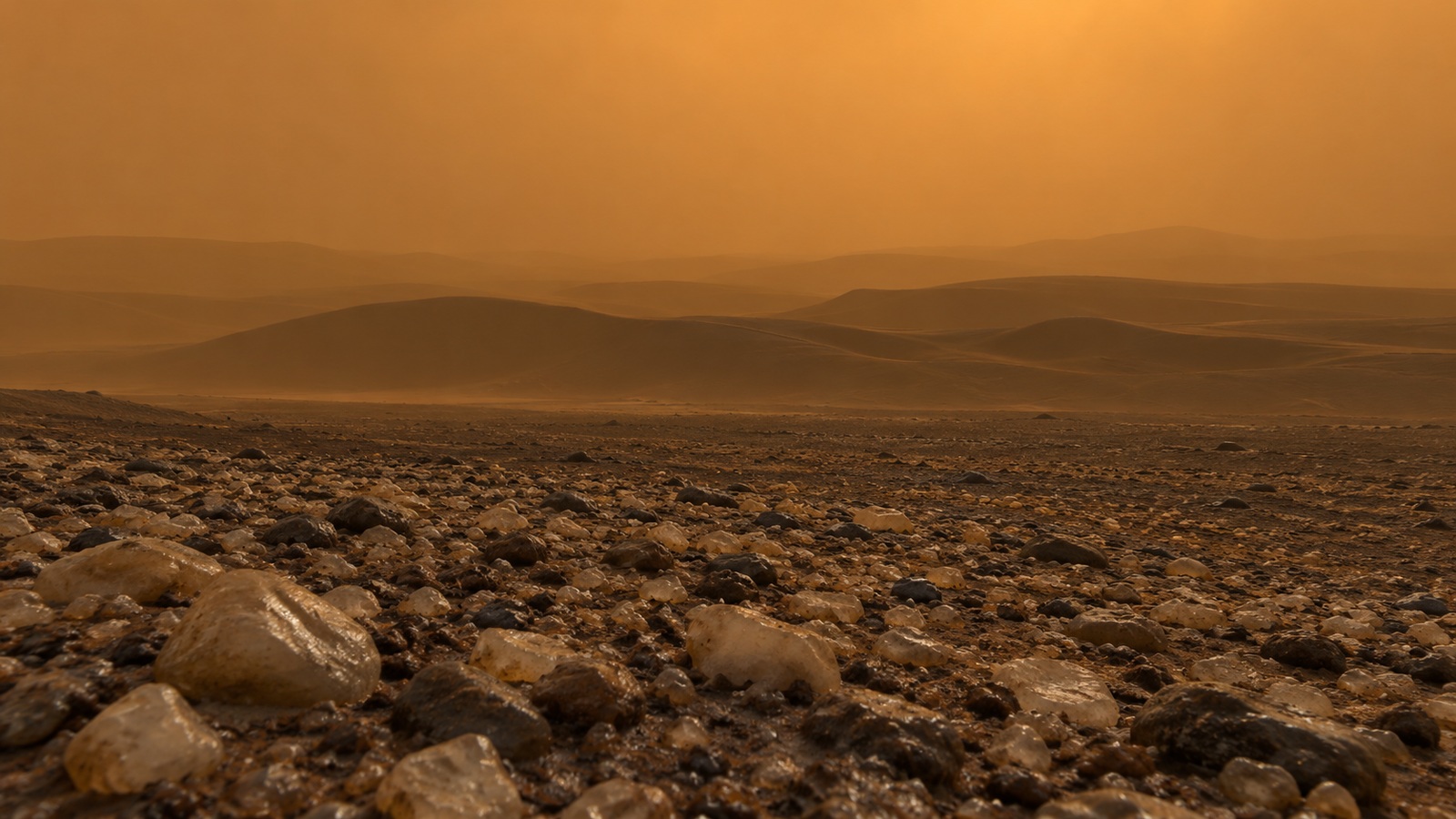
A Hidden Surface With Familiar Processes and Unfamiliar Materials
Titan is Saturn’s largest moon, but its most distinctive feature is not its size. It is the dense atmosphere that hides much of the surface beneath a hazy exterior. Beneath that haze lies a world with channels, dunes, lakes, and changing weather, built from materials behaving very differently than they do on Earth. Water ice supplies durable ground, while methane participates in a cycle of evaporation, clouds, rain, and flowing liquid. Spacecraft measurements have made this world increasingly concrete without removing all its mysteries. Some concern how its methane supply persists; others concern its hidden interior and the connections between atmosphere and landscape. Understanding Titan means following the instruments that revealed those relationships, rather than assuming its Earth-like shapes imply Earth-like temperatures, chemistry, or living conditions.
A Moon With Planetary Scale
Titan is about 5,150 kilometers across, larger in diameter than Mercury and second among solar-system moons to Jupiter’s Ganymede. It is still less massive than Mercury because their compositions and densities differ. The diameter comparison communicates its scale without changing its orbital identity. Titan is a natural satellite traveling around Saturn, not a small independent planet orbiting the Sun. Size and classification answer different questions.
Its surface gravity is only about one-seventh Earth’s. That low gravitational acceleration accompanies a remarkably substantial atmosphere, making Titan very different from a small bare rocky moon. Composition, temperature, and history all contribute to whether a world retains gas. A simple rule that small bodies cannot have thick air fails here. Titan is valuable partly because its combination of properties forces comparisons to become more specific than a size ranking.
Titan turns once relative to distant space during approximately one circuit around Saturn, keeping the same broad hemisphere directed toward the planet. The familiar tidal relationship does not imply that Titan has no daily illumination cycle. Sunlight still changes relative to its surface as the moon travels through its orbit and Saturn moves around the Sun. The longer Saturnian year also supplies a slow seasonal setting for Titan’s atmosphere and liquid reservoirs.
The Air Is Mostly Nitrogen, but Not Breathable
Nitrogen dominates Titan’s atmosphere, while methane and additional compounds play important roles in its chemistry and weather. Surface pressure is roughly one and a half times Earth’s sea-level value. These comparisons can sound comfortable until temperature and composition are considered. Titan’s surface is near 94 kelvins, approximately minus 179 degrees Celsius, and lacks a breathable oxygen supply. Dense air and a solid surface do not make it a terrestrial living environment. NASA’s Titan thermal-environment overview states the cold, dense conditions relevant to spacecraft design.
Haze Is a Chemical Product, Not Just a Curtain
Sunlight and energetic particles initiate reactions involving atmospheric nitrogen and methane. Those reactions produce additional compounds and contribute to the particles that form Titan’s haze. The hazy appearance therefore carries information about chemistry and transport rather than simply hiding an otherwise ordinary surface. Atmospheric material can eventually settle downward. The atmosphere and landscape participate in a connected system, with products formed high above influencing what accumulates below.
Different wavelengths interact differently with the haze. A visible-light picture emphasizes Titan’s opaque orange-brown exterior, while selected infrared observations can reveal aspects of the surface through atmospheric windows. Radar supplies another approach by transmitting and receiving radio signals. These methods do not make every returned image equivalent to human eyesight. A processed infrared mosaic or radar map should retain its measurement context instead of being presented as an unqualified natural-color view.
That distinction explains why Titan can look so different in different scientific products. A smooth hazy globe, a mottled infrared map, and a high-contrast radar strip may describe the same world. Each emphasizes different material properties and depths of access. The variation is not necessarily evidence that one image is false. It reflects the fact that a chemically active atmosphere filters the view, while instruments select particular information from what passes through or returns.
To see what the haze hides, compare an ordinary visible-light view with a radar map of Ligeia Mare in the northern lake country. The former records the obscuring atmosphere; the latter can distinguish smooth liquid surfaces from surrounding terrain. Cassini identified Ligeia Mare as methane-rich; its dark lake areas are physical targets whose outlines, shorelines and connections can be studied, rather than decorative markings on an orange globe. NASA’s Titan facts describes a world with lakes and seas of liquid hydrocarbons. That connection between chemistry and mapped landscape makes the hidden surface far more tangible than haze alone suggests.
Methane Supplies an Alien Version of Weather
At Titan’s surface conditions, methane can exist as gas and liquid and participate in a recognizable cycling pattern. It evaporates, contributes to clouds, and can fall as precipitation. Liquid then flows or accumulates in suitable terrain before further exchange with the atmosphere. The physical pattern resembles parts of Earth’s water cycle, but the substance and temperature are profoundly different. The analogy identifies transport processes without making the two climates equivalent.
Rain does not occur evenly across Titan, and surface reservoirs are concentrated particularly in polar regions. Atmospheric circulation and long seasons influence where precipitation and evaporation matter most. A dune-rich equatorial scene and a northern sea can both be ordinary parts of the same moon. The presence of large liquid bodies therefore does not require a uniformly wet world. Regional context is essential when describing how much liquid a particular landscape contains.
Lakes and Seas Are Not Made of Liquid Water
Cassini established that Titan hosts stable surface bodies of liquid hydrocarbons, including methane and ethane. Their chemistry and mixture can differ between locations. A dark patch on a radar map was an initial clue, while further measurements strengthened the interpretation of actual liquid reservoirs. NASA’s account of the lake discoveries describes this important change from an obscured surface to a world with identifiable standing liquids.
The basins themselves pose additional geological questions. Some lakes occupy relatively small, deep depressions, while large seas have different shapes and settings. Their formation cannot be assigned one explanation merely because all contain dark-looking liquid in an image. Dissolution, collapse, and other processes have been investigated for particular landforms. The origin of a basin and the origin of the liquid filling it are related but distinct problems.
NASA’s 2019 lake study reports evidence for deep methane-rich northern lakes perched in high terrain. That arrangement adds complexity to a simple picture of seas occupying every low area. It points toward exchange through an underlying landscape as well as atmospheric supply. Mapping depth, elevation, and composition helps test the connections rather than assuming every reservoir behaves like one familiar terrestrial lake.
Water Ice Becomes Part of the Geological Framework
At Titan’s intense cold, water ice can behave as a hard surface material instead of an easily melting seasonal cover. It contributes to the terrain in the role rock often plays on Earth. Hydrocarbons then flow across or interact with that framework. The resulting landscape uses familiar processes such as erosion and sediment transport with a different material combination. Saying ice is part of the ground is therefore more informative than imagining Titan as a planet-sized snowbank.
Dunes Reveal a Second Surface-Transport System
Titan’s equatorial regions include extensive dunes built from sand-sized material thought to be rich in organic compounds. The grains are not automatically equivalent to terrestrial quartz sand. Winds rearrange them into long landforms whose shape and orientation contain information about circulation and sediment supply. A dune field offers a record of movement integrated over time. Its geometry cannot always be interpreted from a single brief local wind observation.
Liquid flow and wind transport can act on different materials or locations while participating in the same broader landscape. Rain can wash atmospheric products into channels, while winds collect and redistribute loose particles elsewhere. The balance depends on local weather, terrain, and available sediment. Titan consequently has more than one way to move surface material. The combination is one reason its landscape appears geographically diverse despite the initially uniform haze seen from afar.
Comparisons with earthly deserts can guide questions about dune growth, but differences in air density, gravity, particle composition, and climate must remain explicit. A matching shape does not establish identical wind speeds or construction times. Scientists use the analogy to generate physical tests. They then need measurements appropriate to Titan rather than importing every Earth parameter unchanged.
NASA’s Titan facts describes the dune fields and atmospheric contribution to surface material. These observations make the moon’s carbon chemistry a geographical process as well as a laboratory curiosity. Haze products can become part of a terrain that later moves through wind and rainfall. The connection explains why atmosphere and surface cannot be treated as unrelated chapters in Titan’s story.
Huygens Established What One Landing Site Was Like
ESA’s Huygens probe descended through Titan’s atmosphere and landed on January 14, 2005. It returned measurements and images of a local surface with small rounded pebbles and evidence of drainage-related terrain. The encounter provided a direct point of contact within Cassini’s much broader orbital investigation. ESA’s Huygens highlights explains the descent and landing observations. That local record should not be expanded into a claim that the probe visited the polar seas or surveyed every surface type.
Its photographs showed how planetary interpretation improves when remote maps and local observations meet. A pixel-scale terrain category can resolve into individual clasts and textures, while atmospheric measurements supply the conditions governing their behavior. But local evidence retains a limited geographic scope. A dry-looking landing scene does not refute the existence of lakes elsewhere, and pebbles in one area do not describe the entire moon. The global picture depends on combining the landing with many remote observations.
The Hidden Water Story Has Changed
Titan has long been discussed as a moon with a global liquid-water ocean beneath the surface ice. A NASA-led study reported in December 2025 reinterpreted Cassini data and favored a more complicated interior dominated by ice, slush, and smaller warm-water pockets near the rocky core. The NASA/JPL report presents that revision. It is a reminder that an inferred interior can change as measurements are reanalyzed, even when the visible surface geography is well established.
The revised picture should not be promoted as a new directly photographed interior. It is another interpretation tested against the moon’s observed response and material behavior. The geometry and connectivity of hidden liquid matter for questions about heat and chemical exchange. Surface methane seas remain a separate, measured phenomenon. A challenge to one proposed buried-water arrangement does not remove the surface liquids or transform them into water.
Titan’s mysteries consequently include how reservoirs communicate and how atmospheric methane remains supplied over geological time. Proposed mechanisms such as cryovolcanic activity have not settled every part of that budget. A complete explanation needs to connect production, transport, and destruction. Keeping an open mechanism identified is more useful than filling the gap with a confident story unsupported by observations.
Dragonfly Will Investigate Titan as a Connected Landscape
NASA’s Dragonfly rotorcraft is designed to examine chemistry, geology, and atmosphere at multiple Titan sites. Its ability to move changes the geographical scale of direct investigation compared with one stationary landing. The March 2026 mission update describes integration and testing toward a launch no earlier than 2028. Those planned measurements remain future work, and the mission should not be credited with discoveries it has not yet made.
The Mystery Is in the Connections, Not an Empty Map
Titan is no longer merely an orange sphere hiding an unknowable world. Measurements establish a dense atmosphere, hydrocarbon weather, liquid reservoirs, icy terrain, dunes, and at least one directly examined landing site. The unresolved questions concern how these parts interact and how the interior fits into their history. That is a richer kind of mystery than a lack of all information. It allows proposals to be tested against substantial evidence.
The most useful description treats Titan as a connected world of atmosphere, terrain and liquid reservoirs: atmospheric reactions produce material, weather moves liquids, winds reshape grains, and hidden structure controls longer-term possibilities. Familiar shapes remain valuable analogies when unfamiliar chemistry and temperature stay attached to them. The result is neither a miniature Earth nor a featureless frozen satellite. Titan is its own measured world, with new exploration aimed at the relationships that make it so distinctive.


